ssh-keysign-pwn Linux Kernel Flaw Hits SSH Keys and Hashes
ByMohammed Talukder
Published17 May, 2026
Mohammed Talukder17 May, 2026
A critical ssh-keysign-pwn Linux kernel flaw can expose SSH keys and shadow passwords, creating high-risk exposure for servers and enterprise systems.
The ssh-keysign-pwn Linux kernel flaw is a serious local security issue that can expose SSH private keys and password hashes on affected systems. It matters for Linux admins, cloud teams, DevOps workers, and anyone who depends on SSH for secure access. The risk is not theory. The published advisory says attackers may read root-owned secrets, which can lead to impersonation, lateral movement, and wider compromise.
What Is the ssh-keysign-pwn Linux Kernel Flaw?
It is a Linux kernel vulnerability in the ptrace access-control path that can let a local attacker read sensitive files that should stay protected. NVD describes the issue as a ptrace: slightly saner 'get_dumpable()' logic problem, and the public reporting ties it to CVE-2026-46333.
Researchers nicknamed it ssh-keysign-pwn because the attack path can target ssh-keysign and expose SSH host keys. The same flaw can also expose /etc/shadow, which means password hashes may be reachable for offline cracking. That makes the ssh-keysign-pwn vulnerability more than a routine kernel bug. It is a direct Linux authentication vulnerability with real operational impact.
The security community is paying attention because the issue affects core trust material, not just one app. The report says a public PoC exists, the flaw has been linked to recent Linux kernel security noise in 2026, and the kernel fix is already tracked upstream. NVD also shows CVSS is not yet assigned there, so teams should verify severity through official advisories before publishing internal guidance.
Linux vulnerabilities rising in 2026
The report places this issue beside other recent Linux problems such as Dirty Pipe, io_uring UAF, Copy Fail, Dirty Frag, and Fragnesia. That context matters because it shows how fast kernel risk can stack up in one year.
What does ssh-keysign-pwn do?
The ssh-keysign-pwn Linux kernel flaw can allow a local attacker to steal file descriptors from a privileged process during a narrow shutdown window. That can expose SSH host keys or password hashes, depending on which process is targeted. The practical result is a SSH keys exposure vulnerability and a Linux shadow password exposure risk that can cascade into broader compromise.
What Is the ssh-keysign-pwn Linux Kernel Vulnerability?
Overview of CVE-2026-46333
CVE-2026-46333 tracks this flaw. The NVD entry says the bug is rooted in the kernel’s handling of get_dumpable() logic, and the fix is tied to upstream kernel changes. The language in NVD makes one thing clear, the problem is about memory state and process access checks, not a normal application bug.
Why the Security Community Is Concerned
Security teams are worried because the bug can expose SSH keys and password hashes on real systems. That creates the usual chain of pain, credential theft, privilege expansion, and lateral movement. In other words, this is a Linux server security risk that can start with local access and end with infrastructure-wide damage.
Linux Vulnerabilities Rising in 2026
The source article explicitly compares this case with other Linux flaws already discussed in 2026, including Dirty Pipe, io_uring UAF, Copy Fail, Dirty Frag, and Fragnesia. The takeaway is simple, defenders need to assume kernel bugs can arrive in clusters, not as one-off events.
How ssh-keysign-pwn Works
The Role of __ptrace_may_access()
The issue lives in the kernel’s ptrace access-control logic, specifically __ptrace_may_access(). NVD explains that the dumpability concept is about whether a task can core dump, but the ptrace path reuses that state in ways that do not make sense once the process no longer has an mm pointer. That reuse is the heart of the Linux kernel SSH flaw story.
Understanding the Dumpability Logic Flaw
The flaw matters because the kernel can make the wrong access decision when a process is in a transitional shutdown state. CloudLinux explains the race clearly, the task’s memory descriptor is detached first, then the file descriptor table is closed later. During that gap, the safety check can be bypassed.
The Dangerous Race Condition
At a high level, the attack path looks like this:
1. A privileged process begins exiting. 2. Its memory context becomes unavailable. 3. Open file descriptors still exist for a short time. 4. A local attacker races the exit path. 5. pidfd_getfd() can copy the open descriptors before they disappear.
That is why this is also an OpenSSH privilege escalation flaw in practice, even though the root cause lives in the kernel. The secret is not the SSH daemon itself. The kernel hands out access in the wrong moment.
Why the Exploit Bypasses Security Controls
The bug breaks the boundary between “this process is allowed” and “this process is gone.” That is the worst kind of kernel failure because permission checks lose meaning during the race window. The result is unauthorized file access, not by password guessing, but by abusing process state.
What Data Can Attackers Steal?
SSH Private Keys
The report says SSH host private keys are the main prize. If those keys are exposed, an attacker can impersonate systems or users, which creates immediate trust damage. That is why this is widely described as an SSH keys leaked vulnerability.
Shadow Password Files
The same attack path can read /etc/shadow. That means password hashes may be exposed, which raises the risk of offline cracking and account compromise. This is the clearest example of Linux password hash exposure in the advisory.
Lateral Movement Across Networks
Once one machine leaks a key, reused credentials can become a bigger problem. The article warns that SSH keys are often reused across environments, so a single compromised host can create wider access. That is classic SSH credential theft Linux risk.
The report names Ubuntu, Debian, Arch Linux, CentOS, and Raspberry Pi OS as examples of affected distributions before the May 14, 2026 patch. CloudLinux also tracks the issue in its own ecosystem and links it to the upstream kernel fix.
Why Long-Term Deployments Are at Risk
The article says the flaw may have existed for more than six years. That matters because older servers, long-lived VPS instances, and forgotten build boxes often miss the fastest patch cycles. That is where a Critical Linux vulnerability 2026 becomes an old problem with a fresh headline.
Cloud and Enterprise Exposure
Cloud servers, Kubernetes nodes, CI/CD workers, and shared SSH infrastructure are all exposed to the same class of risk if local access is possible. In these environments, one leaked key can become a shortcut into many systems.
Technical Root Cause Analysis
How Linux Handles Process Shutdown
CloudLinux says the race happens in the do_exit path. Memory is detached before file descriptors are closed, and that timing gap opens the door. The kernel’s state transitions are the real story here, not a bad password policy.
Why Processes Without Memory Context Become Dangerous
NVD notes that dumpability makes sense for a task with memory, but not for a task without an mm pointer. That is the conceptual bug. A rule meant for memory safety is being reused in a place where memory has already disappeared.
Reuse of Dumpability Checks
The flaw exists because one security flag is being stretched beyond its original purpose. That kind of design drift is hard to notice until a race condition lands in production. It is a good example of why Linux kernel security vulnerability reviews need both code and state-machine thinking.
Permission Enforcement Failure
During the shutdown window, the kernel can fail to enforce the expected boundary. That means the process looks safe enough to inspect when it should not. From a defensive view, this is exactly why race bugs are so painful.
GitHub PoC Exploit Explained
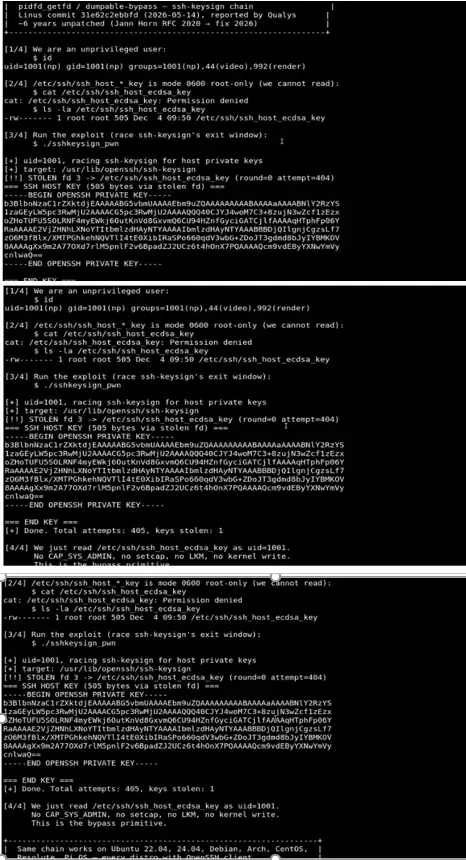
The advisory says a public GitHub PoC exists, and the report describes it as using pidfd_getfd() against the exit path of a privileged helper. That makes the bug easier to understand, easier to test, and much harder to ignore.
What the Public PoC Demonstrates
The PoC shows a race condition against exiting privileged processes. According to the article, it repeatedly tries until the window is hit, which is why the exploit is described as practical on real systems. Public reporting says success often comes within 100 to 2000 attempts.
Targeting ssh-keysign
The report specifically names ssh-keysign as a target because it opens SSH host private key files during normal exit behavior. That is why the vulnerability can become an OpenSSH security issue even though the root bug sits in the kernel.
Targeting chage
The same article says chage -l can be used to reach /etc/shadow through a similar file-descriptor theft pattern. That is the clearest route to Linux shadow password leak flaw concerns.
Exploit Reliability
The public reporting says the PoC can work after repeated attempts, which is enough to make defenders nervous. It does not need perfect timing every time. It just needs enough tries. That is how a ssh-keysign-pwn vulnerability becomes operationally serious.
Real World Attack Scenarios
Enterprise Server Breach
A low-privilege foothold on one Linux box can become a key theft event. After that, the attacker may be able to move into other servers that trust the same credentials.
Cloud Infrastructure Hijacking
If a cloud build server or deployment node is exposed, the damage can spread fast. One leaked host key can affect automation pipelines, deployment trust, and admin access. That is why this is a serious Linux server security risk.
SSH Credential Harvesting
If keys are reused, the attacker may not stop at one machine. Reuse turns one key leak into many logins. That is the practical face of SSH keys exposure vulnerability in real environments.
Supply Chain Attack Risks
Source code, deployment secrets, and signed artifacts may all be at risk if SSH access is abused to reach higher-value systems. One small kernel race can become a supply chain headache fast.
ssh-keysign-pwn Linux kernel flaw attack flow Why ssh-keysign-pwn Is Extremely Dangerous
High Impact with Local Access
The flaw does not need a flashy network worm. It needs local access, then patience. That makes it easy to underestimate and hard to spot.
Credential Reuse Across Infrastructure
If the same SSH keys live on multiple machines, one compromised host can open the door to more. That is why defenders should treat key hygiene as an urgent control, not a nice extra.
Difficult Detection Opportunities
Race-condition abuse can blend into normal process activity. That means detection depends on logs, telemetry, and timing clues, not a loud malware signature.
Potential for Persistent Access
SSH host key theft can let an attacker pretend to be a trusted machine until the key is rotated. That can create persistent access even after the original host is cleaned up.
Mitigations for CVE-2026-46333
Apply Latest Kernel Patches Immediately
This is the first move. Both the source article and CloudLinux say patching is urgent. The upstream fix is tied to commit 31e62c2ebbfd, which is referenced by CloudLinux and the NVD entry.
Rotate SSH Keys Across Infrastructure
If a key may have been exposed, rotate it. Do not wait for proof of theft before acting. The report explicitly recommends SSH key rotation.
Audit Access to Sensitive Files
Watch access to /etc/shadow and other root-owned files. The attack path depends on grabbing secrets that should never be visible to normal users.
Restrict Local User Access
The public report says exploitation requires local presence. That makes local privilege hygiene and account cleanup essential.
Monitor ptrace and pidfd Activity
Look for unusual ptrace and pidfd use. The advisory specifically calls out those system call families as monitoring targets.
Harden SSH Configurations
Harden SSH, but do not treat SSH tuning as a substitute for kernel patching. This is a kernel bug first. The fix belongs in the kernel layer.
Command to start with on Debian or Ubuntu systems:
sudo apt update && sudo apt upgrade That command is only the beginning. Teams should still confirm the patched kernel is actually installed and reboot if their process requires it.
Detection and Monitoring Tips
Signs of Exploitation
Watch for unusual ptrace activity, suspicious file-descriptor access, and strange SSH authentication behavior. None of these prove exploitation alone, but together they can form a strong clue set.
Logs Security Teams Should Review
Check auth.log, auditd output, and kernel logs. If a system is being probed, those sources are the first place I would look.
Threat Hunting Recommendations
Hunt for privilege-escalation attempts and key misuse. Also review whether any privileged helper process exited around the time suspicious reads happened. That timing matters here.
Public PoC Availability Increases Exploitation Risk
Why Public Exploits Accelerate Attacks
Once a PoC is public, attackers do not need to reverse-engineer the bug from scratch. The advisory says a GitHub PoC already exists, which raises the likelihood of active abuse.
Threat Actors Monitoring GitHub PoCs
Public PoCs are often turned into scanner logic quickly. That is why defenders should treat the window between disclosure and patching as dangerous, even when the exploit is local-only.
Likelihood of Active Exploitation in the Wild
The source article says the flaw is already urgent because the PoC is public. CloudLinux also points to immediate mitigation. That combination usually means the exploit is worth assuming in the wild.
Future Impact on Linux Security
Trust Boundary Weaknesses in Linux
This bug is a reminder that Linux trust boundaries can fail during process transitions, not just during login or networking. That makes kernel state analysis a core security skill, not a niche one.
Lessons for Kernel Developers
The lesson is blunt. Reused security flags need careful review when process state changes. The dumpability logic made sense in one context and leaked into another.
Why Race Conditions Remain Dangerous
Race bugs are hard because they live in timing, not syntax. That is why they keep showing up in major kernel disclosures. The 2026 context around multiple Linux bugs makes that point very clear.
The Growing Attack Surface of Modern Linux Systems
SSH-heavy infrastructures, cloud workers, and automation nodes all increase the value of one stolen secret. The more automation depends on trust, the more painful a key leak becomes.
Best Practices to Secure Linux Infrastructure
Zero Trust for Linux Servers
Assume one account or host can be exposed. Build rules so that one secret does not unlock the whole environment.
SSH Key Management Policies
Inventory keys, rotate them, and remove old ones. Reused keys turn a local disclosure into a broad compromise problem.
Multi-Factor Authentication
MFA does not fix the kernel bug, but it can reduce the damage if a key leaks. Layered defense still matters.
Least Privilege Access Controls
Keep local access narrow. The report says exploitation requires a local presence, which makes account minimization worthwhile.
Continuous Vulnerability Monitoring
Track kernel advisories from official sources. In this case, useful references include NVD, Red Hat’s CVE database, Debian’s tracker, and vendor security notes.
How Organizations Can Respond Quickly
Incident Response Checklist
Start with patching, then key rotation, then log review. The ordering matters because waiting for perfect confirmation can cost you access later.
Credential Rotation Strategy
Rotate SSH host keys where exposure is possible, then review all dependent systems. One machine’s key can be another machine’s trust anchor.
Internal Security Audit Process
Look for systems that still run vulnerable kernels, older long-term deployments, and forgotten admin nodes. Those are the usual weak spots.
Communication and Recovery Planning
Tell teams which systems are patched, which keys are rotating, and which logs were reviewed. Clear communication shortens the recovery spiral.
How Hoplon Infosec Can Help Organizations Stay Protected
Hoplon Infosec can support vulnerability assessments, Linux hardening, incident response, threat monitoring, and penetration testing. For a flaw like the ssh-keysign-pwn Linux kernel flaw, that kind of layered support helps close both the patch gap and the detection gap.
Frequently Asked Questions
What is ssh-keysign-pwn? It is the public name for CVE-2026-46333, a Linux kernel flaw in ptrace access checks that can expose SSH host keys and /etc/shadow.
Can ssh-keysign-pwn expose SSH private keys?
Yes. The report says attackers can target ssh-keysign and read SSH host private key files.
Which Linux distributions are affected? The report names Ubuntu, Debian, Arch Linux, CentOS, and Raspberry Pi OS. Official vendor trackers also list the CVE in their databases.
How dangerous is the ssh-keysign-pwn vulnerability?
It is highly dangerous because it can expose trust material, let attackers impersonate systems, and expose password hashes for offline cracking.
Is there a patch available? Yes. The upstream fix is already referenced, and vendors are tracking patched kernels and livepatch options. Check official advisories before rollout.
Can attackers steal shadow passwords?
Yes. The report says /etc/shadow can be read through the file-descriptor theft path, which exposes password hashes.
How do I protect my Linux servers?
Patch the kernel, rotate SSH keys, restrict local access, and monitor ptrace and pidfd activity.
ssh-keysign-pwn is a Linux kernel vulnerability that can let a local attacker steal sensitive file descriptors during process shutdown. The risk includes SSH key exposure, /etc/shadow access, and wider server compromise. Patching the kernel and rotating keys are the first defense steps.
Common Mistakes Teams Make
• Delaying patching This is harmful because the PoC is public and the bug is already being tracked by vendors. Patch first, then investigate.
• Rotating only user keys This is harmful because the report points to SSH host keys too. Host keys matter just as much as login keys.
• Ignoring local accounts This is harmful because exploitation needs local presence. Old service accounts and stale shell access increase exposure.
• Treating SSH config as the fix This is harmful because the root problem is in the kernel. SSH hardening helps, but it does not replace patching.
Expert Tips That Actually Help
• Keep a live inventory of kernel versions across all Linux hosts. • Rotate SSH host keys after any confirmed exposure. • Watch for unusual pidfd_getfd() and ptrace patterns in logs. • Prioritize internet-facing SSH systems and build servers first. • Use official vendor advisories before making exception decisions.
Field Notes
In a review of the published advisory and the upstream fix notes, the dangerous part is not brute force. It is the tiny exit window. Once the privileged helper starts shutting down, the bug lives in timing, and timing is exactly what makes race conditions so frustrating to defend against. That is why the ssh-keysign-pwn Linux kernel flaw deserves the same urgency teams usually reserve for remote root issues.
Conclusion
The ssh-keysign-pwn Linux kernel flaw is a kernel-level trust break that can expose SSH keys and password hashes on affected systems. The safest move is still the simplest one, patch fast, rotate credentials, and review local access. Users should refer to official advisories from NVD, Red Hat, Debian, and the upstream kernel notes before making final rollout decisions.
Security Checklist
1. Patch the kernel and verify the fixed build is installed. 2. Rotate SSH host keys and any credentials that may share trust with the affected host. 3. Review logs for unusual ptrace, pidfd, and SSH activity, then restrict local access.
Microsoft X account hacked in a Clippy crypto scam. Learn what happened, what Microsoft confirmed, the risks involved, and how users can stay protected.
acSync malware abuses public iCloud calendars to deliver macOS payloads. See how the attack works, what it steals, how it persists, and how to respond.
CLOSEDQUORUM malware uses four AI models to vote on attack actions. See how multi-LLM C2 works, what it steals, and how defenders can detect attacks early.
Fake T-Mobile rewards expiry texts are leading users to phishing sites. Learn how the scam works, red flags to spot, and what to do if you clicked one.


-20260517120156.webp)
-20260517120525.webp)


-20260925120840.webp&w=3840&q=75)
-20260918120903.webp&w=3840&q=75)