AI Voice Cloning Scams: What Happens When a Trusted Voice Lies
Yes, AI voice cloning scams are real, growing, and serious enough that the FTC, FBI, and FCC have all issued public warnings or enforcement actions. The core problem is simple: a familiar voice is no longer reliable proof that the caller is genuine. The safest response is to stop the conversation, verify the request through a trusted channel, and never send money or sensitive information under pressure.
Criminals are using AI to imitate real voices in family emergency scams, executive impersonation fraud, and other social engineering attacks. The risk matters now because these scams do not need malware or account takeovers first.
They often succeed by creating panic, urgency, and trust faster than victims can verify what is happening.
Your old defense used to be instinct. You heard your child, your boss, or your colleague on the phone, and that felt like enough. The new reality is different. Verification has to replace assumption. The result is not paranoia. It is control.
That shift is the real benefit of understanding AI voice cloning scams. Once you know how they work, the scam loses much of its power. You stop reacting to the voice and start testing the request.
Why AI voice cloning scams matter right now
The bigger fraud landscape is already moving in the wrong direction. The FTC said consumers reported more than $12.5 billion in fraud losses in 2024, up 25% from the prior year. The same release said the share of people reporting a fraud who actually lost money rose from 27% in 2023 to 38% in 2024.
That does not mean all of those cases were voice cloning, but it does show a fraudulent environment where more victims are being successfully manipulated.
At the same time, the FBI has warned that criminals are using generative AI to make fraud more believable and easier to scale. The FCC also moved to treat AI-generated voices in robocalls as illegal under the TCPA, which tells you this is no longer a fringe threat. It is established enough to trigger national consumer protection and law-enforcement action.
That is why AI voice cloning scams deserve a full, people-first guide, not a thin explainer. Readers do not just need to know what the tech is. They need to know how the pressure works, where the weak spots are, and what to do in the first 30 seconds of a suspicious call.
What are AI voice cloning scams?
AI voice cloning scams are fraud schemes in which attackers use AI-generated or AI-cloned speech to impersonate someone a victim knows or trusts, then push for money, account access, codes, or private information.
In plain English, the scam is not really about audio quality. It is about borrowed trust. The voice gives the criminal a shortcut into your emotions before your logic catches up.
These scams sit inside a broader category called impersonation fraud and often overlap with phishing, which is phishing carried out through voice calls. Instead of a fake email asking you to click a link, the criminal may sound like your daughter, your CFO, a government official, or customer support. That is what makes AI voice cloning scams feel personal in a way older robocalls never did.
What is a deepfake voice, really?
A deepfake voice is a synthetic copy of a real person’s speech patterns, tone, and delivery, generated by AI. Regulators and consumer agencies use related terms like "voice cloning," "AI-generated voices," or "deepfake audio," but the practical issue is the same: software can now imitate the sound of a known person closely enough to mislead victims.
One thing needs to be said carefully here. You will often see dramatic claims online that any voice can be cloned “perfectly” in only a few seconds. Official sources do support the idea that short audio clips may be enough to produce a convincing imitation, especially for scam purposes. But “perfectly” is not a standard that official agencies use, and it should not be treated as verified fact. What matters is simpler and scarier: it only has to sound believable enough in a stressful moment.
That distinction matters for trust. Good security content should not exaggerate the technology. It should explain the real threshold of danger, which is persuasion, not perfection.
How scammers get the voice sample
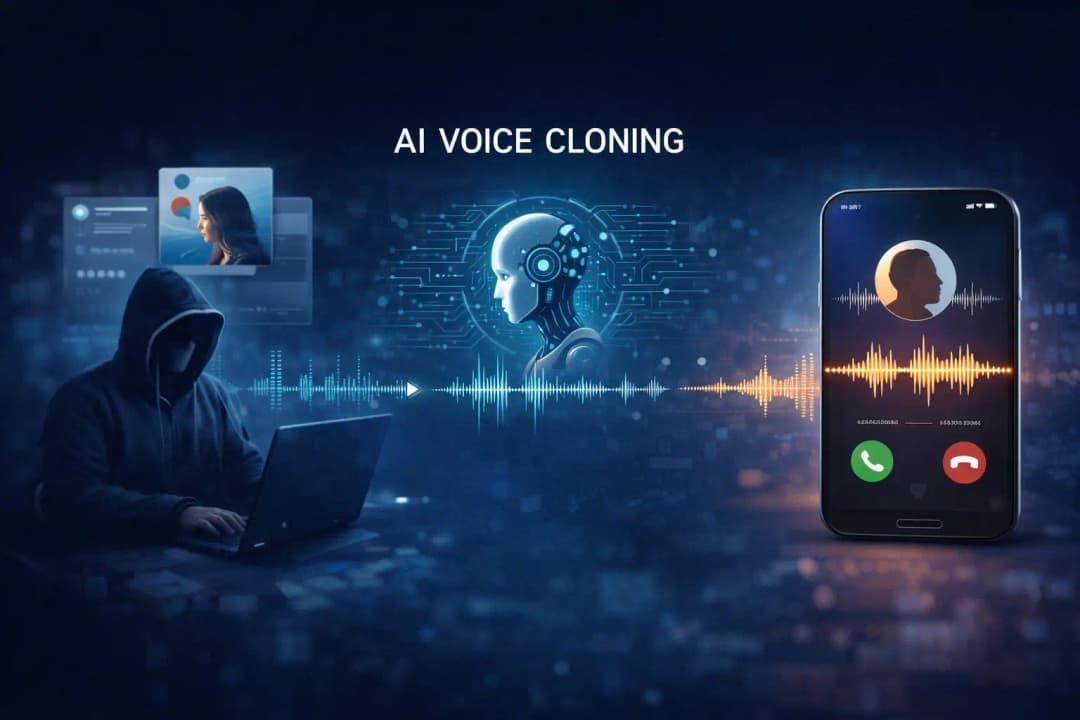
Attackers may collect voice samples from public videos, social posts, voicemail greetings, podcasts, interviews, or short live calls, then use voice-cloning tools to generate a fake version for later scams.
This is one of the biggest content gaps in many articles. People are told to “be careful online,” but not told what that actually means in practice.
A short birthday video on social media. A public webinar clip. A voice note in a group chat. A voicemail greeting with a full name. None of these pieces may feel risky on their own. Together, they lower the cost of impersonation.
The wider issue is scale. The FTC has explicitly described harmful voice cloning as a consumer protection problem, and the FBI has said generative AI reduces the time and effort criminals need to deceive targets. That is the real shift from old-school fraud to AI voice cloning scams. The barrier to entry is dropping.
How AI voice cloning scams work step by step
Traditional scam prevention often assumes the attacker must hack a device, breach an account, or plant malware. That is not always the case here. The “new way” is social engineering powered by synthetic media, and it can work even when your phone, laptop, and apps are fully updated.
Here is the mechanism behind many AI voice cloning scams:
· The criminal gathers a short audio sample and personal details.
· They build a believable story around urgency, fear, or authority.
· They call or send a voice message at a moment when the victim is likely to react fast.
· They try to isolate the victim by saying there is no time to verify.
· They ask for money, gift cards, crypto, account credentials, or one-time codes.
Notice what is missing. No sophisticated malware chain. No exploit kit. No deep technical intrusion. That is why AI voice cloning scams are dangerous for both households and businesses. They target human reflexes first.
The most common scam scenarios
Family emergency scams
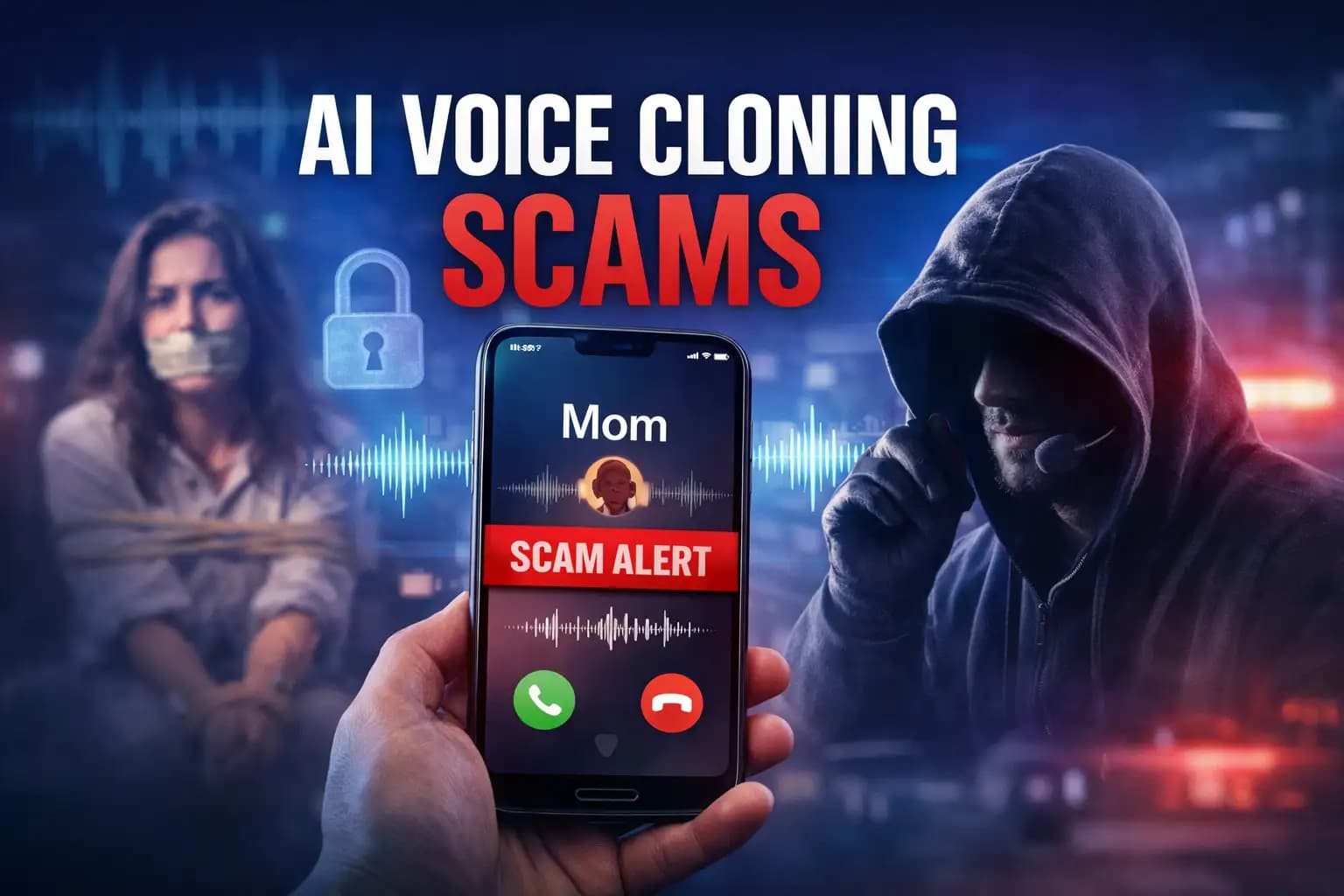
The most common high-pressure version of AI voice cloning scams is the fake emergency call from a loved one who supposedly needs money right away and begs you not to verify the story.
This is the scenario people share in family groups because it cuts straight through common sense. You hear a frightened voice. Maybe it sounds like your son. Maybe it sounds like your mother. The caller says there has been an accident, an arrest, a medical emergency, or a kidnapping threat. Then comes the trap: do not call anyone else, do not hang up, and send the money now.
The emotional design is deliberate. Panic shrinks your decision-making window. That is why the most effective protection is not better guessing. It is a fixed rule: end the call and verify independently.
Executive and authority impersonation
The business version may sound calmer, which can make it even more effective. The voice on the line sounds like a senior executive, a finance lead, or an official contact. The request is framed as urgent, confidential, and time-sensitive. Money needs to move. Credentials need to be shared. A code must be read back immediately.
The FBI has warned about malicious campaigns that impersonate senior U.S. officials through text and voice messaging, and the FTC has also highlighted impersonation fraud as a rising AI-enabled risk. In a corporate setting, AI voice cloning scams can blend into existing business email compromise patterns, except now the call sounds more real than the usual phishing email ever did.
Why these scams are so convincing
People do not evaluate familiar voices the way they evaluate suspicious links. That is the uncomfortable truth. Most of us are trained to distrust emails with odd grammar or random attachments. We are not trained to distrust what sounds like our own family.
There is also a timing problem. AI voice cloning scams tend to work best when they strike before the victim can move from emotion to procedure. Once you hang up, check a saved number, or ask a verification question, the scam often falls apart. That is why criminals try to keep you on the line and in the moment.
The warning signs you should never ignore
Some red flags show up again and again across official guidance. If a call does any of the following, treat it as suspicious:
· demands immediate payment
· insists on secrecy
· discourages hanging up
· asks for gift cards, crypto, or wire transfers
· requests one-time passcodes or account details
· comes from an unfamiliar number but claims high trust
· says normal contact methods are suddenly unavailable
A practical example helps here. Imagine “your nephew” calls saying he is in trouble and needs money in the next ten minutes. The better question is not, “Does this sound like him?” The better question is, “Why can’t I call him back on the number I already have?” That small change in mindset is where many AI voice cloning scams fail.
The Family Password strategy that actually helps
The best low-tech defense for families is a pre-agreed secret word or phrase used only to verify identity during emergencies. The FBI has explicitly recommended creating one.
This is the shareable advice that deserves more attention because it is simple and usable. Pick a word or short phrase your family would not guess from social media, birthdays, or obvious memories. Do not store it publicly. Do not turn it into a joke that gets repeated in group chats. Keep it boring and private.
Traditional trust says, “I know that voice.” A better system says, “I know the verification method.” That is the real USP here. Voice recognition is passive and easy to fake. A family password is active and much harder to improvise under pressure.
What businesses should do differently
Most articles on AI voice cloning scams stop at consumer advice. That leaves a major gap. Businesses face a different risk profile because calls can trigger payments, approvals, data sharing, and account changes.
A safer business process usually includes:
· dual approval for urgent payments
· callback verification using known internal directories
· no approval based on voice alone
· out-of-band confirmation for sensitive requests
· Staff training focused on social engineering, not just phishing emails
That is a meaningful improvement over the traditional approach, where a senior voice on the phone can override the process. In a modern fraud environment, process must outrank familiarity.
Can software stop AI voice cloning scams?
Software can reduce exposure, but it is not a complete fix. Call filtering, spam labeling, and fraud detection tools may block some scam calls or flag suspicious numbers. The problem is that highly targeted impersonation attempts can still slip through, especially if they use new numbers or a personalized script. Official guidance consistently treats technology as a support layer, not the final defense.
That is worth stressing because readers often want a product answer. There is no magic app that makes AI voice cloning scams disappear. The strongest defense is still behavioral: stop, verify, call back, and confirm through a trusted channel.
What to do if you already sent money or shared information
If money, credentials, or account details were shared, move fast. Time matters more than embarrassment.
· Contact your bank, card issuer, or payment provider immediately.
· Change passwords for affected accounts.
· Turn on multi-factor authentication where possible.
· Save call details, numbers, times, messages, and payment records.
· Report the incident to relevant authorities or national fraud reporting channels.
There is a human point here too. Many victims stay quiet because the scam feels humiliating. That reaction helps criminals. Reporting quickly may improve recovery chances and can help protect others from the same scheme.
FAQ
Can scammers clone your voice without your knowledge?
Yes. The FTC has warned that scammers may use audio clips posted online to clone a loved one’s voice for emergency scams.
Are AI voice cloning scams illegal?
Yes, when they are used for fraud or unlawful robocalls. The FCC has said AI-generated voices in robocalls are illegal under the TCPA, and fraud laws also apply to impersonation schemes.
How much audio do scammers need?
Official guidance supports the idea that short audio clips can be enough to create a convincing scam voice, though exact performance varies and “perfect cloning” should not be assumed.
What is the safest response to a suspicious call?
Hang up and verify the request independently using a saved phone number, official contact details, or another trusted channel.
Should businesses stop relying on voice-based trust?
Yes. Sensitive approvals should not depend on a familiar voice alone. Use formal verification and dual-control procedures instead. This is an inference from current FBI and FTC warnings about impersonation and AI-enabled fraud.
Conclusion
AI voice cloning scams work because they hijack something people naturally trust: the human voice. That is why this threat feels different. It is intimate. It is fast. And it does not need advanced hacking to cause real damage. Official guidance from the FTC, FBI, and FCC points in the same direction: assume the voice could be fake, verify the request independently, and normalize the use of a secret family phrase or strict business callback process.
The most useful takeaway is not fear. It is procedure. The moment you stop treating a voice as proof, AI voice cloning scams become much easier to disrupt.
If you are publishing this piece, add a short callout box near the top: “Before you send money, hang up and verify.” That single line may protect more readers than a page of theory.
especially the family password and callback rule. The broader capability is practical fraud resilience for both households and organizations facing AI-driven impersonation risk.
For more latest updates like this, visit our homepage.
Author credibility note: This article is based on publicly available guidance and enforcement statements from the FTC, FBI/IC3, and FCC, with care taken to avoid unverified claims about the limits of voice-cloning technology. Where certainty was not possible, the wording was kept cautious.