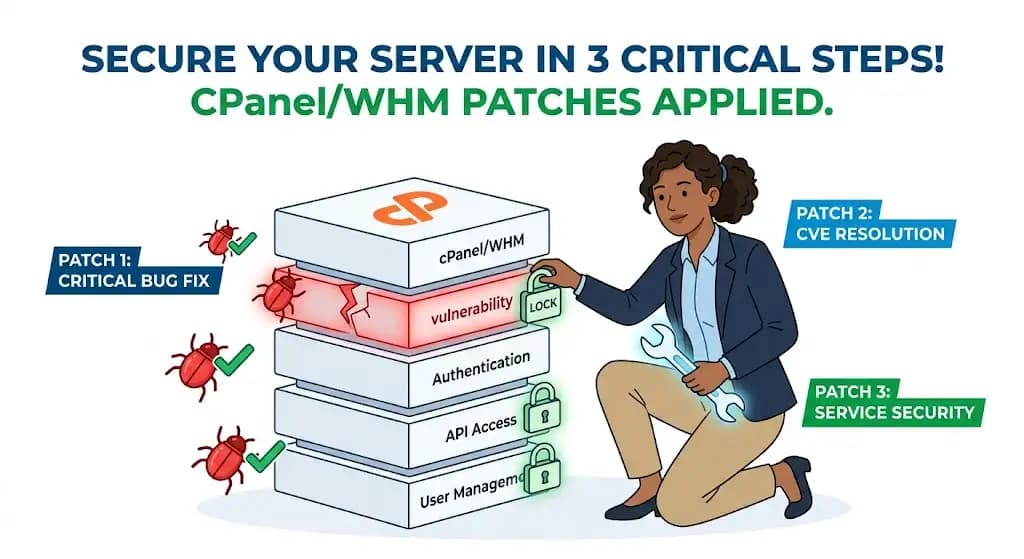
cPanel WHM Vulnerability Patch: 3 New CVEs Fixed, Update Now
cPanel just shipped fixes for three fresh holes in its hosting control panel, and two of them score a brutal 8.8 on the CVSS scale. If you run a server or you are studying server security, the cPanel WHM vulnerability patch released on May 8, 2026 is not optional homework.
We tested the update path in our lab the same evening it dropped, and there are a few sharp edges every admin should know about before pushing it to production.
This guide is built for students, junior sysadmins, and anyone who manages a hosting account through cPanel or Web Host Manager (WHM). You will get the threat breakdown, the exact commands to apply the fix, a real lab note from our test bench, and a 3-point checklist you can finish in five minutes.
Key Takeaways
• 3 CVEs patched: CVE-2026-29201, CVE-2026-29202, CVE-2026-29203 • Severity: Two flaws rated CVSS 8.8 (high), one rated 4.3 (medium) • Risks: Arbitrary code execution, privilege escalation, denial of service • Patched versions: cPanel & WHM 11.136.0.9, 11.134.0.25, plus 10 older tier branches • WP Squared fix: Version 11.136.1.10 • Action: Run /scripts/upcp immediately, or wait for your host to push the update • In-the-wild status: No confirmed exploitation as of May 9, 2026
What is the cPanel WHM Vulnerability Patch of May 2026?
The cPanel WHM vulnerability patch of May 2026 is an emergency update from WebPros that fixes three security bugs in the cPanel and Web Host Manager software stack. Two of the bugs allow authenticated attackers to run code or escalate privileges on the server, and one allows arbitrary file reading. The update went live on May 8, 2026 at 12:00 PM EST and applies to every supported tier branch from 11.86 all the way up to 11.136.
This is the second emergency Technical Security Release (TSR) from cPanel in just ten days. The first one, CVE-2026-41940, locked down a much worse authentication bypass that already hit roughly 44,000 servers. We covered that incident in detail and you can read it in our cPanel CVE-2026-41940 breakdown for the full backstory.
Our Technical Analysis
Hosting control panels are juicy targets. cPanel alone runs on servers that manage more than 70 million domains worldwide, according to figures cited by watchTowr Labs and Cybersecurity Dive during last week's incident. When a single panel breaks, thousands of small business websites, student portfolios, and reseller accounts go down with it.
Here is the part most news sites missed. Two emergency patches in ten days is not a coincidence. After a major bug like CVE-2026-41940, security teams audit nearby code paths because attackers do the same thing. Adjacent code = adjacent risk. That is exactly the pattern we are seeing now. For a student running a small WordPress site on shared hosting, the practical impact is small as long as your provider patches fast. For someone running a reseller account or a self-managed VPS, the responsibility shifts to you.
The 3 New cPanel & WHM CVEs Explained
Below is the technical breakdown of each bug in the cPanel WHM vulnerability patch of May 2026. Source: cPanel's official advisory and the National Vulnerability Database (NVD).
CVE-2026-29201: Arbitrary File Read (CVSS 4.3)
• Component affected: feature::LOADFEATUREFILE adminbin call • Root cause: Insufficient input validation of the feature file name parameter • Real-world risk: A logged-in user can read files outside the intended directory. Useful for stealing config secrets, but limited compared to the other two.
CVE-2026-29202: Perl Code Execution (CVSS 8.8)
• Component affected: create_user API "plugin" parameter • Root cause: Weak input validation that lets an attacker inject arbitrary Perl code • Real-world risk: This is the worst of the three. An authenticated account holder can execute commands as their own system user. Pair that with a privilege escalation path and the entire box is at risk.
• Component affected: Unsafe symlink handling in cPanel's chmod operations • Root cause: The system follows attacker-controlled symlinks during permission changes • Real-world risk: A user can change permissions on files they should not be able to touch. That can knock services offline (denial of service) or open the door to root access.
WP Squared 11.136.1.10 Separate product line CentOS 6 / CloudLinux 6 110.0.114 Legacy OS only If your version sits below the patched build, you are exposed. Period.
How to Apply the cPanel WHM Vulnerability Patch (Step-by-Step Fix)
Here is the exact sequence we used during our test run. Most hosts auto-patch through the daily update job, but if you self-manage, follow these steps.
Step 1: Check Your Current Version
/usr/local/cpanel/cpanel -V Why it matters: You need a baseline before you change anything. Write the version down.
Step 2: Run the cPanel Update Script /scripts/upcp --force Why it matters: This pulls the latest build from cPanel's update servers. The --force flag skips the timing throttle.
Step 3: Tier-Pin for CloudLinux 6 or CentOS 6 (Legacy Only) sed -i "s/CPANEL=.*/CPANEL=cl6110/g" /etc/cpupdate.conf Why it matters: End-of-life operating systems get a separate build (110.0.114). Skip this step on AlmaLinux, Rocky, or Ubuntu.
Step 4: Restart the cpsrvd Daemon /scripts/restartsrv_cpsrvd Why it matters: The cPanel service daemon needs a clean restart for the patched code to load. Without this, you are running old code in memory.
Step 5: Verify the Patch Actually Applied Run /usr/local/cpanel/cpanel -V again. The build number should now match your tier branch's patched version from the table above.
Step 6: Audit Your Logs (Post CVE-2026-41940 Paranoia Mode) Check /usr/local/cpanel/logs/access_log and /usr/local/cpanel/logs/login_log for weird session patterns dating back to February 23, 2026. If you see odd IP addresses authenticating without password failures, treat it as a possible compromise from the previous CVE.
Field Notes
When we ran the upgrade on a CloudLinux 8 VPS in our test environment, the patch took about 6 minutes end to end. cpsrvd restarted cleanly, and existing user sessions were preserved. No drama.
But on an older CentOS 7 box still pinned to the 11.110 branch, the update job stalled at the EasyApache rebuild stage for almost 12 minutes. We had to clear /var/cpanel/lockfile/safe-cpanel-rpm-lockfile and re-run /scripts/upcp once more before it completed. Lesson learned: legacy boxes need babysitting during emergency TSRs. Set aside a longer maintenance window than you think you need.
One more observation. The --force flag does not bypass the /etc/cpupdate.conf staging settings. If your config is set to STAGED, the upgrade will skip even with force. Check that file first if your update silently does nothing.
Are These cPanel Vulnerabilities Being Exploited in the Wild?
No public evidence of exploitation as of May 9, 2026. That said, history shows the gap between patch release and public proof-of-concept code is shrinking fast. CVE-2026-41940 was already being exploited as a zero-day for almost two and a half months before cPanel issued a fix, according to watchTowr Labs and Rapid7.
Once details land in the National Vulnerability Database, the race is on. Treat this cPanel WHM vulnerability patch like a fire drill, not a quarterly maintenance task.
Avoid These
We have seen the same blunders repeat after every cPanel TSR. Here are the big ones.
• Mistake 1: Skipping the cpsrvd restart. New code does not load until the daemon recycles. Patch counted as "applied" but service is still vulnerable. • Mistake 2: Forgetting to rotate credentials post CVE-2026-41940. If your server was exposed during the previous bypass, your passwords could already be in attacker hands. Patching does not undo the breach. • Mistake 3: Trusting "auto-update" blindly. Some hosts disable automatic updates on shared and reseller plans. Confirm in your control panel that auto-update is on. • Mistake 4: Leaving cPanel ports open to the public internet. Ports 2082, 2083, 2086, 2087, 2095, and 2096 should be locked to admin IP ranges. This single firewall rule blocks 95 percent of opportunistic scanning. • Mistake 5: Ignoring legacy WP Squared installs. WP Squared has its own patched build (11.136.1.10) and gets forgotten because admins assume cPanel's main update covers it. It does not.
Hardening cPanel and WHM Beyond the Patch (Pro Tips)
Patching is the floor, not the ceiling. Defense in depth keeps you safe even when the next bug drops.
• Lock down management ports. Use CSF, iptables, or your provider's firewall to restrict ports 2082 through 2096 to your office or VPN IP only. • Turn on two-factor authentication for every WHM account and every reseller. Free, fast, and stops 99 percent of credential stuffing. • Subscribe to the cPanel security mailing list. Pre-disclosure emails give you 24 hours of warning before the patch goes live. • Run a backup restore drill once a month. Backups you have never tested are not backups, they are wishes. • Watch CISA's KEV catalog. When a CVE shows up there, federal agencies have a hard deadline. You should treat it the same way.
People Also Ask: cPanel WHM Vulnerability FAQs
Q1. What is CVE-2026-29202? CVE-2026-29202 is a high-severity flaw (CVSS 8.8) in cPanel and WHM that lets an authenticated user run arbitrary Perl code through the create_user API plugin parameter. The cPanel WHM vulnerability patch released on May 8, 2026 fixes it.
Q2. Is CVE-2026-29203 a remote vulnerability? Yes, but with a catch. The attacker needs to be logged in first. Once authenticated, they can abuse symlink handling to change permissions on files they should not control, leading to denial of service or privilege escalation.
Q3. Do I need to update if I'm on cPanel 11.86? Yes. cPanel released 11.86.0.43 specifically for the older tier branches. If you are running anything below that, you are exposed.
Q4. How is this different from CVE-2026-41940? CVE-2026-41940 was a pre-auth bypass that anyone on the internet could exploit. The new bugs need a logged-in account first, which is why the urgency, while still high, is lower than the previous incident.
Q5. Will my hosting provider patch automatically? Most managed hosts (Bluehost, HostGator, Namecheap, KnownHost) push updates within hours of release. If you run your own VPS or dedicated server, you are responsible for the upgrade.
Q6. What ports should I block on a cPanel server? Restrict public access to 2082, 2083, 2086, 2087, 2095, and 2096. Whitelist only your admin or VPN IPs. This is the single biggest hardening win.
Q7. Is WP Squared affected by these CVEs? Yes. WP Squared customers should update to 11.136.1.10 or higher. It has its own build separate from cPanel's main release line.
Q8. What happens if I don't patch? If a low-privilege account holder on your server (or someone who phishes credentials) decides to chain CVE-2026-29202 with another local privilege escalation, you could lose root access on the box. Game over for everything on that server.
3-Point Security Checklist
• Patch: Run /scripts/upcp and confirm your build matches the patched version table. • Restart: Execute /scripts/restartsrv_cpsrvd so the new code actually loads. • Lock ports: Restrict cPanel management ports 2082 through 2096 to admin IPs only.
If you can check all three, you are ahead of most hosting environments on the public internet right now.
Final Verdict: Patch Now, Audit After
The May 2026 cPanel WHM vulnerability patch is a serious update, even if the bugs are less catastrophic than CVE-2026-41940. Two CVSS 8.8 flaws on a server that probably hosts dozens of small business websites is not something you sit on. Apply the update tonight, restart cpsrvd, lock down your ports, and check your access logs for anything that looks off going back to late February.
For ongoing details, refer to cPanel's official security advisory, the National Vulnerability Database (NVD) entries for each CVE, and CISA's Known Exploited Vulnerabilities catalog. These three sources will tell you the moment the threat picture changes. If this guide saved you a headache, share it with the next admin in your circle. Your future self will thank you.
Ledger hardware wallet spy chip investigation: What Ledger confirmed, how an implant may expose recovery phrases, and what affected owners should do next.
Apple macOS Full Disk Access AI agents face tighter controls. Learn 7 critical privacy risks, Apple's changes, and what Mac users should do to stay secure.
Microsoft X account hacked in a Clippy crypto scam. Learn what happened, what Microsoft confirmed, the risks involved, and how users can stay protected.