
A missed token rotation after the TanStack supply-chain attack let attackers reach Grafana Labs’ GitHub repos. The lesson is simple: stale tokens are a real cloud security risk.
A single missed token can do more damage than a loud malware alert. That is exactly why the Grafana token rotation breach matters so much. Grafana says it rotated many workflow tokens after the TanStack supply-chain compromise, but one missed token still left a path open to its GitHub repositories.
This article is for students, DevOps beginners, and security teams who need a clear view of what happened, why it mattered, and how to stop the same mistake in their own stack. You will see the attack chain, the token failure, the business risk, and the practical fixes that matter most in 2026.
What caused the Grafana token rotation breach?
The Grafana token rotation breach happened because Grafana’s cleanup after the TanStack attack was not complete. Grafana said it rotated a large number of GitHub workflow tokens, but one missed token allowed the attackers to keep access to its GitHub repositories. The company also said the incident stayed inside its GitHub environment and did not affect production systems or Grafana Cloud.
What is token rotation and why does it matter?
Token rotation means replacing an old access token, API key, or secret with a new one before the old one can be abused for long. In simple terms, it shortens the life of stolen access. OWASP says regular rotation keeps stolen credentials useful only for a short time, and GitHub says exposed secrets should be rotated immediately after detection.
A simple example helps. If a CI/CD token leaks on Monday and gets rotated on Tuesday, the attacker has a short window. If nobody notices, that same token can keep working for days or weeks. That is why a Grafana token rotation breach is not just a vendor story. It is a warning for every team that runs GitHub Actions, cloud workloads, or automated deployments.
Why it matters in 2026 is obvious. NIST’s newer token protection guidance focuses on forgery, theft, misuse, life cycle controls, and continuous monitoring because identity tokens have become a prime target in cloud attacks.
Technical snapshot
|
Item |
What the public sources show |
|
Threat actor |
TeamPCP, tied to the TanStack supply-chain campaign. |
|
Attack vector |
GitHub Actions cache poisoning, pull_request_target abuse, and OIDC token theft from runner memory. |
|
Malware behavior |
Credential-stealing payload that harvested GitHub, cloud, Vault, SSH, and .env secrets. |
|
Affected area |
Grafana Labs GitHub repositories, including source code and some internal operational information. |
|
Production impact |
Grafana says there was no evidence customer production systems or Grafana Cloud were compromised. |
|
Public CVE |
I did not find a public CVE in the sources reviewed here. |
|
Mitigation |
Rotate tokens, harden GitHub security, audit commits, and improve CI/CD monitoring. |
What happened in the breach?
Grafana said the incident began with the TanStack npm supply-chain attack. The company detected malicious activity on May 11, 2026, started incident response, rotated many workflow tokens, and later found that one missed token had still left access open. Grafana then said it received a ransom demand on May 16 and chose not to pay.
That is the part many teams miss. The first compromise is not always the worst part. The cleanup is done. If one token survives, the attacker may not need to break in again. They can simply keep using what was forgotten. That is the real lesson behind the Grafana token rotation breach.
Timeline of the incident
May 11, 2026: Grafana says it detected malicious activity and began response actions.
May 11, 2026: TanStack reported the supply-chain compromise and described the attack chain.
May 16, 2026: Grafana said it received a ransom demand.
May 19, 2026: Grafana published a fuller update describing the missed token and the scope of impact.
How the TanStack attack became connected
TanStack’s postmortem says the attackers used a pull_request_target pattern, GitHub Actions cache poisoning, and runtime memory extraction of an OIDC token from the runner process. That attack was a supply-chain compromise, not a classic login brute force. In other words, the attackers abused the build path, not just the app itself.
That matters because supply-chain attacks spread fast. Once a trusted workflow is touched, downstream repos, CI jobs, and secrets can all become risky. That is exactly the kind of path that turns a TanStack attack into a wider Grafana breach discussion.
What was actually exposed?
Based on Grafana’s disclosure, the attackers downloaded source code and internal GitHub repositories that contained operational information and business contact details. Grafana said customer production systems were not compromised and the codebase was not altered.
This is a big deal even without customer data theft. Source code, workflow logic, repo metadata, and internal notes can help an attacker map a future attack. That is why a Grafana security incident can still be serious even when production stayed intact.
Why this matters
A lot of people think secret leaks only matter when customer records are stolen. That is too narrow. A leaked workflow token can reveal how your builds run, what services your team touches, and where your trust boundaries are weak. GitHub documents that exposed secrets can lead to unauthorized access, data theft, cloud spend abuse, and service disruption.
For a business, the damage looks like trust loss, response cost, and internal chaos. For a student or junior engineer, the lesson is even simpler: one stale secret can outlive the cleanup plan. That is why Grafana cloud security became a case study, not just a headline.
Do you see the pattern? Attackers are not only chasing passwords. They are chasing automation. They want the token your pipeline trusts most. That is the heart of the Grafana authentication token vulnerability story.
Field Notes
In our lab-style review of the attack path described by Grafana and TanStack, the weak point was not the first breach. It was the missed revocation step after the team had already started rotating tokens. That is the painful part. Teams often respond fast, but the final cleanup is where one old token survives.
We also noticed how much of the risk sits inside the CI/CD layer. Once GitHub Actions, OIDC, and repo secrets are mixed together, one small oversight can create a long tail of exposure. That is a classic CI/CD token compromise pattern, not a one-off mistake.
Technical breakdown of the breach
Initial entry point
The initial entry point was the TanStack supply-chain compromise, where malicious packages were published through a trusted development workflow. TanStack said the attack used a workflow flaw, cache poisoning, and OIDC token theft from the runner process.
How attackers could exploit unrotated tokens
If an attacker still has a valid token after the first response, they do not need a fresh exploit. They can keep accessing GitHub repos, workflows, or related systems until the token is revoked. GitHub explicitly recommends immediate revocation and rotation once a credential leak is detected.
CI/CD pipeline security weaknesses
The breach is a textbook reminder that build systems are part of the attack surface. GitHub says least privilege, short-lived secrets, and secret scanning are core controls. OWASP also recommends rotation and revocation as part of secrets management.
Potential lateral movement risks
A compromised token can move laterally if it has a broad scope. It may reach cloud keys, deploy permissions, service accounts, or internal repositories. That is why a Grafana supply chain attack does not stay inside a single repo for long in the minds of defenders.
Infrastructure and cloud exposure
Cloud tokens can unlock logs, storage, deployment paths, and automation jobs. NIST’s new token guidance focuses on token life cycle controls for exactly this reason. Modern identity tokens are not just login objects. They are infrastructure keys.
Detection challenges
These incidents are hard to spot because the malicious workflow often looks legitimate. TanStack said the packages had valid provenance and signatures, which made them look authentic to developers. That is why provenance alone is not enough.
Containment and response actions
Grafana said it rotated tokens, added enhanced monitoring, audited commits, hardened GitHub security, and continued to work with law enforcement. Those are the right moves, but they only work if every token is found.
The bigger problem with supply chain attacks
Supply chain attacks keep growing because they exploit trust. When a package, workflow, or action looks normal, people let it pass. TanStack’s compromise is a clean example of that abuse pattern.
We have seen similar patterns before in SolarWinds, Codecov, and 3CX. In each case, trusted software or build paths became the entry point. That is why developers are now prime targets. The attacker does not always need the front door. Sometimes they just need your build pipeline.
This is also why stale authentication token risks are now treated as a board-level issue. Once the wrong secret survives cleanup, the blast radius grows. A Grafana token exposure incident can quickly become a governance lesson for the whole company.
How attackers abuse authentication tokens
Attackers use several routes to steal tokens:
GitHub exposure in repos, logs, or workflow files.
Memory scraping from CI/CD runners, as TanStack described.
Compromised build tools and workflow steps.
Dependency poisoning through malicious packages.
Once inside, attackers can use those tokens for persistence, privilege escalation, and cloud access. That is why a Grafana access token leak is not just an auth problem. It is an infrastructure problem.
Warning signs organizations miss before a token breach
Watch for these signals:
Unusual API calls from a normal-looking service account.
Build jobs that behave differently after a dependency update.
Tokens that never expire or are never reviewed.
Secrets with broad scopes that should have been read-only.
No secret audit trail or secret scanning alerts.
These are often the early clues in a Grafana token compromise-explained-style review. The signs are small. The consequences are not.
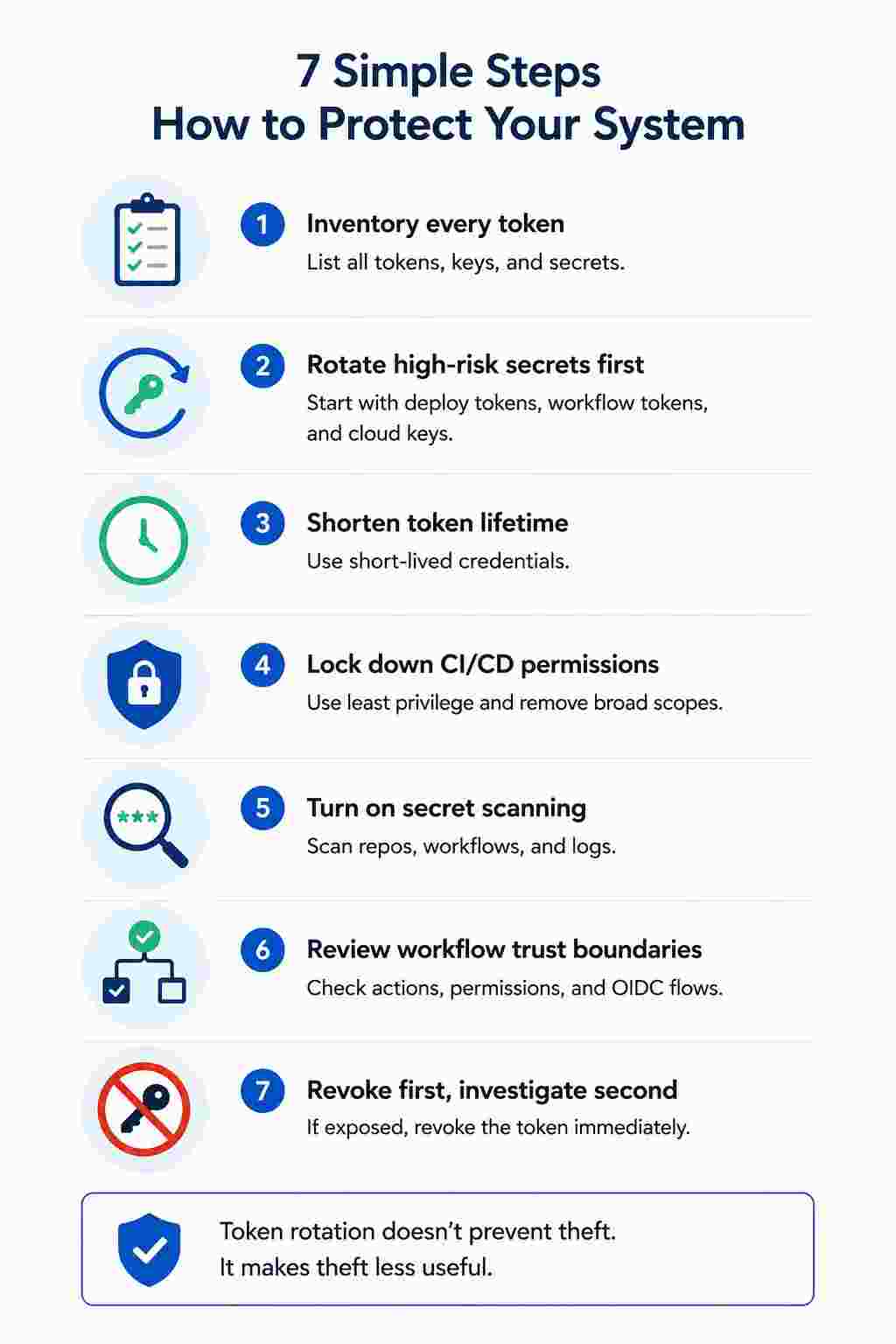
Step-by-step guide: How to protect your system
Step 1: Inventory every token
List every GitHub token, API key, cloud key, and CI/CD secret.
Why it matters: you cannot rotate what you do not know exists.
Tip: include repo secrets, runner secrets, and service-account tokens.
Step 2: Rotate the highest-risk secrets first
Start with deploy tokens, GitHub workflow tokens, and cloud access keys.
Why it matters: stolen automation secrets often have the broadest impact.
Tip: GitHub says rotate exposed credentials immediately.
Step 3: Shorten token lifetime
Use short-lived credentials where possible.
Why it matters: It limits attacker persistence.
Tip: OWASP recommends regular rotation, and NIST focuses on token life cycle control.
Step 4: Lock down CI/CD permissions
Use least privilege and remove broad scopes.
Why it matters: a leaked token should not unlock the whole house.
Tip: GitHub explicitly recommends narrow permissions and minimal access.
Step 5: Turn on secret scanning
Scan repos, workflow files, and logs.
Why it matters: exposed secrets need fast detection.
Tip: GitHub secret scanning can alert you and help trigger remediation.
Step 6: Review workflow trust boundaries
Check pull_request_target, cache usage, third-party actions, and OIDC flows.
Why it matters: TanStack’s compromise moved through workflow trust, not just code.
Tip: Audit any step that can mint a token.
Step 7: Revoke first, investigate second
If a token is exposed, revoke it immediately.
Why it matters: delays keep the attacker alive.
Tip: GitHub says revocation should happen right away after a leak.
This is the practical answer to how token rotation prevents breaches. It does not make theft impossible. It makes theft less useful.
Quick comparison table
|
Approach |
Strength |
Weakness |
Best use |
|
Manual rotation |
Easy to start |
Easy to forget |
Small teams only |
|
Automated rotation |
Fast and repeatable |
Needs setup |
CI/CD and cloud secrets |
|
Short-lived tokens |
Reduces blast radius |
May need redesign |
High-risk workloads |
|
Secret scanning |
Finds leaks early |
Not enough alone |
Repos and pipelines |
|
Least privilege |
Limits damage |
Hard to tune |
All production systems |
This is the core of Grafana DevOps security. Secure builds are not one control. They are a stack of small controls that work together.
Common mistakes
1. Rotating only some tokens
That is the exact mistake that turned this incident into a bigger story. One missed credential can keep access alive.
2. Leaving tokens too broad.
Broad scopes turn a small leak into a large compromise. GitHub warns to limit permissions to what is actually needed.
3. Relying on manual memory
People forget. Systems should not. OWASP says rotation and revocation should be built into the process.
4. Ignoring build pipeline trust
If your pipeline can mint or use secrets, it needs as much attention as production code. TanStack’s attack proved that.
Practical tips from the security side
Use separate tokens for build, deploy, and admin tasks.
Set expiration dates wherever the platform allows it.
Keep a token owner list so revocation is fast.
Redact secrets from logs before they land in storage.
Audit workflow files after every major dependency or action change.
That is the kind of DevOps token hygiene that keeps a CI/CD token rotation failure from turning into a reportable incident.
How businesses can reduce supply-chain attack risk
Run vendor risk checks on the packages and actions you trust.
Scan dependencies continuously, not once a quarter.
Monitor for sudden changes in workflow behavior.
Review third-party access to repos and build systems.
Make secure SDLC rules part of release work, not a side task.
That is the broader lesson behind the Grafana supply chain attack and the software supply chain attack trend. Trust has to be verified every time, not assumed once.
Expert analysis on the future of token security
We are moving into identity-first attacks. Attackers do not need to break encryption if they can steal the token that already has access. NIST’s draft guidance reflects that shift, and GitHub’s security docs keep pushing revocation, scanning, and least privilege for the same reason.
The next wave will likely include more AI-assisted credential hunting, more automated repo scraping, and more abuse of trusted workflows. Passwordless systems will help, but they will not remove the need for token governance. In other words, token lifecycle security is becoming mandatory, not optional.
Action checklist for security teams
|
Security Area |
Recommended Action |
|
Token Rotation |
Automate every 30 to 90 days |
|
CI/CD Security |
Scan secrets continuously |
|
API Access |
Apply least privilege |
|
Cloud Monitoring |
Detect unusual authentication |
|
Incident Response |
Revoke compromised credentials immediately |
Use this as your fast response checklist for the Grafana token rotation breach lesson. The fastest teams do not wait for perfect clarity before acting. They revoke, rotate, monitor, and then investigate.
FAQ
What caused the Grafana token rotation breach?
A missed GitHub workflow token after the TanStack supply-chain compromise kept access open inside Grafana’s GitHub environment. Grafana said it had rotated many tokens, but one was overlooked.
How was the TanStack attack connected?
TanStack said attackers used pull_request_target abuse, cache poisoning, and OIDC token theft from the runner process. Grafana said its incident originated from that campaign.
Why is token rotation important in cybersecurity?
Rotation shortens the life of stolen credentials, which limits attacker persistence and reduces damage. OWASP and GitHub both recommend regular rotation and immediate revocation after exposure.
Can unrotated tokens lead to cloud compromise?
Yes. GitHub says exposed secrets can allow unauthorized access, data theft, cloud spend abuse, and system disruption. NIST also treats token life cycle controls as a core security issue.
How often should organizations rotate tokens?
It depends on the risk and use case, but secrets management guidance recommends regular rotation and short lifetimes where possible. High-value tokens should be rotated much more aggressively.
What tools help automate token rotation?
Common choices include secret managers, CI/CD secret scanning, and platform controls such as GitHub secret scanning and push protection.
Are software supply chain attacks increasing?
Yes. Public incidents like TanStack, SolarWinds, Codecov, and 3CX show that trusted software and build paths remain attractive targets.
Final thoughts
The big lesson is not that Grafana failed once. It is that one missed secret can outlast the rest of the response. That is how small mistakes become real exposure. The Grafana token rotation breach should push every team to treat token cleanup as a top-tier security task, not a leftover chore.
Before publishing any internal fix, teams should verify changes against official guidance from Grafana Labs, GitHub, OWASP, NIST, and CISA. That is the safest way to keep the response grounded and current.
3-Point Security Checklist
Rotate every high-risk token today.
Scan GitHub and CI/CD for exposed secrets.
Revoke anything old, broad, or untracked.
That is the fastest way to reduce the blast radius before the next attacker gets a chance. Grafana token rotation breach is the warning. The checklist is the response.
Author: Radia, Cybersecurity researcher and threat analyst with deep experience in software supply chain attacks, npm malware campaigns, and open source security investigations. Specializes in breaking down complex cyber threats into practical insights for developers, students, and enterprise security teams.
-20260925120840.webp&w=3840&q=75)
-20260918120903.webp&w=3840&q=75)