Salesforce/Gainsight Security Alert: The Impact Grows
What started as a routine security warning from Salesforce suddenly morphed into a full-blown supply-chain wake-up call. Salesforce detected “unusual activity” in integrations tied to Gainsight apps. That triggered an investigation and the discovery that multiple customers might have been exposed to unauthorized access through those integrations.
Gainsight responded by expanding its “impacted customer” list, no longer just a handful but a larger group under review. Meanwhile, Salesforce revoked OAuth tokens and pulled the problematic apps from its marketplace, a precautionary step while they dig deeper.
The big lesson? Even if a core platform like Salesforce is secure, third-party add-ons or integrations can introduce serious risk. Company after company relies on SaaS integrations, but each one is potentially a weak link. This incident reminds everyone how important it is to monitor API usage, audit third-party access, and rotate credentials.
Read more
iOS 26 Zero-Day Rumor: Dark Web Buzz or Real Threat?
A post on a dark-web marketplace recently stirred up alarms: someone claiming to have a full-chain zero-day exploit against iOS 26. According to the claim, the exploit would leverage a memory-corruption bug in a message-parsing component to get root access, giving an attacker full control over an iPhone or iPad without any user interaction.
But here’s the kicker: there’s no public proof that this “iOS 26 full-chain exploit” actually works. No screenshots, no technical dump. Just a claim. The original “dark web listing,” as described by the source, remains unverified.
Still, the mere claim matters because zero-day rumors generate fear, force defensive behavior, and push users to update, change habits, or reconsider risky behaviors. If nothing else, the story reminds us how quickly public perception of security can shift, even on speculative grounds.
Microsoft Update Health Tools Vulnerability: When Maintenance Code Becomes a Risk
Something meant to keep Windows systems healthy, the Microsoft “Update Health Tools” was found to have a flaw. Instead of assisting updates, the misconfiguration allowed attackers to execute code remotely. That means a background maintenance tool became a potential security hazard.
This shows a broader point: even trusted, built-in components can become a vulnerability if set up incorrectly. It’s a reminder that security isn’t just about firewalls or antivirus but also correct configuration, constant vigilance, and regular audits.
My Thoughts and Real-World Angle
When I look at these stories together, a pattern emerges: the weakest link is often something you trust the most, a third-party app integrated with a big cloud service, a behind-the-scenes maintenance tool, or even a rumor in an underground market that scares people into changing behavior.
It’s a bit like building a fortress but leaving a tiny window open because you assume nobody would notice. Integrations, tokens, and background services they’re the “tiny window.” And sometimes attackers don’t even need to break the locks; they just need to walk through a door left slightly open.
For companies and individual users alike, that means don’t just trust the big names (Salesforce, Apple, Microsoft). Trust your own security hygiene. Audit regularly. Question every integration. Install updates, but also verify who, when, and how something connects to your data or device.
What You Should Do
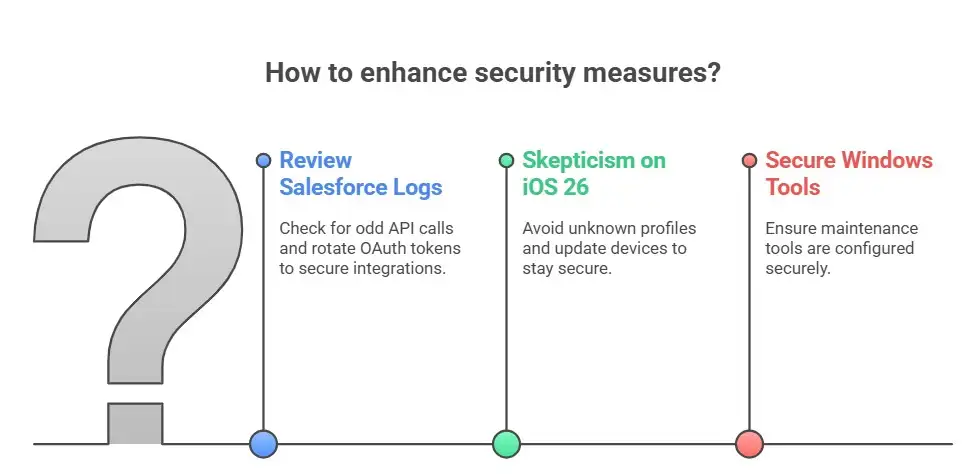
· If you use Salesforce + Gainsight (or similar third-party integrations), review your logs. Check for odd API calls, rotate OAuth tokens, and consider suspending unneeded access until things settle.
· If you own Apple devices, treat the iOS 26 zero-day talk with skepticism. Don’t panic, but stay alert. Avoid installing unknown profiles or unofficial apps, and update when Apple releases security patches.
· For Windows users (or admins), make sure maintenance tools and their configurations are secure. Don’t assume “built-in” means “safe.”
Frequently Asked Questions
Q: Was Salesforce itself hacked?
Not exactly. The issue seems to stem from third-party integrations (Gainsight) abusing OAuth tokens. Salesforce’s core platform isn’t confirmed to be breached.
Q: Did Gainsight confirm that data was stolen?
They haven’t publicly confirmed widespread data theft. They said only a “handful of customers” are known to have been affected.
Q: Is the iOS 26 exploit real? Should I be afraid?
Right now, it’s unverified. No proof has surfaced. Treat it as a rumor, worthy of attention but not panic.
Q: Could this kind of “trusted-tool-turned-threat” problem happen to me?
Absolutely yes. The Microsoft Update Health Tools case shows that even maintenance or update mechanisms can become dangerous if misconfigured. Always keep systems updated and audit internal tools.
Explore our main services:
· Deep and Dark Web Monitoring
· ISO Certification and AI Management System
· Web Application Security Testing


-20260925120840.webp&w=3840&q=75)