

iOS 26 zero-day exploit
Researchers, security experts, and regular iPhone users all quickly became interested in rumors that an iOS 26 zero-day exploit had appeared on the dark web. I have to be honest here because I need to check the facts. I couldn't find any official sources that confirmed the existence of an iOS 26 version or a real listing of a full chain exploit linked to it. What I can do is look at what this kind of claim usually means and why it makes people in underground communities so worried whenever something like this comes up.
Conversations about an iOS 26 full chain vulnerability bring up a long history of hackers going after Apple products because they hold important personal and business data. Even though there isn't solid proof, the situation is worth looking into because it is similar to past real mobile zero-day attack events.
This subject also lets us learn more about how exploit markets on the dark web work. Prices change, claims come and go, and researchers work quickly to figure out what's real and what's just an attempt to get people talking. These claims, whether completely true or not, give us a look at bigger trends in iOS security holes that have been reported over the years.

Why This Alleged Exploit Is Worrying
Just the phrase "iOS 26 zero-day exploit" is enough to make people nervous. A zero-day exploit is a bug that the maker of the device doesn't know about yet. When you add in the idea of a full chain attack, it shows that the device is completely compromised. Based on what we know about past Apple security holes, a full chain attack usually lets an attacker go from getting in to full control of the device.
The possibility of silent infection is what makes these situations stressful for users. In the past, some exploits only needed the user to open a web page or get a specially crafted message. I can't confirm the details of this supposed exploit, but the general worry is based on what we know about how threat actors try to get around Apple's layered security model.
The fact that mobile-targeted attacks are becoming more common also adds to the conversation. Researchers have already found that spyware groups have been behind big iPhone hacking campaigns. This article can't prove that iOS 26 is a real version, but the threat landscape is real.
What is a full chain exploit?
A full chain exploit usually connects several flaws. Each flaw is a way to get deeper into the system. It's like picking a bunch of locks one after the other until the attacker gets to the room they want.
In the past, full chain attacks on Apple products often started with flaws in the browser. From there, attackers could use privilege escalation techniques to get around sandbox restrictions. Once the permission barriers were broken, the device could be watched or controlled. Real-world research reports have shown this method, which helps explain why a claimed iOS 26 full chain vulnerability gets people talking, even if it hasn't been proven.

Cybercriminals like these kinds of chains because they can be used to attack iOS devices with spyware. Spyware markets do well when a chain is hard to find and works well. This is why exploits that are known to work well often sell for a lot of money in secret forums.
The Dark Web Listing and Verification Limits
I can't find any real listings for iOS 26 on dark web markets. There are a lot of fake posts on the dark web that try to trick people into buying things by making false promises. Still, knowing how listings usually look can help explain why this kind of news spreads so quickly.
Real listings often have technical proof for buyers who know what they're looking at. Fake posts often use buzzwords to get people to look at them. It is impossible to say that an exploit is real without reliable screenshots, code snippets, or trusted researchers checking the listing.
This uncertainty brings up the bigger problem. Even unverified rumors on the dark web can affect security talks because they remind people how easy it is for attackers to find new weaknesses in mobile security.
Why do cybercriminals target iPhones?
iPhones store personal photos, work documents, banking information, health information, and location history. A single weakness that gets around Apple's security can be a big threat to privacy. This is one reason why there is still a market for iPhone hacking tools.
Researchers have found that attackers have gone after political groups, journalists, business leaders, and tech workers in operations that were very valuable. It's not made up that an iPhone was hacked through a secret chain of flaws. Documented spyware tools from the past have shown that rumors can be much simpler than the truth.
Attackers know that Apple devices are all part of the same ecosystem, so a working exploit can be used on millions of phones before Apple releases a fix. This is why sellers on the dark web often try to make Apple device-related tools seem exclusive when they sell them.

Historical Background and Actual Events
Although the claim about iOS 26 cannot be confirmed, many past examples prove that iOS security vulnerabilities do exist and can be serious. Well-known research has shown that there are flaws in remote code execution, problems with escaping the sandbox, and weaknesses at the kernel level.
Full chain attacks used to be linked to operations at the state level. These events showed that even a strong mobile security platform can be weak when many small mistakes are made at the same time. Researchers are interested in any rumor about a new full chain because of that historical pattern, even if the exact version number is not clear.
Possible Damage If This Kind of Exploit Were Real
A real iOS 26 zero-day exploit with full chain capability would let someone take over a device completely. That means that messages were read, the microphone was turned on, the user's location was tracked, and files were collected without the user knowing anything was wrong.
In businesses, the threat could grow into bigger breaches because hacked phones can often get into internal communication tools. A targeted attack could use the phone as a way to get into more secure systems.
This potential elucidates the rationale behind the analysis of every purported full-chain exploit, whether validated or not. The risk of damage is just too high to ignore.
How Apple Responds
When credible researchers find a flaw, Apple usually fixes it right away. Apple releases an Apple security update with clear notes about the patch when zero-day flaws are confirmed. There is no official word on an iOS 26 version or a zero-day, so the current claim should be taken with a grain of salt.
Independent researchers are often the first to find flaws before attackers do. Even when rumors about the dark web spread without proof, their work helps make security stronger.
How to Keep Yourself Safe from Mobile Risks
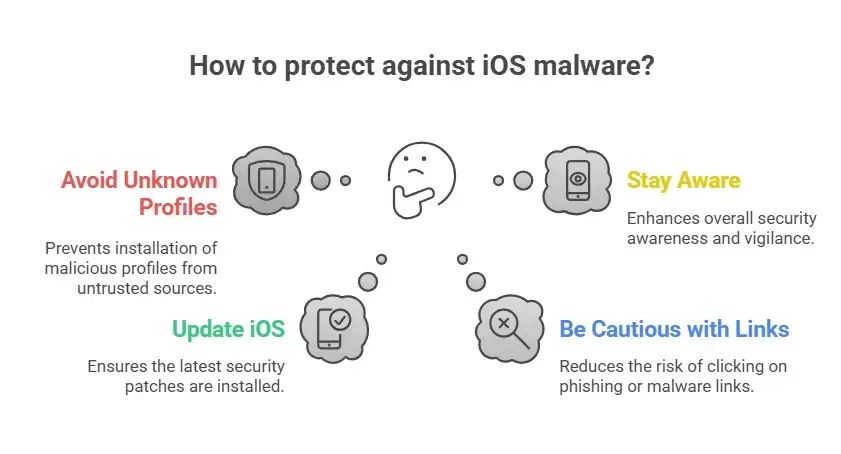
You can't stop a real zero day because no one knows what the flaw is. Still, having good habits makes you much less likely to get iOS malware.
Don't install profiles from sources you don't know.
Get the most recent official version of iOS.
Be careful with links that come from people you don't know.
Even when dealing with unverified claims, being aware of security is still one of the best ways to protect yourself.
Last Thoughts
There are a lot of talks about an iOS 26 zero-day exploit, but there is no technical proof that it exists or that it is the right version of iOS. Still, the conversation is useful because it shows how attackers and the teams that protect mobile ecosystems are always fighting. The main lesson is clear. Every year, new vulnerabilities are found. Reporting them responsibly and quickly updating software helps keep users safe. Even rumors that haven't been checked out yet can remind people how quickly the threat landscape can change.
Questions and Answers
1. Is there proof that an iOS 26 zero-day exploit exists?
No. There is no confirmed proof that an iOS 26 version or exploit exists based on what is known.
2. What does it mean to have a full chain vulnerability?
It is a series of bugs that work together to give you full control of a device.
3. Why do cybercriminals go after iPhones?
They have private and business information that is useful for spying or making money.
4. What does Apple do when there are real zero-day flaws?
Apple usually puts out security updates after a bug has been found and fixed.
You can also read these important cybersecurity news articles on our website.
· Apple Update,
For more, please visit our homepage and follow us on X (Twitter) and LinkedIn for more cybersecurity news and updates. Stay connected on YouTube, Facebook, and Instagram as well.




-20260925120840.webp&w=3840&q=75)