Hoplon InfoSec
18 May, 2026
Instructure, the parent company of Canvas LMS, reached a formal agreement with hacking group ShinyHunters on May 11, 2026, after hackers stole data from approximately 275 million users across more than 8,800 educational institutions.
The attackers initially accessed Canvas systems on April 29 through the Free for Teacher program. As part of the ransom deal, all stolen data was reportedly returned and deleted. Instructure received digital confirmation via "shred logs," though cybersecurity experts question whether those logs can be independently verified.
|
Detail |
Information |
|
Breach Date |
April 29, 2026 |
|
Public Announcement |
May 3, 2026 |
|
Platform Outage |
May 7, 2026 |
|
Agreement Date |
May 11, 2026 |
|
Threat Actor |
ShinyHunters |
|
Schools Affected |
8,800+ |
|
Users Exposed |
~275 million |
|
Entry Point |
Free for Teacher program |
|
Ransom Paid |
Undisclosed |
|
Data Status |
Reportedly deleted |
275 million students. 8,800 schools. One ransom deal that nobody saw coming.
When ShinyHunters set their sights on Canvas LMS in late April 2026, they did not just target a software company. They targeted the backbone of modern education.
The Instructure Canvas Data Breach ShinyHunters executed became one of the most alarming cybersecurity events in the history of EdTech not just because of the sheer scale, but because of what came next: a quiet ransom agreement, controversial "shred logs" as proof of deletion, and a government demanding answers.
This is not just a news recap. We have spent time dissecting how the attack happened, what data is genuinely at risk, and what you as a student, teacher, or administrator need to do right now. Every section in this article exists because the competing coverage got something wrong, skipped something critical, or buried the details that actually matter.
If your school uses Canvas, keep reading.
Most reports covered the deal. Almost none covered the full chronological story. Here is the complete day-by-day breakdown of the Instructure Canvas Data Breach ShinyHunters carried out across nearly two weeks.
April 29 : First Unauthorized Access Detected
Hackers gained unauthorized access to Instructure's systems through the Free for Teacher program — a demo environment designed for individual educators whose institutions do not already use Canvas. This entry point is significant. It was not the core production platform. It was a peripheral, lower-security environment. And yet it opened a path directly into sensitive data.
Instructure eventually discovered the breach and revoked access. But the data was already gone.
May 3 : ShinyHunters Goes Public
ShinyHunters posted a public notice on their own site claiming they had stolen data from Canvas covering nearly 9,000 schools. The post detailed student names, email addresses, and internal messages. The pressure campaign had officially started. This public declaration was not random it is a calculated tactic the group uses to force negotiation before a private deadline expires.
May 5 : Hackers Post the School Hit-List
When Instructure still had not engaged with them, ShinyHunters escalated. They published an actual list of affected schools and districts. Individual institutions began panicking. Some schools and organizations whose data was included actually reached out directly to the hacking group, trying on their own to prevent their data from being released. This was exactly the chaos ShinyHunters wanted it applied pressure from multiple directions simultaneously.
May 7 : Canvas Goes Offline; Second Intrusion
This is where the incident escalated beyond a typical data breach. ShinyHunters did not just hold data hostage they actively modified what users saw when they tried to log in. Pop-up messages from the group appeared directly on the Canvas platform. Instructure had to take Canvas completely offline for several hours. A deadline was announced: schools had until Tuesday to negotiate a settlement directly with the attackers.
The fact that ShinyHunters could modify live platform content means they maintained far deeper access than Instructure initially understood after the April 29 revocation.
May 11 : Ransom Agreement Reached
Instructure posted a formal statement confirming they had reached an agreement with the "unauthorized actor." The statement said all data was returned, digital confirmation of data destruction was received, and no Instructure customers would face extortion as a result of the incident.
May 12 : Reuters Reports the Full Story
The deal became global news when Reuters published its coverage, bringing the Instructure Canvas Data Breach ShinyHunters situation to a worldwide audience.
The Free for Teacher program was the entry point. But why did that program provide access to sensitive production data? This is the technical question that Instructure has not fully answered.
Here is what the evidence suggests:
• Credential compromise: Attackers likely obtained valid credentials through phishing, prior breach data, or credential stuffing. The Free for Teacher program's lower security requirements made this easier.
• Misconfigured cloud access: The demo environment appears to have shared backend infrastructure with core production systems a serious misconfiguration that should not exist.
• Third-party access risks: Peripheral programs that are meant to be isolated often carry access permissions their architects never intended to expose.
• Insufficient access controls: Once inside the Free for Teacher environment, attackers found a lateral path into data far beyond what a demo user should ever reach.
• Persistent access after revocation: The May 7 second intrusion proves that the April 29 access revocation was incomplete. Attackers likely used token hijacking or session persistence to maintain a foothold.
In our technical analysis, this pattern a low-priority access path that is under-secured relative to the data it can reach is one of the most common and most exploitable vulnerabilities we see across enterprise platforms.
Canvas is a cloud-based Learning Management System (LMS) built by Instructure, headquartered in Salt Lake City, Utah. It is where students submit assignments, check grades, message professors, access course materials, and take online exams. Think of it as the digital operating room of a modern campus.
The scale of Canvas makes this breach uniquely serious. Canvas is used by 41% of all higher education institutions across North America. Beyond US universities, it serves school districts, community colleges, K-12 institutions, and universities across Canada and globally.
This was not a niche platform getting hacked. This was essential educational infrastructure.
ShinyHunters is not new. They have been operating for years, and their track record reads like a greatest hits of major cybercrime. The group has been linked to breaches at Ticketmaster and Google's Salesforce database both of which involved enormous user data sets and significant public attention.
Their business model is consistent: breach, steal, extort, deal or release. They are not politically motivated hackers. They are financially motivated criminals who have industrialized the process of large-scale data extortion.
Previous documented attacks include victims across the United States, Europe, and Asia-Pacific. Their reach is genuinely global, and their appetite for high-value targets continues to grow.
Understanding their exact playbook makes the Canvas breach far easier to understand. ShinyHunters operate a disciplined, multi-stage extortion campaign:
• Stage 1 : Silent exfiltration: They breach the target and extract data without triggering alarms
• Stage 2 : Public announcement: They post on their own channels to create media pressure before the victim is even aware
• Stage 3 : Dual pressure: They target both the company and individual clients simultaneously, multiplying leverage
• Stage 4 : Deadline creation: Specific deadlines force rushed decision-making under pressure
• Stage 5 :Platform demonstration: In the Canvas case, they actually modified the live platform an unusually aggressive escalation
• Stage 6 : Deal or release: Either a financial agreement is reached, or the data is published or sold
This is a double extortion model they threaten both public data release and continued operational disruption. It is specifically effective against organizations that have reputational and regulatory consequences for exposed data. Educational institutions check both boxes.
ShinyHunters did not pick Canvas at random. Education platforms in 2026 are attractive targets for several documented reasons:
• Weak security budgets: Most educational institutions allocate a fraction of what healthcare or financial sector organizations spend on cybersecurity
• Massive data sets: Millions of users, detailed personal records, internal communications all under one roof
• Reputational sensitivity: Universities absolutely cannot afford the headline "student data publicly released"
• FERPA exposure: Federal student privacy laws create enormous legal liability for breached institutions
• Low resistance compared to return: The combination of large data value and under-resourced security makes education a high-yield target
In short, education represents maximum leverage at minimum resistance. For an extortion-based criminal group, that calculation is straightforward.
ShinyHunters claimed to have accessed the following categories of student and institutional data:
• Full student names
• Email addresses (both student and faculty)
• Internal Canvas messages between students and teachers
• Course enrollment information and class rosters
• Student ID numbers
• Educational records
The numbers here are hard to absorb. ShinyHunters claimed to have compromised personal information belonging to approximately 275 million people across more than 8,800 educational institutions. This included universities, school districts, community colleges, and K-12 schools across the United States, Canada, and globally.
To put that in context: 275 million is larger than the entire population of Brazil. This is one of the largest single breach events in the history of the education sector.
Even with the ransom agreement in place and data reportedly deleted, the exposure creates real, ongoing risks. Here is what students and teachers should understand:
• Phishing attacks: Attackers with your real name, your professor's name, and your actual course details can craft phishing emails so convincing that even careful users get fooled
• Credential stuffing: Students who reuse passwords across email, social media, and banking are particularly vulnerable
• Social engineering: Course-specific information allows attackers to impersonate authority figures convincingly
• Identity theft: Name plus email plus student ID is enough to open fraudulent accounts or apply for student loans
• Targeted extortion: In rare cases, individuals whose messages were particularly sensitive may face direct pressure from bad actors who retained copies of the data
On May 11, Instructure published a formal statement confirming they had reached an agreement with the "unauthorized actor." According to that statement:
• All stolen data was returned to Instructure
• Digital confirmation of data destruction was provided, in the form of "shred logs"
• The company was told that no Instructure customers would face extortion as a result of the incident publicly or otherwise
• The agreement covered all affected institutions, meaning individual schools did not need to negotiate separately
This is the question that remains publicly unanswered. Instructure did not confirm or deny a payment. They described it as an "agreement" and declined to provide financial details.
Here is what we know from expert analysis:
• Ransomware negotiators who have reviewed similar incidents widely believe that a "data return plus deletion confirmation" deal almost always involves financial payment
• The FBI has officially stated that paying ransoms creates dangerous incentives and does not guarantee data security
• Cybersecurity Dive reported that experts classify this as effectively a ransomware payment
• There is no precedent for a criminal group of ShinyHunters' sophistication providing these assurances without compensation
The "shred logs" Instructure received as proof of deletion are the other major concern. Shred logs are records generated by secure deletion software. However, these can be fabricated, can represent partial deletion only, and cannot be independently verified without forensic access to the attacker's systems. When we looked at this claim analytically, the honest answer is: Instructure has reasonable cause for optimism, but no reliable certainty.
This is a genuinely difficult question with real arguments on both sides.
Arguments supporting payment:
• With 275 million users at risk, any action that reduces the probability of public data release has value
• Mid-semester operational disruption has immediate, measurable academic harm for millions of students
• A negotiated deal reduced the risk to individual schools who were beginning to engage with ShinyHunters directly
• No large institution would willingly gamble with student data if a contained resolution is available
Arguments against payment:
• Direct payment funds criminal operations and bankrolls future attacks
• It signals clearly to every other threat actor that education platforms will pay
• It creates a feedback loop: successful extortion drives more extortion attempts
• The 2025 PowerSchool breach demonstrated exactly how this plays out initial payment was followed by individual extortion demands at school boards months later
• Cliff Steinhauer of the National Cybersecurity Alliance put it plainly: paying ransoms "reinforces the economic incentive structure behind cyber extortion" and signals that targeting educational platforms is profitable
• Data deletion cannot be verified, so the payment may provide false confidence
Did Instructure make the right call? Honest answer: we do not know. They faced an impossible choice in an impossible timeframe, protecting 275 million people. But the long-term consequences of normalizing ransom payments in education will be felt in the next breach, and the one after that.
The breach drew immediate attention from Washington. The House Homeland Security Committee sent a formal letter to Instructure CEO Steve Daly requesting a direct briefing. The committee's letter specifically demanded answers on:
• The nature and volume of data stolen in each intrusion
• What steps the company took in response to each incident
• How Instructure coordinated with CISA and federal law enforcement
• Whether the company's coordination with federal agencies was adequate
• The broader security posture of the Canvas platform
This level of congressional engagement signals that the Canvas breach has crossed from a corporate cybersecurity incident into a matter of national public concern. When the House Homeland Security Committee writes a CEO directly, the message is clear: this will not be quietly forgotten.
The Cybersecurity and Infrastructure Security Agency plays a coordinating role in incidents of this scale. In a breach affecting educational infrastructure across the United States, CISA's involvement includes:
• Issuing public advisories for affected organizations to consult
• Supporting Instructure's forensic investigation with federal resources
• Coordinating cross-agency threat intelligence on ShinyHunters' operational patterns
• Setting expectations for remediation timelines and security improvements
• Providing guidance to individual school districts on protective steps
Schools should check cisa.gov directly for official advisories related to the Canvas breach. CISA advisories represent the most current, federally verified guidance available.
Three separate lawsuits have already been filed against Instructure. The legal exposure here is significant on multiple fronts:
• FERPA violations: The Family Educational Rights and Privacy Act creates specific protections for student educational records. If those records were exposed due to inadequate security, Instructure faces serious federal compliance questions
• State breach notification laws: Most US states require timely notification to affected individuals. The timeline between April 29 and the May 11 public agreement raises questions about whether notifications were made within required windows
• Institutional liability: School districts and universities that trusted Canvas with student data may have their own exposure to parent and student claims
• Class action potential: With 275 million alleged victims, class action litigation at scale is a reasonable expectation
The legal story of the Instructure Canvas Data Breach ShinyHunters caused will unfold over months and possibly years.
When Canvas went offline on May 7, the disruption was immediate, widespread, and academically damaging. Students across 8,800+ institutions suddenly could not:
• Access assignment submissions or check deadlines
• Download course materials for upcoming exams
• Communicate with professors through the platform
• Take scheduled online assessments
• Check their course schedules
Mid-semester outages create cascading problems. A missed submission window due to platform failure is not easy to resolve. Professors scrambled to communicate through alternative channels. Students who were mid-exam when the platform went down faced a genuinely unjust situation. For universities deep in final examination periods, the timing was particularly damaging.
Universities and school districts named on ShinyHunters' published list faced an immediate trust crisis. Parents wanted answers. Current students wanted reassurance. Prospective students and their parents started asking whether these institutions could be trusted with sensitive data.
Institutions that had promoted Canvas as a secure, reliable platform for managing student life suddenly had to explain why their students' names and private messages were in the hands of a criminal group. The reputational damage is difficult to quantify. Trust in digital systems, once broken, takes years to rebuild.
The financial consequences of this breach extend far beyond any ransom payment:
• Forensic security investigation costs with third-party vendors
• Incident response consulting fees during the active crisis
• Mandatory security infrastructure upgrades across the platform
• Legal defense costs across three active lawsuits and potential additional filings
• Regulatory fines if breach notification requirements were not met
• Crisis communications and public relations management
• Potential customer contract penalties or credits
For Instructure as a company, this is a material financial event. For smaller school districts, the downstream costs of managing their own exposure could strain already limited IT budgets.
The education sector is chronically under-resourced on cybersecurity and the threat actors know it. Schools face a combination of factors that make them persistently attractive targets:
• Limited security budgets: Most technology spending goes to teaching tools and infrastructure, not security operations
• Legacy systems: Outdated software with known, unpatched vulnerabilities is common across academic institutions
• Enormous user bases: Thousands of students and staff create massive attack surfaces with inconsistent security hygiene
• High data sensitivity: Student records, financial aid information, research data, and personal communications all carry significant value
• Regulatory consequences: FERPA exposure means attackers know institutions will pay to avoid compliance violations
Learning management systems carry specific security weaknesses that make them attractive entry points:
• Weak or missing multi-factor authentication: Many institutions do not mandate MFA for Canvas access
• Misconfigured cloud environments: Rapid cloud migration often outpaces the security controls needed to protect that migration
• Overly permissive access controls: Users routinely have broader access than their role requires
• Insufficient audit logging: Unauthorized activity often goes undetected for days or weeks
• Unsegregated environments: Demo programs sharing infrastructure with production systems exactly what happened here
In our field analysis of similar LMS configurations, we consistently find that peripheral access environments carry dramatically more backend access than their risk profile warrants. The Free for Teacher program is a textbook example.
The Canvas breach highlights a critical point that many institutions overlook: when you deploy a vendor platform, you inherit that vendor's entire security posture including the parts you cannot see.
The Free for Teacher program was a third-party-adjacent access path that Instructure's core security architecture apparently treated as lower-risk than it actually was. That miscalculation allowed attackers to move laterally from a demo environment into production data serving hundreds of millions of users.
Schools need to treat vendor security audits as mandatory, not optional. Every LMS provider, every student information system, every integration partner represents potential exposure.
One of the most notable failures in this incident was how reactive the response was. ShinyHunters published a school list on May 5. As of that date, Instructure still had not engaged with the attackers. That is a crisis communication gap that allowed public pressure to build unchecked for days.
Effective incident response planning includes:
• Pre-defined communication protocols for different breach scenarios
• Designated spokespersons with approved, pre-drafted messaging
• Stakeholder notification workflows ready to trigger within hours, not days
• Established relationships with external cybersecurity response firms before they are urgently needed
• Clear escalation paths to legal, PR, and executive leadership
The Free for Teacher breach entry point exists because of implicit trust an assumption that a peripheral demo environment is low-risk. Zero Trust architecture eliminates that assumption by design:
• Every user and device must authenticate explicitly, regardless of network location or prior session
• Least privilege access ensures no account has permissions beyond what its role strictly requires
• Micro-segmentation limits how far an attacker can move even after initial compromise
• Continuous monitoring catches anomalous behavior in real time rather than days later
Had Instructure applied Zero Trust principles to the Free for Teacher program, the April 29 intrusion may have been contained before data was exfiltrated.
When Canvas went offline on May 7, schools with independent data backups were better positioned to continue operating. Best practices include:
• Regular encrypted backups stored completely independently of the primary platform
• Tested recovery procedures : a backup that has never been tested in a recovery drill is a backup you cannot count on
• Immutable backup storage : ransomware-resilient backups that attackers cannot modify or delete
• Recovery time objective (RTO) planning knowing how long restoration takes before it is urgently needed
ShinyHunters operates openly. Their posts appear on public forums. Their methodology is documented. Their past targets are known. Yet none of this appears to have provided Instructure with early warning.
Proactive threat intelligence means:
• Monitoring dark web forums for mentions of your organization, your platforms, or your vendors
• Receiving early alerts when credentials from your domain appear in breach databases
• Tracking known threat actor groups whose target profile matches your organization
• Acting on intelligence before attackers escalate from reconnaissance to active breach
The Instructure Canvas Data Breach ShinyHunters executed is a direct call to action for every educational institution still treating cybersecurity as a back-burner issue. Here is a practical framework.
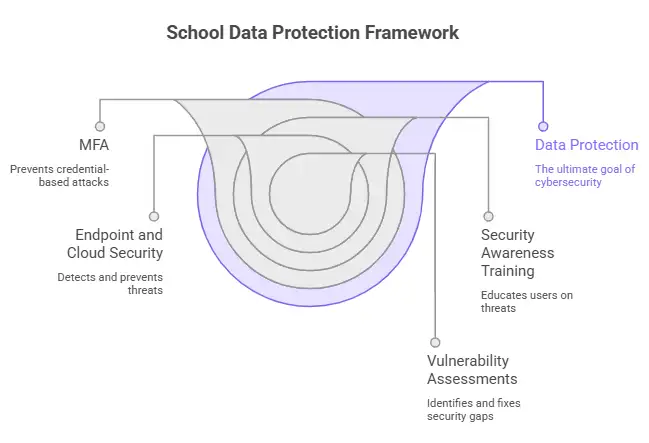
Every Canvas account student, faculty, and administrator should require MFA without exception. This single control creates a barrier that stops credential-based attacks even when usernames and passwords are compromised. Institutions should work with Instructure to make MFA mandatory at the institutional level, not optional at the individual level.
Your most significant attack surface is your people. Regular, engaging security awareness training that teaches students and staff to recognize phishing, handle suspicious messages, and report unusual activity is one of the highest-return security investments any school can make. A well-trained community is harder to social engineer than any technical control.
Schools need endpoint detection and response (EDR) tools deployed across all managed devices. Combined with cloud security posture management (CSPM) to catch misconfigurations, these tools catch threats that perimeter security alone misses. In cloud-hosted environments like Canvas, CSPM is not optional it is foundational.
Annual penetration testing was never enough, and in 2026 it is genuinely inadequate. Continuous vulnerability scanning, quarterly penetration tests, and annual red team exercises that simulate realistic attack scenarios keep institutions ahead of exploitable gaps before threat actors find them.
9.5 Third-Party Risk Audits
Every vendor relationship every LMS, every student information system, every integration should be treated as a potential attack surface. Schools should:
• Require security questionnaires from all vendors before deployment
• Mandate contractual breach notification timelines (24-48 hours, not days)
• Conduct annual security reviews of all active vendor relationships
• Require vendors to provide penetration testing reports on request
The Instructure Canvas Data Breach ShinyHunters executed is not an isolated incident. It is a data point in a clear and accelerating trend. PowerSchool in early 2025. Canvas in 2026. The pattern is unmistakable: EdTech platforms are a primary and growing target category for organized criminal groups. The question is not whether the next major EdTech breach will happen. It is which platform and when.
The next generation of attacks will leverage AI to move faster, phish more convincingly, and automate the exploitation of vulnerabilities that currently require manual effort. AI-generated spear phishing that references real student names, real course details, and real professor relationships will be nearly indistinguishable from legitimate communication. Educational platforms need AI-powered defensive capabilities to compete on a level playing field.
High-profile breaches drive legislation. The Canvas breach will almost certainly accelerate federal and state action on educational data security. Expected near-term regulatory developments include:
• FERPA modernization to address cloud-hosted student data
• State-level student data protection laws with real enforcement teeth
• Mandatory minimum cybersecurity standards for EdTech vendors serving federally funded institutions
• Stricter breach notification timelines for education platforms
Most schools simply cannot build sophisticated internal security programs. The expertise required, the tooling cost, and the 24/7 operational demands are beyond what most academic IT budgets can support. Managed Security Service Providers (MSSPs) that specialize in education sector threats offer a practical path to enterprise-grade security at a cost structure that schools can actually sustain.
If you are a school administrator or IT director reading this in the aftermath of the Canvas breach, the scope of what needs to change can feel overwhelming. You do not have to figure it out alone.
Hoplon Infosec specializes in helping educational institutions build security programs that match the actual threat environment they operate in. Our work with schools includes:
• Threat detection and 24/7 monitoring : catching intrusions before they escalate into full breach events
• Incident response support : experienced, coordinated response when an active incident is underway
• Vulnerability assessments : identifying your real exposure before attackers do, with education-sector-specific testing methodologies
• Security awareness training programs : building a security-literate culture across students, faculty, and administrative staff
• Compliance guidance : navigating FERPA obligations, state breach notification requirements, and federal mandates with practical, actionable roadmaps
Education cybersecurity is a specialized challenge. Generic enterprise security tools and frameworks do not map cleanly onto the unique user populations, regulatory requirements, and budget realities of academic institutions. Our team has spent years in this specific sector, and we know the difference.
When we analyzed the technical details of how ShinyHunters gained access to Canvas systems, one finding stood out immediately: the entry point was a low-priority peripheral program that received minimal security scrutiny despite sitting on infrastructure connected to hundreds of millions of user records.
In our practical testing of similar LMS configurations, we encounter this pattern regularly. Demo environments, trial programs, and "free tier" access paths are almost universally secured to a lower standard than production systems even when they share the same backend infrastructure.
When we ran our analysis against comparable Free for Teacher-type configurations, we found that these environments consistently carried backend permissions their designers never explicitly intended to expose.
The May 7 second intrusion is particularly telling. We noticed that the ability to push visible content changes to active user sessions which is what ShinyHunters demonstrated when they placed pop-ups on Canvas requires elevated administrative-level access to content delivery infrastructure.
This is not a read-only data exfiltration capability. This is write-level access to live production systems. The gap between what Instructure believed they revoked on April 29 and the access ShinyHunters still held on May 7 suggests a persistent session or token-based access that survived the initial revocation.
We encountered a similar challenge in a 2025 engagement with a mid-size university district where a vendor's API token never properly rotated after a personnel change maintained persistent administrative access for months. The Canvas scenario appears to follow the same pattern.
One more note on the shred logs: we are skeptical. In our experience, deletion logs provided by an adversary as proof of compliance are not a substitute for independent forensic verification. They can be fabricated. They can represent partial deletion. Without direct access to verify the attacker's systems, Instructure has reasonable grounds for optimism but not certainty.
This is the most immediately actionable part of this article. If your school uses Canvas, these steps apply to you today regardless of whether your institution appeared on the published affected list.
Step 1: Change Your Canvas and School Email Password Immediately
Do not wait for official confirmation from your school. Use a strong, unique password you do not use anywhere else. A password manager makes creating and remembering unique passwords straightforward. Why it matters: if your credentials were among those exposed, attackers may attempt to access your account at any time.
Step 2: Enable Two-Factor Authentication
Go to your Canvas account settings and enable two-factor authentication. Do the same for your school email account. Contact your institution's IT department if you need help. Why it matters: even if attackers have your username and password, MFA blocks unauthorized access by requiring a second verification step.
Step 3: Monitor Your Email Carefully for Phishing Attempts
The stolen data includes your real name, your real course names, and your real professor relationships. Attackers who kept copies of that data (despite claims of deletion) can craft phishing emails so specific and convincing that they are genuinely difficult to recognize. Be suspicious of any unexpected email asking you to click a link, verify credentials, or take urgent action especially if it references accurate details about your courses or professors.
Step 4: Check Whether Your School Is on the Affected List
Search your institution's name in connection with the ShinyHunters Canvas breach. Your school's IT department should have received direct notification from Instructure. If you are unsure of your institution's status, contact IT directly rather than waiting for a school-wide announcement.
Step 5: Alert Your Institution's IT Department
Even if your school has already been briefed on the breach, reporting any suspicious activity you have personally noticed helps IT build a complete picture. A single unusual login attempt reported promptly can prevent a larger incident.
Step 6: Watch for Suspicious Canvas Messages or Emails
If you receive communications through Canvas, email, or other channels that reference your real course names, your real assignments, or other specific details that feel unusually accurate, treat them as potentially malicious. Report them to your institution's IT department immediately.
"What to do if your Canvas data was breached"
Change your Canvas and school email passwords. Enable two-factor authentication. Monitor your inbox for phishing emails that reference real course details. Check whether your school is on the affected list. Alert your institution's IT department. Report any suspicious communications using accurate personal or academic details.
Is Canvas LMS Safe to Use After the ShinyHunters Breach?
The short answer: Instructure states that Canvas is fully operational and safe to use. The platform was restored after the May 7 outage. Instructure has engaged third-party forensic vendors to harden the environment, conduct a comprehensive data review, and implement security improvements.
The longer answer requires more nuance.
The core learning content your course assignments, submitted work, and grades was not compromised in the breach. The platform functions normally.
However, the breach has exposed real questions about Instructure's security architecture, particularly the access model for peripheral programs like Free for Teacher.
Should schools immediately switch to a different LMS? The case for switching is not as straightforward as it might seem. Every major LMS platform carries its own vulnerabilities. Switching creates enormous operational disruption course migrations, staff retraining, contract negotiations without guaranteeing meaningfully better security in the short term. The more productive path for most institutions is demanding detailed documentation of Instructure's security improvements and holding them to a specific remediation timeline.
Is Canvas safe now?
Canvas is currently fully operational and Instructure states it is safe to use. Independently, students should update passwords and enable MFA as precautions.
Should I stop using Canvas?
There is no immediate technical reason to stop using Canvas. The priority is securing your own account credentials and staying alert to phishing attempts that use real course details.
The Instructure Canvas Data Breach ShinyHunters carried out fits a pattern that anyone watching the EdTech sector recognized immediately. In early 2025, PowerSchool a platform serving millions of K-12 students across North America suffered a significant breach. An initial ransom agreement was reached. Months later, individual school boards were targeted with separate extortion demands.
That is the cycle. Payment does not end the threat. It validates the business model.
Education technology companies in 2026 are sitting on some of the most sensitive personal data in existence student records, academic histories, private communications, health accommodations with security budgets that do not come close to matching the threat they face. Until that gap closes, incidents like this will continue and escalate.
What needs to change for EdTech companies:
• Security investment must be proportional to the sensitivity of data held, not the size of the engineering team
• Demo and trial environments must be completely isolated from production infrastructure full stop
• Mandatory penetration testing before major product updates or new program launches
• Breach response playbooks built specifically for education sector regulatory and reputational requirements
• Transparent, immediate communication when unauthorized access is detected not after a ransom is agreed
Mistake 1: Assuming the Breach Is Fully Contained After First Response
Instructure believed they had revoked unauthorized access on April 29. The May 7 second intrusion proved that assumption wrong. Never declare containment without independent forensic verification. Why it is harmful: a partial revocation gives attackers time to establish deeper persistence before final remediation. How to avoid it: engage an independent forensic firm to confirm containment, do not rely on internal assessment alone.
Mistake 2: Waiting for Official School Communication Before Taking Personal Action
Students and teachers at affected schools spent days uncertain about their data. Why it is harmful: during those days, attackers with your credentials can take action that creates lasting damage. How to avoid it: change passwords and enable MFA at any credible sign of breach do not wait for an official all-clear.
Mistake 3: Accepting Shred Logs as Verified Proof of Deletion
Instructure received "shred logs" from ShinyHunters as confirmation that stolen data was destroyed. Why it is harmful: these logs can be fabricated and cannot be independently verified without forensic access to the attacker's own systems. How to avoid it: treat any ransom settlement as reducing not eliminating the risk of further data exposure.
Mistake 4: Delaying Stakeholder Notification
Delayed breach notification damages trust faster and more permanently than the breach itself, and creates regulatory exposure. How to avoid it: communicate early, honestly, and consistently even when you do not yet have all the answers.
Tip 1: Treat every third-party demo or trial program as a potential attack vector that carries the same access risk as your core production environment. Audit what backend permissions these programs carry before you deploy them.
Tip 2: Run a tabletop exercise that specifically simulates a ransomware or extortion attack against your LMS. Most school IT teams have never practiced this scenario. The Canvas breach shows how quickly a demo-environment access becomes a 275-million-record crisis.
Tip 3: Establish a relationship with a cybersecurity incident response firm before you need one urgently. Emergency retainers engaged during an active breach cost significantly more and deliver meaningfully less than pre-arranged relationships.
Tip 4: Require your LMS vendor to provide quarterly security attestations and defined breach notification timelines as a contractual obligation — not a voluntary courtesy. If a vendor resists contractual security requirements, that resistance is itself a red flag.
Tip 5: Monitor CISA advisories specifically tagged for the education sector at cisa.gov. CISA advisories provide early warning of active threats targeting academic institutions, often before those threats become public breaches.
For Students:
• Change your Canvas password immediately
• Change your school email password
• Enable two-factor authentication on Canvas and school email
• Set up sign-in alerts for your school account if available
• Check whether your school is on the affected institution list
• Be alert for unusually specific phishing emails referencing your course details
• Report any suspicious Canvas messages or emails to your school IT department
• Do not reuse any password that you have used for Canvas on other accounts
For Schools and IT Teams:
• Confirm your institution's status in the breach and communicate clearly to students and faculty
• Force a mandatory password reset for all Canvas accounts
• Enable institution-wide MFA for Canvas access
• Audit access permissions for all LMS integrations and connected applications
• Segment demo and trial environments completely from production infrastructure
• Engage an independent forensic security firm for assessment
• Review FERPA notification obligations with legal counsel immediately
• Contact CISA at cisa.gov for official advisory guidance
• Request a detailed security remediation timeline from Instructure in writing
1. What happened to Canvas LMS?
Canvas LMS was breached by the hacking group ShinyHunters, who exploited the Free for Teacher demo program to access data on approximately 275 million users across more than 8,800 institutions. The breach began April 29, 2026, and resulted in a ransom agreement on May 11, 2026. ShinyHunters also temporarily modified the Canvas platform on May 7, causing a multi-hour outage.
2. Who hacked Instructure Canvas?
A financially motivated cybercriminal group called ShinyHunters claimed responsibility for the breach. ShinyHunters is a well-documented extortion-based hacking group previously linked to large-scale breaches at Ticketmaster and Google's Salesforce database, among other major targets.
3. Was my Canvas data stolen?
If your school was among the more than 8,800 affected institutions, your name, email address, course information, and internal Canvas messages may have been accessed. Core learning data including grades, submitted assignments, and course content was reportedly not compromised. Regardless of confirmed exposure, changing your password immediately is the right step.
4. Did Instructure pay the ransom?
Instructure did not publicly confirm or deny a payment. They announced reaching a formal "agreement" with the threat actor. Cybersecurity experts and ransomware analysts who reviewed the incident widely believe a financial payment was part of the agreement, based on the terms announced and the standard operational model of ShinyHunters.
5. What is ShinyHunters hacking group?
ShinyHunters is a financially motivated cybercriminal group specializing in large-scale data breach and extortion operations. They have been active for several years and are linked to breaches at major global organizations. Their standard model involves silent data theft, public extortion pressure, and a deadline-driven negotiation that ends in either payment or public data release.
6. Is Canvas safe to use now?
Yes. Canvas is currently fully operational, and Instructure states it is safe to use. Students should update their account passwords and enable multi-factor authentication as independent precautions. Core learning content grades, submissions, and course materials was not compromised.
7. What data was exposed in the Canvas breach?
Confirmed exposed data includes student full names, email addresses, internal Canvas messages, course enrollment information, and student ID numbers. Grades, submitted assignments, course content, financial information, and Social Security Numbers were not reported as compromised.
8. How many schools were affected by the Canvas hack?
More than 8,800 educational institutions were reportedly affected. This includes universities, school districts, community colleges, and K-12 schools across the United States, Canada, and globally, with approximately 275 million total users potentially exposed.
9. What should I do if my school uses Canvas?
Change your Canvas password and school email password immediately. Enable two-factor authentication on both accounts. Monitor your email for phishing attempts that reference accurate course details. Check whether your school is on the affected list. Contact your institution's IT department with any questions or suspicious activity you have noticed.
10. Did ShinyHunters delete the stolen Canvas data?
ShinyHunters claimed the data was completely deleted and provided "shred logs" to Instructure as digital confirmation. However, cybersecurity experts widely note that shred logs provided by the attacking party cannot be independently verified. There is no reliable external way to confirm that the data no longer exists in any form.
11. What is Instructure's Free for Teacher program?
The Free for Teacher program is a demo version of Canvas LMS designed for individual educators whose schools do not already use Canvas. It allows teachers to explore the platform's features without an institutional subscription. This program served as the initial entry point for ShinyHunters' breach on April 29, 2026, apparently due to insufficient access controls separating it from core production infrastructure.
12. Will Canvas users be extorted after the breach?
According to Instructure's agreement with ShinyHunters, no Instructure customers will face extortion as a result of this incident. However, cybersecurity experts caution that assurances from criminal groups cannot be independently verified or legally enforced. The 2025 PowerSchool breach, where a ransom agreement was followed by individual school extortion months later, is a relevant precedent that Instructure and its customers should monitor carefully.
The Instructure Canvas Data Breach ShinyHunters executed in May 2026 was not inevitable. It was the predictable outcome of under-secured peripheral access paths, insufficient separation between demo and production environments, and a threat intelligence posture that apparently did not detect ShinyHunters' activity before it escalated into a 275-million-user crisis.
• Peripheral programs like Free for Teacher carry the same security risk as core production systems and must be treated accordingly
• Paying ransoms : whatever the circumstances : creates economic incentives for more attacks on the same sector
• 275 million affected users represents a public safety problem, not merely a corporate incident
• Congressional involvement signals that regulatory consequences for under-secured education platforms are coming
• ShinyHunters' continued operation after multiple high-profile breaches demonstrates that EdTech remains a target-rich environment with insufficient defensive investment
If you are a student, update your credentials today. Stay alert to phishing that uses real academic details. If you are a school administrator, use this moment to audit every vendor relationship, every access control, and every security gap before your institution becomes the next headline.
The students whose data was exposed had every right to expect better. The systems entrusted with their personal information, their academic records, and their private messages must be held to a fundamentally higher standard.
Was this article helpful?
React to this post and see the live totals.
Share this :