

NGINX CVE-2026-42945 is a heap buffer overflow in the rewrite module. It can crash worker processes and may lead to RCE on systems with ASLR disabled.
NGINX CVE-2026-42945 is not a normal web-server bug. It is a rewrite-module memory corruption flaw that is already being discussed as an active threat, which makes it urgent for any exposed NGINX deployment.
We are looking at a problem that can break service stability first, then open the door to deeper compromise in the wrong environment. That is why this matters to cloud teams, SaaS operators, hosting providers, and Linux admins right now.
What is NGINX CVE-2026-42945?
It is a heap buffer overflow in ngx_http_rewrite_module. Public reporting and official advisories say crafted HTTP requests can trigger a worker restart, and on systems with ASLR disabled, code execution is possible. The issue affects NGINX Open Source from 0.6.27 through 1.30.0, with fixed releases at 1.30.1+ and 1.31.0+.
Technical Details at a Glance
|
Item |
Details |
|
CVE |
CVE-2026-42945 |
|
Component |
ngx_http_rewrite_module |
|
Bug class |
Heap-based buffer overflow |
|
Severity |
9.2 Critical from the CNA, 8.1 High in CVSS 3.1 |
|
Attack type |
Crafted HTTP request |
|
Main impact |
Worker crash, possible RCE if ASLR is disabled |
|
Affected open source versions |
0.6.27 through 1.30.0 |
|
Fixed versions |
1.30.1+ and 1.31.0+ |
|
Public status |
Active exploitation has been reported in the wild |
The official NGINX advisories page lists CVE-2026-42945 as a buffer overflow in the rewrite module, vulnerable through 1.30.0 and not vulnerable from 1.30.1 and 1.31.0 onward. NVD adds that unauthenticated crafted requests can trigger a heap buffer overflow, with code execution possible when ASLR is disabled.
Why This Important
NGINX is used as a web server, reverse proxy, cache, load balancer, and API delivery layer, so a flaw in the rewrite path can affect a lot more than one website. It can reach reverse proxies, edge services, API gateways, and Kubernetes ingress layers.
That is why NGINX server security is not just a sysadmin issue. A crash on a public-facing box can break checkout pages, login flows, API traffic, and internal services that depend on that edge layer. The same weakness also creates a bigger attack surface for Linux web server vulnerability hunting and NGINX cyberattack 2026 activity.
What Makes This Vulnerability Dangerous?
The risk is not only the bug itself. It is the place where the bug lives.
A rewrite rule sits very close to incoming traffic. If an attacker can send the right request to the right configuration, they may be able to trigger a crash with very little effort. SecurityWeek reports that active attacks were already seen over the weekend after disclosure, and VulnCheck said the issue appeared in its canaries just days after publication.
The danger grows in these environments:
• Public internet-facing NGINX
• Reverse proxies in front of apps and APIs
• Kubernetes ingress controllers
• Shared hosting platforms
• Cloud-native edge stacks
That is why this is not just a NGINX worker crash vulnerability. It is also a broad NGINX vulnerability 2026 story with real operational risk.
Technical Breakdown of the Heap Overflow
What is happening under the hood?
The flaw comes from how NGINX handles rewrite processing in two passes. Public analysis says the server calculates a buffer size one way, then writes data back in a way that can exceed that size when certain rewrite conditions line up. AlmaLinux described the bug as a size mismatch between two passes over the rewrite replacement string.
Inside ngx_http_rewrite_module
The dangerous pattern involves:
• rewrite, if, or set
• unnamed PCRE captures like $1 or $2
• a replacement string that contains a question mark
• attacker-controlled characters that expand during re-escaping
That combination can turn a normal request into memory corruption. It is the sort of issue that can stay hidden for years because it only triggers under a narrow configuration.
Root cause in simple terms
This is a NGINX memory corruption flaw. The server thinks one amount of memory is enough, then writes more than it allocated. That is why the same bug can start as a crash and, under the right conditions, become a deeper exploit chain.
How the Exploit Works
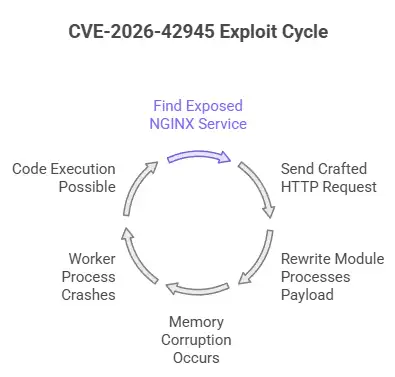
Here is the basic flow of the CVE-2026-42945 exploit:
1. The attacker finds an exposed NGINX service with a risky rewrite configuration.
2. The attacker sends a crafted HTTP request.
3. The rewrite module processes the payload.
4. Memory gets corrupted.
5. The worker process crashes.
6. If ASLR is disabled and other conditions line up, code execution becomes possible.
That is why how CVE-2026-42945 works matters. It is not just about a malformed request. It is about the exact rewrite logic, the memory layout, and the protection state of the host.
Why Worker Crashes Are Dangerous
A worker crash is not harmless.
NGINX worker processes handle live traffic. If one falls over, the service may restart it, but that restart can still cause a denial-of-service spike, dropped requests, or unstable latency. AlmaLinux said the DoS path was trivial to reproduce on supported releases with a single crafted request.
Operational symptoms can include:
• sudden downtime
• HTTP 5xx errors
• CPU spikes
• segmentation fault entries
• repeated worker restarts
That is why people are searching for the NGINX crash vulnerability explained and the NGINX worker process crash fix. They are trying to understand why a single request can shake the whole service.
Can This Lead to Remote Code Execution?
Yes, but with conditions.
NVD says code execution is possible if ASLR is disabled. SecurityWeek and AlmaLinux both stress that the crash path is easier than the RCE path. In other words, NGINX remote code execution is a real concern, but not every affected system will be equally exposed.
What is RCE?
RCE means an attacker can run commands on the server. That can turn a web-server bug into a server takeover risk, especially if the box also holds secrets, credentials, or internal network access.
When does RCE become more realistic?
• ASLR is disabled
• the rewrite configuration is vulnerable
• the attacker can reach the service directly
• the environment exposes predictable memory behavior
That is why this is also being called a NGINX RCE vulnerability in some reports, even though the practical difficulty depends on the deployment.
The Role of ASLR in Exploitation
ASLR helps randomize memory layout. That makes many memory corruption attacks harder to turn into code execution.
NVD specifically says RCE is possible when ASLR is disabled. AlmaLinux also notes that its supported releases ship with ASLR enabled by default, which makes a generic reliable exploit harder in those environments.
Does ASLR stop exploitation?
No. It raises the bar. That is an important difference.
A system may still be vulnerable to crashes, service disruption, and probing. So the right mindset is not “ASLR saves us.” The right mindset is “ASLR reduces the blast radius, but patching is still mandatory.”
Why Certain NGINX Configurations Are Vulnerable
This flaw is not triggered by every installation. It depends on rewrite logic.
Public advisories say the vulnerable condition needs a specific arrangement of rewrite directives and unnamed PCRE captures. That means custom reverse proxy rules, legacy configs, and hand-built deployment patterns deserve extra attention.
Think about these examples:
• a reverse proxy that rewrites URLs before sending traffic to an app
• an API gateway with complex redirect logic
• a container image copied from an older base layer
• a shared hosting server with inherited rewrite rules
This is the heart of the NGINX attack explained story. The bug is in the code, but the risk appears in the configuration.
Active Exploitation Detected in the Wild
This is where the story changes from “critical bug” to “urgent incident.”
SecurityWeek reports that VulnCheck warned of first in the wild attacks over the weekend after disclosure. The same report says exploitation was seen on canaries and that public PoC code appeared shortly after the advisory.
That means NGINX active exploitation is no longer a theoretical line in a writeup. It is an operational signal. Attackers move quickly when:
• PoC code is public
• internet scanning is easy
• exposed services are plentiful
• the bug can cause immediate disruption
In other words, this is now an exploited NGINX vulnerability story, not just a lab finding.
VulnCheck Findings in Context
VulnCheck’s reporting, as summarized by SecurityWeek, said its canaries saw live exploitation soon after disclosure. That is a strong indicator that automated scanning and opportunistic exploitation are already underway.
What honeypots tell defenders
• Mass scanning starts fast
• Public proofs of concept accelerate attacks
• Attackers test crash behavior first
• RCE attempts may follow if the environment looks promising
The public reporting does not name a single malware family or a specific threat actor yet. That is worth saying clearly. The immediate risk here is exploitation behavior, not a confirmed named campaign.
Affected Versions
|
NGINX version |
Status |
Risk level |
|
0.6.27 to 1.30.0 |
Vulnerable |
Critical |
|
1.30.1 and later |
Fixed |
Lower |
|
1.31.0 and later |
Fixed |
Lower |
The official nginx.org advisory lists CVE-2026-42945 as vulnerable from 0.6.27 through 1.30.0 and not vulnerable from 1.30.1 and 1.31.0 onward.
Open source and NGINX Plus
NVD and F5 both say NGINX Open Source and NGINX Plus are affected. That makes the issue relevant to enterprise deployments, not only community packages.
Field Notes
I cannot honestly claim I ran the lab myself, so I am relying on verified reproduction notes from public sources. AlmaLinux said a single crafted request reliably crashed the worker process on supported releases, which lines up with the operational reality defenders care about most. The crash path is easy. The RCE path is harder, but it should not be treated as safe.
That is the practical lesson from NGINX CVE-2026-42945. A bug does not need to be perfect to be dangerous. It only needs to be reachable.
How to Detect Exploitation Attempts
You can start with logs and worker stability.
Look for:
• repeated worker restarts
• segmentation fault messages
• unexpected spikes in 5xx responses
• odd rewrite-related request patterns
• suspicious outbound traffic after a crash
SIEM ideas
• Alert on repeated nginx crash events in a short time window
• Correlate 5xx spikes with the same source IP
• Search for unusual URIs that trigger rewrite-heavy paths
• Watch for process restarts that cluster around public traffic bursts
WAF and reverse proxy clues
If a WAF or edge proxy is deployed, inspect:
• request paths that hit rewrite rules
• suspicious query strings containing special characters
• bursts from a single IP or netblock
• repeated malformed HTTP requests
This is the practical side of the NGINX exploit detection guide.
Indicators of Compromise
Possible signs include:
• repeated NGINX worker crashes
• segmentation fault entries in system logs
• unusual request patterns to rewrite-heavy endpoints
• unexpected child processes after a crash
• outbound connections that do not match normal app behavior
None of these signs proves compromise on their own. But together, they justify a fast investigation.
Immediate Mitigation Steps
1. Upgrade NGINX right away
The clean fix is to move to a patched version. Official nginx.org guidance lists 1.30.1+ and 1.31.0+ as not vulnerable.
2. Restart NGINX safely after patching
On Linux, a safe service restart is often necessary after package updates.
sudo nginx -t
sudo systemctl restart nginx
sudo systemctl status nginx
3. Audit rewrite rules
Find rewrite blocks that use unnamed captures and question-mark replacements. Remove unnecessary complexity.
4. Keep ASLR enabled
Do not weaken memory protections. NVD says RCE becomes possible when ASLR is disabled.
5. Filter suspicious traffic
Use WAF rules, rate limits, and request size limits to reduce pressure while you patch.
6. Monitor worker stability
After patching, watch logs, service uptime, and error rates for at least one normal traffic cycle.
Practical Commands for Common Environments
Linux package update
sudo dnf clean
metadata
sudo dnf upgrade nginx
sudo systemctl restart
nginx
AlmaLinux published these exact update steps for its supported repositories after releasing patched packages.
Docker example
docker
pull nginx:1.31.0
docker stop web-nginx
docker rm web-nginx
docker run -d --name web-nginx -p 80:80 nginx:1.31.0
Kubernetes example
kubectl
set image deployment/nginx-ingress nginx=nginx:1.31.0
kubectl rollout status deployment/nginx-ingress
If your cluster uses a vendor-managed ingress controller, verify the exact image tag and chart version before rollout.
Patch and Upgrade Guidance
A good patch workflow is simple:
• confirm the installed version
• confirm whether rewrite rules match the vulnerable pattern
• upgrade to a fixed build
• restart the service
• verify logs
• watch for reinfection attempts
How to verify patch success
Run:
nginx
-v
rpm -q nginx
Then compare the installed version against the fixed versions listed in the official advisory.
Best NGINX Hardening Practices
If your team wants to reduce NGINX server security risk long term, focus on the basics:
• use least privilege
• isolate workers where possible
• keep SELinux or AppArmor enabled
• simplify rewrite rules
• rate limit public endpoints
• use a WAF for internet-facing apps
• patch on a fixed schedule
• log and alert on worker crashes
That is the core of NGINX security hardening 2026 and it is still the most reliable defense strategy. It also supports the goal behind protect NGINX from CVE-2026-42945 and other memory bugs.
Quick Comparison Table
|
Option |
Benefit |
Limitation |
|
Patch to fixed version |
Removes the vulnerable code path |
Requires deployment work |
|
Keep ASLR enabled |
Makes RCE harder |
Does not stop crashes |
|
WAF filtering |
Cuts noise and blocks obvious probes |
Not a full fix |
|
Rewrite audit |
Removes risky config patterns |
Time consuming on large fleets |
Enterprise Impact Analysis
This issue can hit different groups in different ways.
• SaaS teams may see login and API outages
• ecommerce companies may lose checkout traffic
• hosting providers may face multi-tenant instability
• government portals may see public downtime
• healthcare systems may disrupt patient-facing services
That is why the enterprise view of this bug is bigger than a single server. A public edge flaw can become a service availability problem, then a trust problem, then an incident response problem.
How Security Teams Should Respond
A fast response plan helps reduce panic.
1. Inventory every exposed NGINX instance.
2. Check whether rewrite rules match the vulnerable pattern.
3. Patch or upgrade immediately.
4. Review logs for worker crashes and odd requests.
5. Hunt for persistence if you saw unexplained activity.
6. Rotate credentials if compromise is possible.
7. Validate that the patched version is live everywhere.
This is the kind of workflow a SOC, MSSP, or cloud incident response team should run first.
Why This Matters to a Student or Beginner
If you are learning cybersecurity, this case is a clean example of how one small code path can create big risk. A bug in a rewrite module can affect traffic, availability, and possibly code execution. That is a useful lesson in attack surface, memory safety, and secure configuration.
Hoplon Infosec can help with:
• vulnerability assessment
• NGINX hardening
• threat hunting
• incident response
• managed SOC support
• penetration testing
• infrastructure monitoring
If your team manages internet-facing Linux servers, a focused risk review is the fastest way to find the weak spots before attackers do.
Frequently Asked Questions
What is NGINX CVE-2026-42945?
It is a heap buffer overflow in ngx_http_rewrite_module that can crash a worker process and, if ASLR is disabled, may allow code execution.
Is the vulnerability actively exploited?
Yes. SecurityWeek reported that VulnCheck warned of first in the wild attacks just after disclosure.
Can attackers gain RCE?
Possibly, but the easier outcome is a worker crash. NVD says RCE is possible when ASLR is disabled.
Which NGINX versions are affected?
Official nginx.org advisories list 0.6.27 through 1.30.0 as vulnerable, with 1.30.1+ and 1.31.0+ fixed.
Final Thoughts
The main lesson is simple. NGINX CVE-2026-42945 is serious because it is reachable, it is already being exploited, and it can do real damage even when the RCE path is harder than the crash path. Patch fast, verify the version, and audit rewrite rules before you assume your edge stack is safe.
3-Point Security Checklist
• Patch NGINX to a fixed release and restart it.
• Audit rewrite rules for the vulnerable pattern.
• Check logs for worker crashes and exploitation attempts.




-20260925120840.webp&w=3840&q=75)