

Is the integration of Claude Opus 4.5 and GitHub Copilot really changing how developers write and review code in 2025?
Yes, but not in the way that headlines that hype it up say.
According to reports from Cybersecurity News and developer platform updates, GitHub has started to add support for Anthropic's Claude Opus 4.5 GitHub Copilot as of December 2025. This change shows that we are really moving toward multi-model AI coding, where developers can choose how they want to reason instead of just accepting autocomplete.
This article explains what really changed, why it matters, and how Claude Opus 4.5 fits into the daily work of real developers today.
What is Claude Opus 4.5 GitHub Copilot, and why do developers care?
Anthropic's most advanced large language model for reasoning is Claude Opus 4.5. Unlike models that are made to be fast or creative, Opus is made to slow down, think through problems, and make its reasoning clear.
That difference is important in coding. Programmers are doing more than just writing functions. They are fixing bugs in old systems, rewriting code that isn't safe, and going over logic that other people wrote months or years ago. In those cases, raw speed usually does more harm than good.
With the Claude Opus 4.5 GitHub Copilot integration, developers can now use a model that puts correctness, structured reasoning, and safer outputs first right in their IDE.
This isn't about getting rid of GPT models. It's about giving people a different way of thinking.
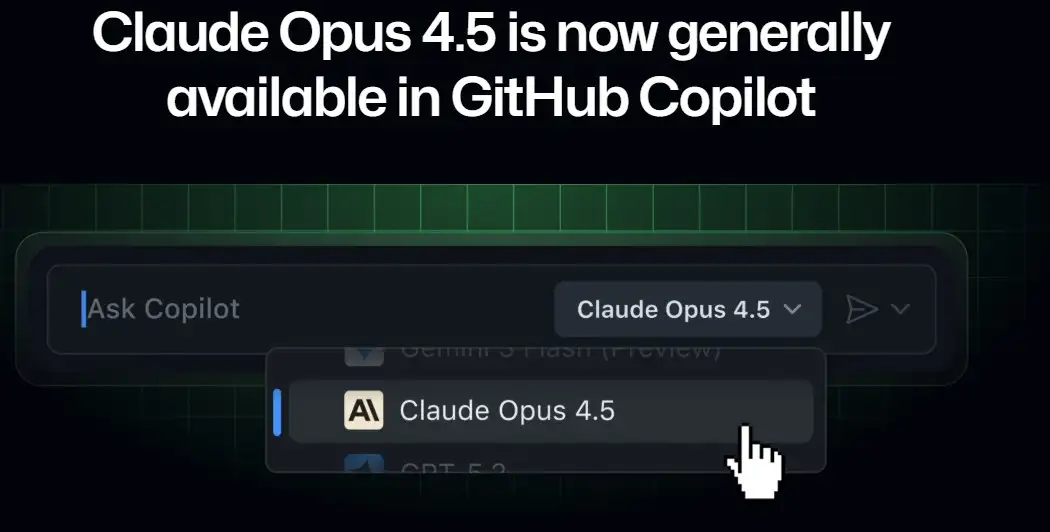
GitHub Copilot changed from an autocomplete tool to an AI pair programmer.
At first, GitHub Copilot seemed like a more intelligent version of autocomplete. Helpful, but not very much. Over time, Copilot became more like an AI pair programmer.
Putting Claude Opus 4.5 inside Copilot makes that change even stronger.
Instead of guessing the next line, Copilot can now explain why one method is safer, point out logical flaws, or suggest refactors based on reasoning instead of pattern matching. Developers who tried out the Claude model say it gives fewer wrong but confident answers, especially when it comes to complicated business logic.
This fits with GitHub's long-term goal for Copilot to be more than just a typing tool.
Claude and GPT in GitHub Copilot: What Makes Them Different? Notice to Developers
Better reasoning and fewer hallucinations
One of the most common complaints about AI coding tools is that they make things up. The model sounds sure of itself, but the code doesn't compile or, worse, it adds bugs that are hard to see.
Claude Opus 4.5 can still make mistakes, but it acts differently. When it doesn't know what to do, it usually explains its assumptions instead of making new APIs or functions. That alone makes production environments less risky.
In tests that developers shared on Reddit and X, Claude Opus often stops to explain the context, but GPT-based Copilot responses go straight to code. That break can save you hours of debugging later.
This difference shows up quickly in large codebases.
How well things work in big and old codebases
Most AI coding assistants have trouble with big repositories. Windows, for context, get full. Dependencies get mixed up. Models make guesses.
Claude Opus 4.5 works better with longer contexts. Developers who work in monorepos say they have a better understanding of how files are related and that their suggestions are less likely to be broken.
This makes the Claude Opus Copilot integration especially useful for business teams that work on older systems where speed isn't as important as accuracy.
That doesn't mean that GPT models are worse. They are usually quicker and more adaptable. But speed isn't always the most important thing.
How to Use GitHub Copilot with Claude Opus 4.5
A step-by-step guide to getting in and setting up
Not all Copilot users will see Claude right away. Availability depends on the type of plan and the phase of the rollout.
This is how developers are making it possible where it is:
• In the IDE, open the GitHub Copilot settings. • Go to the AI model preferences. • Choose Claude Opus 4.5 as the active Copilot model. • Restart the IDE session to make the changes take effect.
Before the Claude model can be seen by team members, enterprise administrators may need to give their approval. GitHub has been careful about rolling out, especially in places where rules are strict.
Just because you don't see the option yet doesn't mean it won't come. Rollouts are done in stages.

Things to think about when it comes to pricing and business access
As of this writing, access to Claude Opus 4.5 GitHub Copilot is included with Copilot Enterprise and some business plans. There isn't a separate price for Claude in Copilot yet.
This has made people wonder about vendor lock-in. Some teams are worried that they will have to use GitHub to get to Claude.
That worry is real. GitHub's move toward multi-model support, on the other hand, suggests that flexibility may get better over time instead of worse.
Claude Opus Copilot: Trust, Privacy, and Security
How Anthropic makes AI coding safer
Anthropic has made Claude a model that puts safety first. In practice, this is how the model deals with requests that are risky.
Claude Opus 4.5 is more likely to refuse code patterns that aren't safe, warn about unsafe practices, or suggest other ways to do things. This is especially important in businesses that deal with authentication, encryption, or user data.
Developers who work on systems that are sensitive to security say that Claude raises red flags more often than other models.
That doesn't replace a human review, but it does help.
Managing data in a business and dealing with uncertainty
Data handling is one area where things are still getting clearer. According to GitHub, Copilot enterprise conversations are not used to teach models. Anthropic has made similar promises.
But the exact details of how to implement each plan depend on the plan and the area. Teams that need to follow strict rules should carefully read the GitHub and Anthropic documentation.
It's better to assume that there are limits if you can't check a detail on your own.
What developers say are the best and worst things about Claude Opus 4.5
• Better reasoning through complicated logic
• Clear explanations with code
• Fewer hallucinations in big projects
• A more careful approach to unsafe requests
Claude Opus 4.5 Copilot is a great choice for backend systems, financial apps, and enterprise tools because of these strengths.
Things to keep in mind
Claude Opus is not the quickest model. People who work on rapid prototyping may find it slower than options based on GPT.
It also tends to ask questions that need more information, which some users find annoying when they're in a flow state.
This is a trade-off, not a mistake.

A real-world example is refactoring an old payment module.
During internal testing, a mid-sized fintech team shared an example.
They told GitHub Copilot to use GPT to rewrite a payment validation module that was ten years old. The result was compiled, but it caused edge-case bugs.
They did the same thing again with Claude Opus 4.5 GitHub Copilot. Claude pointed out assumptions that weren't clear, talked about possible risks, and suggested a slower but safer way to refactor.
The team decided to go with Claude's plan. It took longer, but it kept a production problem from happening.
That story shows a bigger trend. Claude seems like a careful senior engineer, not a junior trying to impress.
Questions and Answers About Claude Opus 4.5 GitHub Copilot
What does Claude Opus 4.5 do?
Anthropic's advanced AI model, Claude Opus 4.5, is focused on deep reasoning, clarity, and safer answers for difficult tasks like coding.
Is it possible to use Claude in GitHub Copilot?
Yes, GitHub Copilot now works with Claude Opus 4.5 for plans that qualify. The rollout will happen slowly.
Is Claude a better programming language than GPT?
It depends. Claude is usually better at tasks that require a lot of reasoning and a lot of code, while GPT may be faster for quick tasks.
Is it safe for business code to use Claude Opus?
Claude stresses safety and caution, but businesses should still read GitHub Copilot's data handling policies before using it.
Should You Change to Claude Opus in Copilot?
Claude Opus 4.5 GitHub Copilot does not mean getting rid of existing models. There is a choice. A well-thought-out one.
Claude might be a better partner if your job involves complicated systems, sensitive logic, or long-term maintenance. You might want to stick with GPT models if speed is your main concern.
The real win is having options.
GitHub With the introduction of Copilot's multi-model era, developers can now control how their AI thinks, not just how quickly it types. That change could change the way AI is coded in 2025 without anyone noticing.
Next, if you can find Claude Opus 4.5 in your Copilot settings, use it to solve a real problem instead of a demo. That's where the difference becomes clear.
You can also read these important cybersecurity news articles on our website.
· Apple Update,
· Windows Fix,




-20260925120840.webp&w=3840&q=75)