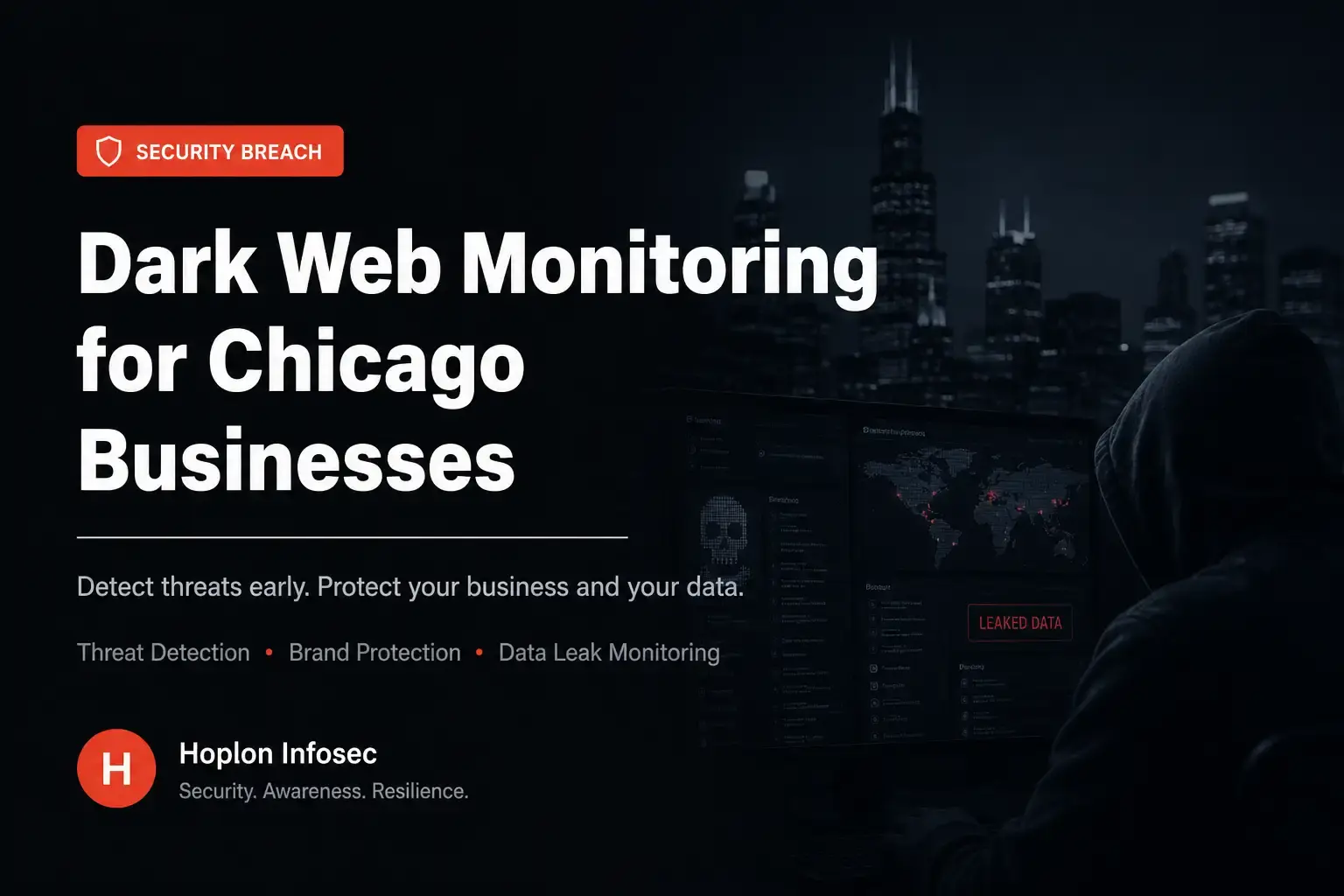
Chicago companies are being hit where it hurts most. Stolen logins, exposed emails, and leaked access data often show up long before a breach becomes public. That is why dark web monitoring for Chicago businesses is no longer a nice extra. It is a practical layer of defense.
What is Dark Web Monitoring for Businesses?
Dark web monitoring for Chicago businesses is the process of watching criminal forums, leak sites, and stolen data marketplaces for company credentials, customer records, and other exposed business information. It helps teams spot risk early, before attackers turn stolen data into fraud, account takeover, or ransomware. NIST guidance on incident handling and FTC business security advice both support fast detection, strong passwords, authentication, and rapid response after exposure.
-20260518144559.webp)
What Does Dark Web Monitoring Actually Do?
It searches for signs that a company’s data has been exposed online. That includes usernames, passwords, employee emails, remote access logins, and sometimes vendor or executive accounts. For a local company, this means the team can react before criminals use the stolen data. In practice, dark web monitoring for Chicago businesses gives security teams a warning system, not a cure. The real value comes from fast follow-up.
Data Insight: What a Monitoring Program Usually Tracks
|
Technical Area |
What It Watches For |
Why It Matters |
|
Credential exposure |
Employee usernames, passwords, reused logins |
Stops account takeover early |
|
Email exposure |
Business mailbox leaks and spoofing risk |
Reduces phishing and BEC risk |
|
Domain exposure |
Company domain mentions in leak dumps |
Flags broader compromise |
|
Executive monitoring |
CEO, CFO, admin, and finance accounts |
High-risk target protection |
|
Breach intelligence |
Leak posts, paste sites, criminal chatter |
Gives early warning |
Why Chicago Businesses Are Major Cybercrime Targets
Chicago has a dense mix of finance, healthcare, manufacturing, logistics, legal services, and retail. That mix creates more entry points for attackers. It also creates more vendors, more remote users, and more login fatigue. Those are exactly the conditions criminals like.
Chicago’s Growing Digital Economy
Local firms rely on cloud platforms, SaaS tools, remote support, and third-party access. That means one leaked password can turn into a chain reaction. A business may look secure on the surface while credentials are already circulating elsewhere.
Most Common Attacks Against Chicago Companies
The biggest threats are still familiar. They are just more organized now.
Phishing
Ransomware
Business email compromise
Credential stuffing
Insider misuse
The FBI says business email compromise is a major cybercrime pattern, and it advises quick reporting through IC3 when these scams hit.
Real Business Risks of Exposed Credentials
When login data leaks, the damage usually follows this path:
Financial fraud
Reputation damage
Compliance pressure
Customer trust loss
Operational shutdowns
If your finance mailbox is exposed, a criminal does not need a fancy exploit. They may only need one working password and a believable email chain. That is why dark web monitoring Chicago searches are often tied to account protection, not just brand protection.
Signs Your Business Data May Already Be on the Dark Web
You do not always get a loud warning. Sometimes the signs are small.
Employee Password Reuse
If staff reuse passwords across tools, one leak can spread fast. FTC guidance says strong, unique passwords and proper authentication are basic defenses.
Sudden Login Attempts
Repeated login attempts from odd locations often mean someone found valid credentials and is testing them.
Unknown MFA Notifications
If employees get unexpected approval prompts, that can mean a password is already in the wrong hands.
Data Breach Alerts
Security tools, vendors, or even customers may report exposure before internal teams notice it.
Suspicious Vendor Activity
If a vendor account looks active at strange hours, do not ignore it. Third-party access is a common blind spot.
Types of Data Criminals Sell on the Dark Web
Attackers value data that can be reused quickly.
Business Email Credentials
These are the most useful because they unlock conversations, invoices, resets, and trust.
Customer Databases
Customer records can be sold, abused, or used for phishing.
Financial Information
Payment data and bank details are high-value targets.
Medical Records
Healthcare data is sensitive, expensive to recover, and heavily regulated.
Intellectual Property
Source files, proposals, pricing sheets, and internal documents all have market value.
Remote Access Credentials
VPN, cloud, and admin logins are especially dangerous.
Cloud Platform Logins
If cloud credentials leak, the attacker may not need malware at all.
This is where credential leak monitoring in Chicago, email breach monitoring in Chicago, and cloud credential monitoring in Chicago become practical service lines, not marketing language.
Benefits of Dark Web Monitoring for Chicago Businesses
Early Threat Detection
The biggest win is timing. You find exposure earlier than the attacker expects.
Faster Incident Response
NIST emphasizes organized incident response because speed matters once compromise starts.
Reduced Ransomware Risk
Stolen credentials are a common doorway into ransomware events. Detecting them early helps reduce that risk. NIST incident handling guidance also notes that attackers often use credentials to reach broader systems.
Better Compliance Management
Monitoring helps support security controls, audits, and breach response discipline. NIST CSF 2.0 and FTC business guidance both push organizations toward basic risk management, access control, and response planning.
Stronger Brand Reputation
Clients trust companies that notice problems quickly and handle them well.
Improved Cyber Insurance Readiness
Insurers like to see monitoring, access control, and MFA in place.
If you are offering Chicago cybersecurity monitoring services, this is often one of the cleanest lead-in offers because it connects directly to business risk.
How Dark Web Monitoring Helps Stop Ransomware Attacks
Detecting Leaked Credentials Before Attackers Use Them
This is the core job. If a password is already on a leak site, you reset it before a criminal logs in to it.
Identifying Initial Access Broker Activity
Initial access brokers sell entry points to other criminals. A warning about exposed credentials can stop the next step in that chain.
Monitoring Criminal Forums for Threat Mentions
Sometimes a company name appears in chatter before a public incident surfaces.
Preventing Lateral Movement
If one account is exposed, attackers may try to move through shared drives, admin consoles, or cloud tools. NIST warns that credential theft can be used to reach deeper systems.
This is why ransomware monitoring Chicago and Chicago ransomware protection services often overlap with dark web work.
Step-by-Step Guide: What to Do After an Exposure Alert
1. Verify the leak
Check whether the data is current, stale, or already blocked. Not every alert means active compromise.
2. Reset compromised credentials
Change the affected password immediately. If multiple accounts reuse it, reset those too.
3. Enable MFA
The FTC says two-factor authentication is one of the best ways to protect accounts.
4. Review access logs
Look for unusual sign-ins, new device activity, or impossible travel patterns.
5. Notify stakeholders
Tell the right people fast. That may include IT, legal, leadership, and affected partners.
6. Run a security audit
Look for the root cause. Was it phishing, reuse, vendor access, or poor password hygiene?
7. Document everything
Keep notes. They help with reporting, insurance, and remediation.
That process works well for managed security monitoring Chicago teams and for smaller firms that need a simple playbook.
How Dark Web Monitoring Works
Understanding the Dark Web
The surface web is what search engines show. The deep web includes private tools and logins. The dark web is where criminals may trade stolen data and discuss access for sale. You do not need deep technical detail to understand the risk. You only need to know that exposed data can move fast once it lands there.
What Dark Web Monitoring Actually Does
A good program usually includes:
Credential monitoring
Email exposure tracking
Domain monitoring
Executive monitoring
Breach intelligence collection
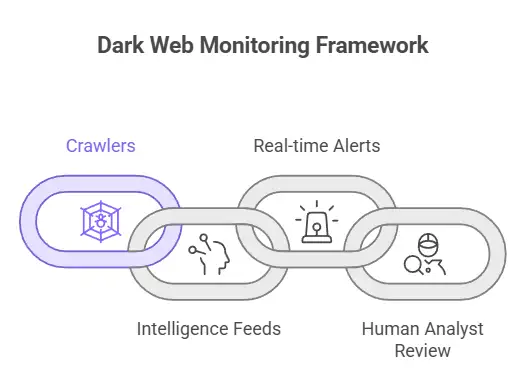
How Dark Web Monitoring Works
Most services use a mix of the following:
Crawlers
Intelligence feeds
Real-time alerts
Human analyst review
That combination matters. Automated systems are fast. Human review reduces noise. For dark web intelligence services Chicago and dark web alert services Chicago, that balance is what makes alerts usable.
Quick Comparison Table
|
Method |
Best For |
Weak Point |
|
Antivirus |
Malware blocking |
Misses exposed logins |
|
Firewall |
Traffic filtering |
Does not see leak sites |
|
SIEM |
Internal log analysis |
May miss outside exposure |
|
Dark Web Monitoring |
Credential and data exposure |
Needs constant follow-up |
This is why dark web monitoring vs. traditional cybersecurity tools is not an either/or debate. They solve different problems.
Industries in Chicago That Need Dark Web Monitoring Most
Healthcare Organizations
Healthcare data is sensitive and heavily targeted.
Financial Institutions
Money moves fast, so attackers focus hard on finance teams.
Law Firms
Legal teams hold valuable documents and trusted email channels. Chicago law firm dark web monitoring is especially useful here.
Manufacturing Companies
Manufacturing often has legacy systems, remote vendors, and production pressure. That creates openings.
E-commerce Businesses
Online stores deal with payments, customer logins, and third-party plugins.
Educational Institutions
Schools and universities often have large user bases and mixed device security.
Logistics and Transportation
Operational accounts, partner portals, and scheduling systems are attractive to attackers.
If you offer cyber monitoring manufacturing in Chicago or cyber monitoring financial services in Chicago, this section becomes a strong local SEO bridge.
How Small Businesses in Chicago Can Benefit
Affordable Security Layer
Small teams cannot monitor everything manually. A service layer helps close the gap.
Reduced Recovery Costs
A fast alert is cheaper than a full breach response.
Protection Against Account Takeovers
This is often the first real payoff.
Better Customer Trust
Clients notice when a business takes exposure seriously.
This is where small business cyber monitoring in Chicago and Chicago SMB cybersecurity services matter most. A small company usually does not need complexity. It needs visibility and fast action. That is why affordable dark web monitoring in Chicago can be a very strong entry offer.
Common Mistakes Businesses Make With Dark Web Monitoring
Treating Monitoring as a One-Time Scan
A single check is not monitoring. Criminal markets change every day.
Ignoring Alert Notifications
A warning without action is just noise.
Failing to Rotate Passwords
If exposed credentials stay active, the risk stays active.
Not Enabling MFA
Without MFA, a stolen password is still useful to attackers. FTC guidance supports MFA for account protection.
Choosing Cheap Unverified Providers
A weak provider can create false confidence. That is worse than no monitoring at all.
Avoiding these mistakes is part of cyber risk monitoring done well.
Field Notes
When we review a monitoring setup, the weak point is rarely the alert itself. It is usually the response plan. A team may spot a leaked password, then wait two days to reset it. That delay creates the real damage.
In practice, the best teams keep three things ready:
A password reset process
An MFA rollout path
A contact list for IT, legal, and leadership
That simple setup often beats a fancy tool with no follow-through.
How to Choose the Best Dark Web Monitoring Provider in Chicago
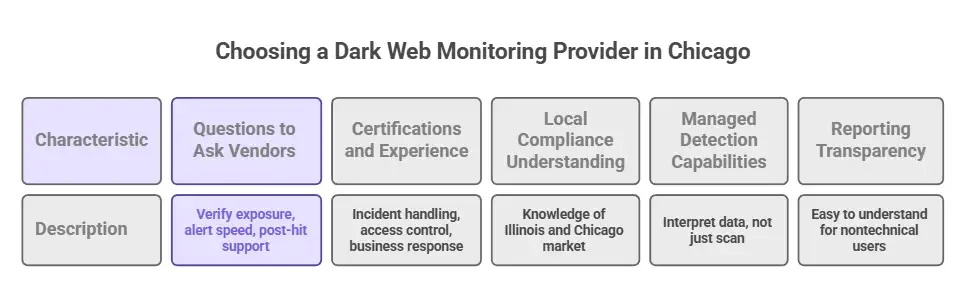
Questions to Ask Vendors
Ask how they verify exposure, how fast alerts arrive, and what support they provide after a hit.
Certifications and Experience
Look for teams that understand incident handling, access control, and business response. NIST and FTC guidance make that baseline clear.
Local Compliance Understanding
A provider should know the realities of Illinois and the Chicago market.
Managed Detection Capabilities
Good providers do more than scan. They interpret.
Reporting Transparency
If the report is hard to understand, the program will not help nontechnical decision makers.
This is where "darkwell in Chicago.dark web security company Chicago," "Chicago"dark cybersecurity consultant," and "business security monitoring near Chicago" become useful search terms for buyers.
Future of Dark Web Monitoring and Threat Intelligence
AI-Powered Threat Detection
AI will keep improving triage, but it will not replace judgment.
Predictive Risk Analysis
Future systems will likely score exposure patterns better and earlier.
Automated Incident Response
Expect faster playbook actions, like forced resets and alert routing.
Integration with SOC Platforms
The strongest programs will connect dark web findings with SIEM, endpoint tools, and ticketing.
That future matters for Chicago managed SOC services and Chicago MDR services because the best defense will blend visibility with response.
Why Businesses Should Combine Dark Web Monitoring With Other Security Layers
Endpoint Security
Protect laptops and servers from malware and unauthorized access.
Zero Trust Architecture
Assume no login is safe by default.
Security Awareness Training
People still click, reuse, and reply to fake messages. Training reduces that risk.
Vulnerability Management
Patch weak systems before they become entry points.
Managed SOC Services
A SOC helps turn alerts into actions.
For corporate cyber monitoring in Chicago, this layered model is the most realistic path.
Frequently Asked Questions
What is dark web monitoring for businesses?
It is a service that checks criminal marketplaces and leak sites for exposed company data, such as passwords, emails, or access logs. It helps businesses respond before attackers use the data. This is the core idea behind dark web monitoring for Chicago businesses.
Is dark web monitoring worth it for small businesses?
Yes, especially for small teams with limited security staff. FTC guidance for small businesses stresses practical controls like strong passwords, access control, and MFA. Monitoring fits that model well.
How much does dark web monitoring cost in Chicago?
Pricing depends on the provider, number of domains, number of users, and amount of analyst support included. Verify current pricing directly with the provider before publishing or buying.
Can dark web monitoring stop ransomware?
It cannot stop every attack, but it can catch exposed credentials and other warning signs early. That gives teams a better chance to block the path attackers often use. NIST incident handling guidance supports fast detection and response.
What data can be found on the dark web?
Common items include usernames, passwords, email accounts, payment data, and sometimes internal documents or remote access information.
How quickly should businesses respond to leaked credentials?
Immediately. The longer exposed credentials stay active, the more likely they are to be abused. FTC and NIST both support quick remediation and stronger authentication practices.
Is dark web monitoring part of cybersecurity?
Yes. It is one part of a broader program that also includes endpoint security, MFA, patching, employee training, and incident response. NIST and FTC both frame security as layered risk management.
Conclusion
Dark web monitoring for Chicago businesses is not about chasing criminals online. It is about finding exposure early, reducing risk, and responding before a leaked credential becomes a breach. If you run a local company, this is one of the most practical security layers you can add in 2026. Start with a review of exposed accounts, then build a plan around MFA, password resets, and continuous monitoring.
Dark web monitoring for Chicago businesses works best when it is part of a larger security stack, not a stand-alone checkbox.
Author Bio
Name: Radia
The author is a senior cybersecurity analyst with 15+ years of experience in dark web intelligence, ransomware research, threat monitoring, and incident response. At Hoplon Infosec, the team helps businesses strengthen cyber defense through dark web monitoring, managed SOC services, vulnerability assessments, and threat intelligence solutions for organizations across Chicago and Illinois.