If you manage a business, website, company network, or customer data, the cybersecurity news this week gives you several things to check.
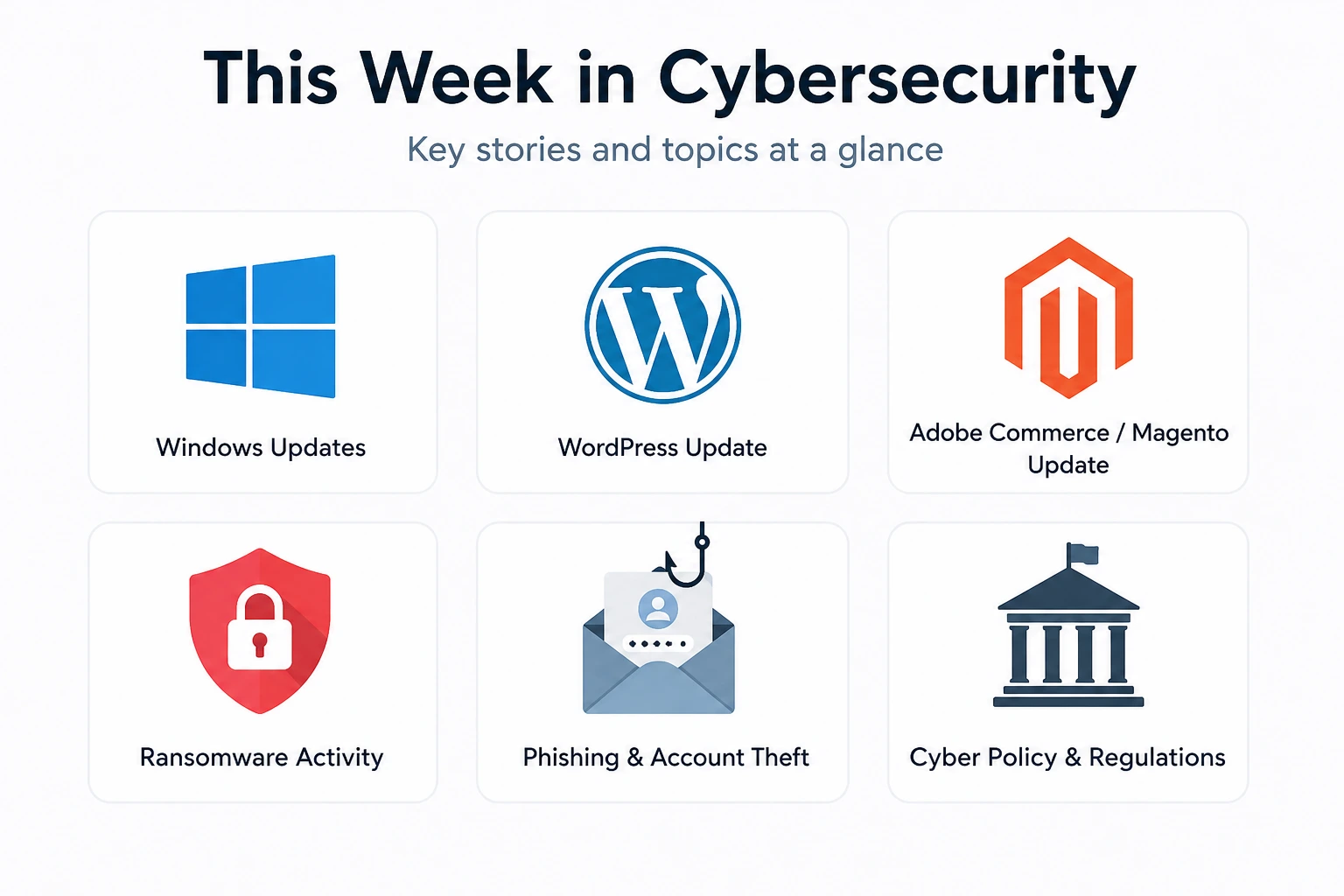
Microsoft fixed hundreds of security flaws. Attackers were already using one Windows weakness before the patch arrived. WordPress and Adobe released important security updates. Researchers published new findings on ShieldBreak, Lazarus Group, and Jewelbug, while ransomware and account theft remained active concerns.
This August 2026 cybersecurity news report looks at what happened, what has been confirmed, what remains a claim, and which Hoplon InfoSec services relate to the risks covered here.
The focus is not only on the latest cyber attacks. It is also on what each event means for the systems businesses actually use.
What Happened in August 2026 Cybersecurity News?
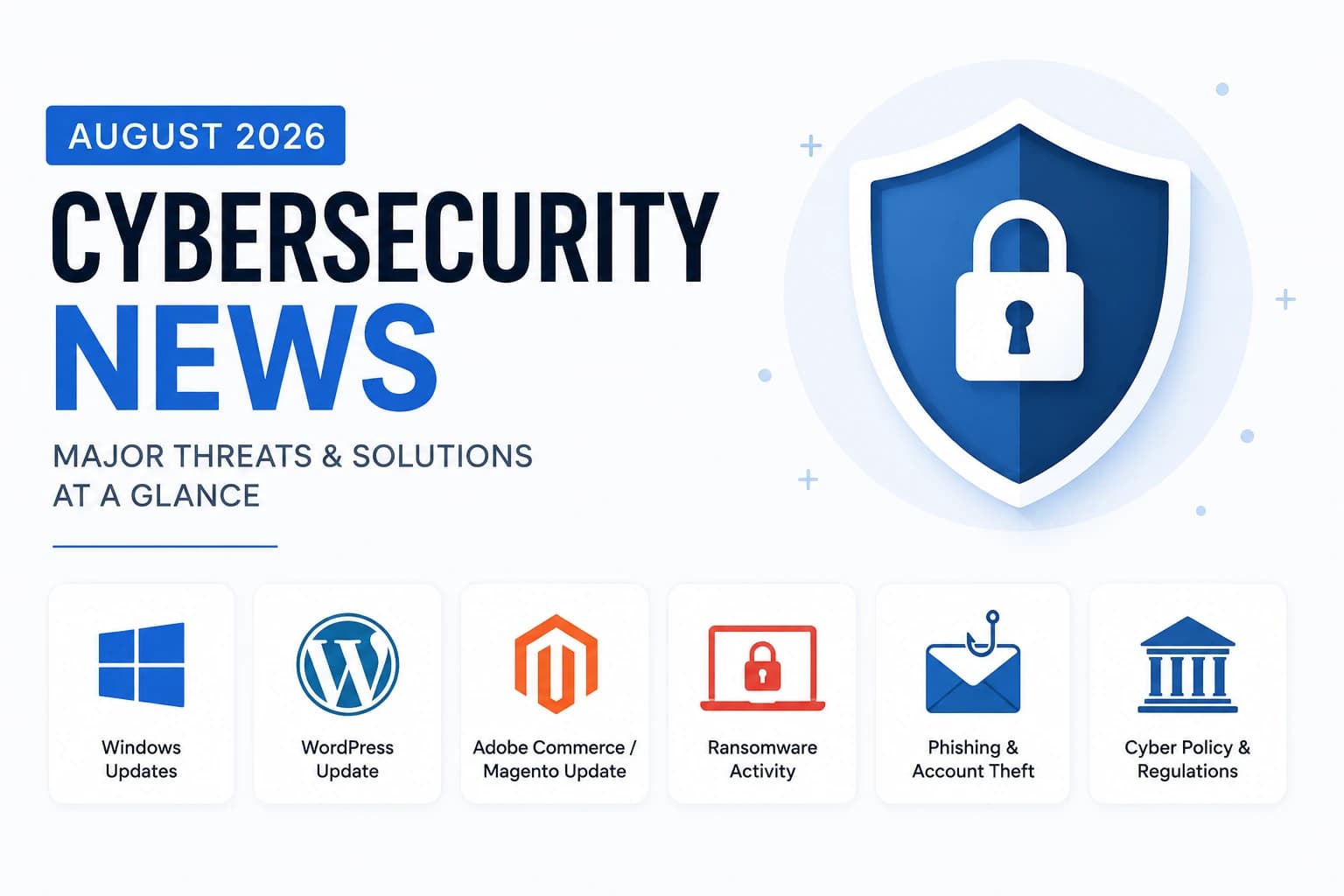
The main stories include:
- Microsoft released fixes for hundreds of vulnerabilities.
- CVE-2026-68820 was confirmed as exploited in real attacks.
- ShieldBreak was published as a bypass of an earlier Microsoft Defender fix.
- Check Point Research linked Lazarus Group activity to CVE-2026-68820.
- Adobe fixed a critical flaw in Adobe Commerce, Adobe Commerce B2B, and Magento Open Source.
- WordPress 7.0.4 fixed an authenticated remote code execution issue.
- Researchers linked Jewelbug to both espionage and cryptocurrency fraud.
- Ransomware pressure against AnMed spread to its Facebook page.
- The FBI warned about schemes used to steal access to private accounts and images.
- The White House created a controlled program for certain private-sector cyber operations.
- Germany's cabinet backed plans for wider cyber powers for its intelligence services, though parliamentary approval is still required.
These stories cover different parts of security. Some are patching problems. Others begin with fake messages, weak account protection, exposed websites, or activity that happens after an attacker has already entered a system.
Microsoft Patch Tuesday August 2026 Fixes Hundreds of Flaws
Microsoft's August security release was one of the largest stories of the week.
Tenable counted 398 CVEs, including 42 rated Critical, 355 Important, and one Moderate. Rapid7 reported 421 vulnerabilities using a broader counting method, including 236 Windows issues. Security companies can arrive at different totals because they do not always count the same Microsoft products and CVEs in the same way.
Microsoft's own security information remains the main reference for checking individual flaws.
Among the Microsoft Patch Tuesday August 2026 vulnerabilities, CVE-2026-68820 needs particular attention because attackers were already using it before the fix became available.
The Windows bug affects the Ancillary Function Driver for WinSock. Microsoft describes it as a use-after-free issue that allows an authorized attacker with local access to gain higher privileges.
CISA added CVE-2026-68820 to its Known Exploited Vulnerabilities catalog on August 11. Affected U.S. federal civilian agencies were given an August 25, 2026 remediation date.
The size of the August release has also led to some misleading headlines. Rapid7 reported a larger total in July 2026 under its counting method, so August should not be described as Microsoft's biggest Patch Tuesday on record.
Did AI help Microsoft find more security flaws?
Microsoft has publicly discussed using AI-supported tools in security research, including its MDASH system, to help find software weaknesses at scale. The company has also said that the pace and range of vulnerability discovery are increasing.
The August patch count alone does not tell us which specific flaws were found by AI.
The confirmed point is narrower: Microsoft is using AI-assisted methods as part of its wider security research work.
ShieldBreak Puts Microsoft Defender Back Under Review
ShieldBreak needs a little more context than a normal vulnerability headline.
On August 12, security researcher Chaotic Eclipse released a
proof-of-concept attack called ShieldBreak. Arctic Wolf describes it as a
bypass of Microsoft's earlier fix for CVE-2026-50656, also known as
RoguePlanet. The original problem affects Microsoft Defender's Malware Protection
Engine and can let a low-privilege local user gain NT AUTHORITY\SYSTEM access.
SYSTEM access gives a user one of the highest levels of control available on a Windows machine.
Public reporting currently treats ShieldBreak as a patch bypass related to CVE-2026-50656. It has not been presented in the material reviewed here as a separate Microsoft CVE.
People searching for a ShieldBreak zero day vulnerability may therefore see the term used in coverage, but the more precise description is a reported bypass of an earlier Microsoft Defender fix.
The technique also requires some level of local access first. It is not described as a way for an unknown attacker on the internet to directly take over any Windows computer.
How to protect Windows from ShieldBreak
Arctic Wolf recommends several controls while organizations follow the issue:
- Limit unnecessary local user rights.
- Use application allowlisting where suitable.
- Enable Microsoft Defender Tamper Protection.
- Use Attack Surface Reduction rules.
- Watch for unusual activity involving Microsoft Defender processes.
At the time of Arctic Wolf's August 12 advisory, there was no official fix made specifically for the reported bypass. Organizations should continue following Microsoft's current security guidance instead of relying on unofficial fixes.
Lazarus Group Used CVE-2026-68820 After Fake Job Lures
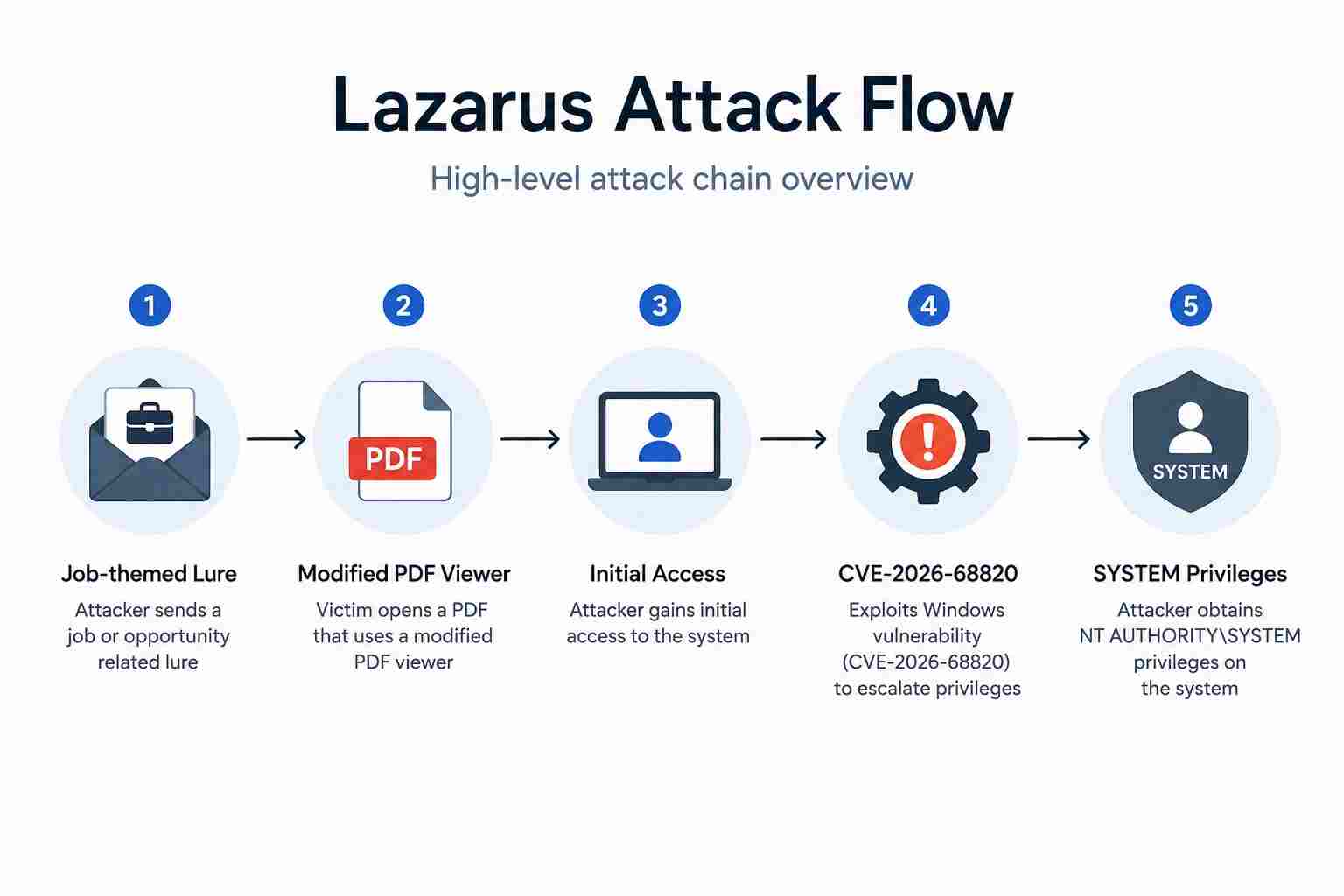
The Lazarus campaign did not start with an exploit. It started with recruitment.
Check Point Research linked exploitation of CVE-2026-68820 to the North Korea-linked Lazarus Group and its Operation Dream Job campaign. The activity focused mainly on defense companies, especially aerospace and aviation organizations.
Researchers found job-themed lures built around attractive employment opportunities. The attackers distributed a modified PDF viewer called SecurityPDF, designed to open attacker-made PDF files and run a new backdoor named Troy.
After gaining access, the attackers used the Windows flaw in AFD.sys to reach SYSTEM privileges.
Check Point reported the bug to Microsoft on July 28. Microsoft confirmed it on July 31, assigned CVE-2026-68820 on August 5, and released a fix on August 11.
The campaign also used a new version of the FudModule rootkit. Check Point found compromised Roundcube and WordPress servers running a PHP webshell called RelayShell, which were used as relay points in the attacker's command-and-control setup.
Check Point said the wider operation targeted the defense sector around the world. It documented at least one case in Western Europe where a compromised organization was later used in further targeted phishing.
For companies in defense, aerospace, aviation, and other sensitive sectors, patching Windows is only part of the response. Recruiter messages, job offers, PDF tools, and unexpected downloads also deserve close review.
Adobe Commerce and Magento Fix CVE-2026-71362
Adobe's August security update included several fixes for Adobe Commerce and Magento Open Source. CVE-2026-71362 was one of the most serious.
Adobe rates the flaw Critical with a CVSS score of 9.1. It affects Adobe Commerce, Adobe Commerce B2B, and Magento Open Source. Adobe says an attacker does not need to be logged in or have administrator rights to exploit the issue, and successful use can lead to privilege escalation.
Adobe said in its bulletin that it was not aware of attacks using the fixed issues when the update was published.
SecurityWeek later reported that web security company Sansec had seen and blocked attempts to exploit CVE-2026-71362.
The timing explains the difference. Adobe's statement described what it knew when the bulletin came out. The later report described activity seen afterward.
Administrators should compare their exact installed build with Adobe Security Bulletin APSB26-92. Simply running a recent 2.4.x release does not confirm that the fix is installed.
For online stores, this is a public website security problem rather than an endpoint issue. The system facing customers and the internet needs its own patching and testing process.
WordPress 7.0.4 Fixes an Authenticated RCE Issue
WordPress 7.0.4 was released on August 12 with a fix for CVE-2026-65640. WordPress recommends updating because version 7.0.4 is a security release.
The flaw can lead to remote code execution, but several conditions have to be present.
An attacker needs an authenticated WordPress account with Author-level access or higher. The website must also use both Imagick and Ghostscript. Exploitation involves a malicious file upload.
Remote code execution means the attacker may be able to make the server run code chosen by them.
So the WordPress 7.0.4 security vulnerability is serious, but it is not an unauthenticated flaw that exposes every WordPress site in the same way.
WordPress also said the fix was being backported through the 4.7 branch and to WordPress 7.1 RC3. Only the latest WordPress version receives active support.
Site owners should check the version actually running on the server and use the official WordPress update process.
Jewelbug Connects Espionage With Cryptocurrency Fraud
Jewelbug is less familiar than Lazarus, but the research around it covers a wide mix of activity.
Broadcom's Symantec Threat Hunter Team describes Jewelbug as a China-based hackers-for-hire group. Researchers linked it to espionage against governments and military targets across the Middle East, Southeast Asia, and South Asia. A separate part of the operation targeted Chinese-speaking cryptocurrency users for financial fraud.
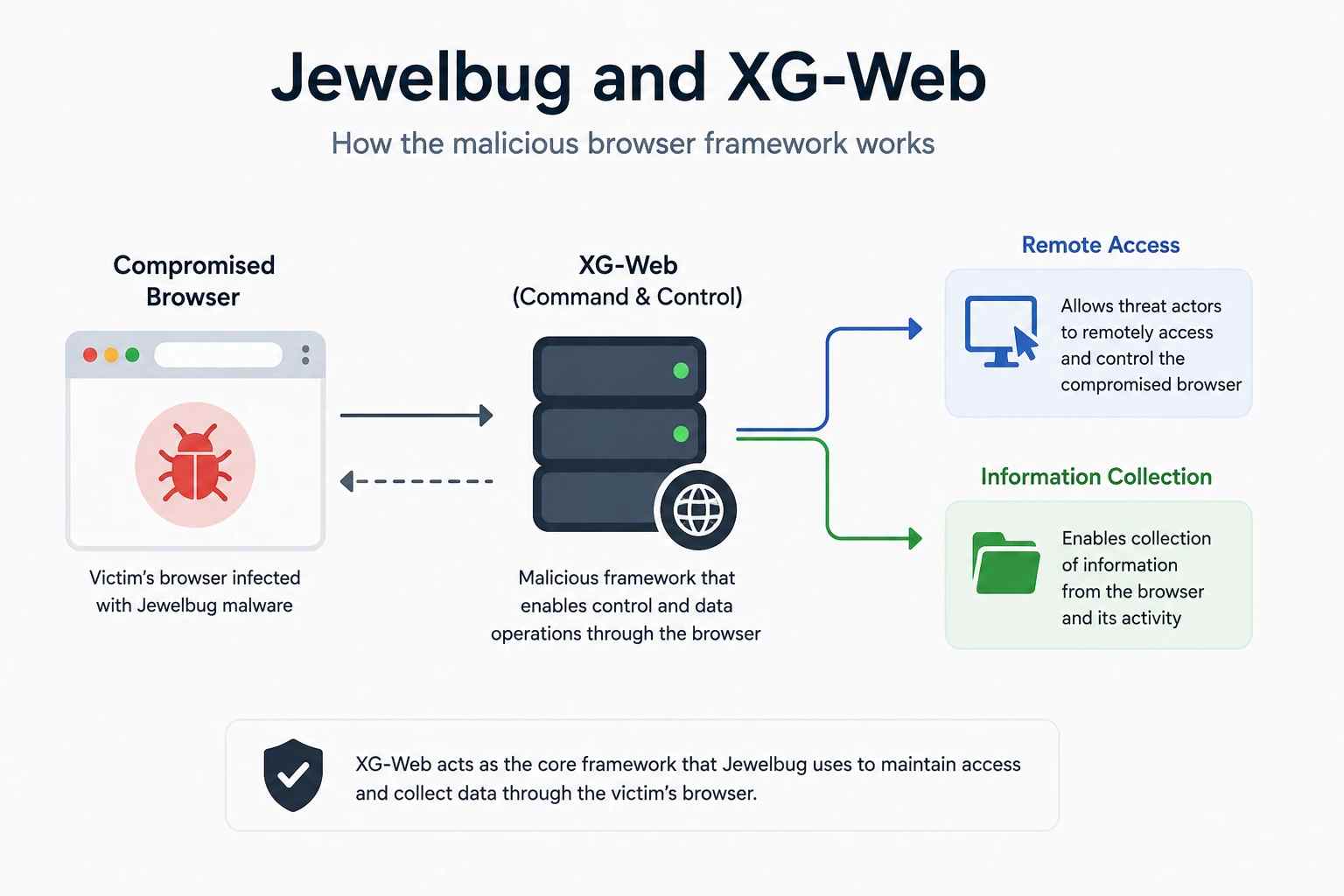
XG-Web sits at the center of much of the activity.
Symantec describes XG-Web as a browser-focused remote-access and information-stealing platform. It can turn a victim's browser into a remote-control channel and provide a path into the computer and internal network behind it.
The term Jewelbug XG-Web malware may appear in searches, but XG-Web is described more broadly in the research as a framework or platform, not just one malware file.
Symantec also found a malicious browser extension presented as a PDF Viewer. It was built for Chrome and Firefox and requested wide browser permissions that could allow remote browser control and data access.
What makes the case unusual is the mix of motives. The same broader operation was connected to both government-focused spying and cryptocurrency fraud.
AnMed Ransomware Pressure Spreads to Facebook
AnMed, a nonprofit health system serving parts of South Carolina and Georgia, had been dealing with a cyber incident since July 26.
While the organization was still responding, unauthorized ransom messages appeared on its Facebook page on August 11. A ransomware group calling itself The Gentlemen claimed responsibility.
The group also claimed to have stolen six terabytes of data, including sensitive health information.
That amount has not been proven.
The Record reported that the attackers did not provide evidence for the six-terabyte claim. AnMed said it had not confirmed the full effect on patient information.
The incident reached beyond internal systems. Public communication became part of the pressure campaign once unauthorized messages appeared on a social media account.
During a breach, companies therefore need to know not only which technical systems can still be trusted, but also who controls public channels used to communicate with customers, patients, or staff.
FBI Warns About Account Theft and Private-Image Extortion
The FBI and NCAA issued a warning on August 10 about cyber-enabled sexual exploitation schemes targeting student-athletes.
According to the FBI, offenders may use fake account warnings, password reset messages, phishing links, or requests for verification codes to gain access to private online accounts and content.
The FBI warning about hackers stealing private photos is therefore closely tied to account security.
A legitimate platform or service should not ask an account holder to send someone a verification code, temporary password, or PIN reset code.
The FBI advises people who believe they have been targeted to avoid unknown links and files, stop contact with the offender, refuse payment, preserve messages and images as evidence, and report the incident.
It also says that paying or continuing contact has not been shown to reliably stop further distribution of a victim's content and can lead to more demands. (
The current FBI and NCAA effort focuses on student-athletes, but the account protection steps apply more widely to people using email, social media, and other online services.
US Creates a Controlled Program for Private-Sector Cyber Operations
The White House issued a presidential memorandum on August 12 creating a program for vetted U.S. companies to take part in certain cyber operations against foreign cyber-enabled transnational criminal organizations.
The policy does not give private companies an open right to attack suspected criminals on their own.
Participating firms can conduct approved Cyber Surveillance Operations and Cyber Effects Operations under federal control and oversight. The National Coordination Center manages the program, with oversight involving the Department of Justice and Department of Homeland Security.
Operations must follow U.S. law and the country's international obligations. Companies must pass vetting, enter contracts, and follow government operating rules.
The memorandum also allows the Justice Department and Department of Homeland Security to require a bond or escrow of at least $1 million from participating companies. The money can be lost if a firm breaks the terms of its agreement.
For anyone following private companies and offensive cyber operations in the US, the central point is clear: these operations require federal approval, control, and supervision.
Germany Backs Wider Cyber Powers for Intelligence Services
Germany's cabinet approved plans on August 12 to expand the powers available to the country's intelligence agencies.
The proposed rules would give the BND, Germany's foreign intelligence service, and the BfV, its domestic security service, wider powers to access digital communications, collect data, and carry out active operations against certain threats.
Reuters reported that, when the required legal conditions are met, intelligence services could enter attackers' IT systems, copy or delete data, and disable tools used in foreign campaigns. The proposals also cover state spyware and access to information held by telecom companies and digital platforms.
The measures are not in force yet.
Germany's parliament still has to approve them. Cabinet approval alone does not make the proposed powers law.
What Security Teams Should Pay Attention to Now
Looking across these reports, the risks do not fall into one neat category.
Some need fast patching. CVE-2026-68820 belongs in that group because exploitation has already been confirmed and CISA has placed it in the Known Exploited Vulnerabilities catalog.
Other attacks begin with trust rather than code. Lazarus used job-related lures, while the FBI described fake security messages and verification-code requests. A fully patched computer does not stop someone from giving an attacker access to an account.
Public websites are another part of the picture. The Adobe Commerce and WordPress issues involve software that may sit directly on the internet. Endpoint security alone cannot cover a vulnerable ecommerce platform or web application.
ShieldBreak and CVE-2026-68820 also draw attention to what happens after initial access. Once someone is already on a device, the next goal may be to gain higher rights and take greater control.
The AnMed incident adds a different problem. During a ransomware case, the security team may be dealing with compromised systems while the organization is also trying to control public communication.
These are among the latest cybersecurity threats covered this week, but they need different responses. Treating every headline as the same kind of risk would make security decisions harder, not easier.
How Hoplon InfoSec's Services Fit These Risks
Different threats need different responses. Hoplon InfoSec provides services for finding exposed systems, testing weaknesses, monitoring activity, training staff, and handling incidents.
Find and Test Weaknesses
Attack Surface Management identifies exposed assets and known weaknesses, while Cyber Security Assessment and penetration testing provide deeper checks across networks, applications, cloud systems, and people.
Official vendor patches should always come first when available.
Monitor and Protect
Endpoint Security and XDR help detect and investigate suspicious activity across devices, networks, cloud systems, and email.
Security awareness training and simulated phishing also help staff recognize common social engineering tactics.
Prepare for Incidents
Hoplon's Incident Readiness, Response & Recovery service supports preparation, containment, investigation, recovery, and crisis communication.
The right service depends on the security gap. These services do not guarantee protection from specific threats, but they help businesses reduce risk and respond more effectively.
What Should You Do Next?
Begin with your own environment rather than the headline.
Check Windows devices against current Microsoft security guidance. Review WordPress, Adobe Commerce, Magento Open Source, and other public applications against official vendor updates. Give faster attention to flaws already being used in attacks.
Then look for gaps you cannot answer easily.
Do you know every public system connected to your business? Can your team see suspicious activity on employee devices? Do staff know how to handle a convincing recruiter message or fake account warning? Is there a clear response plan if ransomware affects both internal systems and public communication accounts?
Hoplon InfoSec publishes separate services for assessment, testing, monitoring, training, and incident response. The right place to start depends on the gap your business actually has.
What should a business check first after reading these reports?
The answer depends on the systems it uses. Known exploited flaws should be checked quickly. Public-facing software should be compared with official vendor updates. Businesses should also know which systems are exposed, whether employee devices are monitored, and whether staff and incident teams know what to do when suspicious activity appears.