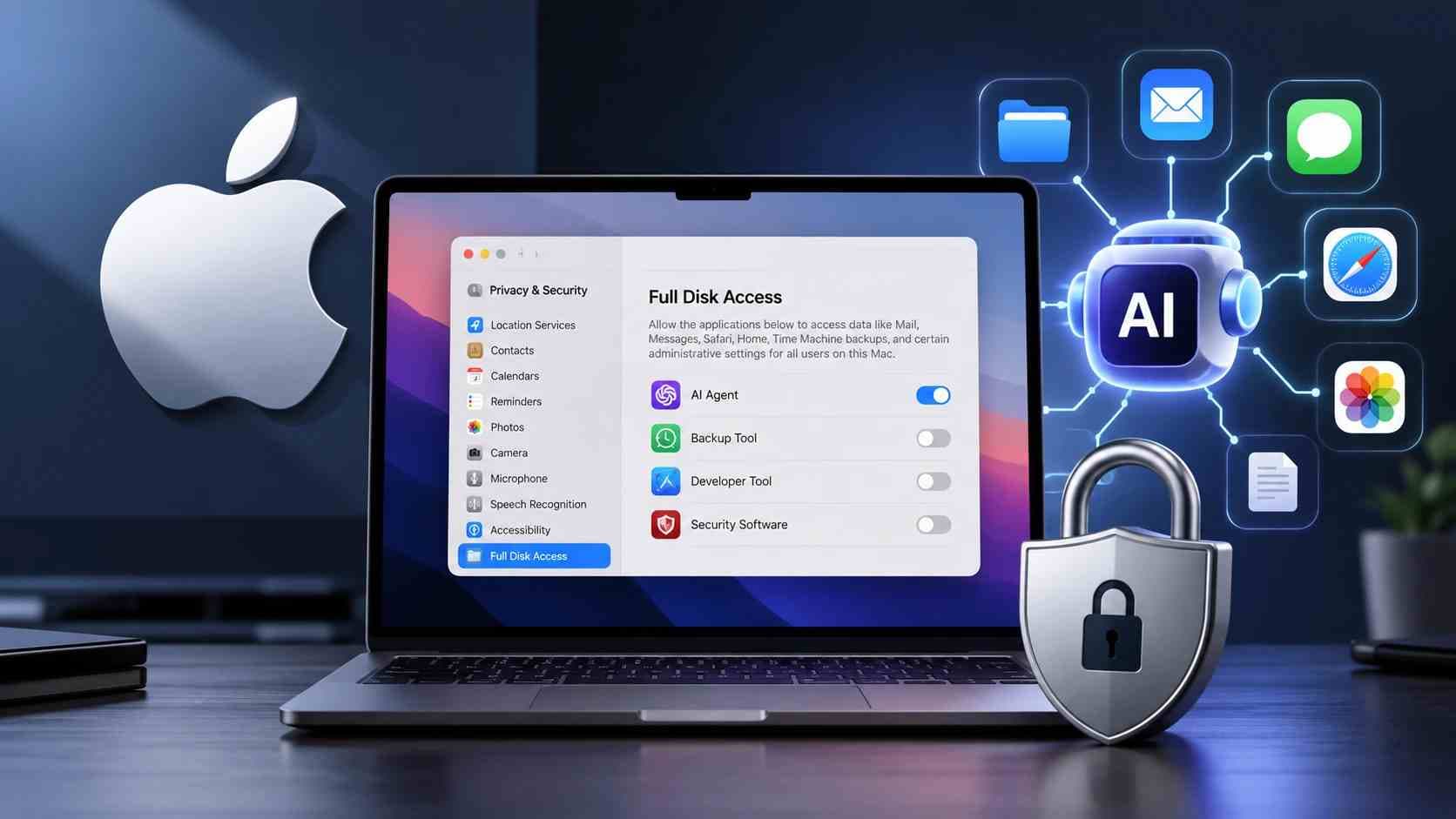
Has Apple changed macOS Full Disk Access because AI agents can see too much private data?
Apple has confirmed that it plans to strengthen Full Disk Access controls on macOS as increasingly capable AI agents create new privacy and security risks. On October 2, 2026, Apple said some apps use this unusually broad permission in ways that can expose files, mail, messages, and browsing history without users fully understanding the consequences. Apple has not yet announced the exact interface, macOS version, or release date for the new controls.
That makes the Apple macOS Full Disk Access AI agents story more than a routine permission change. It is really about a larger shift in desktop security. Traditional apps usually perform a defined function. An AI agent may gather information, interpret it, connect several services, and take multiple actions on a user's behalf.
The important question is no longer only, "Can this application see my data?" Increasingly, it is also, "What can the software do after it sees the data?"
What Exactly Did Apple Announce?
Apple described Full Disk Access as an extraordinary level of access. The company said it largely bypasses controls that normally protect private information because some legitimate software, especially backup tools, needs unusually broad filesystem access.
Apple also acknowledged a problem. Some developers are using that permission in ways that may expose much more information than users realize. The company specifically identified files, mail, messages, and browsing history as examples of potentially exposed information.
The planned response is not yet a clearly defined new permission system. Apple has only said it will introduce additional controls so that granting Full Disk Access requires very explicit user action.
That wording matters. Current reporting sometimes describes the change as Apple "limiting" Full Disk Access. TechCrunch corrected its own report to clarify that Apple's announcement is primarily about stronger informed consent, not a confirmed technical reduction in what the permission can access.
What Apple Has Not Announced
As of October 5, Apple has not publicly specified:
- the exact approval interface
- the macOS release that will contain the change
- a rollout date
- whether access will become temporary
- whether existing approvals will need to be granted again
- whether AI agents will receive a separate permission category
- whether Full Disk Access will be replaced by a more granular system
Any claim that Apple has already confirmed one of those features would go beyond the information currently available from the company.
Why AI Agents Change the Full Disk Access Problem
An ordinary application may need access to a folder because its job is to copy, scan, or back up files.
An agent can be different.
A capable AI agent may receive a broad goal, collect information from several sources, reason about the task, call tools, and perform a sequence of actions. Depending on the product and the permissions a user has granted, those tools may include files, browsers, email, cloud storage, calendars, APIs, or other applications.
That does not mean every agent has all of those capabilities. It means the risk depends on the whole system around the model.
This is the central issue behind Apple AI agent security concerns. A permission that was manageable when given to a narrowly scoped backup utility can have a different consequence when given to software capable of interpreting personal context and taking autonomous actions.
What is Full Disk Access on macOS?
Full Disk Access is a macOS privacy permission that allows approved software to reach protected data and filesystem locations that ordinary applications may not be allowed to access.
Apple's developer documentation says an application cannot simply obtain Full Disk Access through code or an entitlement. The person using the Mac must grant it through System Settings under Privacy & Security.
A useful analogy is a building with locked rooms.
A normal application may receive keys only for the rooms it needs. Full Disk Access is much closer to giving the application a master key for a large set of otherwise protected rooms.
It is still not a key to literally every security boundary in macOS.
Why Does Full Disk Access Exist?
Full Disk Access is not inherently malicious.
Apple specifically identifies backup software as a legitimate reason an application may need to reach files wherever they reside. Security products and certain administrative tools may also require unusually broad visibility to perform their functions.
The security issue is therefore not "Full Disk Access is bad."
The better question is whether an application genuinely needs that much access for the task it performs.
This distinction is especially important for AI agent permissions on macOS. If an agent only needs one project folder, access to that folder may be more appropriate than blanket access to protected data across the system.
What Can Full Disk Access Potentially Expose?
Apple's current documentation identifies protected data associated with applications such as Mail, Messages, Safari, Home, Time Machine backups, and certain administrative settings.
That creates several privacy categories worth understanding.
Files and Business Documents
An app with broad filesystem access may encounter project files, contracts, source code, personal documents, configuration files, or other sensitive material, depending on where those files are stored and what other macOS controls apply.
Mail and Messages
Email and messaging data can contain much more than text.
There may be attachments, customer information, internal business discussions, personal conversations, transaction details, or information belonging to people who never granted the AI application any permission themselves.
Apple explicitly warned that communication apps can create privacy consequences for the people a user communicates with, not only for the Mac owner.
Browsing Information
Apple's announcement also names browsing history.
That can provide useful context to an AI assistant, but it can also reveal interests, research activity, work projects, health searches, financial research, or other highly personal behavior.
Backups
Time Machine backups can contain historical information that no longer appears in a user's current working folders. Broad access can therefore affect more than today's visible files.
Does Full Disk Access Mean an App Can Access Everything?
No.
The name sounds absolute, but macOS contains overlapping security layers.
Apple's developer documentation explains that POSIX file permissions, access control lists, System Integrity Protection, and other mandatory controls may independently prevent access even when another security mechanism allows it.
This distinction matters because claims such as "Full Disk Access gives an app unlimited control over your Mac" are too broad.
FDA is extremely powerful, but it is not identical to unrestricted root control.
Full Disk Access vs Files and Folders
macOS separates narrower file permissions from Full Disk Access.
A user may allow software to work with selected documents or standard folders while keeping broader protected data outside the app's reach. Apple provides user-selected file entitlements for read-only or read-write access inside sandboxed applications.
| Permission | Typical Scope | Practical Exposure |
|---|---|---|
| User-selected file | One chosen file | Narrow |
| User-selected folder | Chosen folder and permitted contents | Limited |
| Files and Folders | Specific protected locations | Broader |
| Full Disk Access | Wide range of protected file and application data | Very broad |
"Practical exposure" in this table is explanatory wording, not an official Apple risk rating.
This is why macOS Full Disk Access controls are receiving attention now. A broad permission is increasingly being used by software with much more flexible behavior than the backup utilities for which this level of access was originally useful.
How macOS Normally Protects Private Data
Understanding macOS Privacy & Security requires looking at several layers rather than one permission.
Transparency, Consent, and Control
Apple describes its privacy model around transparency, consent, and control. In macOS security discussions this is commonly associated with TCC, the system that governs access to many privacy-sensitive resources.
Apple says users should control access to locations such as Documents, Downloads, Desktop, iCloud Drive, and network volumes. Full storage access must be explicitly allowed. Accessibility and automation permissions are also separately controlled because of their ability to interact with other parts of the system.
Camera access does not automatically grant microphone access.
Accessibility does not automatically grant Full Disk Access.
Full Disk Access does not automatically grant every other privacy permission.
Those boundaries are important.
App Sandbox
App Sandbox restricts what a sandboxed application can access by default.
Apple explains that a sandboxed application receives its own container and can extend access through controlled mechanisms such as user-selected files, standard folders, app groups, and other approved capabilities.
Think of the sandbox as a fenced workspace.
Full Disk Access can open doors outside that normal workspace, but other security controls can still remain relevant.
Full Disk Access Is Not Root Access
This is one of the most common technical misunderstandings.
Administrator privileges concern privileged system operations.
The Unix root account represents a very high level of traditional operating-system privilege.
Full Disk Access is primarily a privacy and data-access permission.
These mechanisms interact, but they are not interchangeable.
Full Disk Access is not the same thing as root.
That distinction becomes especially important when discussing Full Disk Access security risk, because exaggerating what the permission does can make legitimate security guidance less credible.
Full Disk Access vs Accessibility and Automation
A capable AI application may become much more powerful when several permissions are combined.
| Permission | Main Purpose |
|---|---|
| Full Disk Access | Broad protected file and app data access |
| Accessibility | Allows certain user-interface interaction capabilities |
| Automation | Allows controlled app-to-app automation |
| Camera | Camera usage |
| Microphone | Audio capture |
| Contacts | Contact information |
Apple separately protects Accessibility and Automation to prevent apps from casually using those capabilities to bypass other safeguards.
The important point is that macOS does not automatically bundle all of these permissions together.
A user, administrator, or management policy may grant different combinations.
What About Gatekeeper, Code Signing, and Notarization?
These controls solve different problems.
Code signing helps establish software identity and detect modification.
Gatekeeper checks downloaded software and, under normal settings, verifies that it comes from an identified developer and meets Apple's security requirements.
Notarization means Apple has received a copy of submitted software and scanned it for known malicious content.
A notarized application can still request broad permissions.
That means:
Notarized does not mean harmless under every possible configuration.
Notarization is an important security signal, but it is not a guarantee that every feature, permission choice, future vulnerability, or cloud integration is risk free.
AI Chatbot vs AI Agent
A chatbot normally follows a simple interaction:
Question -> response
An agent can follow a longer workflow:
Goal -> plan -> gather context -> use tools -> take action
That difference explains much of the current macOS AI agent privacy debate.
If software can only answer a question, a successful manipulation may produce a bad answer.
If software can read files, operate tools, access connected services, and send information elsewhere, the same manipulation may have operational consequences.
Hoplon Infosec has previously discussed this distinction in its AI agent security assessment and prompt-injection research, where the important question becomes not only whether a model can be tricked but what tools and privileges become available if it is tricked.
Read Access and Action Access Are Different
Security discussions often combine these concepts even though they are not the same.
| Capability | Example |
|---|---|
| Read | Open a private document |
| Search | Locate relevant information |
| Write | Change a file |
| Delete | Remove content |
| Execute | Run a command |
| Control | Operate another application |
| Transmit | Send information to an external service |
An AI system that can only read information has a different risk profile from one that can read, modify, execute, and transmit.
This distinction is central to agentic AI security risks.
Why Permission Combinations Matter
Full Disk Access alone is not the complete threat model.
Imagine an agent that has Full Disk Access, a browser integration, email access, an external connector, and permission to execute commands.
Each capability may have a legitimate purpose.
Together, they create a much larger trust boundary.
The security equation is closer to:
Data access + tools + autonomy + connectors + network communication = potential impact
This is conceptual, not a mathematical risk formula.
A useful supporting data point comes from Wallarm's analysis of 2,869 security issues in agentic AI GitHub projects through March 2025. It classified 1,858, or roughly 65 percent, as API-related. That does not measure macOS Full Disk Access, but it illustrates why integrations and external interfaces matter when evaluating an agent's attack surface.
What is Privilege Amplification?
Suppose malicious software wants access to information it cannot normally read.
One possible strategy is to attack another trusted application that already has powerful permissions.
The attacker is effectively trying to benefit from somebody else's keys.
This is the idea behind privilege or access amplification.
Security researcher Patrick Wardle described the concern around Meta's Muse in similar terms, warning that "Muse may have significantly broader access than ordinary local malware."
The point is not that every AI agent will be compromised.
It is that highly trusted, highly privileged applications can become attractive targets.
Threat Model: What Could Actually Go Wrong?
There are several different scenarios, and they should not be mixed together.
A Malicious Application
The software itself intentionally abuses the permission a user granted.
A Legitimate Application With a Vulnerability
The developer has no malicious intent, but an attacker finds a bug that lets them manipulate the application.
Prompt Injection
An agent processes malicious instructions hidden inside content and follows them in a way the user did not intend.
Compromised Connector
The AI model may be functioning correctly while an email, cloud-storage, browser, API, or other integration becomes the weak point.
Stolen Tokens or Sessions
An attacker may obtain authentication material that lets them impersonate part of an agent workflow.
Malware Already Running on the Mac
Local malware may attempt to exploit the access held by another trusted process.
These scenarios have different prerequisites and defenses.
How Prompt Injection Fits Into the Story
Prompt injection happens when an AI system receives instructions designed to influence it in a way that conflicts with the legitimate user's intent.
Indirect prompt injection is particularly relevant to agents.
The malicious instruction might be hidden in:
- a webpage
- an email
- a document
- search results
- a support ticket
- tool output
The agent reads the material as part of a legitimate task.
If it cannot reliably distinguish trusted instructions from untrusted content, the malicious material may affect its behavior.
This does not mean Full Disk Access itself is a prompt-injection vulnerability.
The danger comes from combining manipulation with useful capabilities.
An agent with no sensitive tools has a limited blast radius.
An agent with broad files, email, APIs, and external actions can have a much larger one.
A Simple Hypothetical Attack Chain
This example is illustrative. It is not a confirmed Apple incident.
Step 1: A user gives an AI agent broad file access.
Step 2: The agent is asked to research a website.
Step 3: The webpage contains malicious instructions intended for an AI reader.
Step 4: The agent incorrectly treats those instructions as authoritative.
Step 5: The agent searches private files for information requested by the malicious content.
Step 6: If an external tool or network path is also available, the information could potentially be transmitted elsewhere.
This illustrates why AI agents accessing private data should be analyzed as an end-to-end system.
Disk permission is only one link in the chain.
Access Does Not Automatically Mean Data Exfiltration
This distinction is important.
The fact that an app can read information does not prove that it uploaded that information.
Data exfiltration normally requires another path.
Conceptually:
Protected data -> agent -> connector or network function -> external destination
Whether that path exists depends on the actual product architecture.
That is why users should distinguish between AI agent data access and data transmission.
They are related, but they are not identical.
Local AI vs Cloud AI
Where processing occurs changes the privacy model.
A local workflow may keep more information on the device, reducing some forms of external exposure.
That does not automatically make it safe. Local applications can still contain vulnerabilities, dangerous permissions, insecure plugins, or risky automation.
A cloud-connected agent raises additional questions:
- What information leaves the Mac?
- Which company receives it?
- Is the information stored?
- How long is it retained?
- Does another model provider process it?
- Can connected services access it?
- Is it used to improve models?
There is no single answer because each product has a different architecture and privacy policy.
Who Are You Trusting?
When you grant an advanced agent access, you may be trusting much more than one model.
The trust chain can include:
desktop app -> developer -> cloud platform -> AI model -> API provider -> connector -> authentication system -> third-party service
This is why Mac AI security is increasingly a systems problem rather than a simple antivirus problem.
The model may be secure while a connector is not.
The connector may be secure while a local client contains a vulnerability.
The client may be secure while a user grants unnecessarily broad permissions.
Each boundary matters.
Can Full Disk Access Expose API Keys or Developer Secrets?
Potentially, yes, if sensitive credentials are stored inside files the application is allowed to read.
Examples might include source-code repositories, configuration files, environment files, certificates, tokens, or internal documentation.
That does not mean Full Disk Access automatically defeats every credential protection mechanism.
Where a secret is stored, filesystem permissions, application design, Keychain usage, SIP, and other controls can all affect whether it is accessible.
For development teams, the practical lesson is simple: do not treat a local agent's filesystem access as harmless merely because the agent is running on a developer workstation.
Does Full Disk Access Reveal Every Keychain Password?
No.
Full Disk Access and Keychain authorization are separate security concepts.
It would be inaccurate to tell users that enabling FDA automatically reveals every password stored in macOS Keychain.
This is a useful example of why Full Disk Access security risk should be explained precisely rather than dramatically.
Privacy Risk vs Security Risk
Privacy risk occurs when an application legitimately receives or processes more personal information than the user expected.
Security risk occurs when an attacker compromises, manipulates, or abuses a system.
AI agents can involve both.
A perfectly uncompromised application may still create a privacy problem if its permissions are unnecessarily broad or poorly explained.
A carefully designed privacy flow may still face a security problem if the application later contains an exploitable vulnerability.
Least Privilege Matters More With Agents
The principle of least privilege says software should receive only the access required for its job.
Suppose an agent needs one folder containing project documents.
Giving it access to that folder is narrower than granting broad Full Disk Access.
Suppose it needs to draft an email but not send one automatically.
Separating drafting from sending reduces the consequences of a mistake.
That is the security mindset behind more restrictive AI agent permissions.
Human Approval for High-Impact Actions
Human-in-the-loop security means important actions can require additional confirmation.
Examples include:
- sending an email
- uploading a private document
- deleting files
- executing a sensitive command
- authorizing a payment
- sharing information externally
This is not a new Apple requirement announced on October 2.
It is a broader agent-security design principle.
The idea is to let low-risk automation remain useful while adding friction where an error would have serious consequences.
Meta Muse and the Full Disk Access Dispute
Apple did not name Meta or Muse in its announcement.
That distinction must be preserved.
The timing, however, followed a public dispute over whether Meta's Muse AI agent had accessed a journalist's private Messages data without the permissions he believed he had granted. Reuters, TechCrunch, Ars Technica, The Verge, and other outlets connected the controversy to the broader debate around Full Disk Access.
Meta disputes the journalist's account.
According to Meta executives quoted by TechCrunch and Ars Technica, Muse's Messages integration is opt-in and requires both macOS Full Disk Access and enabling the Messages connector.
The journalist's account and Meta's explanation are therefore in conflict.
Apple has not publicly resolved that factual dispute, and its October 2 post does not identify Muse as the reason for its change.
The safest conclusion is that the Muse controversy provides important context, but direct causation has not been confirmed by Apple.
The not-a-mused Vulnerability Adds Another Layer
Security researcher Patrick Wardle separately demonstrated a now-patched weakness affecting Muse's Mac application.
Reporting says the proof of concept abused an undocumented setting called endo_voyager_dictation_endpoint, allowing an unprivileged local process to redirect dictation-related traffic, capture or inject prompts, and abuse the trusted position of the agent.
The prerequisite matters.
This was not described as a remote attacker anywhere on the internet instantly gaining access to every Mac running Muse.
The demonstrated path involved malicious code already running locally.
That makes the lesson more precise: a powerful agent can become an attractive secondary target after an attacker gains an initial foothold.
ChatGPT for Mac Had a Separate 2026 Security Fix
The Hacker News also linked the broader discussion to CVE-2026-100754, reported by Patrick Wardle and affecting OpenAI's ChatGPT app for macOS.
OpenAI's changelog confirms that CVE-2026-100754 was fixed in its September 25, 2026 macOS security update and credits Wardle and the Objective-See Foundation.
Wired reported that the weakness could have allowed an attacker to hijack trusted app behavior and reach sensitive ChatGPT data.
These incidents do not prove that AI agents are inherently unsafe.
They demonstrate why applications holding valuable permissions and large amounts of context need strong security boundaries.
What Apple Has Confirmed vs What Remains Unknown
| Confirmed by Apple | Not Yet Confirmed |
|---|---|
| Additional Full Disk Access controls are planned | Exact UI |
| FDA can expose highly sensitive information | Release date |
| Explicit user action will be required | Exact macOS version |
| AI-agent autonomy increases the risk | AI-specific permission category |
| User understanding and consent are priorities | Temporary or time-limited FDA |
| Communication data affects third-party privacy | Reauthorization of existing grants |
This is the most important fact-checking section of the story.
Apple has clearly announced a direction.
It has not yet published the final design.
How to Check Which Apps Have Full Disk Access
On current macOS versions, go to:
Apple menu -> System Settings -> Privacy & Security -> Full Disk Access
Review the applications shown there.
Apple's documentation says applications cannot automatically give themselves Full Disk Access. The user must make that choice through System Settings.
If an application no longer needs broad access, consider disabling it.
Be aware that legitimate features may stop working afterward.
Questions to Ask Before Granting Full Disk Access
Before approving an AI agent or another utility, ask:
- Why does this feature need Full Disk Access?
- Would a single folder be enough?
- Is the software from a developer I recognize?
- Is the application signed and notarized?
- Does its documentation explain the permission clearly?
- Does the application send information to the cloud?
- Which connectors are enabled?
- Can it send, delete, modify, or execute things?
- Can I revoke the access later?
- Do I still use the application?
A request for broad access is not proof of malicious intent.
A request with no understandable justification should receive more scrutiny.
What Developers Should Do
Developers building desktop agents should avoid requesting FDA simply because it is convenient.
Apple's own developer guidance encourages software to handle cases where a user refuses Full Disk Access and to use narrower file-selection mechanisms where appropriate.
Good design principles include:
- least-privilege permissions
- contextual permission requests
- separate read and action capabilities
- explicit confirmation for high-impact operations
- secure storage of tokens
- prompt-injection defenses
- connector isolation
- useful audit logs
- easy permission revocation
- secure update mechanisms
The goal is not to make agents powerless.
The goal is to make one mistake, malicious page, compromised connector, or stolen credential less catastrophic.
What Enterprises Should Do
Organizations face a larger problem because a single Mac may contain source code, client files, contracts, internal communications, cloud credentials, business applications, and sensitive browser sessions.
Security teams should know which AI agents are installed and what privileges they hold.
On managed Macs, Apple provides Privacy Preferences Policy Control device-management settings. Apple's documentation includes a System Policy All Files category covering information such as Mail, Messages, Safari, Home, Time Machine backups, and administrative settings.
Enterprise controls therefore should include:
- inventory of AI applications
- inventory of FDA grants
- review of Accessibility and Automation permissions
- review of agent connectors
- approved-agent policies
- sensitive-data classification
- least-privilege access
- logging
- periodic permission reviews
- incident-response procedures
Hoplon Infosec's existing AI Agent Security Assessment Checklist follows the same broader principle: agent security needs to cover identity, permissions, tools, memory, logging, human oversight, and incident response rather than testing the language model alone.
Common Full Disk Access Myths
Full Disk Access means unlimited root control
False.
Full Disk Access is broad, but other macOS controls still exist.
Every AI agent needs Full Disk Access
False.
The required permissions depend on the product and task.
Full Disk Access automatically grants camera and microphone access
False.
Those resources have separate privacy controls.
Full Disk Access automatically reveals every password
False.
Mac Keychain uses separate security mechanisms.
Apple's new restrictions are already available
There is no confirmed rollout yet.
As of October 5, 2026, Apple has announced future additional controls but has not published the release date or detailed implementation.
Why This Matters Beyond the Mac
The deeper lesson goes beyond Apple.
Desktop software is moving from passive applications toward systems that can interpret context and act.
Traditional application security asks:
What can this program access?
Agent security must also ask:
What can it decide, combine, change, send, or execute with that access?
That is the broader significance of the Apple macOS Full Disk Access AI agents discussion.
The permission itself is not new.
The software using it is changing.
Frequently Asked Questions
What is Full Disk Access on Mac?
Full Disk Access is a macOS privacy permission that lets an approved application access broad categories of protected information and filesystem locations. Apple says applications cannot obtain it automatically through code. Users must grant it through System Settings.
Is Full Disk Access safe for AI agents?
It can be appropriate when a trusted application genuinely needs it, but the permission creates a large potential data-access scope. With autonomous AI agents, users should also consider connectors, network access, tool permissions, cloud processing, and what actions the agent can perform.
Can Full Disk Access read Messages and browsing history?
Apple specifically identifies files, Mail, Messages, and browsing history as examples of information that can be exposed by Full Disk Access. Other macOS security controls can still matter in particular cases.
When will Apple release the new Full Disk Access controls?
Apple has not announced a date. As of October 5, 2026, the company has only confirmed that additional controls are coming and that granting this level of access will require very explicit user action.
Hoplon Insight
The practical lesson is not to ban every AI agent or assume every Full Disk Access request is malicious.
The better approach is to map the complete trust chain.
Ask what the agent can read, what tools it can call, where data is processed, which services receive it, whether important actions require confirmation, and how quickly those permissions can be revoked if something goes wrong.
For organizations, treat an AI agent like privileged software rather than a smarter chatbot.
For developers, design for the possibility that the model, connector, or surrounding application will eventually make a mistake.
For users, do not grant a master key when one room key will do.
Final Takeaway
Apple's decision signals an important change in desktop security thinking.
Full Disk Access was built to support legitimate applications that needed unusually broad access. AI agents add reasoning, context aggregation, external tools, and varying degrees of autonomy to that permission model.
That combination can be extremely useful.
It can also increase the impact of poor permission choices or software vulnerabilities.
The Apple macOS Full Disk Access AI agents issue is therefore best understood as a consent and architecture problem, not simply an Apple-versus-AI story.
Apple has confirmed that stronger controls are coming. Until the final design appears, Mac users, developers, and security teams can already reduce risk by reviewing permissions, limiting access, understanding data flows, and treating highly capable agents as privileged software.



-20260925120840.webp&w=3840&q=75)