
Critical Apache Tomcat Vulnerability Lets Attackers Join Trusted Server Clusters Without Authentication
A critical Apache Tomcat Vulnerability has exposed a weakness in how certain application server clusters authenticate their members. Tracked as CVE-2026-133325, the flaw allows an unauthenticated system to join a trusted cluster when affected Tomcat versions use TLS 1.3 with pre-shared keys.
Apache disclosed the security issue on November 19, 2026, after receiving the vulnerability report three days earlier.
The problem is particularly concerning because the affected connections use TLS, a protocol designed to protect network communication. Yet the underlying implementation fails to enforce the authentication method that cluster members are expected to use.
For organizations running clustered Java applications, this raises an important question: What happens when a server accepts an encrypted connection without properly verifying who is connecting?
Apache has confirmed the authentication weakness and recommends switching affected cluster communication to TLS 1.2 until corrected releases become available.
Key Takeaways
- CVE-2026-133325 is a critical Apache Tomcat security vulnerability affecting specific cluster configurations that use TLS 1.3 and TLS-PSK.
- The flaw allows unauthorized cluster membership. An unauthenticated node can join an affected cluster because the expected peer authentication is not properly enforced.
- Affected releases include Tomcat 11.0.28–11.0.29, 10.1.62, and 9.0.124.
- Apache recommends TLS 1.2 as an immediate workaround until the corrected Tomcat releases become available.
- The reviewed official advisory does not establish confirmed exploitation in the wild, remote code execution, or data theft associated with this vulnerability.
What Happened in the Apache Tomcat Security Flaw?
Apache Tomcat is an open-source Java servlet container used to run web applications. Organizations can deploy it as a standalone server or connect multiple instances to support applications that need shared session information and greater availability.
These connected instances form a cluster.
Tomcat clustering allows participating servers to exchange information through internal communication channels. Depending on the configuration, the cluster can support session replication, context attribute replication, and application deployment functions.
That communication needs protection because cluster members operate within a trusted group of application servers.
The Apache Tomcat Security Flaw affects how those members establish trust.
Apache confirmed that a cluster using TLS 1.3 with TLS pre-shared keys may accept an unauthenticated node. The implementation does not correctly enforce the expected peer authentication during connection establishment.
The result is an authentication boundary failure.
A system that has not proved its identity through the required mechanism can become part of a cluster intended for authorized servers.
This is the core security problem. It does not mean every Tomcat installation is vulnerable, and it does not establish that every cluster function becomes accessible after an unauthorized node joins.
Those questions depend on the affected deployment and require further technical assessment.
Why Cluster Authentication Matters
In a typical web application, visitors communicate with the application through public HTTP or HTTPS endpoints.
Cluster members have a different purpose.
They communicate with other application servers to support internal operations. For example, session replication allows session state to be shared among participating nodes.
These operations depend on the assumption that cluster members are authorized infrastructure components.
If that assumption fails, the communication environment can no longer rely on the membership checks it was designed to enforce.
This explains why Apache classified CVE-2026-133325 as critical.
The vulnerability affects authentication between trusted application servers rather than ordinary user authentication through a website.
How Does the Apache Tomcat Authentication Bypass Work?
The Apache Tomcat Authentication Bypass involves a failure to enforce the required authentication mechanism during a TLS 1.3 connection.
Understanding the issue requires separating encryption from authentication.
Encryption protects information while it travels between systems. Authentication establishes whether the communicating parties have satisfied the required identity checks.
Both are important, but they serve different purposes.
A connection may be encrypted without proving that the remote system is authorized to participate in a particular service.
That distinction is central to CVE-2026-133325.
Understanding TLS-PSK in Tomcat Clustering
TLS-PSK stands for Transport Layer Security with Pre-Shared Keys.
A pre-shared key is secret information configured before systems communicate. In a PSK-based connection, the key material is used as part of the secure handshake.
Apache Tomcat supports this approach for cluster communication.
Its cluster configuration includes attributes such as pskKey and pskIdentity. Apache's documentation requires these values to match across the participating nodes.
The configuration also includes settings for enabling secure communication and identifying the relevant receiver ports.
The purpose is to establish protected communication among cluster members that possess the expected authentication material.
However, the affected TLS 1.3 implementation does not enforce that requirement correctly.
What Apache's Security Patch Reveals
The official Apache source-code change provides a more precise explanation of the problem.
In TLS 1.3, offering a pre-shared key does not necessarily mean that the connection will complete using PSK authentication.
A handshake can instead proceed using certificate-based authentication.
For the affected Tomcat cluster configuration, this created a problem.
The cluster expected PSK authentication, but the implementation could accept a connection completed through the certificate-based path.
That alternative did not meet the authentication requirement enforced by Tomcat Tribes.
Apache's corrective patch introduces an explicit validation step to prevent this behavior.
The new verifyPskAuthentication() method examines the established TLS session after the handshake.
If the session contains a peer certificate, the implementation treats that as evidence that the connection did not use the expected PSK authentication mechanism.
The connection is then rejected.
Apache also added a regression test covering a TLS 1.3 connection where the server ignores the offered PSK and uses certificate-based authentication instead.
The test verifies that such a connection is rejected.
This is an important technical detail because it identifies the actual implementation failure rather than simply repeating that authentication could be bypassed.
Source: Apache Tomcat Security Fix, Commit 8dcddccc
Why the Apache Tomcat TLS 1.3 Security Flaw Is Not a General TLS Vulnerability
The affected behavior concerns Tomcat's use of TLS 1.3 for cluster authentication.
It does not demonstrate that TLS 1.3 encryption itself has been broken.
The implementation failed to ensure that the negotiated authentication mechanism satisfied the application's security requirements.
This distinction matters when evaluating the scope of the vulnerability.
An administrator should not conclude that every TLS 1.3 connection is insecure because of this issue.
The vulnerability concerns a specific combination of Tomcat clustering, TLS 1.3, and TLS-PSK.
Apache's recommendation to use TLS 1.2 applies to that affected cluster configuration.
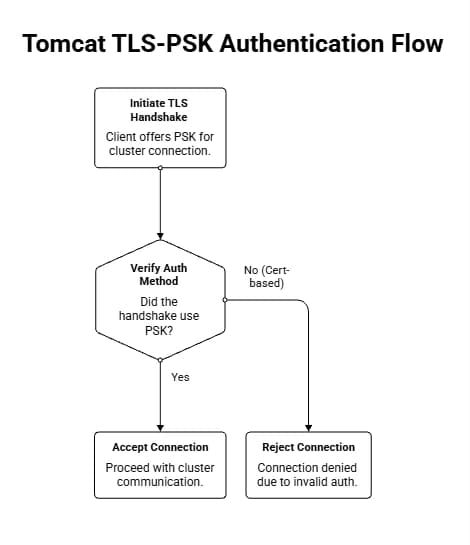
Tomcat TLS-PSK Authentication Flow
CVE-2026-133325: Confirmed Technical Details
Apache classifies the vulnerability as CWE-322: Key Exchange Without Entity Authentication.
MITRE uses this classification for weaknesses involving key exchange without adequate authentication of the participating entity.
For Tomcat, the confirmed result is that an unauthenticated node can join an affected cluster.
The available primary sources establish the following details.
|
Security Detail |
Verified Information |
|
CVE identifier |
CVE-2026-133325 |
|
Vendor |
Apache Software Foundation |
|
Product |
Apache Tomcat |
|
Severity |
Critical, according to Apache |
|
Weakness |
CWE-322 |
|
Affected component |
Cluster TLS-PSK communication |
|
Relevant protocol |
TLS 1.3 |
|
Confirmed impact |
Unauthenticated cluster membership |
|
Reported to Apache |
November 16, 2026 |
|
Public disclosure |
November 19, 2026 |
|
Credited researcher |
Mike Read |
|
Vendor workaround |
Use TLS 1.2 for affected cluster communication |
The vulnerability was reported to Apache on November 16, 2026, and publicly disclosed on November 19.
The published CVE record credits Mike Read with its discovery.
These dates establish the disclosure timeline. They do not establish when the underlying implementation error first appeared in Tomcat's source code.
References: Apache Tomcat Security Advisories and MITRE CWE-322.
Apache Tomcat Vulnerability Affected Versions
The Apache Tomcat Critical Vulnerability affects specific releases across the Tomcat 9, 10.1, and 11 branches.
Apache identifies the following versions.
|
Tomcat Branch |
Affected Releases |
Corrected Release |
|
Apache Tomcat 11 |
11.0.28 through 11.0.29 |
11.0.30 |
|
Apache Tomcat 10.1 |
10.1.62 |
10.1.63 |
|
Apache Tomcat 9 |
9.0.124 |
9.0.125 |
As of November 20, 2026, Apache listed these corrected versions as not yet released.
Administrators should verify their availability through the official project release pages before planning an upgrade.
There is also an inconsistency in the published CVE information.
The CVE description mentions Tomcat 9.0.123 as a corrected release. However, Apache's official Tomcat 9 security advisory identifies 9.0.125 as the version containing the fix.
For remediation planning, the version-specific Apache security advisory provides the clearer reference.
Does This Vulnerability Affect Every Tomcat Installation?
No.
The presence of an affected version does not, by itself, establish that an installation meets the conditions described in the advisory.
The vulnerable arrangement involves TLS 1.3 with TLS-PSK for cluster communication.
A standalone Tomcat instance without the relevant clustering configuration does not meet those documented conditions.
Similarly, a cluster using a different security configuration should be evaluated against the specific conditions in the advisory.
Administrators need to verify the installed release, active clustering configuration, and TLS protocol used for internal communication.
Network accessibility also affects whether an unauthorized system can reach the cluster communication service.
A version inventory is therefore necessary, but it is not enough to complete an exposure assessment.
Why the Apache Tomcat Cluster Vulnerability Matters
The Apache Tomcat Cluster Vulnerability affects trust between systems that are expected to communicate as authorized members of the same infrastructure.
Apache Tomcat clustering supports features such as session replication and cluster-wide application deployment.
These capabilities explain why the authentication boundary matters.
Cluster communication may involve application state and other information required for server coordination.
An unauthorized member creates a concern because it has entered an environment intended for trusted infrastructure components.
However, the exact consequences depend on which cluster features are enabled and what the participating servers exchange.
Could Unauthorized Cluster Access Expose Session Data?
Tomcat supports replication of application sessions between cluster nodes.
Depending on the application, session information may contain data associated with active users.
This makes session replication relevant to an investigation of unauthorized cluster membership.
However, Apache's advisory does not establish that CVE-2026-133325 automatically leads to session theft.
The existence of session replication does not prove that every unauthorized member can retrieve all replicated information.
An assessment should examine the deployment's replication settings, enabled components, and available evidence.
Until those details are established, session-data exposure remains a potential concern rather than a confirmed outcome.
Does the Vulnerability Allow Remote Code Execution?
Apache does not describe CVE-2026-133325 as a confirmed remote code execution vulnerability.
The documented consequence is unauthorized cluster membership.
Tomcat supports cluster-related application deployment functions, but the presence of those capabilities does not establish that this authentication flaw enables arbitrary code execution.
A remote code execution claim would require additional technical evidence.
It should not be inferred from the vulnerability's critical severity rating.
Is Apache Tomcat Unauthenticated Access the Same as Full Server Compromise?
No.
The term Apache Tomcat Unauthenticated Access can describe several different security problems.
For CVE-2026-133325, the confirmed issue is unauthenticated access to cluster membership under the affected configuration.
That is distinct from obtaining administrative access to the operating system, reading arbitrary application files, or executing commands on the server.
The vulnerability should be described according to what Apache has established.
Its potential consequences deserve investigation, but they should not be presented as demonstrated outcomes without evidence.
What Makes the Apache Tomcat Cluster Authentication Bypass Significant?
The central problem is the acceptance of a connection that has not satisfied the cluster's intended authentication requirements.
That is why the technical detail revealed by Apache's patch matters.
The implementation did not simply fail to encrypt traffic.
It permitted an alternative TLS authentication path when the cluster expected pre-shared key authentication.
An administrator could therefore configure TLS-PSK and still encounter a failure in the security property that the configuration was intended to provide.
This is a useful distinction for security reviews.
A configuration can specify a security mechanism, but the implementation must also enforce it.
Without that enforcement, the configured requirement may not provide the protection administrators expect.
The Apache Tomcat TLS-PSK Vulnerability demonstrates this problem in a concrete implementation.
How to Check for Apache Tomcat Unauthenticated Cluster Access
The first priority is to establish whether the environment uses the affected software and configuration.
Administrators can perform this assessment without attempting to exploit the vulnerability.
Check the Installed Tomcat Version
For a standard Tomcat installation on Linux, administrators can use the version utility:
$CATALINA_HOME/bin/version.sh
The command displays information about the installed Tomcat environment.
Its location depends on the installation method.
For containerized, packaged, or managed deployments, administrators may need to inspect deployment manifests, package records, or container images.
Check each cluster node individually.
Do not assume that every server in a cluster runs the same release.
Verify Whether Clustering is Enabled
Review the active Tomcat configuration for cluster components.
Tomcat supports cluster configuration through the Cluster element, commonly within the server configuration.
The location and deployment method may vary.
Administrators should establish whether the running application server actually participates in a cluster.
A cluster definition found in a file does not always prove that the running instance uses it.
The effective configuration must be verified.
Review TLS-PSK Settings
Apache documents the following attributes as relevant to secure cluster communication:
|
Attribute |
Purpose |
|
pskKey |
Configures the pre-shared key |
|
pskIdentity |
Configures the PSK identity |
|
secure |
Enables secure channel communication |
|
securePort |
Configures the secure communication port |
The documented configuration requires appropriate values across participating nodes.
Administrators should inspect these settings without exposing the underlying secret material.
Actual PSK values should not appear in public reports, shared screenshots, or diagnostic messages.
Source: Apache Tomcat Cluster Configuration
Confirm the Negotiated TLS Version
Review the protocol used by the cluster communication channel.
The affected arrangement uses TLS 1.3 with TLS-PSK.
Do not confuse this with the TLS configuration of the public HTTPS connector.
An application may receive browser traffic through HTTPS while using a different configuration for internal cluster communication.
The assessment must identify the protocol used by the affected service.
Review Cluster Network Access
Determine which systems can reach the cluster receiver ports.
Review applicable firewall rules, cloud security groups, and internal network policies.
Access should be limited to systems that require cluster communication.
Unexpected connectivity should be investigated.
Network restrictions can reduce opportunities for unauthorized connections, although they do not correct the underlying authentication defect.
How to Fix CVE-2026-133325
Apache recommends switching affected cluster connections to TLS 1.2 until corrected releases become available.
This is the documented temporary workaround for the Apache Tomcat TLS 1.3 Authentication Bypass.
Administrators should apply the change through their normal configuration-management process and verify that it takes effect.
1. Switch Affected Cluster Communication to TLS 1.2
Identify the cluster nodes using the affected configuration.
Review the TLS settings supported by the installed Tomcat branch and its underlying TLS implementation.
Configure the affected cluster channel to use TLS 1.2.
After applying the change, verify the negotiated TLS version.
The purpose is to ensure that the vulnerable TLS 1.3 configuration is no longer used for cluster communication.
This recommendation does not require disabling TLS 1.3 on unrelated public-facing services.
2. Prepare the Apache Tomcat Cluster Vulnerability Patch
Apache identifies the following corrected releases:
- Tomcat 11.0.30
- Tomcat 10.1.63
- Tomcat 9.0.125
These versions were listed as not yet released in the official advisories reviewed on November 20, 2026.
Administrators should monitor Apache's security and release pages.
Once the corrected release for the relevant branch becomes available, test it before production deployment.
The validation should include application compatibility, cluster membership, session replication where enabled, and normal service operation.
An upgrade should not be considered complete until the corrected software is installed and the relevant services have been verified.
3. Apply Appropriate Network Restrictions
Cluster communication should not be accessible from systems that have no operational reason to participate.
Review firewall and network policies to restrict connectivity to authorized cluster infrastructure.
These controls are useful even after the software vulnerability is corrected.
They help limit unnecessary exposure of internal services.
However, they remain supplementary measures.
A firewall rule does not repair an authentication defect in the application.
4. Review Cluster Membership
Maintain an inventory of approved cluster members.
Compare the participating nodes against deployment and infrastructure records.
Investigate unexpected addresses or unexplained membership changes.
Available logs and monitoring information may support that investigation.
However, Apache's advisory does not identify a universal log signature that proves successful exploitation of CVE-2026-133325.
Administrators should avoid interpreting ordinary TLS errors as confirmed attack evidence without further investigation.
5. Validate the Mitigation
After changing the configuration, verify that the affected cluster communication is using TLS 1.2.
Confirm that legitimate cluster members can still communicate.
Check that applications depending on clustering continue to operate as expected.
Document the installed versions, configuration changes, and validation results.
If an organization determines that its cluster was previously exposed, it should review the available evidence for suspicious activity.
The presence of a vulnerable configuration alone does not prove compromise.
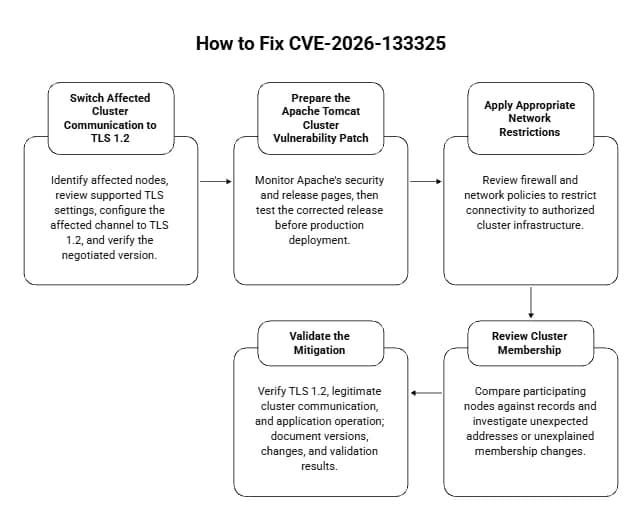
How to Fix CVE-2026-133325
Apache Tomcat CVE-2026-133325 Mitigation: Comparing the Available Options
|
Mitigation |
Security Benefit |
Limitation |
|
Switch to TLS 1.2 |
Applies Apache's documented workaround |
Temporary until corrected software is available |
|
Upgrade to a corrected release |
Incorporates Apache's software fix |
Requires release availability and compatibility testing |
|
Restrict cluster network access |
Reduces unnecessary connectivity |
Does not correct the authentication defect |
|
Monitor cluster membership |
Helps identify unexpected participants |
Does not prevent unauthorized membership |
|
Review TLS-PSK configuration |
Establishes whether the vulnerable conditions exist |
Assessment alone does not remove exposure |
|
Validate the running configuration |
Confirms whether changes took effect |
Requires operational verification |
The strongest response addresses the actual vulnerability while maintaining appropriate infrastructure security controls.
For affected deployments, Apache's recommended workaround should take priority until the corrected release is available.
Is This an Apache Tomcat TLS-PSK Security Misconfiguration?
The distinction between a software vulnerability and a configuration problem matters here.
CVE-2026-133325 is a confirmed implementation vulnerability.
The affected configuration uses TLS 1.3 with TLS-PSK, but the authentication failure occurs because Tomcat does not correctly enforce the expected authentication mechanism.
It would therefore be misleading to describe the issue solely as an administrator's misconfiguration.
A deployment can use the documented configuration and still be affected by an implementation defect.
The configuration determines whether the vulnerable behavior is relevant to a particular installation.
The software defect explains why the security boundary fails.
Both must be considered during an exposure assessment.
Related Apache Tomcat Security Issues: The EncryptInterceptor Advisory
Apache's November 2026 security advisories also identify CVE-2026-95517, which concerns the older EncryptInterceptor component.
Apache reports multiple weaknesses in this component, including problems involving integrity protection and cleartext transmission of sensitive information.
The project has deprecated EncryptInterceptor in favor of TLS-based cluster encryption.
That change provides useful context for CVE-2026-133325.
Administrators reviewing older cluster encryption arrangements must account for the newer TLS-PSK authentication vulnerability when planning a migration.
Moving away from EncryptInterceptor does not mean the affected TLS 1.3 configuration can be used without considering CVE-2026-133325.
Apache recommends TLS 1.2 for the affected cluster connections until corrected releases become available.
The two CVEs concern different security weaknesses. Their impacts should not be combined or treated as interchangeable.
Source: Apache Tomcat 11 Security Advisories
Has CVE-2026-133325 Been Exploited in the Wild?
Apache's disclosure confirms the vulnerability and its impact on cluster authentication.
However, the reviewed official advisory does not document a specific exploitation campaign, compromised organization, or named threat actor.
It also does not establish that attackers have used CVE-2026-133325 to steal data or execute code in a production environment.
That does not mean exploitation is impossible.
It means those claims are not supported by the primary evidence reviewed for this article.
Security teams should continue monitoring updated vendor advisories and reliable vulnerability intelligence.
The absence of a publicly confirmed incident should not delay the recommended mitigation for an affected deployment.
Apache Tomcat Security Best Practices After CVE-2026-133325
The vulnerability offers a useful reminder that secure configurations depend on the behavior of the software enforcing them.
For Tomcat administrators, the immediate concern is whether cluster authentication works as intended.
A broader security review should also examine the network boundaries surrounding cluster communication.
Apache's documentation recommends protecting clustering through trusted network arrangements or appropriate transport security mechanisms.
Administrators should ensure that only authorized systems can reach cluster services.
Sensitive configuration values, including pre-shared keys, must also remain protected.
When software updates introduce changes to communication or authentication mechanisms, those changes deserve specific testing.
A service starting successfully does not necessarily establish that its security controls work correctly.
Why Security Constraints and Security Manager Settings Are Separate Issues
Tomcat has other security controls, including web application security constraints and historically used Security Manager functionality.
These address different parts of the application's security model.
Security constraints are associated with controlling access to web application resources.
They are not a replacement for peer authentication between cluster nodes.
Likewise, Security Manager settings should not be presented as a fix for CVE-2026-133325.
The vendor's documented remediation concerns the affected cluster TLS configuration and corrected Tomcat releases.
Keeping these controls separate helps administrators avoid applying unrelated changes while leaving the actual vulnerability unresolved.
What Organizations Should Do Now
The response to this Apache Tomcat security issue should begin with an inventory of affected deployments.
For small businesses using managed application hosting, the service provider should be asked whether the environment uses Tomcat clustering with TLS 1.3 and TLS-PSK.
IT administrators should identify the installed versions and inspect the active cluster configuration.
Security teams should confirm which systems can reach the relevant communication services.
Where the documented conditions are present, Apache's TLS 1.2 workaround should be applied and verified.
Organizations should also prepare to install the appropriate corrected release when it becomes available.
The aim is to establish actual exposure rather than assume that every Tomcat deployment carries the same risk.
Frequently Asked Questions
What Is the Apache Tomcat Vulnerability CVE-2026-133325?
CVE-2026-133325 is a critical authentication vulnerability affecting certain Tomcat clusters using TLS 1.3 with TLS-PSK. It allows an unauthenticated node to join an affected cluster.
Which Apache Tomcat Versions Are Vulnerable?
Apache identifies Tomcat 11.0.28–11.0.29, 10.1.62, and 9.0.124 as affected. Exposure depends on the relevant cluster communication configuration.
How Can Administrators Mitigate the Apache Tomcat TLS-PSK Vulnerability?
Apache recommends switching affected cluster communication to TLS 1.2 until corrected releases become available. The identified fixed versions are 11.0.30, 10.1.63, and 9.0.125.
Does CVE-2026-133325 Allow Remote Code Execution?
Apache's advisory confirms unauthorized cluster membership but does not establish remote code execution as a consequence of this vulnerability.
Conclusion
The Apache Tomcat Vulnerability CVE-2026-133325 exposes a failure in the authentication process used by certain server clusters.
The affected implementation could accept a TLS 1.3 connection that did not use the pre-shared key authentication mechanism expected by Tomcat Tribes.
Apache's published patch addresses that failure by checking how the connection was authenticated and rejecting the unexpected certificate-based path.
The confirmed consequence is unauthorized cluster membership under the documented conditions.
For affected organizations, the immediate response is to verify the cluster configuration, apply Apache's TLS 1.2 workaround, and prepare to install a corrected release.
The incident also highlights a broader security principle: encryption alone does not establish trust.
A secure system must enforce the authentication requirements that determine which participants are allowed to communicate.
Official References
- Apache Tomcat 11 Security Advisories
- Apache Tomcat 10 Security Advisories
- Apache Tomcat 9 Security Advisories
- Apache Tomcat Security Fix, Commit 8dcddccc
- Apache Tomcat 11 Cluster Configuration
- MITRE CWE-322
- CVE-2026-133325 Official Record
Last Verified: November 20, 2026.
Author : Md Saiful Islam is a Security Engineer specializing in cybersecurity, network security, vulnerability assessment, penetration testing, incident response, and security compliance. She focuses on identifying security risks, strengthening defenses, and implementing secure solutions to protect organizations against evolving cyber threats.
Technical reviewer: Gazi Mahmud, Co-Founder and CIO of Hoplon InfoSec LLC, cybersecurity leader, and CISM & CISA certified professional with expertise in cyber risk management, security governance, compliance, and incident response.
Read More Articles:
Public Wi-Fi Hacking Risks and Security Tips
Fake CAPTCHA Attacks Used by Russian Hackers
eXch Cryptocurrency Exchange Shutdown and $1.9 Billion Laundering Allegations
EddieStealer Rust-Based Information Stealing Malware
100+ LTE and 5G Security Vulnerabilities