Microsoft X Account Hacked to Promote Clippy Crypto Token
Was the Microsoft X account hacked
on October 1, 2026?
Microsoft says unauthorized users did gain access to its official account. The microsoft
x account hacked incident became visible after the account followed and
reposted content from a Clippy-themed cryptocurrency account and temporarily
changed its profile image. Microsoft later secured the account and removed
unauthorized material.
The exact intrusion method has not been disclosed. BleepingComputer described the crypto activity as appearing to form part of a pump-and-dump scheme, but Microsoft has confirmed the account compromise, not every detail about the people behind the token or their financial activity.
That distinction matters. A verified account belonging to one of the world's most recognizable technology companies can give an unauthorized investment message instant credibility. When cryptocurrency is involved, even a short-lived compromise can expose millions of people to misleading claims, malicious links, or financially risky decisions.
What Happened to Microsoft's X Account?
The microsoft x account hacked story started attracting attention when Microsoft's official @Microsoft profile began behaving in ways that did not match its normal activity.
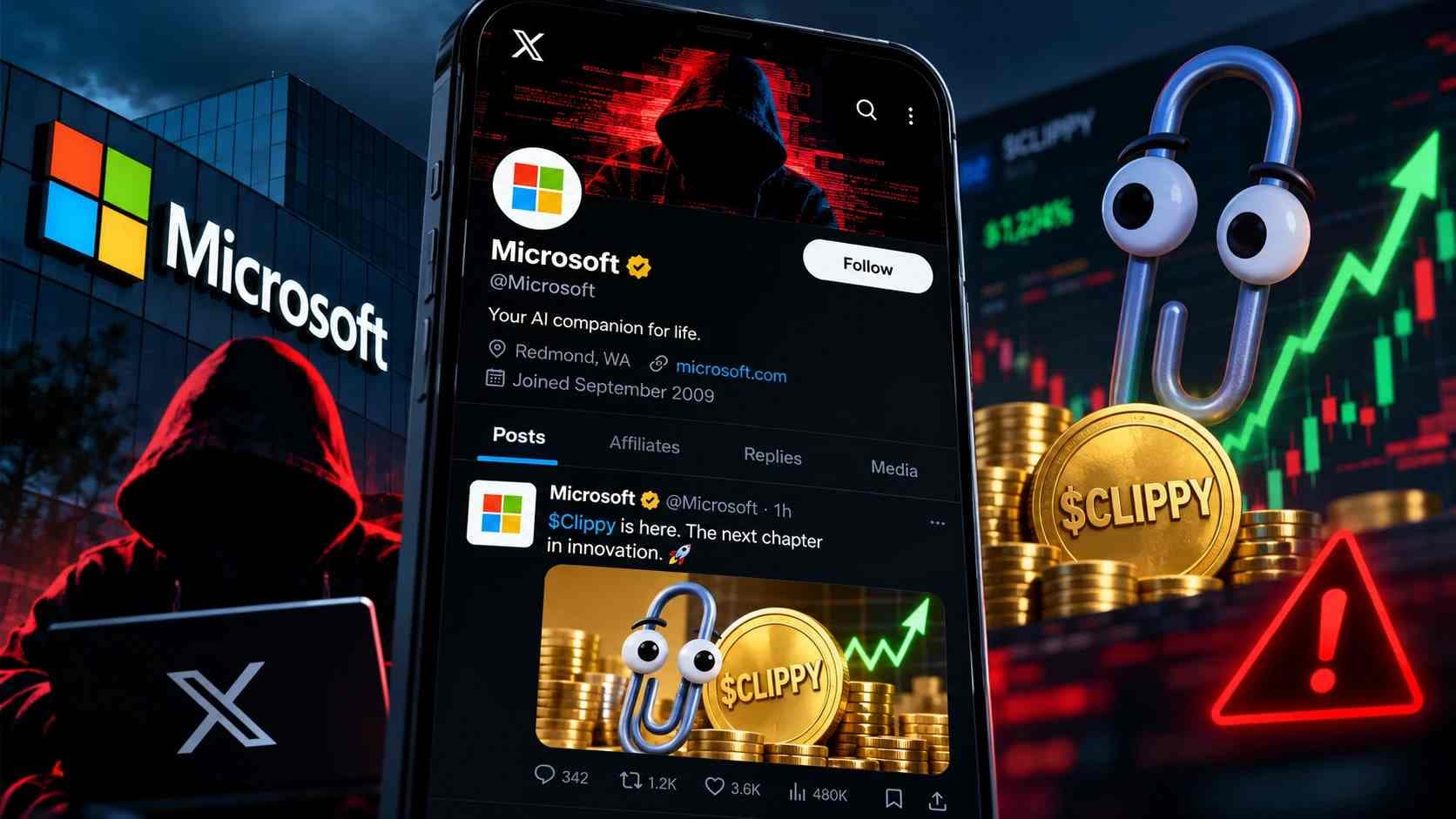
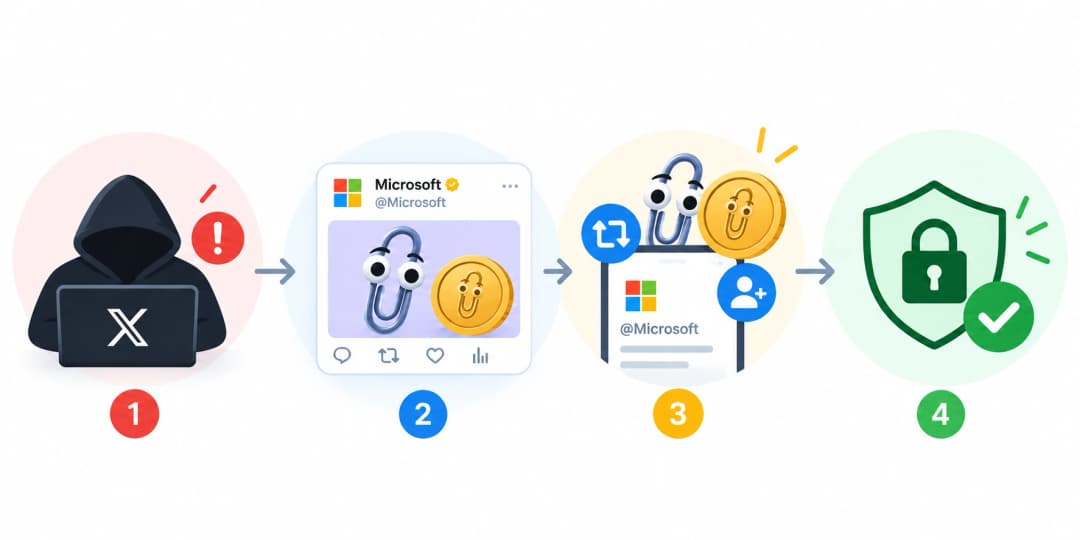
According to The Verge, the account followed a Clippy-related cryptocurrency account, reposted one of its posts, and changed its profile picture to an image based on Microsoft's well-known paperclip character. The unusual material was later removed.
Microsoft spokesperson Brent Colburn then confirmed unauthorized access. Microsoft said the account had been secured, the unauthorized posts had been removed, and the circumstances were still under investigation.
That last point is important. At the time of writing, Microsoft has not publicly identified an attacker or disclosed the technical path used to gain access.
What was unusual about the account?
NewsBytes reported that the profile image was changed to a Clippy-themed image and that the account had followed and reposted material associated with a Clippy crypto profile. It also reported that an unusual apology post appeared roughly 30 minutes later and was subsequently deleted.
BleepingComputer reported that the initially promoted account, @clippymsftcto, was later suspended by X. Another account continued promoting a $Clippy token and claimed it had a liquidity relationship with tokenized $MSFT. That was a claim made by the promoter, not a fact independently verified by Microsoft.
Timeline of the Microsoft X Account Hack
The visible microsoft x account hacked timeline is relatively short, but several events can be established from current reporting.
Unauthorized activity appears
On October 1, Microsoft's official account began interacting with a Clippy-themed cryptocurrency profile. This behavior was sufficiently unusual for technology journalists and X users to notice it quickly.
Clippy crypto content is promoted
The compromised profile followed the Clippy crypto account and reposted content from it. Microsoft's profile image was also changed. These actions are significant because a repost from Microsoft's genuine account can appear far more credible than the same message coming from an unknown crypto profile.
BleepingComputer reported that Microsoft's official account had more than 13 million followers at the time, which dramatically increased the potential visibility of anything published or amplified during the takeover.
Microsoft secures the account
Microsoft subsequently confirmed the unauthorized access and said it had secured the account and removed unauthorized posts. Its investigation remained ongoing when the reports were published.
No reliable public source currently establishes the exact length of attacker access or every action performed while access was available.
What is the Clippy Crypto Token?
The microsoft x account hacked incident attracted additional attention because the cryptocurrency promotion used Clippy, a character strongly associated with Microsoft's history.
Clippy, formally known as Clippit, was the animated paperclip assistant used in older Microsoft Office products. That familiarity has obvious branding value. A cryptocurrency account using the character can immediately look connected to Microsoft even when no legitimate relationship exists.
That appears to be a central issue in this case. BleepingComputer reported that Microsoft explicitly denied authorizing, sponsoring, endorsing, or granting permission for a cryptocurrency associated with Microsoft, Clippy, or $MSFT.
This makes the difference between branding and authorization especially important. A project can use a familiar image, company name, stock ticker, or cultural reference without having a genuine commercial relationship with the company it resembles.
Is the Clippy Crypto Token Really From Microsoft?
No verified information currently establishes the token promoted during the microsoft x account hacked incident as an official Microsoft cryptocurrency.
Microsoft's reported statement was unusually clear on this point. The company denied affiliation with the token and said it had not authorized or endorsed a cryptocurrency associated with Microsoft, Clippy, or $MSFT.
That is why seeing a token mentioned by a genuine corporate social account is not enough to establish legitimacy. If the social account itself has been compromised, its blue or organizational verification badge becomes part of the attacker's credibility.
A safer verification method is to check the company's official website, newsroom, investor relations page, and several independently controlled official channels before acting on a financial announcement.
Was the Microsoft X Hack a Crypto Pump-and-Dump Scheme?
The phrase needs some care.
BleepingComputer reported that the microsoft x account hacked incident appeared to involve a pump-and-dump scheme. That is the publication's characterization based on the observed token promotion. Microsoft itself has confirmed unauthorized account access and denied affiliation with the token, but current public statements do not provide a complete financial or blockchain investigation of the scheme.
What is a pump-and-dump?
A crypto pump-and-dump generally involves promoting an asset in a way that drives attention and buying activity, followed by insiders or major holders selling into that demand. The people who buy later can be left holding an asset whose price rapidly collapses.
The existence of promotional activity alone does not prove every element of such a scheme. Establishing that usually requires evidence involving token ownership, transaction timing, wallet relationships, liquidity, promotional coordination, and subsequent selling.
What is confirmed?
Three important things are confirmed.
Microsoft's account was accessed without authorization. Crypto-related Clippy content appeared through that account. Microsoft secured the account and denied affiliation with the cryptocurrency project.
What remains unknown?
The identity of the attackers is not publicly established.
The initial access method is not publicly established.
Current authoritative reporting also does not provide a complete verified figure for investor losses specifically caused by the Microsoft account compromise.
Readers should therefore be cautious with social posts claiming a precise theft total, attacker identity, or technical exploit unless those claims are later supported by Microsoft, X, law enforcement, or credible blockchain analysis.
How Was Microsoft's X Account Hacked?
The exact cause of the microsoft x account hacked incident has not been publicly confirmed.
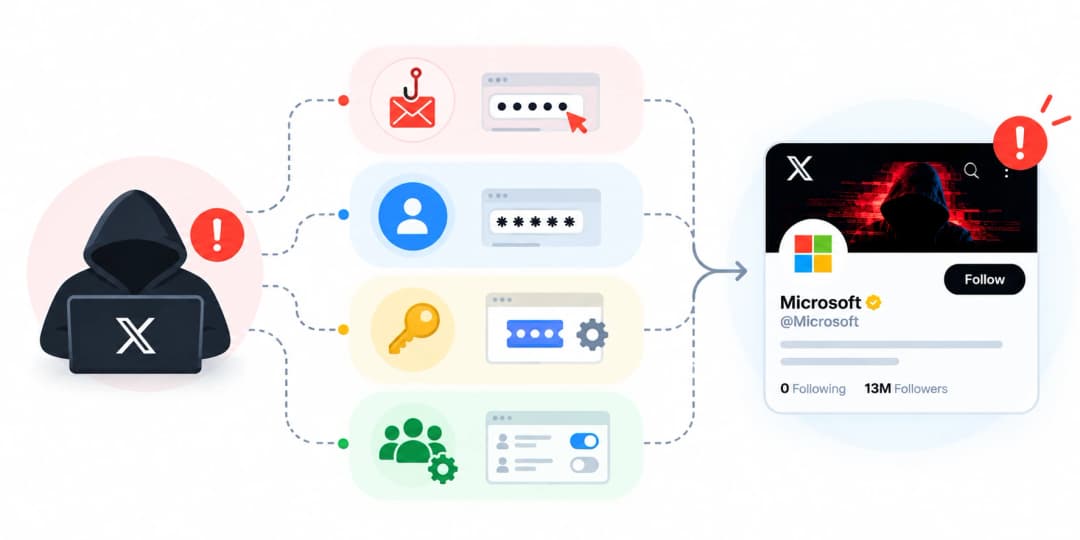
It would be inaccurate to claim that Microsoft lost the account through phishing, SIM swapping, malware, a stolen session cookie, a malicious application, or an insider unless evidence emerges. Microsoft says it is investigating the circumstances.
Still, understanding common account takeover methods helps explain why even strong organizations can face social media compromises.
Phishing and credential theft
X says accounts can be compromised after users provide credentials to malicious websites or third-party applications, use weak passwords, encounter password-stealing malware, or connect through compromised networks.
Phishing remains especially dangerous because an attacker does not need to exploit the social platform itself. Convincing one authorized user to surrender access can be enough.
Session and authentication token theft
Modern attacks can go further than stealing passwords.
Microsoft Threat Intelligence has documented adversary-in-the-middle, or AiTM, phishing campaigns that intercept authentication sessions and capture tokens after a user signs in. A stolen authenticated session can sometimes let an attacker continue acting as the victim without repeatedly entering the original password or completing ordinary MFA prompts.
This is useful context, but there is no public evidence tying AiTM token theft specifically to this Microsoft X incident.
Compromised authorized access
Corporate social accounts are often operated by teams rather than one person. That creates a broader access surface involving staff, agencies, social media management systems, connected applications, and active sessions.
X allows users to review applications and sessions connected to an account and revoke access when necessary.
For organizations, reducing the number of people and systems with publishing rights can reduce the number of places an attacker can target.
Why Do Crypto Scammers Target Verified X Accounts?
The microsoft x account hacked case shows why account reputation has value to attackers.
Imagine receiving the same investment message from two accounts. One was created yesterday and has 19 followers. The other belongs to a company you have recognized for decades. Most people will instinctively give the second message more attention.
That borrowed trust is the attacker's advantage.
The risk is not theoretical. In June 2024, Microsoft India's verified X account was hijacked and used to impersonate Roaring Kitty and promote a fraudulent GameStop cryptocurrency presale. BleepingComputer reported that the campaign directed users toward a site designed to drain cryptocurrency wallets after users connected them and authorized transactions.
Blockchain security researchers have also documented the scale of malicious crypto promotion on social platforms. Scam Sniffer reported that MS Drainer campaigns used roughly 10,072 phishing sites and stole approximately $58.98 million from about 63,210 victims over nine months in 2023.
The research group summarized the distribution problem clearly: "advertising has become an important means for phishing scammers to reach their victims."
How Hacked X Accounts Can Be Used in Crypto Scams
Once the microsoft x account hacked story is viewed as a social media account takeover rather than just a strange social media post, several risks become clearer.
Fake token promotion
An attacker can use an established account to present an unknown cryptocurrency as if it has corporate backing.
The brand does much of the persuasion. The scammer does not need to explain why the token deserves attention if users mistakenly believe the company itself created it.
Phishing and wallet drainers
The next stage can be more dangerous than the promotional post.
A fake token page may ask the visitor to connect a cryptocurrency wallet. Some malicious sites then attempt to obtain blockchain permissions that let an attacker transfer assets.
This happened in the earlier Microsoft India incident, where victims were directed toward a fraudulent crypto presale and risked losing assets after approving wallet transactions.
For related internal coverage, Hoplon readers can review crypto wallet malware and crypto fraud victims.
Fake giveaways and urgency
Scammers can also use limited-time giveaways, token launches, presales, or "claim now" messages.
Urgency works because it reduces verification time. The reader becomes worried about missing an opportunity and clicks before independently checking whether the announcement appears anywhere else.
Brand impersonation
A compromised verified profile solves one of the scammer's hardest problems: looking authentic.
The attacker is no longer merely imitating a company. For a brief period, the attacker is speaking through the company's real account.
Similar High-Profile X Account Crypto Hacks
The microsoft x account hacked incident is not an isolated example of attackers using trusted social identities to influence cryptocurrency activity.
Microsoft India, 2024
In June 2024, Microsoft's India X account was compromised and used in a Roaring Kitty themed cryptocurrency scam. The account had more than 211,000 followers and organizational verification, giving the fraudulent posts additional credibility.
Attackers directed users toward a wallet-draining site presented as a GameStop cryptocurrency presale.
SEC X account, 2024
The Securities and Exchange Commission provides an even clearer example of how one compromised account can affect a market.
The SEC said an unauthorized party gained control of the phone number associated with its @SECGov X account through a SIM swap and published a false announcement claiming that spot Bitcoin exchange-traded funds had been approved.
The U.S. Department of Justice later said Bitcoin rose by more than $1,000 after the fraudulent announcement and fell by more than $2,000 after the correction. Eric Council Jr. was eventually sentenced to 14 months in prison for his role in the account takeover conspiracy.
The comparison is useful, but the two incidents should not be conflated. The SEC attack method is known. Microsoft's October 2026 compromise method currently is not.
A WIRED journalist's X account, 2025
WIRED documented another case in which a journalist's X account was taken over and used to promote a fraudulent WIRED-branded memecoin. The episode illustrates that attackers do not need millions of followers. A smaller account can still be attractive when its identity carries authority inside a particular community.
How to Spot a Crypto Scam From a Hacked Account
The microsoft x account hacked case provides a useful reminder that account verification is only one trust signal.
Watch for several signals appearing together:
- A company that rarely discusses cryptocurrency suddenly launches a token.
- The profile photo, display name, biography, or posting style changes without explanation.
- The post directs users toward an unfamiliar domain.
- The message demands immediate action.
- A wallet connection or cryptocurrency transfer is required.
- No matching announcement appears on the company's official website.
- Other official accounts remain silent.
- The supposed project relies heavily on a famous logo, mascot, executive, or stock ticker.
- Supporting accounts were recently created or have little credible history.
- The project promises unusually easy or rapid returns.
The FBI specifically advises people to independently verify cryptocurrency investment opportunities encountered on social media and to be suspicious of get-rich-quick claims.
What Should Users Do Before Trusting Crypto Posts From Major Brands?
The microsoft x account hacked incident demonstrates why verification should happen outside the post you are trying to verify.
First, visit the company's official website manually instead of following the social post's link. Check its newsroom, investor relations pages, product pages, and other official accounts.
Second, search for independent reporting from established technology, financial, or cybersecurity publications. A genuine cryptocurrency launch by a company the size of Microsoft would normally leave a much broader public record than a single X post.
Third, do not connect a wallet simply to investigate a suspicious project. Wallet connection prompts can lead to requests for permissions or signatures that are difficult for nontechnical users to interpret.
If you already clicked a suspicious link, Hoplon has a separate guide on what to do after clicking a phishing link.
What Organizations Can Learn From the Microsoft X Account Hack
The microsoft x account hacked incident also matters to businesses that never touch cryptocurrency.
A company's social account is part of its public identity. If an attacker controls it, the attacker temporarily inherits the company's audience and reputation.
Use phishing-resistant MFA
CISA recommends multifactor authentication for business accounts and specifically says organizations should aim for phishing-resistant MFA.
CISA guidance also identifies FIDO-based authentication, including hardware security keys, as a strong defense against phishing and account hijacking techniques.
X itself supports authentication apps and physical security keys as two-factor authentication methods.
For an internal educational link, see Hoplon's guide to 2FA vs MFA.
Limit publishing access
Only people who genuinely need social media publishing rights should have them.
Organizations should periodically review employees, contractors, agencies, applications, and active sessions with access to high-value accounts.
CISA recommends role-based access control and the principle of least privilege for important systems.
Monitor account behavior
A changed profile photo, unexpected follow, new connected application, unusual post, or login from an unfamiliar location should trigger review.
X explicitly lists unexpected posts, messages, follows, and account changes among signs that an account may be compromised.
Prepare a social media incident plan
Organizations often have response plans for ransomware and email compromise but overlook public social profiles.
A practical plan should define who can contact the platform, who can revoke sessions, who publishes external corrections, who preserves evidence, and who monitors for secondary impersonation accounts.
The goal is speed without confusion.
Hoplon Insight
Treat high-profile social accounts as part of your identity infrastructure. Use phishing-resistant MFA, minimize privileged access, review connected applications and sessions, monitor unexpected account changes, and maintain a documented recovery process. The safest assumption is that a verified badge proves who normally owns an account, not that every post currently coming from it is trustworthy.
Hoplon has previously covered another social account takeover scenario involving Instagram, which provides additional context for recovery and authentication risks.
Why This Matters Beyond Microsoft
The final lesson from the microsoft x account hacked incident is about digital trust.
Social platforms compress identity, reputation, information, and action into one screen. A familiar logo, verified account, and urgent message can convince people to move from reading to acting within seconds.
Crypto fraud makes that problem more costly because transactions can be difficult to reverse. The FBI reported that Americans submitted 181,565 cryptocurrency-related complaints in 2025 involving more than $11 billion in reported losses. That figure covers many types of crypto-enabled crime and should not be attributed to X account compromises alone.
This is why the most important security habit is not simply "check the badge." Verify important financial claims through a second channel before clicking, connecting, signing, transferring, or investing.
Frequently Asked Questions
Was Microsoft's X account hacked?
Microsoft confirmed unauthorized access to its official X account. The company said unauthorized posts were removed and the account was secured. Its investigation was still continuing when current reports were published.
Is the Clippy cryptocurrency officially connected to Microsoft?
Current evidence does not show an official relationship. Microsoft reportedly denied authorizing, sponsoring, endorsing, or granting permission for a cryptocurrency associated with Clippy, Microsoft, or $MSFT.
How was Microsoft's X account hacked?
The attack vector has not been publicly disclosed. Phishing, credential theft, session theft, malware, malicious applications, and other techniques are known ways social accounts can be compromised, but attributing any specific method to this incident would currently be speculation.
Was the incident definitely a pump-and-dump?
BleepingComputer described the activity as appearing to be a crypto pump-and-dump scheme. Microsoft has confirmed unauthorized access and denied affiliation with the promoted cryptocurrency. A complete public analysis establishing every financial component of a pump-and-dump operation is not currently available.
Wrap Up
The microsoft x account hacked incident shows how quickly trust in a legitimate social media account can be redirected toward an unauthorized financial promotion. Microsoft's account interacted with Clippy-themed cryptocurrency content before the company regained control, removed unauthorized material, and confirmed the compromise.
What remains unknown is equally important. Microsoft has not publicly identified the attacker or confirmed how access was obtained. Readers should therefore separate established facts from theories circulating online.
For users, the practical lesson is simple: verify unexpected financial announcements outside the social platform before acting. For organizations, protect social accounts with the same seriousness given to email, administrator identities, and other systems capable of speaking on the company's behalf.