
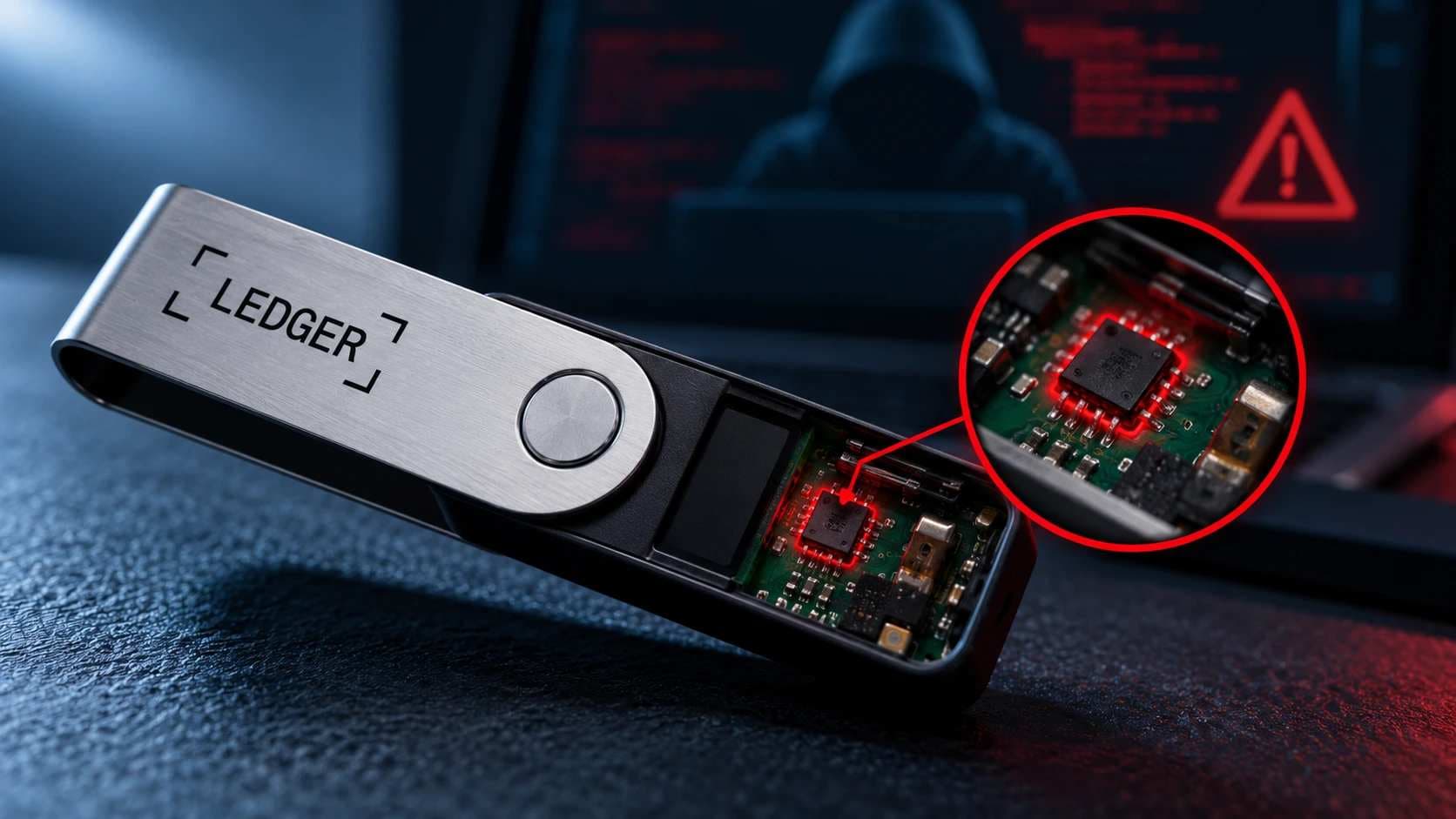
Can a genuine Ledger hardware wallet contain a hidden chip that steals its owner's recovery phrase? Yes. On October 10, 2026, Ledger confirmed finding an unauthorized hardware implant inside one device belonging to an affected customer. The discovery followed reports of cryptocurrency thefts involving wallets purchased through Southeast Asian reseller CryptoBilis.
The Ledger wallet spy chip investigation raises an important question about physical security. A device can contain genuine security components and still be modified to expose sensitive information. Independent researchers have demonstrated how concealed circuitry can intercept recovery words displayed during setup. Ledger has not established that this mechanism caused every reported theft.
The financial impact may also be substantial. In its October 12 update, blockchain analytics firm Bitquery estimated that approximately $102 million was drained from 324 wallets across six networks. This is an independent estimate, not a total confirmed by Ledger.
For anyone using a Ledger crypto wallet, the incident shows why protecting a recovery phrase involves more than keeping a device disconnected from the internet.
What Happened in the Ledger Wallet Spy Chip Incident?
The investigation began publicly on October 9, 2026, when Ledger acknowledged reports of missing cryptocurrency from customers who had purchased devices through CryptoBilis.
CryptoBilis operated as a hardware wallet reseller serving customers in Southeast Asia, including Indonesia, Malaysia, and the Philippines.
At first, the cause of the reported losses was unclear. Some investigators suspected that attackers had interfered with devices before customers received them.
Ledger asked CryptoBilis to suspend sales and shipments while the investigation continued. The company also warned recent buyers not to initialize unused devices.
On October 10, Ledger confirmed that one affected customer's device contained unauthorized hardware.
A further company update on October 11 said the confirmed cases associated with the October 9 draining incident involved CryptoBilis-sold devices. Ledger described the number of affected devices as limited and said its own systems and direct sales channels remained unaffected.
Timeline of the CryptoBilis Ledger Attack
|
Date |
Verified development |
|
October 9, 2026 |
Ledger acknowledged reports of cryptocurrency losses involving CryptoBilis customers. |
|
October 9, 2026 |
Ledger requested a pause in reseller sales and advised potentially affected customers to take precautions. |
|
October 10, 2026 |
Ledger confirmed an unauthorized implant in one affected customer's device. |
|
October 11, 2026 |
Ledger said all confirmed cases in the disclosed incident involved CryptoBilis-sold devices. |
|
October 12, 2026 |
Bitquery updated its independent estimate to $102 million across 324 wallets. |
The sequence matters because several early reports were published before Ledger confirmed the physical implant.
Some articles also used smaller financial-loss estimates that were subsequently revised.
What Has Ledger Actually Confirmed?
Ledger's public statements establish that unauthorized hardware was found in at least one affected device.
They do not conclusively identify who installed the component, precisely when it was installed, or whether the same modification caused every reported wallet drain.
The investigation also has not established that all Ledger devices, or every device sold through CryptoBilis, were compromised.
These distinctions are essential. Finding a malicious component provides physical evidence of tampering, but establishing its role in every theft requires additional forensic evidence.
How Does the Ledger Wallet Spy Chip Work?
A conventional hardware wallet protects private keys by keeping them inside a dedicated security chip rather than exposing them directly to an internet-connected computer.
That protection is valuable, but it depends on the integrity of the complete device.
Independent research into modified Ledger Nano X devices has documented another attack path: monitoring the communication between the wallet's electronics and its display.
Instead of extracting private keys directly from the Secure Element, an unauthorized component can observe what appears on the screen.
This is particularly dangerous during initial wallet setup, when recovery words are displayed so the owner can record them.
Intercepting Information Sent to the Display
The Ledger Nano X uses an OLED display to show sensitive information and transaction details.
Tibane Labs examined modified devices containing additional circuitry connected to the display communication system.
The researchers documented implants that monitored the SPI interface, a communication method used to transfer data between electronic components.
An unauthorized circuit connected to this interface can observe information being sent to the screen.
The attacker does not necessarily need to change what the owner sees.
That is an important detail. The wallet may appear to behave normally while another component quietly monitors the display information. (Tibane Labs)
How Recovery Words Can Be Captured
During setup, a Ledger device generates a recovery phrase that allows the wallet to be restored later.
For the investigated Nano X implementation, the relevant recovery phrase contains 24 words.
The words appear on the device display, where the legitimate owner is expected to write them down privately.
According to Tibane Labs, the documented implant can identify recovery words by analyzing the screen data and recognizing the displayed letters.
The researchers describe a process that reconstructs words from information transmitted to the display.
This is different from breaking the encryption protecting the private keys.
The attacker is targeting sensitive information at a moment when it becomes visible to the user.
Once the recovery phrase is exposed, the attacker may be able to restore the corresponding wallet elsewhere without physically possessing the original device.
How the Information Leaves the Wallet
The analyzed implants included cellular communication components.
Researchers identified hardware such as microcontrollers, LTE modules, eSIM components, and antennas.
These components provided a potential path for transmitting captured information outside the device.
A normal Ledger Nano X does not need an independent cellular modem to protect private keys or authorize transactions.
The additional communications hardware is therefore significant.
The documented attack shows how a seemingly offline security device can contain unauthorized equipment capable of communicating independently.
This does not mean every modified device used precisely the same components or that all observed implants transmitted successfully in every environment.
The Ledger wallet spy chip research establishes the feasibility and physical implementation of the technique. Its connection to each individual theft remains an investigative question.
-20261013173827.webp "Ledger Hardware Wallet")
Why the Secure Element May Remain Uncompromised
The Secure Element is the protected chip responsible for sensitive cryptographic operations inside a Ledger device.
Its purpose includes safeguarding secrets and supporting secure transaction authorization.
A common misunderstanding is that a recovery phrase theft must mean the security chip itself was hacked.
That is not necessarily true.
In the documented hardware-implant research, the attacker observes information outside the protected chip rather than extracting its secrets directly.
This creates a distinction between protecting a secret while it is stored and protecting it when it is displayed.
The Secure Element may continue performing its intended operations correctly, even though another component has been added to the device.
Tibane Labs summarized the finding this way:
“The secure element is never attacked, and the device works normally.”
This is the researchers' description of the examined implant architecture, not a claim that every reported theft has been forensically reconstructed.
Three Generations of Ledger Nano X Hardware Implants
The research also reveals how the physical design of these implants changed over time.
|
Generation |
Documented design |
Main difference |
|
First generation |
Additional board connected with visible hand-soldered wires |
Relatively crude physical installation |
|
Second generation |
Custom flexible circuit connecting to board contacts |
More integrated and less conspicuous |
|
Third generation |
Smaller assembly designed to fit beneath the display |
Improved concealment while retaining the original battery |
Joe Grand, a hardware security researcher, investigated an earlier modified device after reports emerged in 2025.
Tibane Labs later documented more integrated designs in devices obtained during September 2026.
The progression illustrates how unauthorized hardware can become harder to identify through casual visual inspection.
However, these research specimens should not automatically be treated as devices involved in the October 9 CryptoBilis losses.
The published evidence does not establish that every specimen belonged to the same criminal operation.
Why Ledger Genuine Check May Not Detect the Implant
One of the most important questions surrounding the incident is how a modified device can pass Ledger's authenticity verification.
Ledger Genuine Check is designed to establish whether a device contains an authentic Secure Element.
It uses cryptographic authentication to verify the identity of that component.
This process can help distinguish genuine security hardware from counterfeit components.
But it does not provide a complete inspection of every physical part inside the wallet.
Ledger's own security documentation acknowledges that the Genuine Check cannot detect all unauthorized physical modifications when the original Secure Element remains intact.
Authenticity and Physical Integrity Are Different
Consider two separate questions.
First, does the device contain the expected authentic security chip?
Second, has someone installed additional circuitry inside the device?
A cryptographic authenticity check can answer the first question without conclusively answering the second.
The Ledger wallet spy chip case demonstrates why those questions must be considered separately.
A genuine component does not automatically establish that the rest of the device has remained untouched throughout manufacturing, storage, transportation, and resale.
|
Security control |
What it helps verify |
What it does not establish |
|
Genuine Check |
Authenticity of the Secure Element |
Absence of every physical implant |
|
Device PIN |
Authorization to unlock the physical device |
Secrecy of an already exposed recovery phrase |
|
Secure Element |
Protection of sensitive cryptographic material |
Integrity of every external circuit |
|
Packaging inspection |
Visible signs of damage or interference |
Absence of carefully concealed modifications |
|
Trusted purchase channel |
Better control over product sourcing |
An absolute guarantee against tampering |
Packaging provides another example.
An unopened-looking box may appear reassuring, but seals and wrapping are not definitive security measurements.
Ledger's threat-model documentation explains that traditional tamper-evident seals can be reproduced or bypassed.
The practical lesson is not that authenticity checks are useless.
They remain valuable within their intended security boundaries.
The problem arises when users assume that passing one type of verification proves that every possible attack has been excluded.
How Much Cryptocurrency Was Reportedly Stolen?
The reported financial impact of the incident changed as blockchain investigators expanded their analysis.
Early estimates exceeded $86 million.
Subsequent research identified additional addresses and transactions, increasing the estimated total.
On October 12, Bitquery updated its investigation after identifying previously missed wallet drains.
Its revised findings covered approximately $102 million in suspected losses.
What Bitquery Found
According to Bitquery's October 12 update:
|
Finding |
Reported result |
|
Estimated cryptocurrency losses |
$102.0 million |
|
Wallets identified |
324 |
|
Blockchain networks |
6 |
|
Networks examined |
TRON, Bitcoin, Ethereum, Solana, BNB Chain, Polygon |
|
Tether funds reportedly frozen |
Approximately $10 million |
|
Evidence of coordinated activity |
Closely timed approvals and transfers |
These numbers come from Bitquery's independent on-chain investigation, not from an official Ledger loss statement. (Bitquery)
The distinction matters because blockchains reveal transactions, wallet addresses, and patterns of asset movement.
They do not automatically reveal how an attacker first obtained access to a recovery phrase.
Why the Theft Appears Coordinated
Bitquery reported that multiple wallets authorized similar activity within a remarkably short period.
Its investigation identified 25 TRON wallets signing the same type of approval within approximately three seconds.
The report also described earlier test transactions and a coordinated sequence of transfers across several networks.
Those patterns support the researchers' assessment that the attacker may have accumulated access before initiating the larger theft.
A stolen recovery phrase can remain useful long after initial exposure.
An attacker who possesses it does not need to empty the wallet immediately.
That creates a dangerous situation: the owner may continue using the device without realizing that another party can reproduce access to the associated accounts.
However, coordinated transactions alone cannot prove that the hardware implant caused every compromise.
Does the $102 Million Estimate Mean Victims Lost That Amount Permanently?
Not necessarily.
Funds being traced, frozen, exchanged, or held in suspected attacker-controlled addresses are different investigative categories.
For example, Bitquery reported that Tether froze approximately $10 million in USDT associated with the activity.
Frozen cryptocurrency should not automatically be described as recovered or returned to victims.
Recovery depends on additional processes and circumstances that the available research does not establish.
Ledger has not published an independently verified final loss total for the incident.
Which Ledger Hardware Wallets Are Affected?
The confirmed incident reports concern devices sold through CryptoBilis.
Ledger's October 11 statement connected all confirmed cases in the disclosed October 9 draining incident to that reseller.
Independent researchers have examined modified Ledger Nano X devices, but Ledger's public statements did not provide a complete model-by-model breakdown of affected products.
It would therefore be misleading to conclude that every Ledger Nano X was compromised.
It would also be premature to declare every other model completely unaffected without supporting evidence.
Are Ledger Wallets in the United States Affected?
The confirmed cases described by Ledger were associated with a Southeast Asian reseller.
The reviewed investigation updates did not establish a confirmed group of affected customers in the United States.
That does not prove that physical tampering is impossible in other markets.
It simply means the currently verified incident scope should not be expanded without evidence.
For US customers, the appropriate response depends on where the device was purchased, whether that seller is connected to the investigation, and whether there is any credible indication of compromise.
An unrelated purchase is not automatically evidence of exposure.
What About Authorized Resellers?
The incident highlights a broader supply-chain problem.
Buying from an authorized reseller can reduce certain purchasing risks, but it cannot provide an absolute guarantee that a product has never been modified.
Ledger advised distributors to obtain devices through authorized channels and not to return previously sold products to inventory.
CryptoBilis also suspended hardware-wallet sales during the investigation.
The Ledger wallet spy chip incident therefore raises questions about inventory handling, product custody, returned devices, and verification procedures throughout the distribution chain.
It does not establish that any particular employee, distributor, or manufacturer was responsible for installing the implant.
What Should Ledger Wallet Owners Do Now?
The most useful response is based on the owner's actual situation.
Someone who purchased a device through the affected reseller needs different guidance from someone who bought through an unrelated channel and has no indication of compromise.
Ledger's initial advice specifically addressed customers who purchased devices through CryptoBilis during the preceding 90 days.
If You Purchased a CryptoBilis Device but Have Not Set It Up
Do not initialize the device.
Ledger advised affected recent buyers to avoid starting the setup process while the investigation continued.
Do not generate or import a recovery phrase on a device suspected of containing unauthorized hardware.
Contact Ledger through its official support website for current instructions.
Keep the purchase information, order confirmation, and relevant communications available.
Avoid opening or modifying the device yourself merely to search for additional circuitry.
An untrained inspection may damage the hardware or interfere with later examination.
If You Already Initialized a Potentially Affected Device
Treat the possibility of recovery phrase exposure seriously.
Ledger advised customers who had already initialized relevant devices to consider moving their assets to a new trusted signer with a newly generated recovery phrase.
The most important part is using a genuinely new secret.
Restoring the old recovery phrase on a replacement device does not prevent someone who already knows those words from accessing the original accounts.
The replacement must create a new wallet identity, and the assets must be transferred to addresses controlled by that new identity.
A careful response involves obtaining a trusted replacement device, generating a new recovery phrase securely, verifying the receiving addresses, and transferring remaining assets without exposing the recovery words online.
Users dealing with significant balances or an actively compromised wallet should seek immediate guidance through verified support channels.
Why Changing the PIN is Not Enough
A device PIN protects access to the physical wallet.
A recovery phrase protects the underlying ability to restore the wallet elsewhere.
These are separate protections.
If an attacker already possesses the recovery phrase, changing the PIN on the original device does not invalidate the phrase.
The attacker may be able to restore the associated accounts on another compatible wallet.
That is why migration to a newly generated recovery phrase matters.
Ledger's recovery documentation explains that a recovery phrase can restore the corresponding accounts even when the original device is unavailable.
Beware of Fake Support Messages
Major cryptocurrency incidents frequently create opportunities for impersonation scams.
Someone claiming to represent a wallet manufacturer, security investigator, exchange, or recovery service may attempt to collect additional information from concerned users.
The most dangerous request is for a recovery phrase.
Do not share recovery words through email, messaging applications, websites, phone calls, or social media.
Never enter them into a form presented as a security verification or refund process.
Ledger states that its support representatives will not request a user's secret recovery phrase.
Always navigate to official support channels independently instead of trusting unexpected messages.
-20261013174206.webp)
What is a Ledger Wallet, and How Does It Work?
Understanding the underlying technology helps explain why this attack is unusual.
A Ledger wallet is a hardware device used to protect the cryptographic keys associated with cryptocurrency accounts.
A Ledger hardware wallet does not physically store Bitcoin, Ethereum, or other digital assets inside the device.
The assets exist as records on their respective blockchains.
The hardware wallet protects the private keys that authorize transactions involving those assets.
When an owner initiates a transaction, the device performs a signing operation using the protected key.
That design helps reduce exposure to malware running on an ordinary computer.
Is Ledger a Cold Wallet?
A Ledger device is commonly described as a cold wallet because its private keys are intended to remain protected inside dedicated hardware rather than being exposed to an internet-connected computer.
The Ledger Nano X cold wallet is designed to support this separation while allowing users to manage transactions through compatible applications.
However, cold storage does not mean that every physical component inside a device is incapable of communicating.
A maliciously modified device may contain hardware that was never part of the legitimate design.
That distinction is central to the current investigation.
Is Ledger Non-Custodial or Decentralized?
A Ledger cryptocurrency wallet supports non-custodial ownership because the user controls the cryptographic secrets needed to access the associated assets.
Ledger does not ordinarily need to hold those private keys on the user's behalf for the wallet to function.
The terms decentralized wallet and Web3 wallet describe related but different ideas.
The underlying blockchain may be decentralized, while the wallet device and supporting applications remain products developed by specific organizations.
A Ledger device can also be used with compatible Web3 applications.
None of these classifications guarantees immunity from physical tampering.
The Ledger wallet spy chip incident concerns device integrity, not a fundamental change in how blockchain ownership works.
How is This Different From Other Crypto Wallet Attacks?
Not every cryptocurrency theft involving a hardware wallet has the same cause.
Attackers can target browser extensions, computer clipboards, recovery backups, malicious websites, and the physical device itself.
The differences matter because each attack requires different defensive measures.
|
Attack type |
Primary target |
Common security concern |
|
Hardware implant |
Physical wallet electronics |
Recovery information intercepted inside a modified device |
|
Crypto clipper malware |
Computer clipboard |
Destination address replaced before a transaction |
|
Recovery phrase phishing |
Wallet owner |
User tricked into revealing recovery words |
|
Malicious transaction approval |
Transaction authorization |
User approves an unintended operation |
|
Supply-chain tampering |
Product before delivery |
Unauthorized changes introduced before use |
Hoplon InfoSec has previously examined a different cryptocurrency threat in its analysis of crypto clipper malware and the Silent Swap attack.
That campaign involved malicious software replacing cryptocurrency addresses copied to the clipboard.
Another related example is fake OpenClaw installer malware targeting crypto wallets. The reported campaign targeted cryptocurrency wallet extensions and information stored by Ledger Live, showing how attackers can pursue wallet-related data through software installed on a user's computer.
The CryptoBilis investigation involves a separate potential attack path.
In one scenario, a compromised computer changes the destination of a transaction.
In the other, unauthorized hardware may capture the recovery phrase that controls an entire set of accounts.
Both threaten cryptocurrency security, but they should not be confused.
The incident also connects to the wider problem of software supply-chain attacks, in which a trusted product or distribution process becomes a route for compromise.
What This Incident Means for Hardware Wallet Security
A hardware wallet is designed to reduce the risks associated with storing private keys on general-purpose devices.
That remains an important security benefit.
The current investigation does not establish that hardware wallets are inherently ineffective or that all Ledger devices have been compromised.
Instead, it illustrates a limitation that applies broadly to physical security products.
A component can perform its intended function while another unauthorized component observes information passing through the system.
The owner may not notice the difference.
Physical Security Extends Beyond the Main Chip
A device consists of more than its security processor.
Its screen, circuit board, battery connections, buttons, communication interfaces, and packaging all form part of the environment in which sensitive operations occur.
Protecting cryptographic material inside one component does not eliminate the need to consider the integrity of the surrounding hardware.
The documented implant exploits that distinction.
This is why hardware authentication and physical supply-chain controls should be understood as complementary protections.
Why the Incident Matters Beyond Ledger
The broader concern is product integrity.
Organizations rely on physical devices for identity verification, cryptographic signing, authentication, secure communications, and sensitive data handling.
If an attacker gains an opportunity to modify a product before delivery, the resulting risk may exist before the end user performs the first security check.
A related concern appears in AI supply chain attacks involving plugins and browser extensions. Although these attacks target software rather than physical wallets, they demonstrate how seemingly legitimate components can expose sensitive information through unauthorized behavior.
The Ledger wallet spy chip findings provide a relevant example of this threat model.
They do not prove that the same method works against every hardware wallet or security product.
However, they demonstrate why product custody and hardware integrity deserve attention alongside software vulnerabilities.
What Questions Remain Unanswered?
Despite the confirmed implant, several important questions remain open.
Investigators have not publicly established the complete chain of events that introduced the unauthorized circuitry into the affected device.
The identity of the person or group responsible has not been conclusively confirmed in the reviewed sources.
The precise relationship between independently examined implants and the entire group of reported wallet drains also remains unresolved.
The full number of physically modified devices is unknown.
Nor is there a verified final account of how much stolen cryptocurrency may ultimately be recovered.
Is There a CVE for the Ledger Spy Chip?
No CVE identifier was verified in the reviewed incident reporting or technical documentation.
A CVE is an identifier associated with a publicly documented cybersecurity vulnerability.
The observed incident primarily concerns unauthorized physical modification rather than a confirmed software vulnerability with a published CVE entry.
It would be misleading to invent a CVE number or describe the incident as a particular firmware exploit without evidence.
Has a Threat Actor Been Identified?
The reviewed sources do not establish a confirmed perpetrator.
Bitquery's transaction analysis suggests coordinated control over multiple wallets, but blockchain tracing does not independently establish a real-world identity.
Attributing responsibility requires evidence beyond observing the destination of cryptocurrency transfers.
Frequently Asked Questions
Can Ledger Genuine Check Detect a Spy Chip?
Not necessarily. Ledger's Genuine Check authenticates the Secure Element, but its documentation explains that unauthorized physical modifications can remain undetected if the original security chip is intact.
Can a Ledger Wallet Be Hacked Without Knowing Its PIN?
A recovery phrase exposed to an attacker can allow the associated wallet to be restored elsewhere. The attacker would not need the original device's PIN to access accounts restored using that phrase.
Are All Ledger Nano X Devices Compromised?
No evidence in the reviewed investigation establishes that all Ledger Nano X devices are compromised. Confirmed cases in the disclosed incident were associated with CryptoBilis purchases, and the broader investigation remains incomplete.
Can Cryptocurrency Be Recovered After a Wallet Drain?
Recovery is uncertain and depends on the circumstances. Investigators may trace or freeze some assets, but those actions do not guarantee that funds will be returned to victims. Affected users should preserve transaction records and report the incident through legitimate channels.
Hoplon Insight: What the Hardware Implant Investigation Teaches Us
The central lesson is that cryptographic authenticity and complete device integrity are not the same thing.
A secure chip can remain genuine while unauthorized circuitry elsewhere in the device creates a separate path for exposing sensitive information.
This changes how the risk should be understood.
A successful Genuine Check provides useful evidence about the security chip. It does not provide a forensic certification of every component or the product's complete distribution history.
Practical recommendations:
- Follow official incident guidance if a purchase is connected to CryptoBilis.
- Never initialize a device that is reasonably suspected of being compromised.
- Use a newly generated recovery phrase when migrating away from an exposed wallet.
- Keep recovery information offline and never share it with support contacts.
- Treat physical supply-chain integrity as a separate security concern from software authentication.
- Verify claims against current official statements and published research.
These recommendations reflect the documented security principles and the available incident guidance. They are not a substitute for an individual forensic examination.
The Future of Hardware Wallet Security
The investigation may influence future discussions about stronger device verification, product custody, and tamper resistance.
However, the available evidence does not establish that Ledger or another manufacturer has committed to a particular new security mechanism in response to the incident.
It would be premature to promise that a software update could identify or disable every possible physical implant.
Different unauthorized components can behave differently.
Future improvements will need to be evaluated against specific, documented threats rather than assumed to provide universal protection.
For now, the most important distinction remains clear: verifying that a device contains an authentic security chip is not the same as proving that nobody has modified the rest of the device.
Wrap Up
The Ledger wallet spy chip investigation is a significant reminder that cryptocurrency security depends on both cryptography and the physical integrity of the devices used to protect it.
Ledger confirmed an unauthorized hardware implant in one affected customer's wallet and linked the confirmed October 9 draining cases to CryptoBilis-sold devices. Independent researchers demonstrated how modified Ledger Nano X hardware can intercept recovery information without directly compromising the Secure Element.
The full cause and scope of the reported losses remain under investigation.
For potentially affected owners, the immediate priority is to follow verified security guidance, protect remaining assets, and avoid reusing a recovery phrase that may have been exposed.
The strongest protection comes from understanding what each security control can actually verify, and recognizing the risks that fall outside its boundaries.
Sources and References
Primary technical research
- Ledger Donjon: Genuineness and Physical Verification
- Tibane Labs: Ledger Nano X Hardware Implant Research
- Ledger: Secret Recovery Phrase Security
- Bitquery: Ledger CryptoBilis On-Chain Investigation
Incident reporting
- BleepingComputer: Ledger Hardware Wallet Implant Confirmation
- The Hacker News: CryptoBilis Hardware Implant Investigation
- Help Net Security: Hidden Ledger Implant
- Decrypt: Ledger and CryptoBilis Investigation Update
- The Block: Initial October 9 Investigation
Reporting reviewed October 13, 2026. Findings and estimates may change as the investigation develops.



-20260925120840.webp&w=3840&q=75)