
| Field | Detail |
|---|---|
| Vulnerability name | RoguePlanet |
| CVE ID | CVE-2026-50656 |
| CVSS score | 7.8, Important (version needs confirmation against the live MSRC page) |
| Weakness type | CWE-59, improper link resolution before file access |
| Root cause | A time of check to time of use race condition |
| Affected component | Microsoft Malware Protection Engine, mpengine.dll |
| Affected systems | Fully patched Windows 10 and Windows 11, including the June 2026 cumulative update |
| Impact | Local elevation of privilege to NT AUTHORITY SYSTEM |
| Attack vector | Local, low privilege required, no user interaction |
| Discoverer | A researcher publicly known as Nightmare Eclipse, also Chaotic Eclipse |
| Public disclosure | June 10, 2026 |
| CVE published | June 16, 2026 |
| Patch status | Fixed through an update to the Microsoft Malware Protection Engine, exact date to confirm against Microsoft's release notes |
| Exploited in the wild | Not confirmed at disclosure, reconfirm before publishing |
RoguePlanet is the nickname for CVE-2026-50656, a Microsoft Defender zero-day that let a local attacker turn a standard Windows account into full SYSTEM access by winning a timing race inside the Microsoft Malware Protection Engine.
Microsoft has since shipped a fix, but the flaw is a useful reminder that even the tool built to stop attackers can become part of an attacker's path forward.
There is something almost uncomfortable about a security tool becoming the way in. that is exactly what happened with the Microsoft Defender zero-day known as RoguePlanet. for a few weeks in the middle of 2026, a piece of code that Windows users trust to catch malware was itself sitting on an unpatched flaw that could hand an attacker the highest level of control a Windows machine can offer.
This article walks through what RoguePlanet actually is, how the underlying Windows Defender vulnerability worked, who brought it to light, and what the patch means for anyone running Windows 10 or Windows 11 today.
What is the RoguePlanet Microsoft Defender Vulnerability
RoguePlanet is the public nickname given to CVE-2026-50656, a Microsoft Defender vulnerability that lives inside the Microsoft Malware Protection Engine. That engine, often referred to by its file name mpengine.dll, is the scanning core shared across Microsoft Defender Antivirus, Microsoft Defender for Endpoint, and related Microsoft antimalware products. It is the part of Defender that actually opens files, inspects them, and decides whether something is safe.
This Microsoft Defender flaw is what security researchers call a local elevation of privilege bug. Key facts that define it:
- A standard Windows user account is normally limited in what it can touch or change.
- Elevation of privilege means an attacker finds a way to jump from that limited account up to NT AUTHORITY SYSTEM, the most powerful account on a Windows machine.
- Once someone has SYSTEM level access, they can install software, disable security tools, read or change almost anything on the device, and generally act without restriction.
The reason this Microsoft Defender CVE drew so much attention is simple. mpengine.dll runs with elevated privileges by design, because scanning files for malware sometimes requires deep access to the system. That same elevated access is exactly what makes a bug inside it so valuable to an attacker, and exactly why a flaw here defeats the purpose of the tool in a way that a bug in an ordinary app would not.
Inside the Race Condition That Made This Windows Defender Vulnerability Work
Why mpengine.dll Was the Target
Mpengine.dll was an attractive target for a simple reason. It already runs with high privileges and touches an enormous number of files on every Windows machine, automatically, all the time. A flaw here does not need to trick a user into clicking anything. It only needs the engine itself to make a small mistake at the right moment.
What CWE-59 Link Following Means in Practice
The technical root cause behind RoguePlanet is classified as CWE-59, improper link resolution before file access, sometimes called link following. Picture a security guard who checks an ID card, then walks away to open a door based on what that ID said.
If someone swaps the ID for a different one in that brief gap between the check and the door opening, the guard ends up letting the wrong person through, even though the check itself was done correctly.
That gap is called a time of check to time of use problem, often shortened to TOCTOU. Here is how it applied to RoguePlanet:
- Defender's privileged file handling logic checks a file or path first.
- It then acts on that path a moment later.
- During that small window, the path could be redirected using Windows features like junctions or reparse points.
- The privileged engine ended up acting on a different, attacker controlled location instead of the one it originally validated.
It is worth being honest about the limits of this Windows Defender exploit too. The researcher who published it noted that success was inconsistent from machine to machine, since winning a timing race is never guaranteed.
On some systems the exploit reportedly worked almost every time, and on others it struggled. That inconsistency does not make the flaw less serious, but it does mean RoguePlanet was never a simple, one click weapon.
An earlier and more severe version of this general research path, one that involved remote SMB hosted files and virtual disk formats and leaned toward remote code execution rather than just local privilege escalation, had already been closed by Microsoft's hardening work in May 2026.
RoguePlanet, as publicly disclosed in June, represents what remained exploitable as a local privilege escalation path after that earlier door was shut.
RoguePlanet Timeline, From Zero-Day Exploit to Microsoft Security Update
| Date | Event |
|---|---|
| June 10, 2026 | Proof of concept details for the RoguePlanet zero-day exploit were published, just hours after that month's Microsoft Patch Tuesday had closed, meaning the flaw affected systems that were already fully up to date. |
| June 16, 2026 | Microsoft formally acknowledged the issue and assigned it the identifier CVE-2026-50656. No fix existed yet, and Microsoft rated the flaw as exploitation more likely on its exploitability index, without confirming exploitation in the wild. |
| Mid to late June 2026 | The researcher shared further updates confirming the exploit worked whether Defender's real time protection was switched on or off, and reportedly could work even in passive scanning modes on some builds. |
| Following weeks | Microsoft released a Microsoft security update addressing the flaw through a new version of the Microsoft Malware Protection Engine, alongside additional defense in depth hardening not fully detailed publicly. Exact date to confirm against Microsoft's own release notes. |
Who is Behind the RoguePlanet Zero-Day Exploit
The RoguePlanet Microsoft Defender vulnerability was publicly disclosed by a researcher operating under the aliases Nightmare Eclipse and, at times, Chaotic Eclipse. Rather than reporting the flaw privately and waiting for a fix before going public, which is the usual practice known as coordinated vulnerability disclosure, this researcher published exploit details and proof of concept code directly.
Public reporting has tied this pattern of disclosures to an ongoing dispute between the researcher and Microsoft over the company's bug bounty and vulnerability handling practices.
The researcher has reportedly stated an intention to publish a new Windows zero day vulnerability after each Patch Tuesday, and has followed through on that pattern more than once.
Microsoft has not credited this researcher by name for finding RoguePlanet, which is consistent with the company's stated preference for coordinated disclosure over public first releases.
A Pattern of Microsoft Defender Zero-Day Disclosures
RoguePlanet was not this researcher's first Microsoft Defender zero-day. Public records point to a series of related disclosures across 2026.
| Name | CVE | Component | Status |
|---|---|---|---|
| BlueHammer | CVE-2026-33825 | Windows local privilege escalation | Patched |
| UnDefend | CVE-2026-45498 | Microsoft Defender | Patched |
| RedSun | CVE-2026-41091 | Windows local privilege escalation | Patched |
| RoguePlanet | CVE-2026-50656 | Microsoft Malware Protection Engine | Patched |
Beyond this table, public coverage also references additional disclosures by the same researcher, including GreenPlasma, MiniPlasma, and YellowKey, which targeted other Windows and BitLocker related components rather than Defender specifically.
Taken together, this Microsoft Defender zero-day exploit was the fourth Defender focused flaw attributed to the same researcher within a fairly short window, worth remembering as its own signal, separate from any single CVE's severity score.
How the Microsoft Defender SYSTEM Privileges Exploit Actually Works
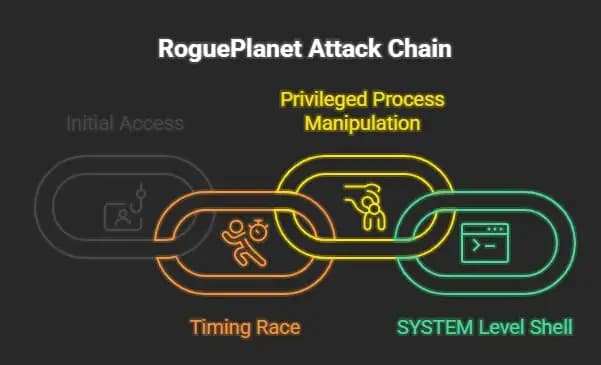
At a conceptual level, here is what a successful RoguePlanet attack chain looked like:
- An attacker who already had some form of local access to a Windows machine, even a low privileged standard account, could trigger the timing race described earlier.
- If the race succeeded, Defender's privileged process ended up acting on attacker controlled input instead of the file it believed it was handling.
- The end result, when it worked, was a command shell running with SYSTEM level rights.
It is important to be precise about what this Windows privilege escalation bug is and is not. RoguePlanet is a local privilege escalation flaw, not a remote entry point. It does not let an outside attacker break into a machine over the internet on its own.
It becomes dangerous only after an attacker has already gained some initial foothold, whether through a phishing payload, a malicious document, a compromised low privilege account, or a stolen or borrowed workstation. Once that foothold exists, a flaw like this is what turns a minor annoyance into complete control of the device.
This is also where the idea of the detector becoming the attack surface matters most. Most of the layered defenses organizations rely on, from least privilege access to endpoint detection and response, assume that a low level compromise cannot automatically become a full one.
A privilege escalation bug inside the very engine meant to enforce that boundary quietly removes one of the walls that layered security depends on.
Why This Windows Privilege Escalation Bug Matters Beyond Its CVSS Score
A CVSS score of 7.8 sounds serious but not catastrophic on paper. The real story behind this Microsoft Defender vulnerability sits in the details the score alone does not capture:
- For regulated organizations, the period between public disclosure and an official fixed build number created a genuinely uncomfortable gap, since compliance frameworks tend to prefer clean, binary answers, either vulnerable or patched.
- During the weeks before Microsoft published a specific fixed engine version, security and compliance teams had no clean way to mark the CVE as remediated, even while actively monitoring for it and reducing exposure wherever they could.
- Some public research suggested the underlying engine level issue likely affected Windows Server as well, though the specific published proof of concept was harder to reproduce there in practice. This point should be treated as a belief supported by some researchers rather than a fact directly confirmed by Microsoft, unless the live advisory says otherwise.
Detecting RoguePlanet Style Local Privilege Escalation on Windows
Security teams looking to detect this kind of Windows Defender exploit, or similar future ones, should watch for a handful of behavioral signs rather than relying on a single signature:
- Unusual child process creation coming from Defender or mpengine related processes, especially command shells spawned unexpectedly.
- Unexpected reparse point or junction activity appearing near user writable directories, since that is the mechanism this class of bug tends to abuse.
- Anomalous file replacement or remediation actions taken by the antimalware engine outside of its normal scanning pattern.
Two limitations worth flagging directly:
- Signature based detection tied to one specific proof of concept is unreliable for this kind of flaw, since small changes to exploit code can bypass a narrow signature. Behavioral, EDR style monitoring tends to hold up far better over time.
- Many organizations currently have no simple way to confirm which Microsoft Malware Protection Engine version is deployed across their entire fleet, which is worth treating as a gap to close, independent of this specific CVE.

How to Protect Windows From the RoguePlanet Defender Flaw
The practical response to this Microsoft Defender zero-day breaks down into a few clear steps:
- Apply the Microsoft security update that brings the Microsoft Malware Protection Engine to the fixed version, and confirm it actually landed through Windows Update history or endpoint management tooling, rather than assuming it happened automatically.
- Do not treat toggling Defender's real time protection as a workaround. Reporting on this flaw indicated it functioned whether real time protection was switched on or off, so turning the feature off does not create any meaningful protection and only removes other benefits Defender provides.
- Keep general hardening in place as a longer term habit, not a one time reaction. That includes enforcing least privilege wherever possible, using Attack Surface Reduction rules, enabling tamper protection, applying application control where feasible, and limiting local administrator rights so that one compromised account cannot easily become SYSTEM everywhere.
- Avoid depending on any single security agent, including Defender, as the sole line of defense. Layered visibility through endpoint detection and response tools remains valuable precisely because no individual tool, however trusted, is immune to its own vulnerabilities.
- Maintain healthy backup practices as a general resilience measure, since privilege escalation bugs are often one step in a longer attack chain rather than the final goal on their own.
RoguePlanet in the Bigger 2026 Microsoft Patch Tuesday Picture
RoguePlanet did not appear in isolation. It arrived as the fourth Defender specific flaw tied to the same researcher within a relatively short stretch of 2026, following a public and ongoing disagreement with Microsoft over how vulnerabilities are reported and rewarded.
Viewed on its own, RoguePlanet is a single Windows Defender vulnerability with a patch already available. Viewed as part of that pattern, it is a reminder that detector level vulnerabilities, meaning flaws inside the tools meant to catch attackers, are becoming a recurring category worth tracking on their own, not just isolated incidents to react to one at a time.
How Hoplon InfoSec Supports Vulnerability Management
Staying ahead of fast moving Windows zero day vulnerabilities like RoguePlanet takes more than reading a single advisory. It takes consistent patch verification across an entire device fleet, behavioral monitoring that does not depend on any one signature, and a habit of treating even trusted security tools as part of the attack surface rather than automatically outside it.
Hoplon InfoSec's vulnerability management and endpoint security work is built around exactly that ongoing discipline, helping organizations confirm patch status, tighten detection coverage, and reduce exposure during the messy window before an official fix lands.
Key Takeaways
- RoguePlanet, tracked as CVE-2026-50656, is a Microsoft Defender vulnerability in the Microsoft Malware Protection Engine that could let a local attacker reach NT AUTHORITY SYSTEM.
- The flaw relies on a TOCTOU race condition combined with CWE-59 link following, not a simple coding mistake a user could avoid on their own.
- It affected fully patched Windows 10 and Windows 11 systems, and reportedly worked whether Defender's real time protection was on or off.
- Microsoft has released a Microsoft security update addressing the issue through an updated Microsoft Malware Protection Engine version.
- RoguePlanet is the fourth Defender focused zero-day tied to the same researcher in 2026, part of a larger pattern worth watching rather than a one time event.
Frequently Asked Questions
What is RoguePlanet in cybersecurity RoguePlanet is the public name for CVE-2026-50656, a Microsoft Defender zero-day in the Microsoft Malware Protection Engine that allowed a local attacker to escalate to SYSTEM level privileges.
Is CVE-2026-50656 being actively exploited At the time of public disclosure, Microsoft had not confirmed active exploitation, though the flaw was rated exploitation more likely due to available proof of concept code. This status can change, so check the current MSRC advisory for the latest confirmation.
Does disabling Microsoft Defender protect against RoguePlanet No. The exploit reportedly worked regardless of whether real time protection was enabled or disabled, so disabling Defender does not offer protection and removes other security benefits in the process.
Which Windows versions are affected by RoguePlanet Fully patched Windows 10 and Windows 11 systems were affected, including devices running the June 2026 cumulative update.
Has Microsoft released a patch for RoguePlanet Yes. Microsoft addressed the flaw through an updated version of the Microsoft Malware Protection Engine, along with additional unspecified hardening.
Who discovered the RoguePlanet vulnerability A researcher publicly known as Nightmare Eclipse, also referred to as Chaotic Eclipse, disclosed RoguePlanet as part of a broader, ongoing series of Microsoft zero-day disclosures.
Wrap Up
RoguePlanet is a good example of why local privilege escalation bugs deserve more attention than their CVSS score alone suggests, especially when they live inside the very tool built to stop attackers in the first place. The good news is that Microsoft has released a fix, and the steps to respond are straightforward:
- Confirm the updated Microsoft Malware Protection Engine version is deployed across the fleet.
- Do not rely on toggling real time protection as a defense.
- Keep treating every security tool, Defender included, as one layer among several rather than an unbreakable shield on its own.
References:
Microsoft Security Response Center (MSRC) advisory
National Vulnerability Database (NVD) entry
Related Articles:
Windows Defender 0-Day Vulnerability: BlueHammer, Risks, Fix
Windows Defender Firewall Service Vulnerability Patch Guide
Protect Against CVE-2024-30085: Critical Windows 11 Flaw
New PipeMagic Trojan Exploits Windows Zero-Day Vulnerability