Quick Summary: cybersecurity news this week
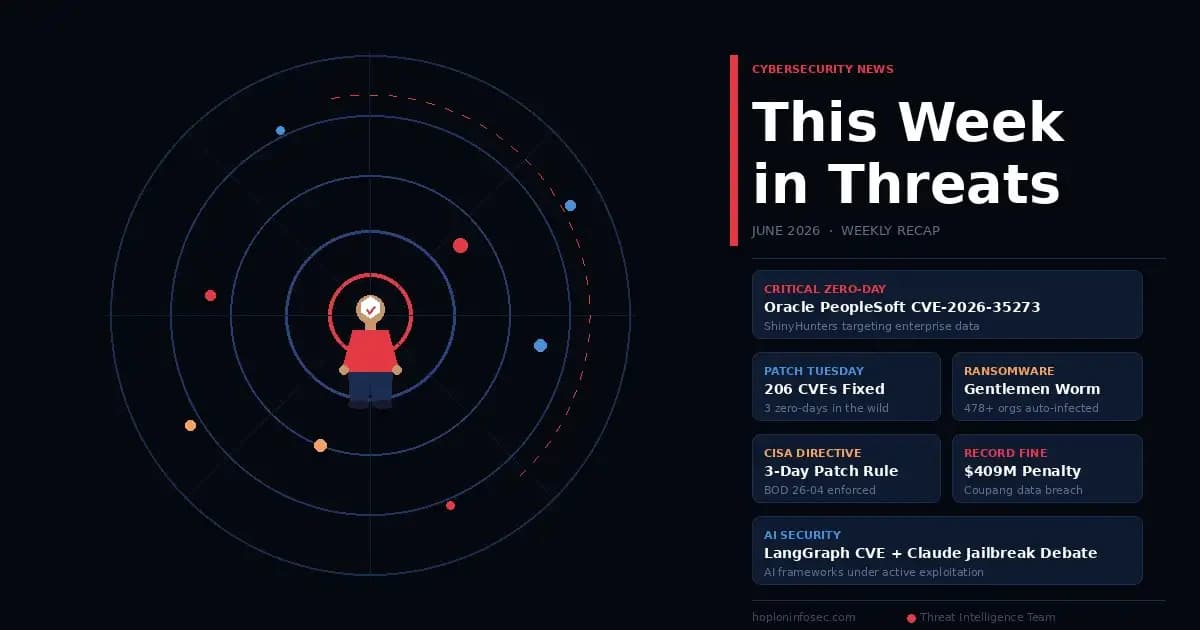
- ShinyHunters is actively exploiting a critical Oracle PeopleSoft zero-day (CVE-2026-35273), targeting enterprise and education sectors.
- Microsoft patched a record 206 CVEs in a single Patch Tuesday, including 3 already-exploited zero-days.
- A new self-spreading ransomware strain called "Gentlemen" autonomously infected over 478 organizations.
- AI frameworks LangGraph and Langflow are under active attack via CVE-2026-5027, exposing hijack risks in AI agent servers.
- South Korea's data protection authority fined Coupang a record $409 Million for a major data breach.
- CISA issued Directive 26-04, cutting the federal patch window from 14 days down to just 3 days.
- Europol and Interpol dismantled two major cybercrime networks through Operation AudiA6 and Operation Sniper Dz.
At-a-Glance: Top Threats and Response Summary
| Threat / Event | Severity | Who Is Affected | Immediate Action Required |
|---|---|---|---|
| Oracle PeopleSoft Zero-Day (CVE-2026-35273) | Critical | Enterprise, Education Sector | Isolate PeopleSoft from public-facing web vectors immediately |
| Microsoft 206-CVE Patch Tuesday (3 zero-days) | Critical | All Windows / Microsoft product users | Apply June patches within 72 hours |
| Gentlemen Ransomware (Worm Variant) | Critical | 478+ organizations globally | Audit lateral movement paths, segment internal networks |
| LangGraph / Langflow CVE-2026-5027 | High | AI/ML teams, DevOps using self-hosted LLM frameworks | Patch AI middleware frameworks, restrict agent server exposure |
| Coupang $409M Penalty | Regulatory | E-commerce, data-heavy businesses | Review data handling practices and breach notification policies |
| CISA Directive 26-04 (3-Day Patch Rule) | Compliance | US Federal Agencies | Establish 72-hour patch deployment workflow immediately |
| Ralph Lauren / Novo Nordisk Data Theft | High | Retail, Pharma sectors | Conduct dark web monitoring, review access controls |
Why This Week Changed the Cybersecurity Landscape
There are weeks in cybersecurity where the news feels routine. A patch here, a phishing campaign there. Then there are weeks like this one, where you sit back and realize the rules of the game just changed underneath everyone's feet.
This week was the second kind.
Microsoft shipped its biggest patch release in recorded history. A ransomware strain started spreading like a worm across hundreds of organizations without needing a single human click. A federal agency rewrote the patching playbook, cutting the grace window from 14 days down to three. And AI security, the frontier that everyone has been cautiously optimistic about, took hits from multiple directions at once.
If your security team has been operating on a comfortable schedule, this week handed you a wake-up call. The speed of attacks has outpaced the speed of defense for a while now. What changed this week is that governments and vendors are finally admitting it out loud through policy and action.
Here is everything that happened, what it means for your organization, and exactly what you need to do before the weekend is over.
Top 3 Critical Threats This Week
Oracle PeopleSoft (CVE-2026-35273): Actively exploited zero-day. ShinyHunters is targeting enterprise and university data at scale.
Microsoft Patch Tuesday: 206 CVEs fixed, including 3 zero-days already being exploited before the patch dropped. Update now.
Gentlemen Ransomware: Worm-capable strain that hit 478+ organizations autonomously. No user interaction required.
Critical Threats in the Wild: Oracle Exploits and Self-Spreading Ransomware
The Oracle PeopleSoft Crisis
If your organization runs Oracle PeopleSoft for HR, finance, or student management, this section deserves your full attention right now.
CVE-2026-35273 is a zero-day vulnerability that the ShinyHunters group has been actively weaponizing against enterprise and higher education targets. If you are not familiar with ShinyHunters, they are the same crew behind some of the most damaging data exfiltration campaigns in recent years. They do not mess around, and they do not sit on a new exploit for long before selling or dumping what they find.
The attack vector here is web-facing PeopleSoft portals, the kind that universities leave publicly accessible for student logins and enterprises use for employee self-service. Attackers are using the vulnerability to move laterally once inside, pulling everything from payroll data to social security numbers to academic records.
Your attack surface management posture matters enormously here. Organizations that know exactly what is internet-facing are the ones catching this early. Those running blind are the ones getting a call from ShinyHunters with a ransom demand.
The fix: isolate Oracle PeopleSoft instances from public-facing web vectors immediately while Oracle finalizes its patch guidance. If you cannot isolate, take it offline until you can.
Gentlemen Ransomware: When Malware Does Not Need You to Click Anything
The name sounds almost polite. The behavior is anything but.
Gentlemen, ransomware tore through 478 confirmed organizations this week using a worm-like propagation mechanism that requires zero human interaction. In most ransomware scenarios, someone has to click a link, open an attachment, or fall for a login spoofing page. Gentlemen skip that step entirely. It finds vulnerable network shares, moves laterally across connected systems, encrypts as it goes, and drops ransom notes across the entire infected environment before most security teams even get their first alert.
The extortion model is the standard double-extortion playbook: pay to get your files back and pay again, or the stolen data gets published. What is not standard is how fast this thing moved. Organizations reported their entire file infrastructure going dark within hours of initial compromise.
This is exactly the threat category where extended detection and response earns its keep. EDR alone is not enough when the malware has already chained across 50 endpoints before the first alert fires. You need behavioral detection across your entire environment, not just individual devices.
If you experienced any unusual lateral movement or file access spikes in the last 72 hours, treat it as a potential Gentlemen infection until proven otherwise.

The 206-Flaw Milestone: Inside Microsoft's Record-Breaking Patch Tuesday
Two hundred and six. That is the number of CVEs Microsoft addressed in this month's Patch Tuesday, the largest single release in the company's patching history. To put that in perspective, a typical Patch Tuesday resolves somewhere between 60 and 100 flaws. This month nearly doubled that ceiling.
Among those 206 fixes, three deserve special attention because they were already being exploited in the wild before Microsoft even had a patch ready. That means attackers had working exploits, were using them actively, and organizations running unpatched systems were being hit the entire time the fix was being developed and tested.
The three actively exploited zero-days spanning Windows core components with the potential for privilege escalation and remote code execution. Specific CVE numbers are detailed in our dedicated deep-dive, Microsoft June 2026 Patch Tuesday: 200 Flaws and 3 Zero-Days, but the short version is this: if any of those three reach a domain controller or a system running critical services, the blast radius is severe.
System administrators who delay this specific update are making a genuinely dangerous call. There is no "we'll schedule it for next maintenance window" on zero-days that are already being exploited. The window for discretion closed when the first attack was confirmed.
A strong vulnerability management program treats these three with the same urgency as a fire alarm, not a calendar appointment. If yours does not, this week is a good time to revisit that process.
Also worth noting: Microsoft's Windows 11 KB5094126 and KB5093998 updates are part of this release cycle. For a full breakdown of what changed in those specific builds, check out our coverage of the Windows 11 June 2026 update.
-20260612115517.webp "The 206-Flaw Milestone")
AI Under Siege: From LangGraph Exploits to Claude Fable 5 Jailbreaks
A year ago, the conversation around AI security was mostly theoretical. This week made it very concrete.
Framework Vulnerabilities: When the AI Plumbing Gets Compromised
CVE-2026-5027 targets Langflow and LangGraph, two of the most widely used frameworks for building AI agent pipelines. If you are not familiar with these tools, think of them as the connective tissue between large language models and the data sources, APIs, and automations those models interact with.
The vulnerability allows attackers to hijack AI agent servers, meaning they can intercept the commands your AI systems are sending and receiving, redirect those commands, or inject malicious instructions into the pipeline. For organizations using AI agents to handle internal workflows, customer queries, or automated decisions, this is essentially a supply chain attack that sits one layer below where most people are looking.
The fix is updating your self-hosted LLM and AI middleware frameworks immediately. If you are running Langflow or LangGraph in a production environment, this is not optional maintenance. Our work on ISO certification for artificial intelligence frameworks is designed precisely for this kind of systematic risk, where the threat is not in the model itself but in the infrastructure around it.
The Claude Fable 5 Jailbreak Debate
Independent security researchers published findings this week claiming successful prompt-injection attacks against Claude Fable 5 (referred to in some security circles as Claude 5), Anthropic's current frontier model. The claims sparked a public back-and-forth between the researchers and Anthropic, with both sides presenting evidence and methodology arguments.
Without taking sides in what is an ongoing technical dispute, the broader pattern is worth noting. As AI models get deployed in more sensitive contexts, including legal, medical, financial, and operational settings, the attack surface around those models grows. Prompt injection is not a new problem. What is new is the scale at which it matters when the model has real authority over real systems.
This is where AI-driven automated red teaming and rigorous web application security testing of AI-integrated interfaces become non-negotiable rather than nice-to-have. If your organization is deploying AI with any kind of elevated access or external-facing interaction, adversarial testing of those surfaces should already be on your roadmap.
Big Tech Pulls Back on Internal AI
Several major technology companies, including Microsoft in its own internal communications, have reportedly begun restricting employee use of certain AI tools over data privacy concerns. The fear is straightforward: employees paste sensitive data into AI interfaces, that data goes somewhere outside the organization's control, and the organization has no visibility into what happens next.
It is a real problem. And it points to why endpoint security and online threat exposure monitoring need to account for the AI layer now, not just traditional data exfiltration channels.
The $409 Million Penalty: The High Cost of Unsecured Customer Data
South Korea Drops a Historic Fine on Coupang
South Korea's Personal Information Protection Commission levied a record-breaking $409 million penalty against Coupang, the country's largest e-commerce platform, following a data breach that exposed millions of customer records. The fine is the largest data protection penalty in South Korean history and sends a signal that is hard to misread: regulators in Asia are catching up to GDPR-level consequences.
For organizations operating across borders, this matters. The era of data breaches being primarily a reputational problem is over. They are now a financial catastrophe with a predictable price tag attached. The math of investing in proper dark web monitoring and breach prevention looks very different when a single incident costs nine figures.
Ralph Lauren and Novo Nordisk: Two Very Different Breach Stories
Ralph Lauren confirmed that a threat actor exfiltrated approximately 220 gigabytes of data in a breach that appears to have gone undetected for longer than it should have. The stolen data includes internal design files, vendor contracts, and customer information. This is a brand intelligence nightmare on top of the security incident itself, which is why brand intelligence monitoring is increasingly part of a mature security program rather than a marketing afterthought.
Novo Nordisk, the pharmaceutical company behind Ozempic and other high-demand medications, reported a breach affecting clinical trial data. The sensitivity here goes beyond customer information. Clinical data breaches carry regulatory exposure under multiple frameworks simultaneously and can affect drug development timelines. For organizations in healthcare or life sciences, the overlap between SOC 2 compliance and operational security has never been more important to get right.
Both incidents reinforce the same lesson. Digital forensic investigation capabilities are not just useful after a breach. Organizations that can detect, contain, and understand an intrusion quickly are the ones that minimize both the damage and the regulatory exposure.
The Global Counter-Offensive: CISA's 3-Day Rule and Criminal Takedowns
CISA BOD 26-04: The 14-Day Window is Gone
The Cybersecurity and Infrastructure Security Agency issued Binding Operational Directive 26-04 this week, mandating that federal agencies patch known exploited vulnerabilities within three days of discovery instead of the previous 14-day window.
Three days. That is the new baseline for the federal government.
For context, most private sector organizations are still operating on 30-day or even 90-day patching cycles for non-critical systems. The gap between what government is now demanding of its own agencies and what most enterprises are actually doing has never been wider.
The directive applies specifically to federal civilian agencies, but the signal it sends to the broader industry is unmistakable. If the government believes 14 days is too slow, enterprises that are still debating whether to patch in the next quarter have a serious problem. Our full breakdown of the directive is available in the CISA BOD 26-04 coverage we published earlier this week.
Organizations that want to honestly assess whether they could meet a three-day patching requirement, or even a seven-day one, should start with a gap assessment of their current patching and vulnerability response workflows. Most will find surprises.
-20260612115517.webp)
Operation AudiA6 and Sniper Dz: Law Enforcement Lands Two Big Hits
On the enforcement side, Europol and Interpol scored meaningful wins this week with two coordinated operations targeting cybercriminal infrastructure.
Operation AudiA6 dismantled a crypto-laundering network that had processed hundreds of millions of dollars in ransomware proceeds across multiple jurisdictions. The network had been operating for years by exploiting gaps in international financial monitoring. The arrests and asset seizures came after a multi-agency intelligence sharing effort that reportedly took nearly 18 months to build.
Operation Sniper Dz targeted one of the most prolific phishing-as-a-service platforms currently operating, a criminal marketplace that provided ready-made phishing kits, hosting, and victim credential management to thousands of lower-level fraudsters. Dismantling the platform disrupts the supply chain that enables a huge volume of credential theft attacks. A strong email security and anti-phishing posture remains essential, but taking down the infrastructure these criminals rely on helps the entire ecosystem.
Both operations relied heavily on cyber threat intelligence sharing between agencies and private sector partners. The lesson for organizations watching from the sidelines: threat intelligence is not just a government resource. It is something your security program should be actively consuming and, where possible, contributing to.
The Weekend Defense Checklist: 5 Steps to Secure Your Network Right Now
The threats this week are not theoretical. They are active. Before you close your laptop for the weekend, work through this list.
1. Apply the Microsoft June Patch Tuesday update immediately. All 206 CVEs, with priority on the three actively exploited zero-days. If you manage a fleet of Windows systems, this goes to the top of your queue before anything else. Systems running Windows 11 should reference the KB5094126 and KB5093998 update guidance alongside the security fixes. Your endpoint security controls are only as good as the underlying OS they are protecting.
2. Isolate Oracle PeopleSoft instances from public-facing web vectors. If you cannot apply a patch right now, take the exposure away. That means removing internet-facing access to any PeopleSoft portal until Oracle releases and you can test a fix. It is a painful operational decision. It is less painful than explaining a Shiny Hunters breach to your board. Your attack surface management tooling should flag this kind of exposure automatically.
3. Update all self-hosted LLM and AI middleware frameworks. If you run Langflow, LangGraph, or any similar AI orchestration layer, patch CVE-2026-5027 now. If you are not sure what AI frameworks your development teams are running internally, that uncertainty itself is a risk worth addressing with a proper cyber resilience assessment.
4. Review access logs for phishing-related credential compromise indicators. The Sniper Dz takedown disrupted one phishing-as-a-service network but did not eliminate the credentials it already harvested. Look for unusual login times, logins from unexpected geolocations, and multiple failed attempts followed by a success. Your email security and anti-phishing stack should be alerting on suspicious inbound activity, but the log review catches the cases that slipped through.
5. Run a BLUERABBIT malware check across your Windows environments. A new Windows backdoor called BLUERABBIT was disclosed this week with specific indicators of compromise now public. Cross-reference those IOCs against your environment before the weekend. Our detailed write-up on the BLUERABBIT malware discovery has the specific signatures you need. If you do not have the internal capacity to run this kind of sweep, security-on-demand experts can do it for you quickly.
Staying Ahead of AI-Paced Threats
There is a phrase that keeps coming up in security conversations this year: the automation gap. Attackers have automated their reconnaissance and their exploitation and, in the case of Gentleman ransomware, their lateral movement. Meanwhile, many defenders are still relying on manual processes, weekly patch cycles, and reactive alert triage.
CISA's three-day mandate is the clearest sign yet that this automation gap has become a policy problem, not just a technology one. When a government agency tells you that 14 days is too slow and you need to move in 72 hours, the only way to meet that bar consistently is with tooling and processes that do not require a human in every step of the loop.
That means investing in vulnerability management platforms that triage and prioritize automatically. It means XDR that correlates signals across your environment without waiting for an analyst to connect the dots. It means incident response and recovery playbooks that are tested and ready, not theoretical documents in a shared drive nobody reads.
For organizations that are not sure where their gaps are, a gap assessment or a full cyber resilience assessment is the honest starting point. You cannot defend what you cannot measure, and you cannot improve what you have not evaluated against the actual threat landscape.
The week we just lived through was a stress test. The organizations that come out of it in good shape are the ones that already had the fundamentals in place. The organizations that scrambled are the ones who now have a clear list of things to fix before the next one arrives.
And there will be a next one. Probably sooner than anyone wants.
Is your team ready to operate on a three-day patch cycle? Drop your answer in the comments below. It is one of those questions that sounds simple until you sit with it for a few minutes and start counting the steps involved.
Get the Hoplon Threat Brief delivered to your inbox every week
No noise. Just the threats that matter, the context to understand them, and the actions to take. Sign up below and stay one step ahead.
Subscribe to the Weekly Threat Brief.
Cybersecurity Weekly Recap | June 12, 2026 | Radia

-20260925120840.webp&w=3840&q=75)