Palo Alto Networks August 2026 Security Update Fixes 10 CVEs
If you use Palo Alto Networks security products, the August 2026 update needs a careful review. Palo Alto Networks released fixes for 10 standalone CVEs affecting PAN-OS, GlobalProtect, and Prisma Access Agent, along with a separate Prisma Browser Chromium security update.
The flaws cover risks such as privilege escalation, code execution, information disclosure, buffer overflow, and security bypass. Palo Alto Networks said it was not aware of malicious exploitation of these newly disclosed issues when the advisories were published.
The update was released on August 12, 2026. It also includes PAN-SA-2026-0011, a larger Prisma Browser and Chromium vulnerability rollup.
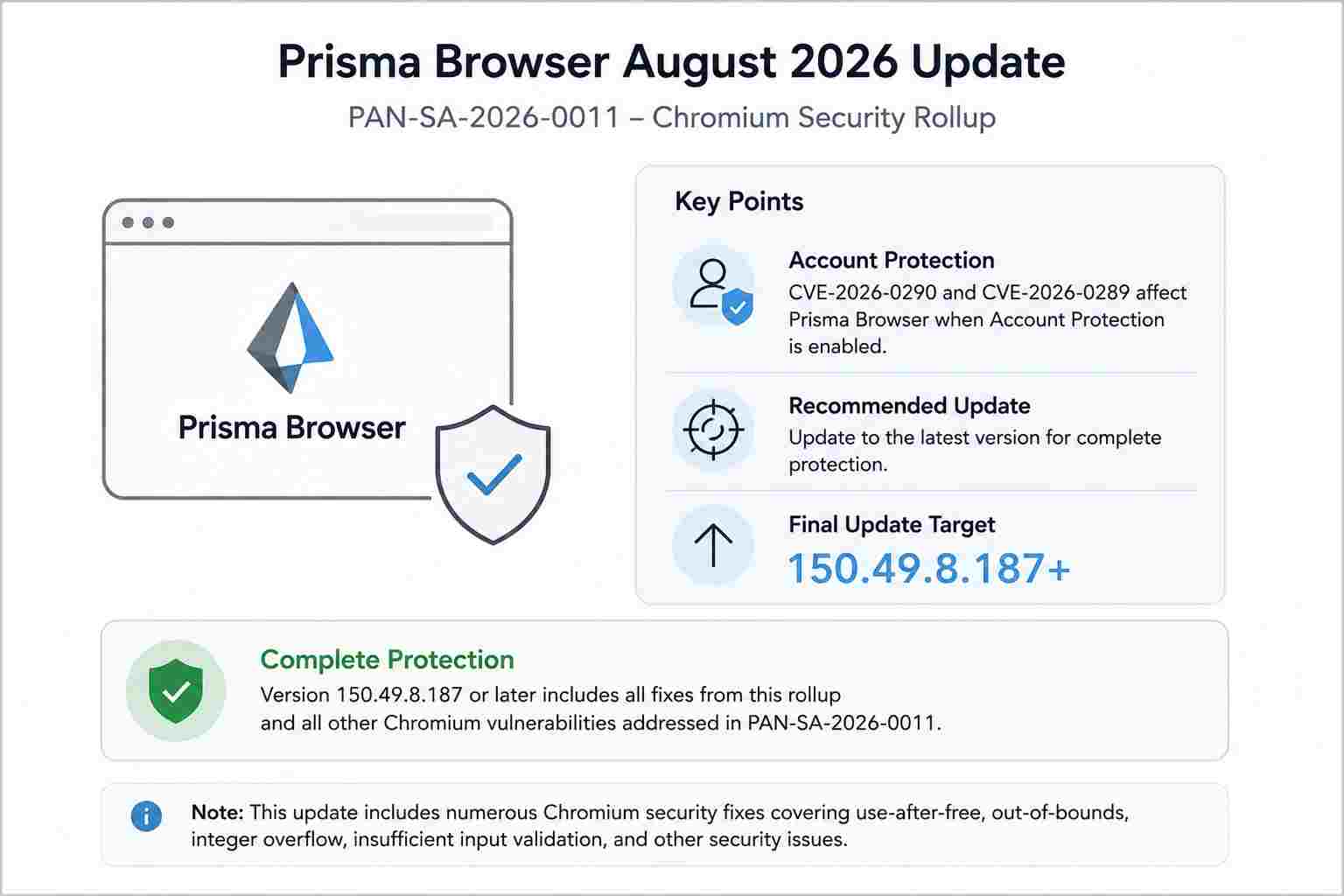
Two Palo Alto Networks-specific Prisma Browser issues, CVE-2026-0290 and CVE-2026-0289, are included in the browser update along with many Chromium security fixes.
Across the full August patch cycle, Palo Alto Networks addressed local privilege escalation, arbitrary code execution, certificate validation problems, anti-tamper bypass, security inspection bypass, limited file deletion, information disclosure, and browser security-control weaknesses.
The standalone Palo Alto Networks vulnerabilities are rated Low to Medium under the vendor's threat-adjusted CVSS scoring. The Prisma Browser rollup is more serious, with a CVSS-BT score of 7.2, a CVSS-B base score of 9.2, High severity, and Moderate urgency.
None of the advisories in this group is rated Critical.
Security teams should not look at PAN-OS alone. The August release affects firewalls, endpoint VPN software, Prisma Access Agent installations, and Prisma Browser deployments.+
Palo Alto Networks August 2026 Vulnerabilities
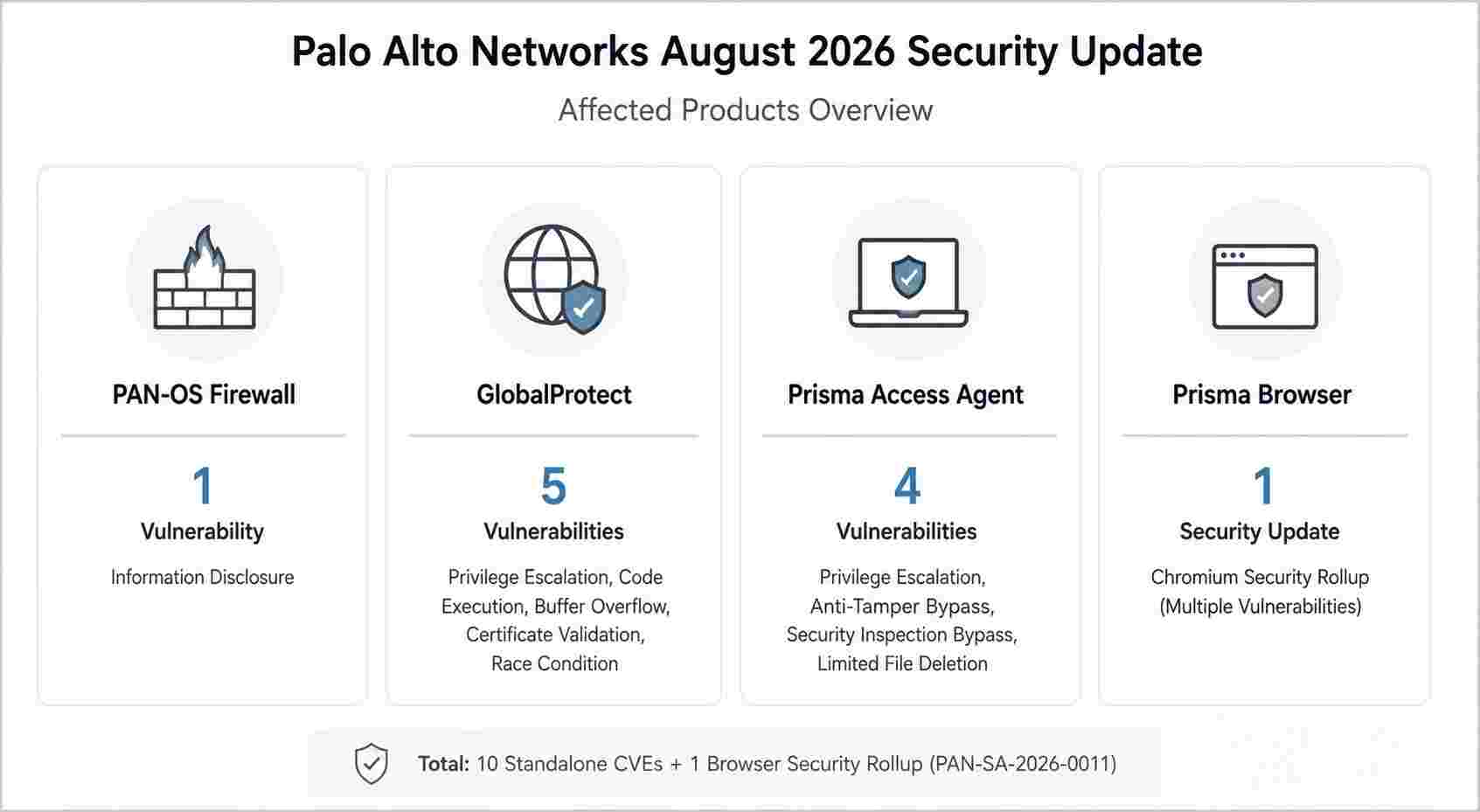
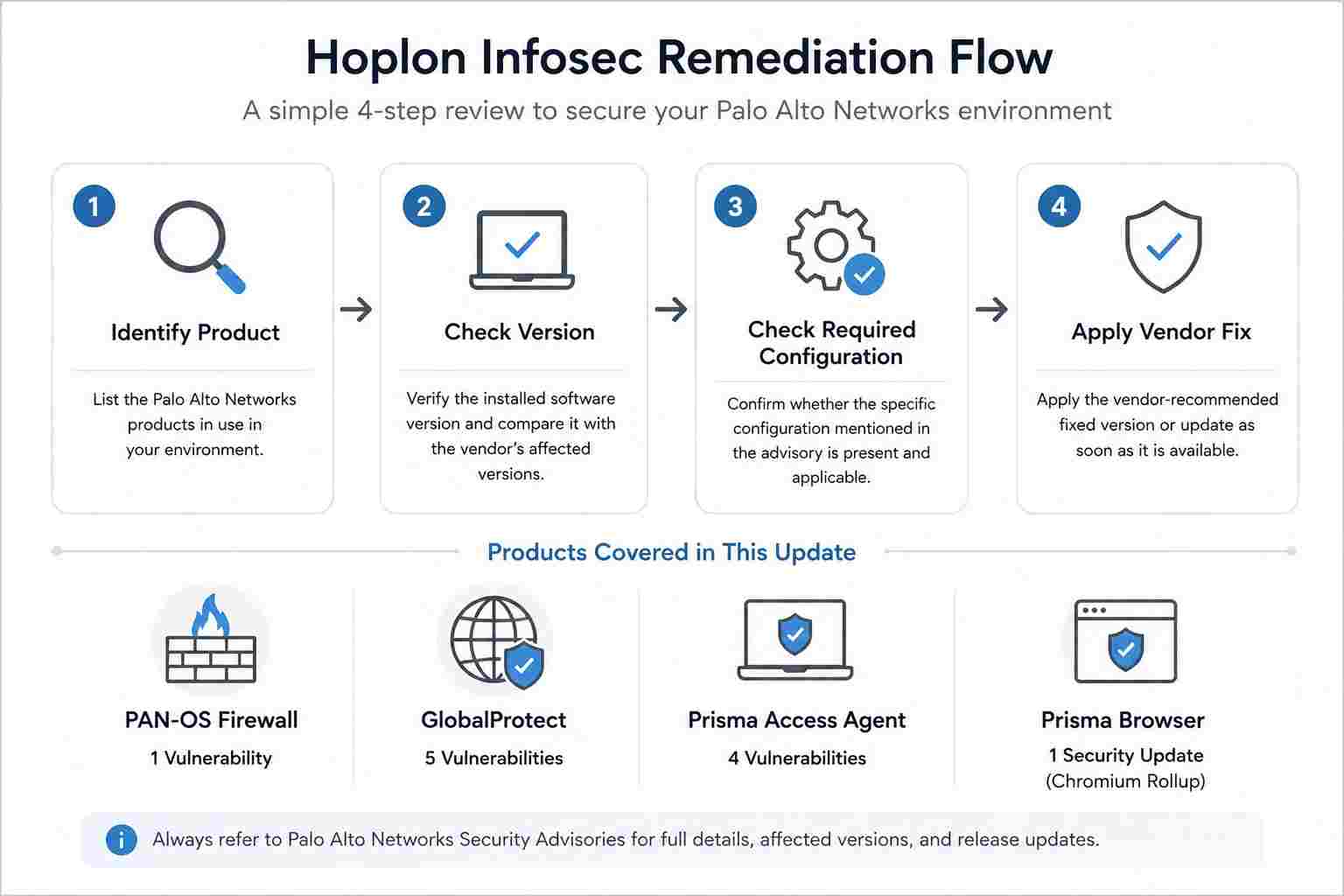
The standalone update contains one PAN-OS vulnerability, five GlobalProtect vulnerabilities, and four Prisma Access Agent vulnerabilities. Prisma Browser has a separate Chromium-based security rollup.
|
CVE / Advisory |
Product |
Severity / CVSS-BT |
Security Issue |
Fix / Status |
|
CVE-2026-0301 |
PAN-OS / Prisma Access / Cloud NGFW |
1.7 Low |
URL Filtering Information Disclosure |
Fixed versions available; cloud upgrades scheduled |
|
CVE-2026-0299 |
GlobalProtect |
5.9 Medium |
Fixes available; additional platform ETAs |
|
|
CVE-2026-0298 |
GlobalProtect Windows PLAP |
5.2 Medium |
MitM Code Execution |
Fixed in 6.3 and 6.2; 6.0 fix scheduled for Aug. 31 |
|
CVE-2026-0297 |
GlobalProtect |
5.2 Medium |
UDP Tunnel Handshake Buffer Overflow |
Platform-specific fixes and ETAs |
|
CVE-2026-0296 |
GlobalProtect |
4.5 Medium |
Certificate Validation Bypass |
Platform-specific fixes and ETAs |
|
CVE-2026-0295 |
GlobalProtect macOS |
4.1 Medium |
Race Condition Privilege Escalation |
Fixed in current 6.3 and 6.2 branches |
|
CVE-2026-0294 |
Prisma Access Agent |
6.0 Medium |
Local Privilege Escalation |
Version 26.3 scheduled for Aug. 20 |
|
CVE-2026-0293 |
Prisma Access Agent Windows |
5.6 Medium |
Anti-Tamper Protection Bypass |
Version 26.3 scheduled for Aug. 20 |
|
CVE-2026-0292 |
Prisma Access Agent Windows |
2.1 Low |
Security Inspection Bypass |
Version 26.3 scheduled for Aug. 20 |
|
CVE-2026-0291 |
Prisma Access Agent Linux |
1.1 Low |
Limited File Deletion |
Fixed in 26.2.2 and later |
|
CVE-2026-0290 |
Prisma Browser |
0.5 Low |
Sensitive Information Disclosure |
Fixed in 148.18.4.217 and later |
|
CVE-2026-0289 |
Prisma Browser |
Included in PAN-SA-2026-0011 |
Account Protection Security Bypass |
Fixed in 150.49.4.125 and later |
|
PAN-SA-2026-0011 |
Prisma Browser / Chromium |
7.2 High |
Chromium Monthly Vulnerability Rollup |
Overall update target: 150.49.8.187 and later |
CVE-2026-0301 Affects PAN-OS URL Filtering
The main PAN-OS security flaw in this release is CVE-2026-0301. It is a Low-severity information disclosure issue in the PAN-OS URL Filtering feature.
An unauthenticated attacker with network access to an affected firewall may be able to obtain sensitive information.
Panorama is not affected.
The flaw does not affect every PAN-OS release, so checking the version is important.
Affected systems include:
- PAN-OS 11.1 versions earlier than 11.1.16-h1 or 11.1.17
- PAN-OS 10.2 versions earlier than 10.2.8
- Prisma Access 10.2 versions earlier than 10.2.10
- Certain Cloud NGFW deployments on AWS and Azure
PAN-OS 12.1 and 11.2 are not affected.
Prisma Access 12.1 and 11.2 are also unaffected.
Cloud NGFW systems running version 11.2 are not impacted.
A Specific Configuration is Required
Running an affected version alone does not mean the firewall can be exploited through this issue.
For CVE-2026-0301 to apply, URL Filtering must be enabled, and the firewall must use a custom URL Filtering response page.
Administrators can check this setting under:
Device > Response Pages
If a custom URL Filtering HTML response page has been imported, the firewall may meet the configuration condition required for exposure.
PAN-OS Fixes
Palo Alto Networks recommends moving PAN-OS 11.1 systems to:
- 11.1.16-h1
- 11.1.17
- Or a later fixed version
PAN-OS 10.2 systems should use:
- 10.2.8 or later
Prisma Access 10.2 should move to:
- 10.2.10 or later
There is also a mitigation for organizations that cannot update immediately.
Palo Alto Networks says custom response pages can be limited to variables already used by its predefined URL Filtering response pages.
The predefined user, url, category, and pan_form variables are not affected.
Prisma Access and Cloud NGFW customers are scheduled to receive upgrades during Palo Alto Networks' next maintenance cycle. Customers that need an earlier update can request an on-demand maintenance window through Palo Alto Networks Support.
Five GlobalProtect Vulnerabilities Need Different Fixes
GlobalProtect security received the largest number of standalone patches in the August update.
Five vulnerabilities affect different platforms and features.
Their conditions also differ. Some require local access. Others involve a man-in-the-middle attack, where an attacker positions themselves between two systems that are communicating. One issue depends on a specific Windows login setup.
That means administrators should check each GlobalProtect environment separately rather than treating all endpoints as equally exposed.
CVE-2026-0299 Can Give a Local User SYSTEM or Root Access
CVE-2026-0299 carries a CVSS score of 5.9 and affects GlobalProtect on Windows, macOS, and Linux.
The issue can allow a low-privileged local user to run commands with much higher privileges.
On Windows, successful exploitation could allow commands to run as:
NT AUTHORITY\SYSTEM
On macOS and Linux, the attacker could gain:
root privileges
iOS, Android, and Chrome OS are not affected.
No special configuration is required for exposure.
Palo Alto Networks lists no workaround for this vulnerability.
For GlobalProtect 6.3, Windows and macOS users should move to:
6.3.3-h14 (6.3.3-1121) or later
Linux users need a different build:
6.3.3-h15
That Linux release was scheduled for August 28.
For GlobalProtect 6.2, Windows and macOS systems should use:
6.2.8-h13 (6.2.8-1045) or later
Linux installations on the 6.2 branch do not currently have an unaffected 6.2 release. Those systems should move to the fixed 6.3 branch.
GlobalProtect 6.0.15 was scheduled for August 31, 2026.
CVE-2026-0298 Targets a Specific Windows Login Setup
Windows systems using GlobalProtect Connect Before Logon need another check.
CVE-2026-0298, rated CVSS 5.2, is an improper input validation flaw in the Windows Pre-Logon Access Provider, also called PLAP.
A man-in-the-middle attacker could potentially use the weakness to execute arbitrary code with SYSTEM privileges on a vulnerable Windows endpoint.
But the attack requires a specific setup.
The Windows device must use:
SAML authentication + GlobalProtect Connect Before Logon
Without that combination, the stated exposure requirement is not met.
Linux, macOS, iOS, Android, and Chrome OS are not affected.
Fixed versions include:
- GlobalProtect 6.3: 6.3.3-h14 / 6.3.3-1121 or later
- GlobalProtect 6.2: 6.2.8-h13 / 6.2.8-1045 or later
- GlobalProtect 6.0: 6.0.15 or later, scheduled for August 31
Organizations that cannot update immediately have two vendor-listed mitigation choices.
They can use Connect Before Logon without SAML authentication.
Another option is replacing Connect Before Logon with Pre-logon using a machine certificate.
CVE-2026-0297 Causes a Buffer Overflow During UDP Tunnel Setup
CVE-2026-0297 also carries a CVSS score of 5.2.
This issue affects the GlobalProtect UDP tunnel handshake, which is part of the process used when setting up communication.
A man-in-the-middle attacker or rogue gateway could trigger the buffer overflow.
Successful exploitation could disrupt system processes and may allow arbitrary code to run with elevated privileges.
That could include SYSTEM privileges on Windows and root privileges on macOS or Linux.
This flaw has a wider platform reach than several other GlobalProtect issues in the same update. Desktop and mobile builds are affected.
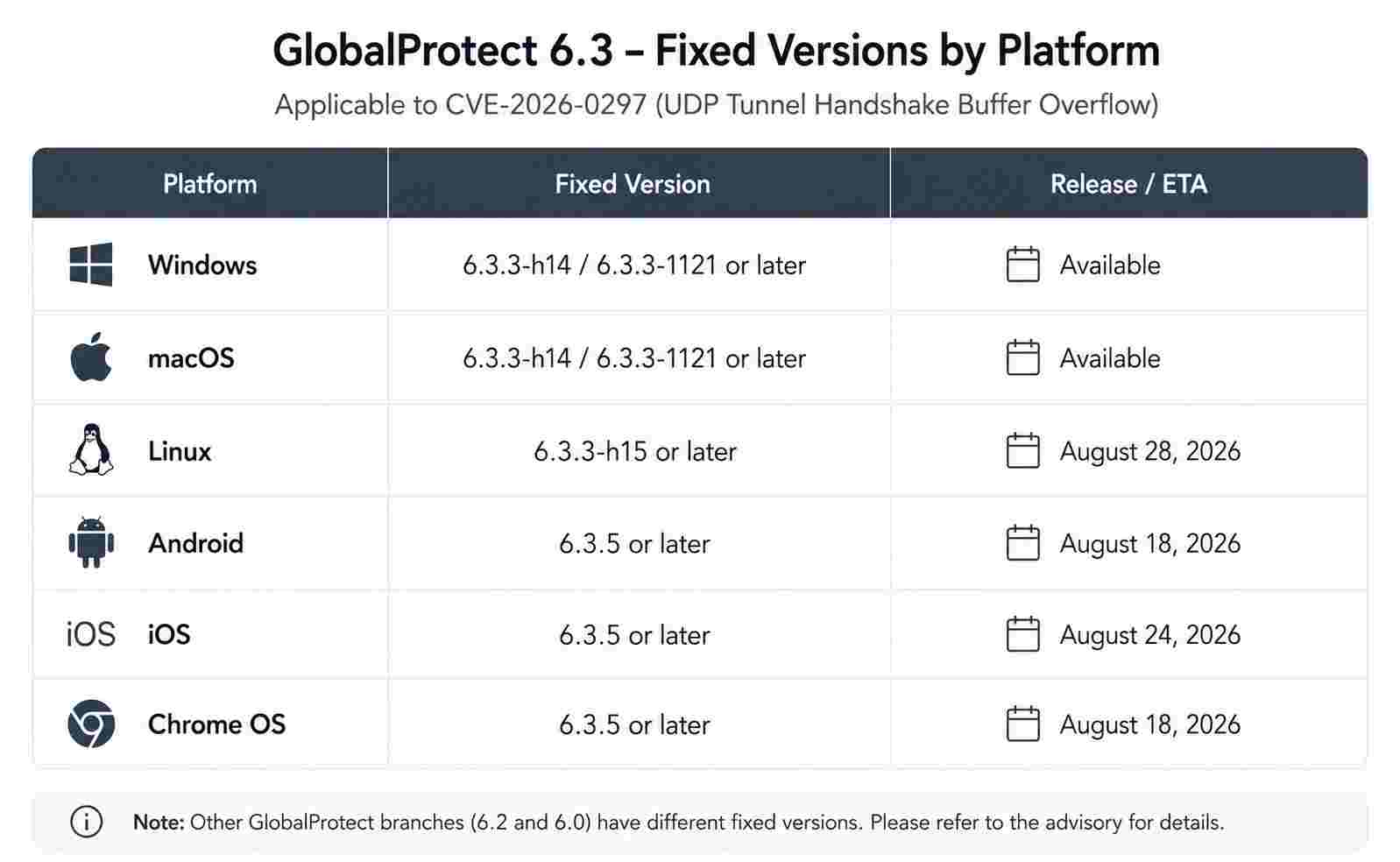
The fixed version depends on the operating system.
For GlobalProtect 6.3:
- Windows: 6.3.3-h14 / 6.3.3-1121 or later
- macOS: 6.3.3-h14 / 6.3.3-1121 or later
- Linux: 6.3.3-h15 or later, scheduled for August 28
- Android: 6.3.5 or later, scheduled for August 18
- Chrome OS: 6.3.5 or later, scheduled for August 18
- iOS: 6.3.5 or later, scheduled for August 24
For GlobalProtect 6.2, Windows and macOS are fixed in:
6.2.8-h13
Affected 6.0 platforms were scheduled to receive fixes in:
GlobalProtect 6.0.15 on August 31
GlobalProtect CVE-2026-0297 Patch Versions
CVE-2026-0296 Has a Certificate Validation Problem
CVE-2026-0296, rated CVSS 4.5, involves improper certificate validation in GlobalProtect.
An unauthenticated attacker with man-in-the-middle access may be able to intercept and change application communications.
One detail matters here.
Palo Alto Networks specifically states that VPN tunnel traffic itself is not affected by this vulnerability.
Windows, macOS, and Linux are affected.
iOS, Android, and Chrome OS are not.
Windows and macOS fixes are available in:
- GlobalProtect 6.3.3-h14
- GlobalProtect 6.2.8-h13
For Linux on the 6.3 branch, the fix is:
6.3.3-h15
That release was scheduled for August 28.
The 6.0 branch was scheduled to receive its fix in:
GlobalProtect 6.0.15 on August 31
Palo Alto Networks lists no known workaround or mitigation for this issue.
CVE-2026-0295 Is Limited to GlobalProtect on macOS
The final GlobalProtect vulnerability in this group affects macOS only.
CVE-2026-0295, rated CVSS 4.1, is a race condition privilege escalation flaw.
A locally authenticated user with low privileges could exploit the vulnerability and gain root privileges.
Windows, Linux, iOS, Android, and Chrome OS are not affected.
GlobalProtect 6.3 users on macOS should move to:
6.3.3-h14 or later
Systems on the 6.2 branch should use:
6.2.8-h13 or later
The fix for GlobalProtect 6.0 is included in:
6.0.15
That release was scheduled for August 31.
Four Prisma Access Agent Vulnerabilities Were Disclosed
The August release also covers four Prisma Access Agent security vulnerabilities.
These issues affect different operating systems and cover privilege escalation, anti-tamper protection bypass, security inspection bypass, and limited file deletion.
CVE-2026-0294 Can Raise Local Privileges
At CVSS 6.0, CVE-2026-0294 is the highest-rated standalone Prisma Access Agent vulnerability in this August group.
The issue affects Windows and macOS.
A local user could exploit it to run code with elevated privileges.
No special configuration is required.
Linux, iOS, Android, and Chrome OS are not affected.
Prisma Access Agent versions earlier than:
26.3
are affected on Windows and macOS.
Palo Alto Networks scheduled Prisma Access Agent 26.3 for August 20, 2026.
No known workaround exists.
CVE-2026-0293 Can Bypass Anti-Tamper Protection
CVE-2026-0293, rated CVSS 5.6, affects Prisma Access Agent on Windows.
The weakness can allow an attacker to bypass anti-tamper protection, but there is an important condition.
The local attacker must already have administrator privileges.
With that level of access, the attacker could bypass Prisma Access Agent's anti-tamper controls and gain unauthorized access to protected processes and files.
Windows versions earlier than:
26.3
are affected.
Version 26.3 was scheduled for August 20.
macOS, Linux, iOS, Android, and Chrome OS are not affected.
CVE-2026-0292 Can Bypass Local Security Inspection
Another Windows-only issue is CVE-2026-0292.
It carries a CVSS score of 2.1.
The vulnerability is an authentication bypass in the Prisma Access Agent Windows network driver.
A local administrator could bypass security inspection and then inject or intercept arbitrary network traffic.
Affected Windows versions are those earlier than:
Prisma Access Agent 26.3
Version 26.3, scheduled for August 20, contains the fix.
Other supported platforms are not affected.
Palo Alto Networks lists no known workaround.
CVE-2026-0291 Allows Limited File Deletion on Linux
Linux has a separate issue.
CVE-2026-0291, rated CVSS 1.1, is an improper link resolution vulnerability in Prisma Access Agent.
A local low-privileged user could exploit the flaw to delete certain system files within a limited scope.
The issue could potentially disable Prisma Access Agent.
Linux releases earlier than:
26.2.2
are vulnerable.
Organizations should upgrade to:
Prisma Access Agent 26.2.2 or later
Windows, macOS, iOS, Android, and Chrome OS are not affected.
Prisma Browser Receives a Large Chromium Security Update
Palo Alto Networks separately published PAN-SA-2026-0011, its August 2026 Prisma Browser and Chromium vulnerability update.
This advisory carries a High severity rating.
Its scores are:
- CVSS-BT: 7.2
- CVSS-B: 9.2
Unlike a single-CVE advisory, this update covers a large collection of Chromium security problems.
The vulnerability classes include:
- Use-after-free flaws
- Out-of-bounds reads
- Out-of-bounds writes
- Integer overflows
- Insufficient input validation
- Security policy enforcement weaknesses
- Inappropriate security implementations across Chromium components
The rollup also contains two Palo Alto Networks-specific Prisma Browser vulnerabilities:
- CVE-2026-0290: Sensitive Information Disclosure
- CVE-2026-0289: Account Protection Security Bypass
CVE-2026-0290 Can Expose Sensitive Information
CVE-2026-0290 applies to Prisma Browser installations where Account Protection is enabled.
A local attacker could potentially view sensitive information.
Affected versions are earlier than:
148.18.4.217
For this specific issue, Palo Alto Networks recommends:
Prisma Browser 148.18.4.217 or later
Administrators can check whether the affected feature is active through the Login Controls configuration.
Look for:
Activate account protection
If that option is selected, Account Protection is enabled.
CVE-2026-0289 Can Bypass Account Protection Controls
CVE-2026-0289 is another Prisma Browser Account Protection problem.
It can allow a user to bypass intended security controls.
Palo Alto Networks lists:
150.49.4.125
as the version containing the specific fix for CVE-2026-0289.
But administrators should not treat that version as the final target for the whole August browser update.
PAN-SA-2026-0011 includes many more Chromium vulnerabilities fixed across several releases.
For the broader advisory, Prisma Browser versions earlier than 148.18.4.217 are listed as affected.
The overall unaffected target for the complete August rollup is:
Prisma Browser 150.49.8.187 or later
No special configuration is required for exposure to the broader advisory.
Palo Alto Networks said it was not aware of malicious exploitation of the vulnerabilities covered by PAN-SA-2026-0011 when the advisory was published.
Hoplon Infosec Insight
Based on Palo Alto Networks' published vulnerability details, the first job is to identify which products, versions, operating systems, and configurations are actually affected. A CVSS score alone does not show whether a specific device meets the conditions needed for exposure.
For PAN-OS, check both the software version and whether a custom URL Filtering response page is in use. For GlobalProtect, Windows and macOS endpoints need close review because several flaws can lead to SYSTEM or root-level privileges. Windows devices using Connect Before Logon with SAML authentication need a specific check for CVE-2026-0298.
Prisma Access Agent users should follow the platform-specific fixed versions, while Prisma Browser administrators should target 150.49.8.187 or later for the complete August browser rollup rather than stopping at a version that fixes only one CVE.
Hoplon Infosec's recommendation is based on the vendor-published advisory information covered in this report. This insight does not claim that Hoplon Infosec independently discovered these vulnerabilities, reproduced the exploits, or observed active attacks.
If you are unsure whether these Palo Alto Networks issues affect your environment, Hoplon Infosec’s Vulnerability Management service can help you review affected systems, understand which findings need attention first, and support the remediation process. It is a practical option for teams that want a clearer view of their exposure without adding unnecessary complexity.
Which Palo Alto Networks Systems Should Be Checked First?
Not every installation has the same exposure.
Security teams should first list the Palo Alto Networks products they use, then check the software version, operating system, and any configuration required by the individual advisory.
Check PAN-OS Version and URL Filtering Settings
For PAN-OS vulnerability management, identify systems running affected 11.1 or 10.2 versions.
Then check whether a custom URL Filtering response page is configured.
That second check matters because CVE-2026-0301 requires the specific URL Filtering configuration described earlier.
Review GlobalProtect Windows and macOS Endpoints
Several August GlobalProtect vulnerabilities can lead to SYSTEM privileges, root access, privilege escalation, or code execution under their stated attack conditions.
Windows endpoints using Connect Before Logon with SAML authentication need particular attention because that configuration is required for CVE-2026-0298.
Linux and mobile administrators also need to follow the correct platform patch dates.
Relevant scheduled release dates in the advisory information include:
- August 18
- August 24
- August 28
- August 31
The correct date depends on the operating system, GlobalProtect branch, and vulnerability.
Update Prisma Access Agent by Operating System
Linux clients affected by CVE-2026-0291 should move to:
Prisma Access Agent 26.2.2 or later
Windows and macOS administrators should prepare for:
Prisma Access Agent 26.3
Palo Alto Networks scheduled that release for August 20.
The version addresses the relevant issues covered by:
- CVE-2026-0294
- CVE-2026-0293
- CVE-2026-0292
Use the Full Prisma Browser Rollup Fix
Individual Prisma Browser vulnerabilities have their own minimum fixed versions.
But administrators seeking the complete August Chromium and Prisma Browser security update should target:
Prisma Browser 150.49.8.187 or later
That is the overall unaffected target listed for the full PAN-SA-2026-0011 security rollup.
No Known Malicious Exploitation Was Reported at Publication
When Palo Alto Networks published these advisories on August 12, 2026, the company said it was not aware of malicious exploitation of the vulnerabilities covered by the release.
That point should be read together with the technical impact of the flaws.
The August update contains weaknesses involving local privilege escalation, SYSTEM and root-level access, MitM-assisted code execution, buffer overflow, information disclosure, certificate validation, browser vulnerabilities, and security-control bypasses.
Organizations using affected products should apply the correct vendor-listed fix based on their software version, platform, and configuration.
Because some fixes had platform-specific release dates, administrators should also keep checking the official Palo Alto Networks Security Advisories portal for changes to release availability, patch dates, exploitation status, and remediation instructions.