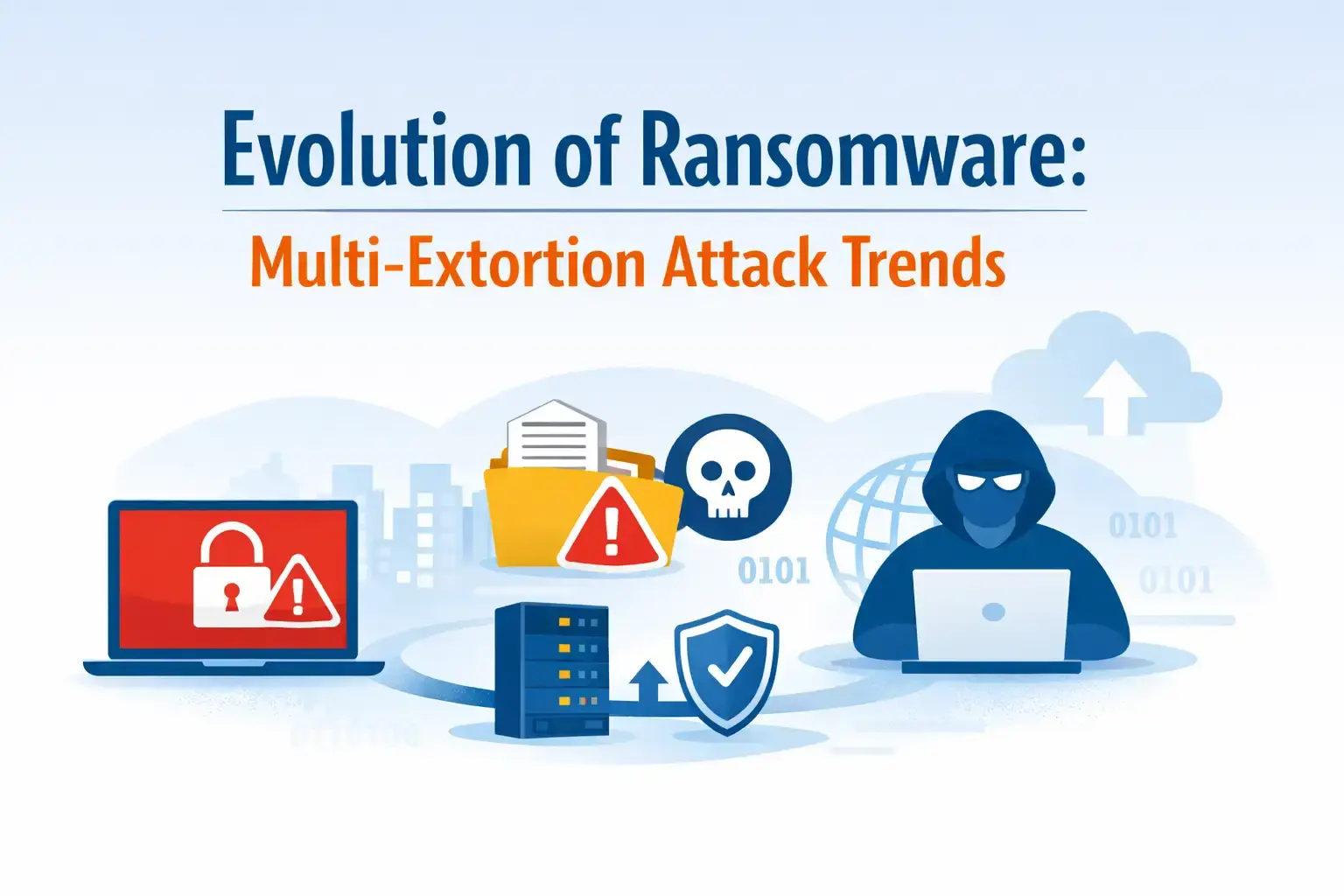
Why has the modern ransomware attack become more damaging than the old file-locking model?
Because today’s operators often do far more than encrypt systems. They steal data, threaten leaks, disrupt operations, pressure customers, and sometimes use phone calls or DDoS attacks to force payment.
Official guidance from CISA now treats ransomware and data extortion as a combined risk, while recent reporting and incident disclosures show that healthcare and enterprise victims are still being hit hard in 2025 and 2026.
There was a time when a ransomware attack was almost simple to explain. A criminal group got inside a network, encrypted files, dropped a ransom note, and waited. The damage was serious, but at least the story was straightforward. If a company had clean backups, good incident response, and a bit of luck, recovery was painful but possible. That old playbook still exists, but it no longer describes the whole threat.
What changed is pressure. Criminal groups learned that encryption alone does not always produce payment. Backups improved. Law enforcement pressure increased. Victims became more cautious about transferring money.
So attackers adapted. They started stealing sensitive files before locking devices, then threatening to publish or sell the data if the victim refused to pay.
That shift is the heart of the evolution of ransomware, and it explains why multi-extortion has become such a central story in modern cybercrime.
From file encryption to leverage at every layer
The first major phase of ransomware was about access denial. Attackers locked files and sold the cure. The second phase added data theft. That became known as double extortion.
The third phase went even further, adding outside pressure such as DDoS attacks, direct outreach to patients or customers, public shaming on leak sites, and threats aimed at partners.
criminals stopped asking, “Can we lock the company?” and started asking, “How many pain points can we create at once?”
That is why a modern ransomware attack is no longer just an IT outage. It can become a legal issue, a privacy crisis, a public-relations mess, and a patient-safety problem all at the same time. In healthcare, for example, operational disruption can affect scheduling, records access, imaging systems, and billing.
In distribution or manufacturing, the impact can ripple outward through the supply chain. This layered pressure is exactly what makes multi-extortion more effective than the old model.
What multi-extortion ransomware actually means
Multi-extortion ransomware is best understood as stacked coercion. The attackers may encrypt data, exfiltrate sensitive files, threaten publication, contact stakeholders, or launch additional disruption if negotiations stall.
Some campaigns even skip encryption and go straight to extortion based on stolen data alone. That sounds like a small tactical detail, but it changes everything for defenders. Backups can restore systems, but they cannot erase a stolen database from a criminal server.
This is where ransomware detection becomes more difficult and more important. Security teams are not just looking for rapid encryption anymore.
They need to catch credential theft, suspicious remote access, privilege escalation, lateral movement, bulk data staging, and unusual outbound transfers before the extortion phase fully matures.
That is one reason official guidance now frames ransomware and data extortion together rather than as separate problems.
-20260403184010.webp&w=1080&q=75 "Ransomware evolution_ multi-extortion trends")
Why attackers moved in this direction
The short answer is economics. Encryption created one source of pressure. Data theft created another. Public leak sites created a third. Every extra lever increased the odds that a victim would negotiate. At the same time, distributed criminal ecosystems made this easier.
Initial access brokers, credential theft campaigns, phishing crews, malware developers, and affiliate operators all feed the same market. A modern ransomware attack can be assembled almost like a criminal supply chain.
IBM said ransomware remained the largest share of malware cases in 2024 at 28%, even as overall ransomware incidents declined for a third year.
That sounds contradictory until you look closer. Some groups are moving toward lower-risk, stealthier models, including credential theft and extortion-led operations.
Sophos also reported continuing change in encryption and data-theft patterns, suggesting that the business model is evolving rather than disappearing.
The healthcare lesson is impossible to ignore
If you want to understand why this matters beyond security teams, look at healthcare. The kettering health ransomware attack and the davita ransomware attack show how quickly a cyber event can become a real-world disruption story.
Kettering Health says it was impacted on May 20, 2025, in an incident linked to Interlock, and DaVita disclosed on April 12, 2025, that a ransomware incident encrypted parts of its network.
These are not abstract examples. They show what happens when digital pressure collides with time-sensitive care.
That is why healthcare ransomware news, hospital ransomware news, and ransomware hospital news keep drawing such strong reader interest.
Hospitals and care networks store valuable personal data, depend on continuous system availability, and cannot easily pause operations.
A ransomware attack in this sector carries emotional weight because the downstream effects are easier for the public to understand. Delayed appointments, diverted services, and patient anxiety make the threat feel immediate.
The phrase hospital ransomware attack news today may sound like a search query, but it reflects a real pattern in reader behavior. People search that phrase because they want to know whether the latest incident affects care delivery right now, not six months later after a breach notice arrives.
That urgency is one reason healthcare stories often outperform broader ransomware attack news coverage in search and engagement.
Enterprise victims face a different kind of spillover
Outside healthcare, enterprise cases show another side of the same problem. The ingram micro ransomware attack is a strong example.
Ingram Micro disclosed on July 5, 2025, that it identified ransomware on certain internal systems and took systems offline as part of mitigation.
When a major distributor experiences a serious security outage, the impact does not stay neatly inside one corporate boundary. Partners, resellers, customers, and dependent workflows all feel the drag.
That is where enterprise ransomware protection becomes more than a technical budget line. It is not just about saving one company from embarrassment. It is about preserving the reliability of connected business operations.
In supply-chain-heavy sectors, one ransomware attack can trigger delays, licensing issues, procurement bottlenecks, and trust problems far beyond the original victim. Cybersecurity people have known this for years, but recent incidents keep making the lesson painfully public. Can you have ransomware attack with a zero day vulnerability?
Yes, absolutely. To answer the long-tail question directly, can you have ransomware attack with a zero day vulnerability? Yes. A zero-day vulnerability is the undisclosed or unpatched flaw. A ransomware campaign can use that flaw as the initial access path or as part of privilege escalation and lateral movement. In other words, the zero-day is the door, while ransomware is one possible intruder or payload.
Recent reporting reinforces the point. Security coverage in 2026 linked active exploitation of serious flaws, including VMware ESXi-related issues and Cisco-focused activity, to ransomware risk and post-compromise abuse.
Not every exploited vulnerability leads to encryption, of course. Sometimes the endgame is espionage, credential theft, or data extortion only. But the connection between zero-day access and a later ransomware attack is very real.
Why backups alone no longer solve the problem
For years, backup discipline was the star defensive recommendation. It still matters. Clean, tested, segmented backups remain essential. But ransomware backup news has become more complicated because restoration only addresses one piece of the crisis.
If attackers already copied legal documents, patient records, pricing files, or identity data, a recovered server does not close the extortion loop. The victim may still face disclosure pressure, regulatory scrutiny, and notification costs.
This is why the idea of “we have backups, so we’re fine” now feels a little outdated. It is not wrong. It is just incomplete. A modern ransomware attack should be treated as both a resilience challenge and a data governance challenge. If sensitive information is not well segmented, encrypted, controlled, and monitored, recovery can be technically successful while the organization still loses the bigger battle.
What effective defense looks like now
A serious defense plan has to assume that attackers may enter, move, and steal before they encrypt. That means identity security, privileged access controls, network segmentation, endpoint visibility, anomaly detection, and data protection all need to work together. This is the practical side of cyberproof ransomware protection as a search concept. No product can make that promise literally, but the user intent behind the phrase is clear: organizations want layered defenses that interrupt the full attack chain, not just the last stage.
CISA’s guidance is still one of the best starting points because it emphasizes preparation, prevention, mitigation, and response.
NIST’s ransomware risk-management work points in the same direction. In plain terms, good defense now means reducing the chance of initial compromise, spotting suspicious behavior early, protecting sensitive data before exfiltration, and rehearsing response before an incident turns chaotic. The days when a single appliance could “solve” the ransomware attack problem are gone.
-20260403184009.webp&w=1080&q=75 "Ransomware evolution_ multi-extortion trends")
What users and organizations should do next
For readers following ransomware attack today, ransomware attack news, or ransomware attack news today, the most useful question is not “Which gang is trending?”
It is “What weak point are attackers exploiting over and over?” The answers are familiar: stolen credentials, exposed remote services, delayed patching, poor segmentation, over-privileged accounts, and weak visibility into data movement.
That may sound repetitive, but criminal success often depends on familiar gaps, not movie-style hacking magic.
If you run a business, start with basics that still matter: enforce MFA, monitor privileged access, test backups, isolate critical systems, and rehearse incident response.
Then go a step further. Identify your most sensitive data, control where it can move, and reduce how much any one account can reach. A ransomware attack becomes much harder to monetize when attackers cannot easily steal meaningful data or use one compromised identity to roam freely.
Quick FAQ
What is the difference between double extortion and multi-extortion?
Double extortion usually means encryption plus data theft. Multi-extortion expands the pressure toolkit and may include leak threats, DDoS attacks, direct outreach to customers or patients, or extortion without encryption at all.
Are ransomware attacks decreasing?
Some reports show overall ransomware incidents declining in certain datasets, but that does not mean the risk is fading. Attackers are shifting tactics, including more stealth, credential theft, and extortion-led operations.
Why is healthcare targeted so often?
Healthcare organizations hold sensitive data and depend on uninterrupted access to systems. That combination makes them especially vulnerable to pressure-heavy extortion tactics.
Can backups prevent a ransomware crisis?
Backups help restore operations, but they do not undo data theft. In a multi-extortion case, recovery without data-protection strategy may still leave the victim exposed.
Hoplon Insight Box
What smart organizations should prioritize now
1. Treat ransomware as both an availability threat and a data-theft threat.
2. Build detection around identities, exfiltration, and lateral movement, not just encryption behavior.
3. Test backups, but also classify and protect sensitive data before it is stolen.
4. Rehearse cross-functional response with legal, communications, privacy, and executive teams.
5. Watch healthcare and supply-chain incidents closely because they preview where pressure tactics are heading next.
Trusted source and research quote
A trusted starting point is CISA’s #StopRansomware Guide, which explicitly frames ransomware and data extortion together and provides prevention and response guidance.
For a research-backed signal, IBM’s 2025 X-Force Threat Intelligence Index said ransomware accounted for 28% of malware cases in 2024 even as overall incidents declined, highlighting tactical shifts rather than a simple disappearance of the threat.
Final takeaway
The old image of ransomware is outdated. Today, the real story is leverage. A modern ransomware attack is built to hurt on several fronts at once: systems, data, reputation, customers, and operations.
That is why the evolution of ransomware matters so much. It tells us that defenders can no longer think only about restoring files.
They have to think about controlling identities, protecting data, limiting blast radius, and reacting before extortion pressure fully builds. And honestly, that shift is not a small update. It is the whole game now.
You can also read these important cybersecurity news articles on our website.
· Apple Update,
For more, please visit our homepage and follow us on X (Twitter) and LinkedIn for more cybersecurity news and updates. Stay connected on YouTube, Facebook, and Instagram as well.