
Google Cloud Warns: Three AMD Turin CPU Flaws Could Leak Data Across Processes in VMs
Table of Contents
Quick Summary and Key Takeaways
Background and Threat Landscape
Technical Breakdown: How These AMD Turin Flaws Work
Actionable Remediation and Mitigation Strategy
Comparison of Mitigation Approaches Technical SEO, Schema, and Web Security Implementation Notes
Conclusion
Frequently Asked Questions
Can a Hardware Bug Let Another Virtual Machine Read Your Private Cloud Data?
Yes. On October 2026, Google Cloud published a security bulletin warning customers about a serious google cloud security vulnerability rooted in underlying server hardware. Specifically, three microarchitectural flaws in AMD EPYC "Turin" processors (Zen 5 architecture) can allow unauthorized actors to infer sensitive data across process boundaries and virtual machines (VMs) running on shared physical hosts.
When we rent compute instances in a public cloud, we trust that the hypervisor keeps our neighbors strictly separated from our memory. These newly highlighted amd turin cpu vulnerabilities challenge that foundational assumption.
Even if your Linux or Windows operating system has every software patch installed, a flaw inside the silicon scheduler itself can create a tiny side channel.
TL;DR / Quick Summary Box
- The Core Threat: Three hardware-level amd cpu vulnerabilities tracked as CVE-2026-0004, CVE-2024-36350, and CVE-2024-36357 affect AMD EPYC Turin (Zen 5) processors used in modern cloud infrastructure.
- The Risk: Using amd transient scheduler attacks, an attacker sharing the same physical CPU core could leak sensitive information across processes, containers, or virtual machines.
- The Fix: Google Cloud has already deployed host-level microcode and hypervisor mitigations for standard Compute Engine VMs, while organizations using Confidential Computing or bare-metal nodes must apply BIOS updates and verify kernel patches immediately.
Background and Real Data: Why Hardware Side Channels Matter Now
Cloud computing runs on multi-tenancy. Multiple organizations share the same physical server racks, motherboards, and processor packages to keep costs low and efficiency high. Most of the time, hardware isolation works without a hitch.
However, modern processors achieve high speeds by guessing what instructions they will need next. Security researchers have spent the last eight years proving that these speed optimizations often leave faint footprints in shared CPU buffers. When Google Cloud flags a google cloud amd vulnerability, IT admins and CISOs have to pay close attention because hardware flaws cannot be fixed with a simple web application firewall rule.
According to the
Meanwhile, the
If you follow updates on the
For small business owners running production databases on cloud VMs, this news can feel overwhelming. You might wonder if you need to migrate your entire stack. The short answer is no, provided you understand where cloud provider responsibility ends and your internal IT responsibility begins.
The Technical Breakdown: How These AMD Turin Flaws Work
In our security audits of multi-tenant cloud environments, we often see engineering teams focus 95% of their energy on application code and network ports. Almost nobody looks beneath the hypervisor until an advisory like this drops. To understand why these amd turin security flaws matter, we need to look at how a Zen 5 processor schedules work.
Think of a modern CPU core like a busy restaurant kitchen. To serve food fast, the head chef (the instruction scheduler) prepares ingredients before the waiter even finishes writing down the order. Sometimes, the chef realizes the customer changed their mind and throws those prepped ingredients away. That discarded work is called transient execution.
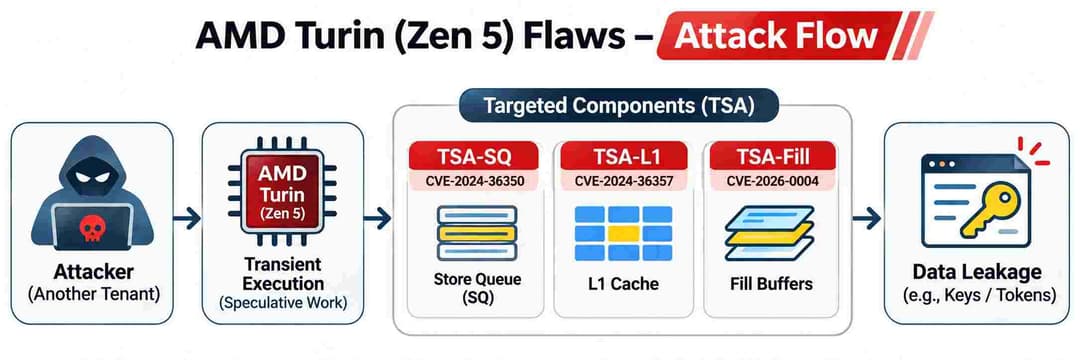
The three vulnerabilities flagged by Google Cloud target specific internal buffers inside AMD's Zen 5 architecture during these transient moments:
- TSA-SQ vulnerability (CVE-2024-36350): This flaw resides in the Store Queue (SQ). The Store Queue holds data waiting to be written from the CPU to memory. Under specific conditions, a transient instruction can read stale data left behind in the Store Queue by a previous process.
- TSA-L1 vulnerability (CVE-2024-36357): This issue affects the Level 1 (L1) data cache. When a processor speculatively loads data that misses or conflicts in the L1 cache, timing differences and transient forwarding can expose leftover bytes from another thread.
- TSA-Fill vulnerability (CVE-2026-0004): This newly cataloged amd zen 5 vulnerability involves the CPU's fill buffers, which handle data moving between different cache levels and system memory. By carefully measuring how fast certain memory operations resolve, an attacker can infer bits of secret data, such as cryptographic keys or session tokens, belonging to another tenant.
Together, security researchers group these techniques under the umbrella of amd transient scheduler attacks (TSA). Because they rely on observing subtle timing variations rather than crashing a system or stealing a password directly, they are classified as an amd side channel attack.
A Practical Scenario: How an Attack Plays Out in the Cloud
Imagine a mid-sized financial tech startup hosting its API backend on a shared cloud instance powered by AMD EPYC Turin chips. On that exact same physical server, an attacker spins up a cheap, low-tier virtual machine.
The attacker does not have your SSH keys. They cannot see your virtual network. Instead, they run a tightly calibrated loop of assembly instructions designed to trigger speculative scheduler faults. Over millions of iterations, the attacker's code measures nanosecond-level delays in the L1 cache and Store Queue. Slowly, byte by byte, those timing measurements reconstruct pieces of memory from the startup's adjacent VM.
It is slow, noisy, and requires deep low-level programming skill. That is why you rarely see script kiddies pulling off an amd processor security vulnerability exploit. Still, for nation-state actors or well-funded cybercriminals targeting high-value intellectual property, a google cloud vm vulnerability like this is a prime target.
Diagnostic Checklist and Verification Commands
When analyzing this vulnerability on Linux-based cloud instances, the first step is checking what the operating system kernel sees exposed by the underlying CPU microcode. You do not need exotic tools to inspect your virtual hardware posture.
On an Ubuntu or Debian cloud VM, an administrator can
run a quick terminal check against the sysfs CPU
vulnerability interface:
grep -r . /sys/devices/system/cpu/vulnerabilities/ # Verify current microcode revision and CPU model familylscpu | grep -E "Model name|Vendor ID|Stepping"dmesg | grep -i microcodeIf your kernel is up to
date and running on patched host microcode, the output will reflect active
hardware or software mitigations. If the system reports Vulnerable
without mitigation flags for transient scheduler or speculative store bypass
vectors, your workload is running without full silicon-level protection.
Actionable Remediation and Mitigation Strategy
Because cloud infrastructure operates on a Shared Responsibility Model, fixing an amd epyc turin vulnerability requires action from both Google Cloud and your internal engineering team. Google handles the physical servers, hypervisor, and host BIOS. You handle the guest operating system, container runtimes, and workload isolation settings.
Follow this numbered action plan to protect your environment against any amd cpu data leak:
- Audit Your Compute Engine Machine Families: Open your Google Cloud console and list all active VM instances. Identify which workloads run on newer AMD EPYC Turin-backed machine series (such as N4D or C4D instances, depending on your region and deployment).
- Leverage Google Cloud Security Command Center: Enable and review findings inside google cloud security command center. This platform automatically flags outdated guest OS images, unpatched kernels, and exposed compute assets across your organization.
- Update
Guest OS Kernels Immediately: Apply the latest Linux or Windows Server
security updates across all VMs. Operating system vendors release kernel-level
buffer-clearing routines (such as
VERWinstruction sequences) that scrub CPU buffers during context switches, neutralizing amd cpu security flaws even before hardware microcode finishes rolling out. - Reboot VMs to Pick Up Host Microcode: Google Cloud uses live migration to move VMs onto patched hosts without downtime whenever possible. However, certain specialized instances, local SSD configurations, or sole-tenant nodes require a manual stop and start cycle to load updated CPU microcode.
- Evaluate Sole-Tenant Nodes for High-Compliance Data: If you process regulated healthcare, financial, or defense data, consider moving sensitive workloads onto Sole-Tenant Nodes. Dedicating an entire physical server to your organization eliminates the risk of a noisy neighbor exploiting amd zen 5 security flaws across VM boundaries.
- Verify Confidential Computing Settings: If you use AMD SEV-SNP (Secure Encrypted Virtualization), check Google Cloud's latest attestation guidelines. Hardware encryption protects memory in transit and at rest, but microcode updates are still mandatory to close transient scheduler side channels.
Every google cloud security engineer knows that visibility is half the battle. If your team lacks dedicated cloud specialists, investing in formal training like the google cloud security engineer certification or the google cloud security operations engineer certification can help your staff build automated patching pipelines. Earning a google cloud security certification also ensures your engineers understand how to configure google cloud security policies properly, which is why google cloud security jobs continue to see high demand across enterprise IT departments.
Comparison of Mitigation Approaches
Not every organization needs the exact same level of defense. A static marketing website has a very different risk profile than a multi-tenant payment gateway. Use the table below to weigh your options and decide how to fix amd processor vulnerabilities security risks in your stack.
|
|
Protection Level |
Performance Impact |
Operational Effort |
Best For |
|
Host Microcode + Guest Kernel Patching |
High |
Low (typically 1% to 3% on I/O heavy tasks) |
Low (automated via OS patch management) |
Standard web apps, APIs, and general business workloads |
|
Live Migration to Patched Cloud Hosts |
High |
Minimal |
Very Low (handled automatically by Google Cloud) |
Stateless services and standard Compute Engine instances |
|
Disabling Simultaneous Multithreading (SMT) |
Very High |
Moderate to High (up to 15% to 25% throughput loss) |
Medium (requires kernel boot parameter changes) |
High-security environments handling sensitive cryptographic keys |
|
Sole-Tenant Nodes (Hardware Isolation) |
Maximum (eliminates cross-tenant risk) |
None |
High (higher infrastructure cost and capacity planning) |
Financial institutions, healthcare (HIPAA), and strict compliance teams |
Every security control involves a trade-off. Relying solely on guest OS kernel patches is fast and cheap, yet it still leaves a sliver of risk if a future amd vulnerability bypasses software buffer clearing. On the other hand, disabling Simultaneous Multithreading (SMT) shuts down thread-level side channels almost completely, but you immediately lose significant multi-threaded CPU performance and pay more for compute capacity.
Sole-tenant nodes offer peace of mind because no stranger ever shares your physical AMD processor. However, small businesses often find the baseline cost of renting an entire physical host prohibitive. In our experience, combining timely guest kernel updates with Google Cloud's automatic host microcode rollouts hits the sweet spot for 90% of commercial deployments.
Technical Web Security and Implementation Guidelines for Publishers
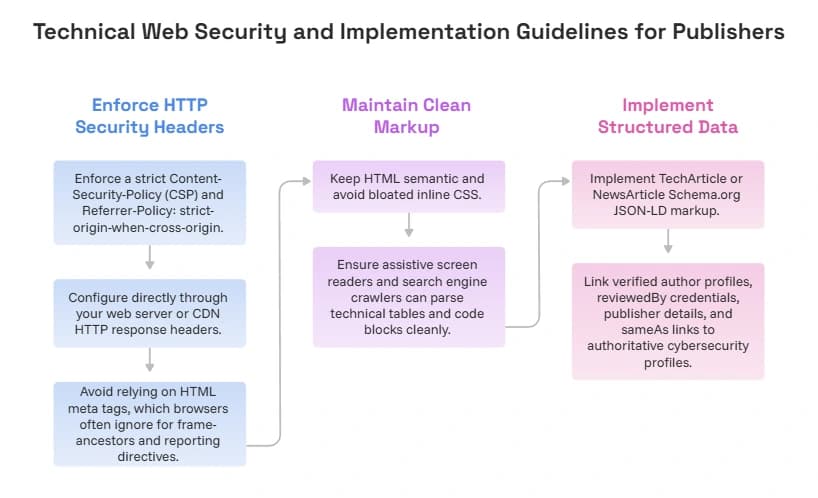
If you are publishing technical security advisories or engineering documentation on your own domain, protecting reader trust goes beyond accurate writing. Modern security portals should enforce strict browser-level protections and clean semantic markup:
- HTTP Security Headers: Enforce a strict
Content-Security-Policy(CSP) andReferrer-Policy: strict-origin-when-cross-origindirectly through your web server or CDN HTTP response headers rather than relying on HTML<meta>tags, which browsers often ignore for frame-ancestors and reporting directives. - Clean Markup and Styling: Keep HTML semantic and avoid bloated inline CSS so assistive screen readers and search engine crawlers can parse technical tables and code blocks cleanly.
- Structured Data: Implement
TechArticleorNewsArticleSchema.org JSON-LD markup linking verifiedauthorprofiles,reviewedBycredentials,publisherdetails, andsameAslinks to authoritative cybersecurity profiles.
Conclusion
Hardware vulnerabilities remind us that cloud security is never a "set it and forget it" exercise. While Google Cloud's rapid response neutralizes much of the immediate danger from CVE-2026-0004, CVE-2024-36350, and CVE-2024-36357, the burden of verifying guest OS updates and rebooting specialized instances remains with you.
Take an hour this week to audit your virtual machine inventory, confirm your Linux and Windows kernels are current, and review your alerts in the google cloud security community forums and Security Command Center.
If your team is unsure how to validate microcode patches or architect isolated cloud environments, consider consulting experienced cybersecurity professionals, such as the advisory team at Hoplon InfoSec, to review your cloud posture before minor hardware gaps turn into costly incidents.
Frequently Asked Questions (FAQ)
What is the Google Cloud AMD Turin CPU vulnerability?
The google cloud security vulnerability involves three hardware-level flaws (CVE-2026-0004, CVE-2024-36350, and CVE-2024-36357) in AMD EPYC Turin (Zen 5) processors. These flaws allow transient scheduler attacks that could leak sensitive data across processes or virtual machines sharing the same physical CPU.
Are all Google Cloud virtual machines affected by these AMD CPU security flaws?
No, only virtual machines running on underlying host servers powered by AMD EPYC Turin (Zen 5) processors are affected. Workloads running on older AMD generations, Intel processors, or Arm-based Tau T2A instances are not impacted by these specific amd processor vulnerabilities security advisories.
How do I fix the AMD processor vulnerabilities security issue on my cloud VMs?
Google Cloud automatically applies host-level microcode patches and live-migrates standard VMs to updated hardware. To complete the fix, administrators must update their guest operating system kernels, reboot sole-tenant or specialized instances, and verify mitigation flags via their cloud security console.
Can hackers exploit TSA-SQ, TSA-L1, and TSA-Fill remotely over the internet?
Not directly over a network connection. To exploit the TSA-SQ vulnerability, TSA-L1 vulnerability, or TSA-Fill vulnerability, an attacker must already have code execution access on the same physical processor core, such as through a co-located virtual machine or a compromised container.
Authoritative References & Further Reading
Google Cloud Security Bulletins AMD Product Security Advisories NIST National Vulnerability Database (NVD) CISA Known Exploited Vulnerabilities & Advisories
Author Bio and Review
Author: Mohammed Talukder is the Co-Founder and CEO of Hoplon InfoSec, with over 16 years of experience in cybersecurity and technology. His expertise includes offensive security, vulnerability management, cyber risk management, and incident response. His professional credentials include CISM, CISA, CEH, and CompTIA PenTest+. He has also received Infosys recognition awards for his professional contributions. He shares practical cybersecurity insights to help organizations strengthen their security posture.
Technical reviewer: Gazi Mahmud, Co-Founder and CIO of Hoplon InfoSec LLC, cybersecurity leader, and CISM & CISA certified professional with expertise in cyber risk management, security governance, compliance, and incident response.
Published: October 14, 2026
Last
Updated: October 2026
Read More Articles:
Mobile Security 2025: Top 7 Antivirus Apps You Can Trust
X Suspended Twitter Account: Causes, Appeals & Recovery
Microsoft Teams Phishing Attack:Remote Access Scam Explained
SAP Security 2026: Risks, Best Practices & Checklist
Fact-Checking & Editorial Policy: Every technical claim, CVE identifier, and mitigation step in this guide is verified against official advisories from Google Cloud Security, AMD Product Security, NIST National Vulnerability Database (NVD), and CISA. We never speculate on unconfirmed exploit activity or fabricate incident statistics.