
OpenAI said in November 2025 that hackers got into Mixpanel, a third-party analytics partner the company used. Reports say that the data that was made public only included some API users' limited analytics and profile information. OpenAI wants to make it clear that ChatGPT users, their chats, passwords, and payment information were not affected.
This article explains what we know for sure, what was revealed, what is still safe, and what you should do now if you use OpenAI's API.
What happened was a breach at Mixpanel, not OpenAI.
The timeline of the breach and what was revealed
On November 9, 2025, Mixpanel found that someone had gotten into some of its systems without permission. An attacker took a dataset that only had a small amount of analytics customer data.
OpenAI was told by Mixpanel, and on November 25, the analytics company told OpenAI about the affected dataset.
OpenAI's disclosure says that the exposed data may include:
• Names linked to API accounts
• Email addresses used for API accounts
• Approximate location based on browser metadata (city, state, or country)
• Browser and operating system (OS) used to access the API account
• Referring to website information and organization or user IDs linked to the API account
It's important to note that chat messages, API requests or responses, API usage data, passwords, API keys, payment information, government IDs, session tokens, or other sensitive credentials were not made public.
OpenAI's answer and taking Mixpanel down
As soon as OpenAI found out about the breach, it took Mixpanel out of its production environment.
They are doing a wider security review of all vendors and raising the security standards for partners to avoid future risks.
OpenAI also started to directly tell the organizations, account admins, and users who were affected. Their goal is to be open and watch for any signs of abuse.
What this means: safe vs. exposed
• You are safe as long as you only use ChatGPT and not the API. OpenAI said that ChatGPT users were not affected. Sensitive information like chats, payment information, API keys, passwords, and credentials is still safe.
• The names, email addresses, rough location, browser/OS info, and other data that were leaked are not very sensitive. Even so, the information that was exposed could be used for phishing or social engineering.
You might be affected if you used OpenAI's API. There's no proof that your personal data or conversations were compromised if you only used ChatGPT or other consumer products.

What you should do now: practical steps to stay safe
OpenAI's own advice gives a clear list of things to do to stay safe.
• Be careful with any emails or messages that you didn't expect to get that say they are
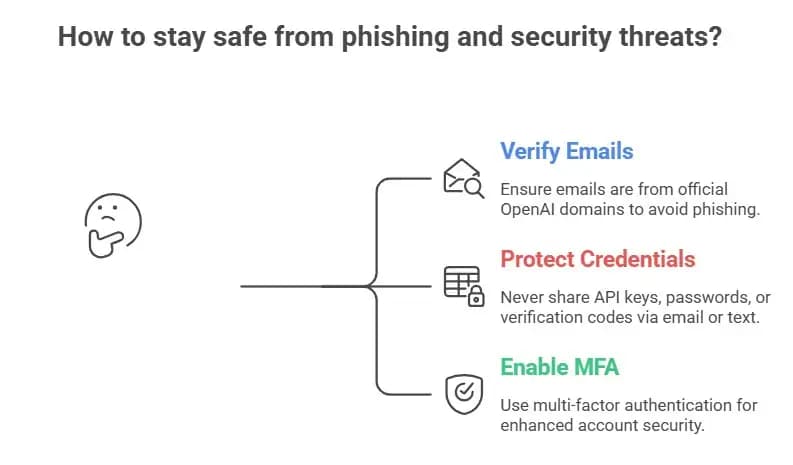
from OpenAI, especially if they have links or attachments.
• Before you do anything, make sure that any email is really from an official OpenAI domain.
• Don't give out your API key, password, or verification codes when someone asks for them by email or text. OpenAI says they won't ask for these over email or text.
• If you can, turn on multi-factor authentication (MFA) for your account to make it even safer.
These are easy but helpful steps. They are very important for API users whose names and email addresses may have been made public.
Important Insights
What was done correctly
• The breach only affected a third-party provider (Mixpanel), not OpenAI's main infrastructure. That helped keep the damage to a minimum.
• No one ever touched sensitive information like passwords, chats, payment information, or API keys.
• OpenAI acted quickly by taking Mixpanel down, letting affected users know, and promising to do a security review of all vendors.
• Openness: OpenAI made the breach public and gave details about what was exposed.
What still worries me
• Phishing and social engineering can happen with even small amounts of data, like a name, email address, or location. This kind of metadata leak is still dangerous.
• Using third-party analytics added a risk to the supply chain because it depended on outside services that could be attacked.
• Uncertainty: OpenAI hasn't said how many users (or organizations) were affected. We don't know how many people were affected.
• API, this incident is a wake-up call: third-party tools can make security weaker, even if the main platform is secure.
Update: July 2026 : OpenAI Clarified That Some ChatGPT Users Were Also Affected
OpenAI later issued an important clarification about the Mixpanel security incident. On December 19, 2025, the company updated its original disclosure to state that the incident did not affect only API users.
A limited number of ChatGPT users may also have been affected if they:
- Submitted a ticket through the OpenAI Help Center, or
- Were logged into platform.openai.com
OpenAI said that all affected users had already been identified and notified during its original outreach. The company also stated that this clarification did not change its understanding of the information involved in the incident.
Important Correction About ChatGPT Users
The original statement that users were completely safe as long as they used only ChatGPT is too broad.
Most ordinary ChatGPT users were not affected. However, a limited number of ChatGPT users who interacted with the Help Center or were logged into the OpenAI API platform may have had limited account-profile and analytics information included in the exported Mixpanel dataset.
This does not mean that their ChatGPT conversations or account credentials were exposed.
What Information May Have Been Exposed?
According to OpenAI, the affected information was limited to:
- The name provided on the account
- The email address associated with the account
- Approximate location, such as city, state, or country
- Browser and operating-system information
- Referring websites
- OpenAI organization or user IDs
This information could potentially be used to create convincing phishing emails, fraudulent support messages, or social-engineering attempts.
What Was Not Exposed?
OpenAI confirmed that the following information was not compromised:
- ChatGPT conversations
- API prompts or responses
- API request content
- API usage data
- Passwords
- API keys
- Payment information
- Government identification
- Session tokens
- Authentication tokens
- Account-access credentials
The incident occurred within Mixpanel’s systems and did not involve unauthorized access to OpenAI’s infrastructure.
Do Users Need to Reset Passwords or Rotate API Keys?
OpenAI does not recommend resetting passwords or rotating API keys specifically because of this incident. The company confirmed that passwords, API keys, authentication tokens, and other sensitive credentials were not included in the affected data.
Users may still change their password or rotate an API key as a general security precaution, particularly if they notice suspicious activity. However, OpenAI has not identified these actions as necessary responses to the Mixpanel incident.
Was This Confirmed as a Smishing Attack?
OpenAI’s official disclosure says that an attacker gained unauthorized access to part of Mixpanel’s systems and exported a dataset. However, OpenAI’s notice does not describe the initial intrusion as a confirmed smishing attack.
Therefore, references to a “smishing attack on Mixpanel” should be treated as unconfirmed unless supported by a separate official Mixpanel investigation. The confirmed fact is that unauthorized access occurred within Mixpanel’s environment—not OpenAI’s systems.
OpenAI’s Response
OpenAI took the following actions after learning about the incident:
- Removed Mixpanel from its production services
- Reviewed the affected datasets
- Notified affected organizations, administrators, and users
- Monitored for signs of misuse
- Conducted broader reviews of its third-party vendors
- Increased security requirements for partners and service providers
OpenAI subsequently terminated its use of Mixpanel.
Updated Safety Recommendations
Users should continue to watch for phishing and social-engineering attempts that may reference their OpenAI account, organization, API activity, location, or browser information.
Take the following precautions:
- Be cautious with unexpected emails, texts, or support messages claiming to come from OpenAI.
- Avoid opening suspicious links or attachments.
- Verify that account-related messages originate from an official OpenAI domain.
- Never provide passwords, API keys, authentication codes, or verification codes through email, text, or chat.
- Enable multi-factor authentication on the OpenAI account.
- Organizations using single sign-on should enforce MFA through their identity provider.
- Review API keys, organization members, billing activity, and account login activity if anything appears unusual.
OpenAI specifically recommends MFA even though account credentials and tokens were not exposed during this incident.
Updated Frequently Asked Questions
Were all ChatGPT users affected?
No. OpenAI identified only a limited number of affected ChatGPT users. These included some users who submitted Help Center tickets or were logged into platform.openai.com.
Were ChatGPT conversations exposed?
No. OpenAI confirmed that chats, prompts, responses, and API request content were not affected.
How can users know whether they were affected?
OpenAI stated that it directly notified the affected users, organizations, and account administrators. Users who did not receive a notification were not identified by OpenAI as part of the affected group.
Has OpenAI continued using Mixpanel?
No. OpenAI confirmed that it removed Mixpanel from its services and terminated its use of the provider.
Is phishing still the main concern?
Yes. The exposed names, email addresses, approximate locations, account identifiers, and technical metadata could help attackers make fraudulent messages appear more credible.
Updated Takeaway
The Mixpanel incident was not a breach of OpenAI’s infrastructure, and sensitive information such as conversations, passwords, API keys, payment information, prompts, responses, and authentication tokens was not exposed.
However, the original description should be updated to reflect that a limited number of ChatGPT users—not only API users—were potentially affected. These users included people who submitted Help Center tickets or were logged into platform.openai.com.
The primary remaining risk is targeted phishing and social engineering using exposed profile and analytics metadata. Users should remain cautious, enable multi-factor authentication, and verify unexpected messages before clicking links or providing information.
Common Questions
Did someone hack ChatGPT in this case?
No. The breach only happened at Mixpanel, which is a third-party analytics company. OpenAI's systems and ChatGPT users were not affected.
What information was made public?
Names, email addresses, approximate location (city, state, country), browser and operating system used, information about the website that linked to the API accounts, and user or organization IDs linked to API accounts.
Did passwords, chats, and payment information get out?
No. There was no exposure of passwords, API keys, payment information, chat logs, API usage data, or authentication credentials.
What can I do to keep myself or my team safe?
Be careful with emails that say they are from OpenAI, but you didn't expect them. Turn on multi-factor authentication. Don't send sensitive information by email or text.
Finish up
The 2025 OpenAI Mixpanel breach/ ChatGPT Mixpanel hack shows that even third-party services that you trust can be a weak link. A smishing attack on Mixpanel in this case put some OpenAI API users' limited analytics data at risk.
The good news is that ChatGPT users' passwords, chat histories, API keys, and payment information are all still safe. OpenAI moved quickly by ending the Mixpanel integration, letting affected users know, and promising better vendor security.
If you use OpenAI's API, be on the lookout for phishing attempts and turn on multi-factor authentication. For now, you can relax if you only use ChatGPT. But let this incident be a lesson: even small metadata leaks can be dangerous, and online security depends on more than just the main platforms. It also depends on the vendors or services they use.
You can also read these important cybersecurity news articles on our website.
· Apple Update,
For more, please visit our Homepage and follow us on X (Twitter) and LinkedIn for more cybersecurity news and updates. Stay connected on YouTube, Facebook, and Instagram as well.
Author: Hoplon Infosec
Bio: Security enthusiast with over 10 years in mobile cybersecurity. Connect with me on LinkedIn.
Address: 1415 W 22nd St Tower Floor, Oak Brook, IL 60523, United States
Phone: +1 773-904-313 , Contact: info@hoploninfosec.com
About/Privacy: At Hoplon Infosec, we provide expert insights into cybersecurity. Our editorial policy: all articles are written by in-house specialists or thoroughly reviewed by them to ensure accuracy, credibility, and up-to-date information.