PHP2Shell: Critical PHP Flaws Patched, New RCE Risk Remains
Are PHP Servers Still at Risk After the Latest PHP2Shell Security Updates?
PHP Security Vulnerabilities are back in the spotlight after two critical flaws in the PHP runtime were patched on October 21, 2026. Just two days later, another remote code execution (RCE) vulnerability was disclosed, this time without an available security fix.
The first two flaws, CVE-2026-109618 and CVE-2026-109619, are collectively known as PHP2Shell. Both carry a critical CVSS v4.0 score of 9.2 and could allow attackers to execute code on vulnerable web servers without logging in.
The newly disclosed CVE-2026-115560 is a separate issue. It affects PHP applications using an unusual combination of session settings.
The important difference is that the original PHP2Shell vulnerabilities have been patched, while the newly reported RCE issue remains unpatched as of October 23, 2026.
Quick Summary
- Two critical PHP2Shell vulnerabilities have been fixed. PHP released versions 8.5.12, 8.4.27, 8.3.36, and 8.2.35 on October 21 to address CVE-2026-109618 and CVE-2026-109619.
- Another PHP RCE vulnerability remains unpatched. CVE-2026-115560 affects applications using specific session serialization settings. PHP recommends temporarily disabling session upload progress where necessary.
- Researchers have already observed exploitation attempts. AWS, Sophos, and Arctic Wolf reported suspicious PHP2Shell-related activity. However, the documented attempts should not be mistaken for confirmed successful attacks against production servers.
What Happened? A Timeline of the October 2026 PHP Security Incidents
The PHP2Shell story began before the vulnerabilities were publicly disclosed.
On October 17, Amazon Threat Intelligence detected an attempted exploit through its MadPot honeypot infrastructure. A honeypot is a monitored system that attracts suspicious activity so researchers can study how attackers operate.
This activity appeared four days before the official security updates became available.
On October 20, the PHP project warned users that a critical security release was coming. The fixes arrived the following day, October 21.
Then, on October 23, PHP disclosed another vulnerability, CVE-2026-115560.
Although these events happened within the same week, the third vulnerability is not simply another report about the original PHP2Shell flaws. It has different technical requirements and separate mitigation guidance.
For administrators, that distinction matters. Applying the fixes for the first two vulnerabilities does not necessarily address the third.
PHP Security Incident Timeline
|
Date |
Development |
Confirmed Security Impact |
|
October 17, 2026 |
AWS observed an early PHP2Shell exploitation attempt. |
Evidence of attempted exploitation before disclosure. |
|
October 20, 2026 |
PHP announced an upcoming critical security release. |
Administrators were advised to prepare for patching. |
|
October 21, 2026 |
PHP published emergency security updates. |
Two critical RCE vulnerabilities received official fixes. |
|
October 22, 2026 |
Sophos and Arctic Wolf published research on attempted exploitation. |
Botnet-related payload activity was documented, without confirmed successful delivery in the reviewed cases. |
|
October 23, 2026 |
PHP disclosed CVE-2026-115560. |
A separate configuration-dependent RCE risk remained unpatched. |
Three vulnerabilities were disclosed during this period, but they should not all be treated as having the same severity, exploitation requirements, or patch status.
Why These PHP Security Vulnerabilities Matter
PHP runs behind many websites and web applications. It handles tasks such as processing user requests, managing login sessions, communicating with databases, and generating webpage content.
Popular content management systems, including WordPress, Joomla, and Drupal, rely on PHP.
What makes PHP2Shell particularly concerning is where the problem exists.
The vulnerabilities affect the PHP runtime itself, not just an individual plugin, theme, or website feature.
A business could have a fully updated WordPress installation and still be exposed if the PHP version running on its server has not been patched.
Updating the website and updating the server's PHP runtime are two different tasks.
Wiz Research demonstrated the original vulnerabilities in environments running WordPress, Drupal, and Joomla. The researchers also showed that exploitation did not necessarily depend on a vulnerability in the website's application code.
That means administrators need to look beyond the applications they maintain and check the software running underneath them.
For more information on CMS-related security risks, Hoplon InfoSec's JCE Vulnerability and WordPress Security Guide explains how weaknesses in content management systems and their dependencies can create different security problems.
What Broader Cybersecurity Research Shows
The 2026 Verizon Data Breach Investigations Report offers some useful context.
According to Verizon, vulnerability exploitation accounted for 31% of initial access in the breaches analyzed, making it the leading initial access vector in the report.
That figure does not specifically describe PHP2Shell attacks. It comes from Verizon's broader analysis of reported security incidents and breaches.
Still, it helps explain why organizations should take vulnerabilities in widely used software seriously, especially when attackers have already started testing ways to exploit them.
Understanding the Two Critical PHP2Shell Vulnerabilities
Both PHP2Shell vulnerabilities involve problems with how PHP manages memory.
When PHP processes a request, it temporarily allocates memory to store information and perform operations. Once that information is no longer needed, the memory should be released safely.
Problems arise when software tries to use memory incorrectly, accesses information that has already been released, or handles incomplete data as though it were valid.
These errors can sometimes cause an application to crash. Under more serious conditions, they may expose sensitive information or allow an attacker to execute unauthorized code.
The two PHP2Shell vulnerabilities involve different memory-management problems.
CVE-2026-109618: Remote Code Execution Through Memory Corruption
CVE-2026-109618 involves PHP's handling of certain out-of-memory conditions.
An out-of-memory condition occurs when a program cannot allocate enough memory to finish an operation.
In vulnerable PHP versions, a memory allocation failure can interrupt request processing before some internal data structures have been fully initialized.
The problem comes afterward.
During cleanup, PHP may treat that incomplete data as valid information. This creates a memory corruption condition.
Under certain circumstances, an unauthenticated attacker could exploit the error to execute code within the affected PHP environment.
The risk is particularly serious because the vulnerable behavior may occur before the application has a chance to perform its normal security checks.
An attacker may therefore reach the vulnerable code without first passing through the website's authentication system.
The official PHP security advisory assigns CVE-2026-109618 a critical CVSS v4.0 score of 9.2.
CVE-2026-109619: Remote Code Execution Through Stale Global State
CVE-2026-109619 comes from a different memory-management weakness.
PHP workers can process multiple web requests during their lifetime. After completing one request, the worker must clean up certain internal references before handling another.
In affected versions, a fatal error can leave some references pointing to memory that has already been released.
If the same worker later processes another request, PHP may attempt to use that outdated reference.
Security researchers call this a use-after-free vulnerability.
In simple terms, the program tries to use memory after it has already been freed.
Depending on the circumstances, this can lead to crashes, information disclosure, or remote code execution.
The PHP advisory confirms that the problem involves request-related global state.
However, not every PHP installation is exposed in exactly the same way. Successful exploitation depends on the runtime configuration and how requests are handled.
Why Apache mod_php Faces Particular Risk
PHP can run through several different web server configurations.
With Apache mod_php, PHP runs directly inside Apache processes. PHP-FPM, by comparison, uses separate worker processes to handle PHP requests.
The PHP security team identified Apache mod_php as a particularly concerning configuration because researchers demonstrated an attack path that could be reached before application code starts running.
This is important because login checks, request validation, and other protections written into the application may not execute before the vulnerable operation occurs.
But Apache mod_php is not the only configuration administrators need to examine.
PHP's advisory also identifies environments using PHP-FPM, php-cgi, FrankenPHP, and LiteSpeed as potentially affected.
The exposure can differ between these environments.
Administrators should check the actual PHP version, server configuration, and available vendor fixes rather than assume their server is safe because it does not use Apache mod_php.
PHP2Shell Memory Disclosure: Risks to Passwords, Tokens, and API Keys
Remote code execution has received much of the attention surrounding PHP2Shell. But it is not the only concern.
Wiz Research also demonstrated that the vulnerabilities could allow unauthenticated attackers to read information from PHP process memory.
This is known as memory disclosure.
The information stored in a PHP worker's memory may include passwords, authentication tokens, API keys, and other sensitive application data.
An authentication token is a digital value that allows a user or application to prove it has permission to access a system.
API keys serve a similar purpose when applications communicate with external services.
If an attacker obtains one of these secrets, they may be able to access connected systems or information without using the original user's password.
The actual risk depends on what information was present in memory and whether the attack succeeded.
A memory disclosure vulnerability does not automatically mean every password or API key used by an application has been stolen.
However, it creates another potential consequence that administrators should consider when investigating suspected PHP2Shell exploitation.
Why Memory Disclosure Changes Incident Response
Installing a security patch addresses the vulnerable software, but it may not answer every question after a suspected attack.
If sensitive information could have been exposed before the patch was installed, administrators need to consider what that information might have allowed an attacker to access.
For example, an exposed API key may continue working even after the original server vulnerability has been fixed.
In that situation, updating PHP alone would not invalidate the exposed credential.
Organizations investigating credible evidence of compromise may need to review authentication logs and consider rotating potentially affected credentials.
Credential rotation means replacing an existing password, token, or API key so the old value can no longer be used.
Not every PHP2Shell incident requires every credential to be replaced.
The decision should depend on the available evidence, the systems involved, and the potential consequences of exposure.
Another PHP RCE Vulnerability Remains Unpatched: CVE-2026-115560
On October 23, the PHP project published another security warning.
This time, the issue involved PHP session handling rather than the original PHP2Shell memory-management flaws.
The new vulnerability, CVE-2026-115560, could allow remote code execution when an application uses a particular combination of session settings.
However, those conditions are unusual.
The PHP project has not assigned a public CVSS severity score to the new vulnerability. It has also not released a complete version-specific advisory.
For now, administrators should assess the configuration requirements before deciding whether their applications are exposed.
What Makes CVE-2026-115560 Exploitable?
According to PHP's October 23 advisory, several conditions must exist together.
First, the application must configure session.serialize_handler to use either php_binary or php_serialize.
It must then change the setting to php during execution using ini_set().
That change must happen before the application calls session_start().
PHP's session upload-progress functionality must also be enabled.
This is not a common configuration pattern.
Applications that never change their session serialization handler during execution are not exposed through the specific path described in the advisory.
The distinction matters because the new vulnerability should not be presented as though every PHP application is equally exposed.
Has PHP Released a Fix for CVE-2026-115560?
As of October 23, 2026, PHP has not released an official fix for CVE-2026-115560.
The project plans to address the problem through its regular release process and publish a complete advisory when the fix becomes available.
Until then, PHP recommends temporarily disabling session upload progress where necessary.
The recommended configuration is:
session.upload_progress.enabled=0
This disables PHP's built-in session upload-progress tracking.
It does not necessarily prevent an application from accepting ordinary file uploads.
Administrators should still check whether their applications depend on this functionality before changing the configuration.
PHP also notes that organizations which already applied the same mitigation following the CVE-2026-109619 advisory do not need to repeat it for the newly disclosed issue.
However, this setting does not replace the official security updates for the original PHP2Shell vulnerabilities.
Is CVE-2026-115560 Actively Exploited?
As of October 23, the reviewed public reports do not identify confirmed exploitation of CVE-2026-115560.
The scanning and attack attempts discussed in recent PHP2Shell investigations concern the two earlier vulnerabilities.
The PHP project has also not confirmed whether the newly disclosed problem shares the same underlying cause as either original flaw.
It would therefore be inaccurate to describe all three vulnerabilities as having the same technical impact, severity, or exploitation method.
Real-World PHP2Shell Attack Attempts: What Researchers Confirmed
The release of public proof-of-concept code brought additional attention to PHP2Shell.
A proof of concept is a technical demonstration showing that a vulnerability can be exploited under certain conditions.
Researchers use these demonstrations to understand the security weakness and evaluate possible defenses.
Attackers may also study publicly available exploit information and attempt to adapt it.
But one distinction is essential when examining PHP2Shell reports.
An attempted exploit does not necessarily mean an attacker successfully compromised the targeted server.
A controlled laboratory demonstration, a blocked attack, and a confirmed production breach are three different findings.
The reports from AWS, Sophos, and Arctic Wolf provide useful examples of why that difference matters.
AWS Detected Exploitation Attempts Before Public Disclosure
Amazon Threat Intelligence identified an attempted PHP2Shell exploit through its MadPot honeypot infrastructure on October 17, 2026.
This happened four days before the vulnerabilities were publicly disclosed.
AWS later observed additional attempts involving different payloads and infrastructure.
Its researchers reported that the activity suggested multiple actors may have been experimenting with the vulnerabilities.
However, AWS also acknowledged that it was unclear whether the observed attempts would have succeeded against real production systems.
For administrators, one practical lesson is that incident investigations should not always begin on the official disclosure date.
If suspicious activity started before the vulnerability became public, reviewing logs only from October 21 could miss relevant evidence.
AWS recommended examining potentially related activity dating back to at least October 17.
Sophos Investigated an Attempted Potassium Botnet Deployment
Sophos investigated suspicious activity involving a malicious payload associated with Potassium, a likely Mirai-derived botnet variant.
A botnet is a group of compromised devices that can be controlled remotely.
Attackers may use botnets for different malicious activities, including distributed denial-of-service attacks.
A DDoS attack attempts to overwhelm a website or online service by sending large amounts of traffic from multiple systems.
Sophos initially reported evidence suggesting successful PHP2Shell exploitation.
However, the company corrected its assessment on October 22 at 21:21 UTC.
After reviewing the available evidence, Sophos said its customer telemetry showed scanning and a small number of unsuccessful exploitation attempts.
The Potassium payload had not been delivered because the observed attempt was blocked.
That correction is important.
A security system blocking a malicious request is evidence that an attack was attempted. It is not proof that the targeted server was compromised.
Sophos continued recommending urgent patching because the underlying vulnerabilities remained serious, regardless of whether the specific attempts it investigated had succeeded.
Arctic Wolf Identified Malicious Payload Delivery Attempts
Arctic Wolf Labs also investigated suspicious activity connected to PHP2Shell.
Its researchers identified requests that appeared intended to execute commands and retrieve additional malicious software.
The investigation linked related infrastructure to Potassium malware samples.
This activity went beyond ordinary vulnerability scanning because some requests appeared designed to download additional payloads.
Still, the available evidence did not establish that the observed requests successfully downloaded or executed the malware.
The findings confirm that malicious actors were attempting to use PHP2Shell in attacks.
They do not establish a successful compromise of the systems examined in the report.
What These Investigations Tell Defenders
Taken together, the reports show how quickly attackers can begin testing a newly discovered weakness.
Some attempts may even happen before the vulnerability becomes public.
Once technical details or proof-of-concept code are released, researchers and attackers may begin testing different request patterns and payloads.
But suspicious traffic alone cannot establish what happened inside a server.
Security teams need supporting evidence from web server logs, PHP error logs, endpoint monitoring, and network activity.
Only then can they make a reliable distinction between a blocked attempt and unauthorized code execution.
Cloudflare's PHP2Shell Research Highlights the Limits of WAF Protection
Cloudflare reported introducing PHP2Shell-related web application firewall protections before the public disclosure.
A web application firewall, or WAF, examines incoming web traffic and attempts to block requests that match suspicious or malicious patterns.
Cloudflare also observed attackers modifying their requests in attempts to get past existing protections.
One of the approaches described in its research is called full transaction detection.
Instead of examining only the incoming request, this method also considers information from the application's response.
That extra information can help security systems understand whether a request behaved suspiciously after reaching the application.
It may also improve the accuracy of security investigations.
However, Cloudflare made an important point in its guidance.
WAF protection is not a replacement for patching PHP.
A firewall may block known attack patterns, but it cannot repair the vulnerable memory-management code inside the PHP runtime.
Organizations should therefore use WAF rules as an additional layer of protection while installing the official security updates.
Government Cybersecurity Agencies Recommend Urgent PHP Patching
The PHP2Shell vulnerabilities also received attention from government cybersecurity agencies.
The UK's National Cyber Security Centre published an alert covering CVE-2026-109618 and CVE-2026-109619.
The agency advised organizations to identify PHP installations across their infrastructure, prioritize internet-facing systems, monitor suspicious activity, and install the relevant security updates.
It also recommended considering temporary service isolation when organizations cannot apply the necessary patches or adequately reduce exposure.
Another concern involves products that include PHP as an internal component.
For those systems, software vendors may need to provide their own security updates. Administrators cannot always fix the problem by updating PHP through the server's usual package manager. (ncsc.gov.uk)
How CISA Guidance Applies to PHP2Shell
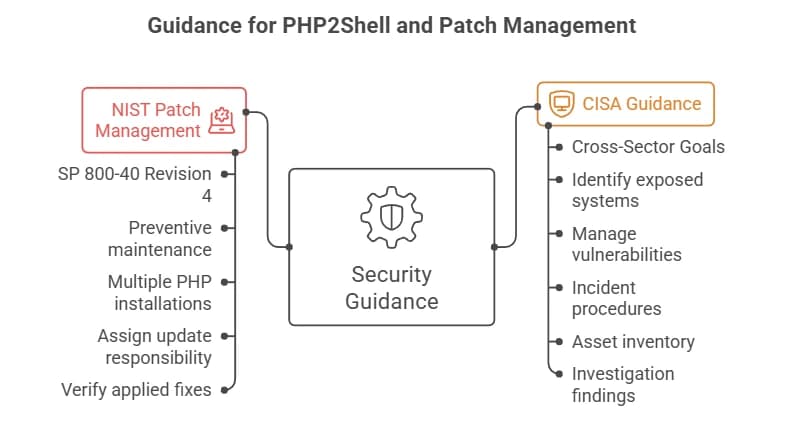
The US Cybersecurity and Infrastructure Security Agency provides broader recommendations through its Cross-Sector Cybersecurity Performance Goals.
The guidance encourages organizations to identify exposed systems, manage known vulnerabilities, and maintain procedures for detecting and responding to cyber incidents.
These recommendations are relevant to PHP2Shell because an organization cannot patch a vulnerable system effectively if it does not know the system exists.
An accurate asset inventory helps administrators identify affected PHP installations and prioritize those exposed to the internet.
However, CISA's general vulnerability-management guidance should not be confused with evidence that every reported PHP2Shell attack was successful.
The success of individual exploitation attempts must be established through reliable investigation findings. (cisa.gov)
NIST Guidance on Enterprise Patch Management
NIST Special Publication 800-40 Revision 4 discusses how organizations should plan, prioritize, deploy, and verify software updates.
It describes enterprise patch management as an important part of preventive maintenance.
This guidance is relevant to organizations managing multiple PHP installations.
A company may have different PHP versions running on production servers, development environments, containers, and third-party products.
Updating one installation will not necessarily protect the others.
A reliable patch management process helps administrators identify the affected systems, assign responsibility for updates, and confirm that the fixes have actually been applied.
PHP2Shell Exposure Data: What Security Research Reveals
Technical research helps explain how PHP2Shell works. Exposure data offers another perspective by showing how widely different PHP versions are deployed.
Qualys Threat Research examined anonymized information from approximately 12,000 customers.
Its October 2026 analysis identified around 167 million PHP package installations within that dataset.
According to Qualys, approximately 73% of those installations were associated with internet-facing assets.
Among roughly 155 million installations with identifiable PHP versions, about 110 million were using older, end-of-life or end-of-support branches.
These figures need to be interpreted carefully.
They describe installations recorded in Qualys' dataset. They are not a verified count of vulnerable PHP websites across the entire internet.
They also do not mean that every installation was exploitable or had already been compromised.
Still, the research provides useful context about the challenges organizations face when maintaining older PHP environments.
Why Legacy PHP Installations Are Difficult to Secure
Many businesses still rely on applications built for older PHP versions.
Upgrading these systems is not always as simple as installing a new package.
An older application may depend on libraries, frameworks, or features that behave differently in newer PHP releases.
Some organizations also use commercial products that include PHP internally.
In those cases, administrators may have to wait for the product vendor to provide a supported update.
The challenge becomes greater when the PHP version is no longer supported by the upstream project.
Businesses need to determine whether a supported security backport is available or whether the application must be migrated to a maintained version.
This is one reason software lifecycle planning matters alongside emergency vulnerability patching.
Which PHP Versions Are Vulnerable and Which Are Patched?
The PHP project released security updates for the two original PHP2Shell vulnerabilities on October 21.
The following table summarizes the upstream patch status.
|
PHP Branch |
Affected Upstream Releases |
First Fixed Release |
|
PHP 8.5 |
Before 8.5.12 |
8.5.12 |
|
PHP 8.4 |
Before 8.4.27 |
8.4.27 |
|
PHP 8.3 |
Before 8.3.36 |
8.3.36 |
|
PHP 8.2 |
Before 8.2.35 |
8.2.35 |
|
PHP 8.1 and older |
Older branches may be affected |
No regular upstream security release |
These releases fix CVE-2026-109618 and CVE-2026-109619.
They should not be described as fixes for CVE-2026-115560, which was disclosed separately.
PHP also provided limited source backports for versions 7.4, 8.0, and 8.1.
However, those backports do not mean that the older versions have returned to normal upstream security support.
Some Linux distributions and commercial support providers may also release their own patched packages.
As a result, administrators should check the relevant vendor advisory before deciding that a package is vulnerable based only on its displayed upstream version number.
Third-Party Products and Enterprise Systems May Also Be Affected
PHP2Shell is not limited to websites built with WordPress, Drupal, or other content management systems.
Some enterprise applications, network appliances, and administration tools include PHP as part of their internal software.
These components may not appear in a company's regular website inventory.
An administrator could update PHP on the main web server while an older version remains inside a separate management appliance.
The Dutch National Cyber Security Centre maintains an operational PHP2Shell information repository covering software products that may be affected.
Its information helps organizations identify products that require further investigation and vendor-specific updates.
However, product status can change when suppliers publish patches or updated advisories.
Organizations should therefore verify the latest information directly with the relevant vendor before deciding whether a particular product is affected or fully patched. (github.com)
Red Hat's PHP2Shell Security Guidance
Red Hat published a security bulletin covering CVE-2026-109618 and CVE-2026-109619.
The bulletin discusses affected enterprise environments and explains how exploitation conditions can differ between PHP deployment methods.
It also examines differences between Apache mod_php and PHP-FPM.
Organizations using Red Hat Enterprise Linux or related environments should follow the appropriate Red Hat security advisory and supported update packages.
An older upstream PHP version number does not always mean a vendor-maintained package is missing a security fix.
Some vendors apply backported patches while maintaining an older version identifier for compatibility.
The vendor's security documentation is therefore an important part of confirming remediation.

How to Identify and Remediate PHP2Shell: Seven Defensive Steps
Organizations should approach PHP2Shell remediation systematically.
The first task is to identify the affected systems. After that comes patching, temporary risk reduction where needed, security investigation, and verification.
The following seven steps provide a practical defensive approach.
Step 1: Identify All PHP Installations
Start by identifying every PHP runtime used across the organization.
Check public websites, internal applications, staging environments, containers, managed hosting services, and administration interfaces.
Do not assume that each server has only one PHP installation.
Some environments use different versions for command-line tools, web applications, and background services.
Administrators with authorized access can use the following read-only commands to begin identifying the PHP environment:
php -v
php --ini
The first command displays the PHP command-line version.
The second shows which configuration files the command-line PHP installation uses.
These commands are useful starting points, but they do not provide a complete vulnerability assessment.
The PHP version serving website traffic may differ from the command-line version.
For more information about identifying and managing security weaknesses, see Hoplon InfoSec's Vulnerability Management Guide.
Step 2: Prioritize Internet-Facing and Business-Critical Systems
Once the affected installations have been identified, determine which systems require the most urgent attention.
A publicly accessible application handling customer information may present a different level of business risk from an isolated development environment.
Consider whether the application is exposed to the internet, how PHP is configured, what protective controls are already in place, and what a successful compromise could affect.
Apache mod_php installations deserve particular attention because of the demonstrated exploitation path that can be reached before application code runs.
However, other affected configurations should not be ignored.
Prioritization helps teams organize the work. It does not eliminate the need to address remaining vulnerable systems.
Step 3: Apply the Official PHP Security Updates
Install the appropriate security update for each affected PHP installation.
For upstream PHP releases, the first fixed versions are 8.5.12, 8.4.27, 8.3.36, and 8.2.35.
Organizations using vendor-maintained packages should follow the vendor's supported patching instructions.
Before updating production systems, prepare backups and check whether the applications are compatible with the intended PHP release.
A recovery procedure is also useful if an update causes unexpected application problems.
After installing the updates, restart or replace the affected PHP worker processes.
This is important because an existing process may continue running code loaded before the update.
Container-based applications may require updated images and redeployment.
Finally, confirm that the active PHP runtime is using the intended patched version.
Step 4: Apply Temporary Mitigations Where Necessary
When immediate patching is not possible, temporary configuration changes may help reduce exposure.
PHP's official security guidance includes recommendations for memory-management and session-related conditions.
One recommended setting is:
session.upload_progress.enabled=0
For CVE-2026-109619, PHP recommends applying this through configuration that takes effect before request parsing and restarting affected workers.
The project also provides additional guidance involving memory limits, request sizes, and certain PHP 8.5 error-handling settings.
Administrators should review the complete advisory before changing those settings.
Configuration changes can affect application behavior, so they should be tested carefully.
The most important point is that temporary mitigations do not provide the same protection as fixing the underlying vulnerability.
For the two original PHP2Shell vulnerabilities, installing the official security updates remains the only complete remediation. (php.net)
Step 5: Review Security Logs and Investigate Suspicious Activity
Security teams should review potentially relevant activity dating back to at least October 17, 2026, where historical logs are available.
AWS reported attempted exploitation before the public disclosure, making that date useful for retrospective investigations.
Relevant evidence may appear in web server logs, PHP error logs, endpoint monitoring systems, process execution records, and network traffic.
Administrators should look for unusual request patterns, unexpected processes, suspicious file changes, and unfamiliar outbound connections.
However, a single suspicious event is not enough to confirm exploitation.
An unusual request may have been blocked. A PHP error may have an unrelated cause.
Investigators should compare evidence from different systems before deciding what happened.
If the evidence suggests a possible compromise, the organization should follow its incident response procedures and preserve relevant records.
Step 6: Evaluate Web Application Firewall and Network Protections
Web application firewalls can provide additional protection while organizations deploy security updates.
Administrators should check that relevant security rules are current and monitor whether suspicious requests are being detected.
Network restrictions may also help.
For example, an administration interface that does not need public internet access may be safer when access is limited to authorized networks.
These measures can reduce the number of ways an attacker might reach an exposed service.
But they do not fix the vulnerable PHP runtime.
Organizations should use them alongside patching rather than as permanent substitutes for it.
Hoplon InfoSec's Penetration Testing vs. Vulnerability Assessment Guide explains the difference between finding security weaknesses and evaluating their practical impact.
Step 7: Verify Remediation and Maintain Continuous Monitoring
After patching, confirm that the affected systems are actually running the updated PHP software.
Check installed packages, active services, container images, and any relevant vendor backports.
Review temporary configuration changes to ensure they remain appropriate.
Organizations should also maintain a record of which systems were affected, what updates were installed, and whether any security concerns remain unresolved.
Monitoring should continue after the immediate remediation work is complete.
This is particularly important for CVE-2026-115560, which remained unpatched as of October 23.
Administrators should follow the official PHP advisory and reassess the issue when a security update becomes available.
PHP2Shell Mitigation Strategies Compared
Different security measures solve different problems.
Patching repairs the vulnerable software. Firewalls and network restrictions reduce exposure. Monitoring helps identify suspicious activity.
These controls work best when their purposes and limitations are understood.
|
Security Measure |
Main Purpose |
Limitation |
|
Official PHP Update |
Repairs the original PHP2Shell vulnerabilities |
Must be installed across affected runtimes |
|
Vendor Security Backport |
Provides fixes through supported distribution packages |
Requires vendor-specific verification |
|
Session Upload Progress Mitigation |
Reduces exposure to specific session-related paths |
Does not eliminate every PHP2Shell attack path |
|
Web Application Firewall |
Helps detect or block certain suspicious requests |
Does not repair vulnerable PHP code |
|
Network Access Restrictions |
Reduces unnecessary exposure |
May restrict application accessibility |
|
Security Monitoring |
Helps identify suspicious behavior and investigate incidents |
Cannot prevent every attack |
|
Vulnerability Assessment |
Identifies weaknesses and helps prioritize remediation |
Findings must be validated and acted upon |
No temporary security control offers the same assurance as installing a verified fix.
Organizations should combine patching with configuration reviews, monitoring, and post-update verification.
MITRE ATT&CK: Understanding the PHP2Shell Threat
PHP2Shell can also be examined using the MITRE ATT&CK framework.
MITRE ATT&CK is a publicly available knowledge base that describes techniques used by cyber attackers.
One relevant technique is T1190: Exploit Public-Facing Application.
This technique describes attempts to exploit weaknesses in applications or services that can be reached from the internet.
PHP2Shell exploitation attempts against publicly accessible web servers fit the general behavior described by T1190.
However, that does not mean every observed PHP2Shell campaign followed the same sequence or successfully gained access.
The available research documents exploitation attempts. Whether a particular attack succeeded requires separate evidence.
What Should Security Teams Detect?
MITRE's related detection guidance supports examining several types of activity together.
For PHP-based applications, useful indicators may include suspicious HTTP requests, unusual application errors, unexpected child processes, and unfamiliar outbound network connections.
Suppose a web server receives an unusual request and endpoint monitoring also records an unexpected process launched by a PHP worker.
Those events would deserve further investigation.
However, the combination would still need to be examined before being classified as a confirmed compromise.
Reliable detection depends on understanding normal application behavior and comparing evidence from different sources. Mitre
OWASP Guidance: Why PHP Runtime Security Matters Beyond Application Code
The OWASP Top 10:2025 includes Software Supply Chain Failures under category A03.
This category covers security problems involving software dependencies, outdated components, unsupported packages, and weaknesses in how software is obtained and maintained.
PHP2Shell provides a practical example of why application security involves more than the code written by developers.
A website may depend on frameworks, libraries, server software, and a PHP runtime. Each component has its own security requirements.
Keeping the application updated does not automatically mean those supporting components are secure.
OWASP recommends maintaining software inventories, identifying unsupported components, tracking known vulnerabilities, and following effective patch management practices.
These measures help organizations find weaknesses in software dependencies before they become overlooked security risks.Owasp
What PHP2Shell Means for Small Businesses, IT Teams, and CISOs
The same vulnerability can create different responsibilities depending on who manages the affected systems.
Business owners may depend on hosting providers, while IT administrators handle runtime updates directly. Security leaders need to understand the organization's overall exposure and remediation progress.
Small Business Owners
Businesses using managed hosting should contact their provider and ask whether the PHP2Shell security updates have been applied.
The request should mention CVE-2026-109618 and CVE-2026-109619 specifically.
It is also worth asking whether the provider has assessed the separate CVE-2026-115560 configuration risk.
A general confirmation that WordPress or another website application is up to date may not be enough.
The underlying PHP runtime needs to be checked separately.
IT Administrators
IT teams should identify the active PHP versions, review server configurations, apply the relevant security patches, and verify the results.
They should also examine containers, secondary PHP installations, and applications that include embedded PHP runtimes.
If a system cannot be patched immediately, the reason and any temporary protective measures should be documented.
Administrators should continue monitoring until the outstanding risk has been addressed.
CISOs and Security Leaders
Security leaders need a clear picture of which systems are affected, who is responsible for updating them, and whether the fixes have been verified.
They should also understand the operational impact if a critical application must be temporarily isolated or restricted.
Where immediate remediation is not possible, decisions should be based on the available technical evidence and the potential business consequences.
A severity score is useful, but it does not replace an assessment of how a vulnerability affects the organization's actual environment.
Hoplon Insight: Four Security Lessons From PHP2Shell
The October PHP disclosures offer several lessons for organizations responsible for protecting web applications and server infrastructure.
1. Know which software is actually running.
A company may have a complete list of its websites but still overlook PHP versions installed inside containers, hosting platforms, or third-party products.
2. Installing a patch is not the same as verifying it.
An update may be installed successfully while an older worker process continues running. Administrators should confirm that the active services are using the fixed software.
3. Treat attack reports carefully.
A researcher demonstrating a vulnerability does not mean every attack attempt has succeeded. Security teams should distinguish scanning, blocked requests, attempted exploitation, and confirmed compromise.
4. Temporary protection should not become permanent neglect.
WAF rules and configuration changes can help reduce exposure, but they should not replace official security patches when a complete fix is available.
For another example involving internet-facing infrastructure, Hoplon InfoSec's Citrix NetScaler RCE Defense Guide discusses security risks and defensive measures related to exposed enterprise systems.
Frequently Asked Questions
What Is PHP2Shell?
PHP2Shell refers to two critical vulnerabilities, CVE-2026-109618 and CVE-2026-109619, that can allow unauthenticated remote code execution in affected PHP installations.
Which PHP Versions Fix the PHP2Shell Vulnerabilities?
The first fixed upstream versions are PHP 8.5.12, 8.4.27, 8.3.36, and 8.2.35. Organizations using vendor-maintained PHP packages should verify whether the required fixes have been backported.
Is CVE-2026-115560 Patched?
As of October 23, 2026, PHP has not published a fix for CVE-2026-115560. The project recommends temporarily disabling session upload progress to reduce exposure to the identified configuration-dependent risk.
Can a WAF Completely Prevent PHP2Shell Attacks?
No. A web application firewall can block or detect certain attack attempts, but installing the official PHP security updates is necessary to completely fix the two original PHP2Shell vulnerabilities.
Wrap Up
The recent PHP Security Vulnerabilities have raised important questions for organizations running PHP-based websites, applications, and enterprise systems.
Two critical flaws were patched on October 21, 2026. Both could allow unauthenticated remote code execution under vulnerable conditions.
Researchers also documented attempts to exploit PHP2Shell, including activity linked to malicious payload delivery. Separate research identified the possibility of sensitive memory disclosure.
At the same time, the available investigations show why attempted exploitation should not automatically be reported as a successful breach.
The disclosure of CVE-2026-115560 on October 23 added another concern. Unlike the original PHP2Shell flaws, the new vulnerability requires an unusual session configuration and remained unpatched at the time of review.
For organizations running PHP, the next steps are straightforward.
Identify the affected installations, apply the available security updates, check relevant configuration settings, and investigate suspicious activity where necessary.
Businesses should also confirm that their hosting providers and software vendors have addressed any PHP components they manage.
Keeping accurate software
inventories and maintaining a reliable patching process will make it easier to
respond when similar vulnerabilities appear.
Protect your PHP servers from security vulnerabilities with Hoplon InfoSec’s Vulnerability Management services. Get a Security Assessment Today!
The vulnerability and patch information in this article was checked against PHP's published advisories available on October 23, 2026. CVE-2026-115560 remained without a published fix at the time of review. Its status should be checked again when the article is updated.