Cybersecurity teams rarely struggle to find vulnerabilities. The harder problem is deciding which vulnerabilities actually matter, who should fix them, how quickly they need attention, and whether the fix truly removed the risk.
That is where vulnerability management becomes important.
Vulnerability management is a continuous cybersecurity process for discovering weaknesses, evaluating their real-world risk, prioritizing remediation, fixing or mitigating them, and verifying that the exposure has been removed.
It goes far beyond running a vulnerability scanner. A scanner may identify hundreds or thousands of potential issues. An effective vulnerability management program turns those findings into prioritized, accountable security actions.
Modern organizations also need to consider much more than technical severity. Internet exposure, active exploitation, asset importance, business impact, threat intelligence, and available security controls can completely change which vulnerability should be addressed first.
What is Vulnerability Management?
Vulnerability management is the structured and continuous process of identifying, assessing, prioritizing, remediating, mitigating, verifying, and monitoring security vulnerabilities across an organization's technology environment.
A complete program typically covers:
Asset discovery
Vulnerability identification
Finding validation
Risk assessment
Prioritization
Remediation
Mitigation
Verification
Exception management
Reporting
Continuous monitoring
The word continuous is important.
Organizations constantly introduce new devices, cloud workloads, software versions, applications, APIs, containers, dependencies, and configurations. At the same time, security researchers continue to discover new vulnerabilities in technologies that may already be deployed.
A system that appeared secure yesterday may therefore require attention today.
Vulnerability management creates a repeatable process for dealing with that changing risk.
Vulnerability vs. Threat vs. Risk
Understanding vulnerability management is easier when three commonly confused terms are separated.
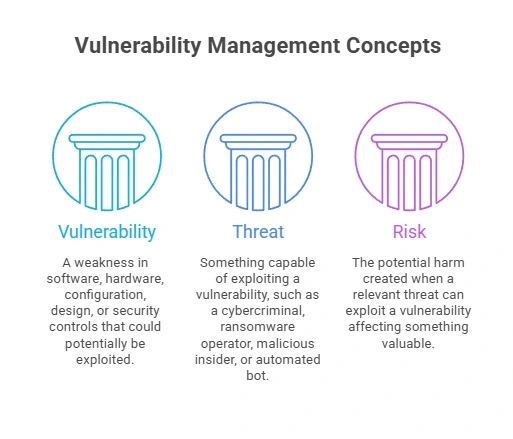
Vulnerability: A weakness in software, hardware, configuration, design, or security controls that could potentially be exploited.
Examples include an unpatched application, exposed administrative interface, insecure cloud configuration, vulnerable library, or excessive permissions.
Threat: Something capable of exploiting a vulnerability.
A threat could be a cybercriminal, ransomware operator, malicious insider, automated bot, or another adversary.
Risk: The potential harm created when a relevant threat can exploit a vulnerability affecting something valuable.
This distinction explains why two organizations can discover the same vulnerability but assign it different priorities.
A critical software flaw on an isolated laboratory machine may represent less immediate risk than a moderately severe vulnerability on an internet-facing production server containing sensitive information.
A broader risk assessment can help organizations evaluate vulnerability findings in the context of business impact, likelihood, and existing controls.
Why is Vulnerability Management Important?
Vulnerability management helps organizations reduce preventable exposure before attackers can take advantage of it.
Its value comes from turning security weaknesses into manageable business risk.
Reduces Opportunities for Exploitation
Known vulnerabilities give attackers potential entry points into systems.
Once information about a vulnerability becomes public, defenders are not necessarily the only people examining it. Security researchers, vendors, penetration testers, criminal groups, and automated scanning infrastructure may all begin looking for affected systems.
Reducing the time that important vulnerabilities remain exposed can reduce the opportunity available to attackers.
Improves Asset Visibility
A vulnerability management program cannot work effectively without knowing what assets exist.
Organizations may have:
Forgotten servers
Temporary cloud workloads
Old applications
Unmanaged endpoints
Development environments
Public APIs
Legacy systems
Shadow IT
Internet-facing services unknown to security teams
Incomplete inventory creates blind spots.
This is particularly important for external systems because an attacker may discover an exposed asset before the organization realizes it exists.
Attack surface management can complement vulnerability management by continuously identifying and monitoring internet-facing assets and exposures.
Helps Organizations Prioritize Limited Resources
Few organizations can patch every vulnerability immediately.
Trying to treat every scanner finding as equally urgent can overwhelm IT and engineering teams while genuinely dangerous weaknesses remain unresolved.
Effective vulnerability management helps answer:
Which vulnerabilities create the greatest risk right now?
That allows remediation teams to focus their time where it can produce the greatest reduction in exposure.
Supports Compliance and Governance
Many security standards, regulatory requirements, contractual obligations, and internal policies expect organizations to identify and address security weaknesses.
The exact requirements vary by industry and framework.
Vulnerability management can help provide evidence that an organization has processes for:
Identifying vulnerabilities
Evaluating risk
Assigning remediation
Tracking unresolved issues
Managing exceptions
Verifying corrective actions
A vulnerability management program should support compliance rather than being treated as proof of compliance by itself.
Protects Critical Business Systems
Not every system has the same importance.
A vulnerability affecting a public marketing site and the same vulnerability affecting an identity platform, payment environment, production database, or customer portal may create very different consequences.
Adding business context helps security teams protect the systems whose compromise would cause the greatest harm.
How Does Vulnerability Management Work?
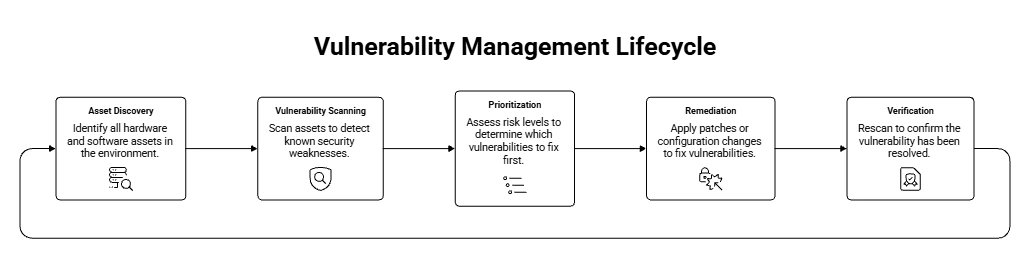
A mature vulnerability management lifecycle moves from asset visibility to verified remediation.
The exact number of stages varies between frameworks and organizations, but the following process provides a practical model.
1. Define Scope and Discover Assets
Before searching for vulnerabilities, determine what needs to be protected.
Asset discovery may cover:
Servers
Workstations
Laptops
Network equipment
Virtual machines
Cloud workloads
Containers
Databases
Websites
Web applications
APIs
Mobile applications
Software dependencies
Internet-facing infrastructure
Development environments
Asset inventory should include context rather than only hostnames or IP addresses.
Useful information may include:
Asset owner
Business function
Environment
Internet exposure
Data sensitivity
Location
Technology
Operating system
Software version
Business criticality
Without this information, prioritization becomes difficult.
2. Identify Vulnerabilities
Organizations typically use multiple methods to identify weaknesses.
These can include:
Network vulnerability scanning
Authenticated scanning
Endpoint assessment
Cloud security assessment
Configuration scanning
Container scanning
Dependency scanning
Software composition analysis
Static application security testing
Dynamic application security testing
Vendor security advisories
Threat intelligence
Manual security testing
Different technologies require different testing approaches.
A network scanner, for example, may identify an outdated server package but fail to detect a complex authorization flaw inside a web application.
For business-critical applications, web application security testing can provide deeper validation of weaknesses that automated infrastructure scanning may not identify.
3. Validate and Enrich Vulnerability Findings
Scanner results should not automatically become remediation tickets.
Findings need context.
Security teams may investigate questions such as:
Is the vulnerable component actually installed?
Is the affected service running?
Is the vulnerable functionality enabled?
Can an attacker reach it?
Does exploitation require authentication?
Is the system publicly accessible?
Is exploit code available?
Has exploitation been observed in real attacks?
What security controls protect the asset?
What business function depends on the system?
What information could be exposed?
This step can also help identify:
False positives
Duplicate findings
Findings affecting decommissioned systems
Vulnerabilities already covered by compensating controls
The objective is not to remove inconvenient findings. It is to make sure remediation decisions are based on accurate information.
4. Prioritize Vulnerabilities Based on Risk
Prioritization is where basic vulnerability scanning becomes vulnerability management.
A common mistake is to sort vulnerabilities only by technical severity.
Severity matters, but it is only one factor.
A stronger prioritization process combines several signals.
CVSS Severity
The Common Vulnerability Scoring System, or CVSS, provides a standardized framework for communicating characteristics and severity of vulnerabilities.
CVSS can help security teams understand technical factors such as:
Attack requirements
Required privileges
User interaction
Potential impact
However, a CVSS score should not be treated as a complete measurement of organizational risk.
It does not automatically tell you whether your vulnerable system is exposed to attackers or how valuable that system is to your organization.
Known Exploited Vulnerabilities
Evidence that attackers are already exploiting a vulnerability can significantly change remediation priority.
The CISA Known Exploited Vulnerabilities, or KEV, Catalog tracks vulnerabilities with evidence of exploitation in the wild.
Organizations can use KEV status as one input when determining which vulnerabilities require urgent attention.
EPSS Exploitation Probability
The Exploit Prediction Scoring System, or EPSS, provides an estimate of the probability that exploitation activity for a published CVE will be observed in the wild during the next 30 days.
EPSS can help distinguish vulnerabilities that may be more likely to attract attacker activity.
However, EPSS is not a complete risk score.
It does not know:
Whether your organization runs the affected software
Whether the vulnerable system is exposed
What data the asset contains
What business processes depend on it
Which compensating controls are already present
EPSS should therefore complement rather than replace environmental risk analysis.
Asset Exposure
An internet-facing vulnerability may offer attackers a very different opportunity from the same vulnerability inside a tightly segmented internal system.
Exposure considerations include:
Public internet accessibility
Network segmentation
Required authentication
Accessible ports
Remote access
Existing firewall controls
Security monitoring
Business Criticality
Technical vulnerability severity should be combined with business impact.
Ask:
Does the system process sensitive customer information?
Does it support financial operations?
Is it part of authentication infrastructure?
Would compromise disrupt production?
Could an attacker move from this asset to more sensitive systems?
A technically severe vulnerability on a low-value asset may not always deserve priority over an actively exploited vulnerability affecting a critical service.
Threat Intelligence and Exploit Availability
Prioritization may also consider:
Public proof-of-concept code
Known exploitation campaigns
Inclusion in attacker tooling
Ransomware association
Vendor warnings
Threat intelligence
Exploit maturity
The strongest prioritization model combines severity, exploitation evidence, exploitation likelihood, exposure, business criticality, and potential impact.
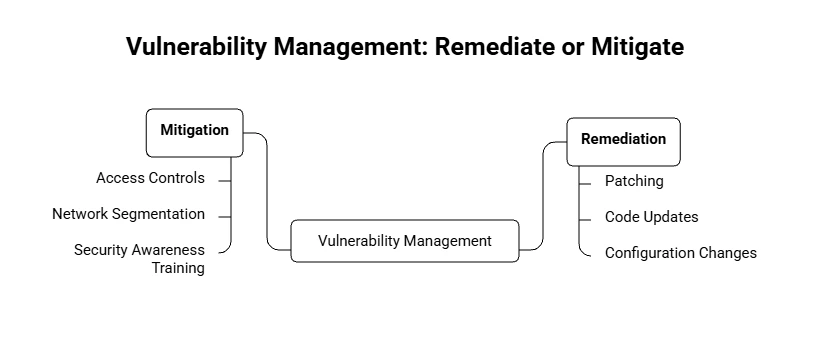
5. Remediate or Mitigate Vulnerabilities
Once a vulnerability has been prioritized, the organization must decide how to treat it.
There are several options.
Remediation
Remediation removes the underlying weakness.
Examples include:
Installing a security patch
Upgrading software
Correcting an insecure configuration
Fixing vulnerable code
Removing unnecessary software
Disabling a vulnerable service
Replacing an unsupported component
Patching is one form of remediation, but it is not the only one.
Mitigation
Immediate remediation is not always possible.
A system may be operationally critical, incompatible with a patch, dependent on legacy software, or awaiting a vendor fix.
Temporary mitigation may include:
Network segmentation
Restricting external access
Firewall rules
Disabling vulnerable features
Stronger authentication
Removing unnecessary privileges
Application controls
Increased monitoring
Mitigation reduces exposure without necessarily eliminating the original vulnerability.
The underlying issue should remain tracked.
Risk Acceptance
An organization may occasionally determine that remediation cost or operational impact exceeds the remaining risk.
This should be a documented decision rather than an ignored vulnerability.
A formal exception can include:
Affected vulnerability
Affected asset
Business justification
Remaining risk
Compensating controls
Risk owner
Approval
Review date
Expiration date
Risk acceptance should have accountability.
6. Assign Remediation Ownership
Security teams frequently discover vulnerabilities without directly controlling the affected systems.
Remediation may require action from:
IT operations
Application developers
DevOps teams
Cloud engineers
Network administrators
Endpoint teams
Database administrators
Asset owners
Vendors
Every important finding should therefore have a clearly assigned owner.
The remediation process should define:
Who receives the finding
When action is expected
How priority is determined
How overdue vulnerabilities are escalated
How exceptions are approved
Who verifies completion
Without ownership, vulnerability reports easily become growing backlogs.
7. Verify the Fix
Closing a ticket does not prove that a vulnerability has disappeared.
Verification may require:
Re-scanning
Manual validation
Software version checks
Configuration review
Application retesting
External exposure checks
Verification should confirm that the original weakness is no longer exploitable through the identified path.
This stage is particularly important after complex remediation.
8. Continuously Monitor and Improve
Vulnerability management does not end when a vulnerability is fixed.
The process starts again.
New vulnerabilities are disclosed. Software changes. Cloud resources are deployed. Applications are updated. Employees install software. Configurations drift.
Continuous monitoring helps organizations detect those changes before vulnerability backlogs become unmanageable.
What is Risk-Based Vulnerability Management?
Risk-based vulnerability management focuses remediation resources on vulnerabilities that create the greatest practical risk instead of treating all vulnerabilities with similar severity as equally important.
Traditional approaches frequently depend heavily on CVSS scores.
Risk-based approaches add context.
The question changes from:
"Which vulnerabilities have the highest severity score?"
to:
"Which vulnerabilities are most likely to be exploited and cause meaningful harm to our organization?"
Why CVSS Alone Is Not Enough
Consider two hypothetical vulnerabilities.
Vulnerability A
Critical CVSS severity
Located on an isolated test system
Not publicly accessible
No known exploitation
No sensitive data
Strong network restrictions
Vulnerability B
High rather than critical severity
Internet-facing production server
Exploitation observed in the wild
Contains sensitive information
Supports an important business service
Sorting strictly by CVSS may place Vulnerability A first.
A risk-based process may determine that Vulnerability B requires more urgent action.
This does not mean CVSS is unimportant.
It means vulnerability severity is one component of a larger risk decision.
What Types of Vulnerabilities Should Be Managed?
Modern vulnerability management should extend beyond traditional operating-system vulnerabilities.
Software and Operating System Vulnerabilities
These include security flaws in:
Operating systems
Browsers
Server software
Desktop applications
Firmware
Libraries
Frameworks
Third-party components
Keeping software inventory accurate is essential for identifying affected versions.
Security Misconfigurations
Not every vulnerability has a CVE.
Security exposure may result from:
Default credentials
Excessive permissions
Public administrative interfaces
Weak encryption settings
Unnecessary ports
Unsafe cloud permissions
Insecure default configurations
Improper access controls
Configuration management should therefore be part of vulnerability management.
Cloud Vulnerabilities
Cloud environments introduce additional areas of risk, including:
Public storage
Exposed workloads
Overprivileged identities
Weak security group rules
Vulnerable virtual machines
Insecure containers
Poor secrets management
Misconfigured cloud services
Cloud resources can also appear and disappear quickly, making periodic inventory alone insufficient for highly dynamic environments.
Web Application Vulnerabilities
Applications may contain weaknesses such as:
Broken access control
Injection flaws
Authentication weaknesses
Session-management problems
Security misconfigurations
Vulnerable dependencies
Business-logic flaws
Automated scanners can identify some of these issues, while others require application-specific testing.
API Vulnerabilities
APIs frequently connect applications, cloud services, mobile apps, customers, and internal systems.
Weaknesses may include:
Broken object-level authorization
Authentication failures
Excessive data exposure
Improper access control
Security misconfiguration
Vulnerable dependencies
Weak rate limiting
API security should be integrated into both development testing and production vulnerability management.
Mobile Application Vulnerabilities
Mobile applications introduce security considerations across:
Local data storage
Authentication
Authorization
Network communication
API interaction
Cryptography
Application permissions
Third-party libraries
Organizations developing Android or iOS applications may require dedicated mobile application security testing alongside infrastructure vulnerability management.
Container and Dependency Vulnerabilities
Containerized environments may contain vulnerable:
Base images
Operating system packages
Application libraries
Runtime components
Dependencies
Development teams should scan both images and software dependencies throughout the development lifecycle.
Endpoint Vulnerabilities
Laptops, desktops, and servers can become exposed through:
Missing updates
Unsupported software
Configuration drift
Vulnerable applications
Excessive privileges
Insecure local settings
Vulnerability remediation works best alongside effective endpoint security protection, which addresses malicious behavior and endpoint threats that vulnerability scanning alone cannot resolve.
Network Vulnerabilities
Routers, switches, firewalls, VPN appliances, wireless infrastructure, and other network devices may contain vulnerabilities or unsafe configurations.
Network infrastructure should therefore be included in both asset inventory and vulnerability scanning.
Vulnerability Management vs. Vulnerability Assessment
Vulnerability management and vulnerability assessment are related but different.
A vulnerability assessment is an evaluation performed to identify and analyze security weaknesses within a defined scope.
A vulnerability management program is continuous.
It includes:
Discovery
Assessment
Prioritization
Assignment
Remediation
Verification
Exception management
Reporting
Ongoing monitoring
A vulnerability assessment can therefore be one part of a larger vulnerability management program.
Vulnerability Management vs. Vulnerability Scanning
Vulnerability scanning is primarily a discovery activity.
A scanner can detect potential weaknesses and generate findings.
Vulnerability management determines what happens afterward.
For example, scanning alone does not necessarily determine:
Whether a vulnerability is exploitable in your environment
Whether the asset is business-critical
Who owns the system
Which vulnerability should be fixed first
Whether temporary mitigation is sufficient
Whether a completed fix actually worked
A vulnerability scanner is a tool.
Vulnerability management is the complete operational process surrounding the findings.
Vulnerability Management vs. Patch Management
Patch management focuses on identifying, testing, deploying, and confirming software updates.
Vulnerability management has a broader scope.
Some vulnerabilities have no patch.
They may require:
Code changes
Configuration changes
Architecture changes
Access restrictions
Service removal
Software replacement
Compensating controls
Risk acceptance
Patch management is therefore an important part of vulnerability remediation, but it does not replace vulnerability management.
Vulnerability Management vs. Penetration Testing
Vulnerability management aims to provide continuous and broad coverage across the technology environment.
Penetration testing usually examines a defined scope more deeply and attempts to determine whether vulnerabilities can be exploited in realistic attack scenarios.
For example, vulnerability scanning may identify:
An exposed service
A weak configuration
An outdated software component
A penetration tester may investigate whether those weaknesses can be combined to gain unauthorized access or reach sensitive systems.
Organizations can use cyber security penetration testing to complement vulnerability management with deeper, attacker-focused validation.
Neither practice automatically replaces the other.
How to Build an Effective Vulnerability Management Program
Technology alone does not create an effective program.
Organizations need defined processes, ownership, prioritization, and measurable remediation.
Maintain an Accurate Asset Inventory
Inventory should continuously reflect the environment rather than depend entirely on a spreadsheet updated once a year.
Useful asset data includes:
Ownership
Business importance
Technology
Environment
Exposure
Data sensitivity
Location
Lifecycle status
Asset context enables better vulnerability decisions.
Establish Risk-Based Prioritization
Create documented criteria for determining vulnerability priority.
Relevant factors can include:
CVSS severity
KEV status
EPSS
Threat intelligence
Exploit availability
Internet exposure
Business criticality
Data sensitivity
Existing controls
This helps prevent different teams from interpreting the same vulnerability completely differently.
Define Clear Ownership
Every high-priority finding should have an accountable remediation owner.
Security may coordinate the vulnerability management program, but remediation responsibilities should be distributed to the teams that control affected assets.
Ownership should be recorded rather than assumed.
Establish Remediation Targets
Organizations can establish internal remediation targets according to risk.
For example, higher-risk vulnerabilities may require faster action than low-risk findings.
There is no single universal remediation deadline appropriate for every organization.
Targets should consider:
Exposure
Severity
Exploitation activity
Business impact
Operational requirements
Regulatory obligations
Emergency procedures should exist for vulnerabilities that require unusually rapid response.
Create an Escalation Process
High-risk findings should not remain unresolved simply because their original owner did not respond.
Define:
Escalation thresholds
Management notification
Exception approval
Risk ownership
Overdue review procedures
Accountability becomes particularly important when vulnerabilities remain unresolved beyond internal targets.
Integrate Vulnerability Management With Existing Workflows
Security findings are easier to manage when they reach the tools technical teams already use.
Integration may involve:
IT service management
Ticketing systems
DevOps platforms
CI/CD pipelines
Patch management
Endpoint management
Cloud security platforms
Security operations
Automation can reduce manual handoffs and make remediation status easier to track.
Integrate Vulnerability Management Into the SDLC
Security weaknesses are often easier to address before software reaches production.
Development workflows can include:
SAST
DAST
Software composition analysis
Dependency scanning
Container scanning
Infrastructure-as-code scanning
Secret detection
Security testing
The objective is not to eliminate production vulnerability management.
It is to identify certain classes of problems earlier.
Establish a Formal Exception Process
Some vulnerabilities will remain unresolved temporarily.
Those findings should not simply disappear from reports.
A formal exception process should document:
Why remediation is delayed
What risk remains
Which controls reduce exposure
Who accepted the risk
When the exception expires
When it will be reviewed again
This prevents temporary decisions from becoming permanent unmanaged exposure.
Verify Critical Remediation
Important vulnerabilities deserve more than a status change in a ticketing system.
Re-scan or retest high-risk findings where appropriate.
Verification can also reveal incomplete patches, incorrect configuration changes, or alternate attack paths.
Review the Wider Security Posture
Vulnerability management is one part of cybersecurity risk management.
Organizations may also need to evaluate:
Identity controls
Security architecture
Incident readiness
Network segmentation
Endpoint controls
Detection capabilities
Third-party risk
A broader cyber security assessment can help determine whether vulnerability management is working effectively alongside other security controls.
What Tools Are Used in Vulnerability Management?
Most mature programs use several categories of technology.
No single tool covers every vulnerability type.
Asset Discovery Tools
Asset discovery helps identify devices, workloads, services, applications, and infrastructure that should be assessed.
Vulnerability Scanners
Vulnerability scanners identify known weaknesses, missing patches, exposed services, and certain security misconfigurations.
Scanning may be:
Authenticated
Unauthenticated
Internal
External
Agent-based
Network-based
Each method provides different visibility.
Application Security Tools
Application security may include:
SAST
DAST
Interactive testing
Software composition analysis
API testing
Dependency scanning
Secret detection
These tools help find application-layer weaknesses that traditional network scanners may not detect.
Cloud Security Tools
Cloud-focused platforms can assess:
Virtual machines
Containers
Cloud configurations
Storage
Identity permissions
Workloads
Public exposure
Threat Intelligence
Threat intelligence can add context such as:
Active exploitation
Malware activity
Exploit availability
Threat actor behavior
Targeted technologies
This information can improve prioritization.
Patch and Configuration Management
These systems help operational teams deploy:
Software patches
Application updates
Operating system changes
Security configurations
Their effectiveness should still be verified.
Ticketing and Workflow Systems
Ticketing platforms help assign findings, establish deadlines, escalate overdue issues, and track remediation status.
Reporting and Analytics Platforms
Dashboards can help security leaders monitor:
Vulnerability trends
Remediation performance
High-risk exposure
Asset coverage
Exceptions
Overdue findings
Tools are useful only when the underlying process works.
A sophisticated vulnerability platform cannot compensate for missing asset ownership, poor prioritization, or ignored remediation tickets.
Vulnerability Management Best Practices
A mature vulnerability management program should follow several practical principles.
Know What You Own
Maintain current asset visibility across on-premises, cloud, remote, application, and development environments.
Prioritize Beyond Severity
Do not make CVSS the only remediation criterion.
Add exploitation activity, exposure, business context, and threat intelligence.
Focus on Known Exploitation
A vulnerability being actively exploited deserves different attention from a theoretical weakness with no evidence of attacker use.
Give Internet-Facing Assets Additional Context
External exposure can significantly affect exploitation opportunity.
Prioritization should reflect that.
Reduce False Positives Before Assignment
Engineering teams lose confidence in security programs when repeatedly assigned findings that are incorrect or irrelevant.
Validate important findings where possible.
Establish Clear Remediation Ownership
Every actionable vulnerability needs someone responsible for addressing it.
Set Risk-Based Remediation Targets
Use different urgency levels for different types of risk instead of treating all vulnerabilities identically.
Verify High-Risk Fixes
A ticket marked complete should not automatically equal successful remediation.
Review Accepted Risks
Exceptions should expire or require periodic review.
Cover More Than Traditional Infrastructure
Include:
Cloud
APIs
Applications
Containers
Endpoints
Dependencies
Mobile environments
Keep Threat Context Current
A vulnerability's priority can change.
New exploitation activity or newly available attack tooling may make an older vulnerability suddenly more urgent.
Use Automation Without Removing Human Judgment
Automation is useful for:
Discovery
Enrichment
Ticket creation
Prioritization inputs
Reporting
Human review remains valuable for complex business-impact and exception decisions.
Common Vulnerability Management Challenges
Even well-funded organizations encounter operational problems.
Incomplete Asset Inventory
Unknown assets create unknown exposure.
Cloud environments, acquisitions, temporary infrastructure, and shadow IT can quickly make inventories inaccurate.
Too Many Vulnerability Findings
Large environments may generate far more findings than remediation teams can handle immediately.
Prioritization is therefore essential.
The goal is not to close tickets randomly.
It is to reduce the greatest amount of risk with available resources.
False Positives
Automated tools can report issues that do not apply to the actual environment.
Validation can prevent unnecessary work.
Duplicate Findings
Different tools may identify the same vulnerability using different names or findings.
Correlation and deduplication can reduce noise.
Lack of Ownership
Security teams may identify a vulnerability but have no authority to modify the affected application or infrastructure.
Clear asset and remediation ownership helps prevent this gap.
Remediation Backlogs
Unresolved findings can accumulate until teams stop treating the backlog as actionable.
Risk-based triage and escalation can help keep the queue manageable.
Patch Compatibility
Patching can sometimes affect:
Application compatibility
Legacy software
Production availability
Business operations
Organizations may need testing, backups, rollback procedures, and scheduled maintenance.
Legacy and Unsupported Systems
Some systems cannot be patched because the software or hardware is no longer supported.
Options may include:
Network isolation
Access restrictions
Additional monitoring
Compensating controls
Replacement planning
Unsupported technology should be treated as an ongoing risk rather than forgotten.
Temporary Mitigations Becoming Permanent
A mitigation introduced for a few weeks can remain in place for years if nobody tracks the original vulnerability.
Temporary controls need ownership and review dates.
Vulnerability Management Metrics and KPIs
Metrics should show whether exposure and remediation performance are improving.
Avoid measuring success only by the total number of vulnerabilities.
Asset Coverage
Measure whether important assets are included in vulnerability assessment.
A low vulnerability count is meaningless if large parts of the environment are not being assessed.
High-Risk Vulnerability Backlog
Track high-priority vulnerabilities that remain unresolved.
Vulnerability Age
Measure how long important findings remain open.
Older unresolved high-risk vulnerabilities may indicate operational or ownership problems.
Mean or Median Time to Remediate
Remediation time can help identify whether teams are becoming faster at addressing vulnerability risk.
Median values can sometimes provide useful context where a small number of unusually old findings distort an average.
Remediation Target Compliance
Track the percentage of vulnerabilities resolved within your organization's defined targets.
Known Exploited Vulnerabilities Still Open
Monitoring unresolved vulnerabilities with confirmed exploitation can provide a useful view of urgent exposure.
Internet-Facing Vulnerability Exposure
Separate important vulnerabilities on externally accessible assets from findings in less exposed environments.
Recurring Vulnerabilities
Repeated appearance of the same vulnerability can indicate:
Weak patching processes
Configuration drift
Insecure development practices
Incomplete remediation
Recurring problems often point to systemic issues rather than isolated mistakes.
Risk Exceptions
Track:
Number of active exceptions
Age
Business owners
Expiration dates
Risk level
Accepted risk should remain visible.
What Happens When Vulnerability Management Fails?
Poor vulnerability management can leave known weaknesses available long after defenders have the information needed to address them.
Potential consequences include:
Unauthorized access
Malware infection
Ransomware
Data exposure
Privilege escalation
Lateral movement
Service disruption
Compliance issues
Emergency remediation
Incident response costs
Failure does not always mean that a scanner missed the vulnerability.
The organization may have discovered the weakness but failed to prioritize, assign, remediate, or verify it.
If exploitation has already taken place, patching alone may not solve the problem.
The organization may need investigation, containment, credential resets, eradication, recovery, and additional monitoring through an incident response and recovery process.
Frequently Asked Questions About Vulnerability Management
What is vulnerability management in cybersecurity?
Vulnerability management is the continuous process of identifying security weaknesses, evaluating their risk, prioritizing remediation, fixing or mitigating them, verifying the corrective action, and monitoring for new vulnerabilities.
What are the main stages of vulnerability management?
Different frameworks organize the lifecycle differently, but a practical process includes asset discovery, vulnerability identification, validation, prioritization, remediation or mitigation, verification, reporting, and continuous monitoring.
What is the difference between vulnerability scanning and vulnerability management?
Vulnerability scanning identifies potential weaknesses.
Vulnerability management includes the larger process of determining which findings matter, assigning responsibility, remediating them, verifying fixes, and tracking risk over time.
What is risk-based vulnerability management?
Risk-based vulnerability management prioritizes vulnerabilities using technical severity together with factors such as active exploitation, exploitation likelihood, asset exposure, business criticality, and potential impact.
Is CVSS enough to prioritize vulnerabilities?
No.
CVSS provides valuable information about vulnerability severity and characteristics, but it should not normally be used as the only measure of organizational risk.
What is CISA KEV?
The CISA Known Exploited Vulnerabilities Catalog identifies vulnerabilities for which there is evidence of exploitation in the wild.
Organizations can use KEV status as one input when prioritizing remediation.
What is EPSS?
EPSS estimates the probability that exploitation activity for a published CVE will be observed in the wild during the next 30 days.
It is useful for prioritization but does not replace asset, impact, or environmental risk analysis.
How often should vulnerability scanning be performed?
There is no single frequency appropriate for every organization.
Scanning frequency should reflect:
Asset criticality
Exposure
Rate of environmental change
Business risk
Compliance requirements
Dynamic cloud or internet-facing environments may require more continuous visibility than stable isolated systems.
What is the difference between vulnerability management and patch management?
Patch management focuses on software updates.
Vulnerability management includes discovery, risk analysis, remediation, mitigation, exception management, verification, and reporting.
Patching is one possible remediation method.
What is the difference between vulnerability management and penetration testing?
Vulnerability management provides continuous broad visibility and remediation tracking.
Penetration testing typically performs deeper controlled testing to determine how specific weaknesses could be exploited and what an attacker could achieve.
Who is responsible for vulnerability management?
Security teams often coordinate the program, but remediation is usually shared across:
IT
Security
Developers
DevOps
Network teams
Cloud teams
Asset owners
Vendors
Clear ownership is essential.
Which vulnerabilities should be fixed first?
There is no single factor that determines priority.
Organizations should consider:
Active exploitation
Exploit likelihood
External exposure
Business criticality
Technical severity
Potential impact
Existing controls
The highest CVSS score is not automatically the highest business risk.
Can vulnerability management prevent every cyberattack?
No.
Vulnerability management reduces exposure from known and discoverable weaknesses.
Organizations still need controls for risks such as:
Phishing
Credential theft
Malicious insiders
Supply-chain compromise
Social engineering
Misuse of legitimate access
Previously unknown vulnerabilities
Vulnerability management should therefore operate as one part of a broader cybersecurity program.
Final Thoughts
Effective vulnerability management is not about generating the longest vulnerability report or patching the largest number of findings.
It is about reducing meaningful security risk.
A mature program answers five important questions:
What assets do we have?
Where are they vulnerable?
Which weaknesses create the greatest risk?
Who is responsible for fixing them?
Did the remediation actually work?
Organizations that can answer those questions consistently are doing more than vulnerability scanning.
They are building a repeatable process for turning security findings into measurable risk reduction.
The most important shift is moving away from:
"How many vulnerabilities did we find?"
and toward:
"Which vulnerabilities give attackers the best opportunity to harm the organization, and what are we doing about them?"
That is the foundation of effective vulnerability management.



-20260925120840.webp&w=3840&q=75)