Penetration Testing vs Vulnerability Assessment
If you are responsible for your company’s security, you have probably heard the terms penetration testing and vulnerability assessment more than once.
They are often mentioned together, and that can make them sound like two names for the same thing. They are not.
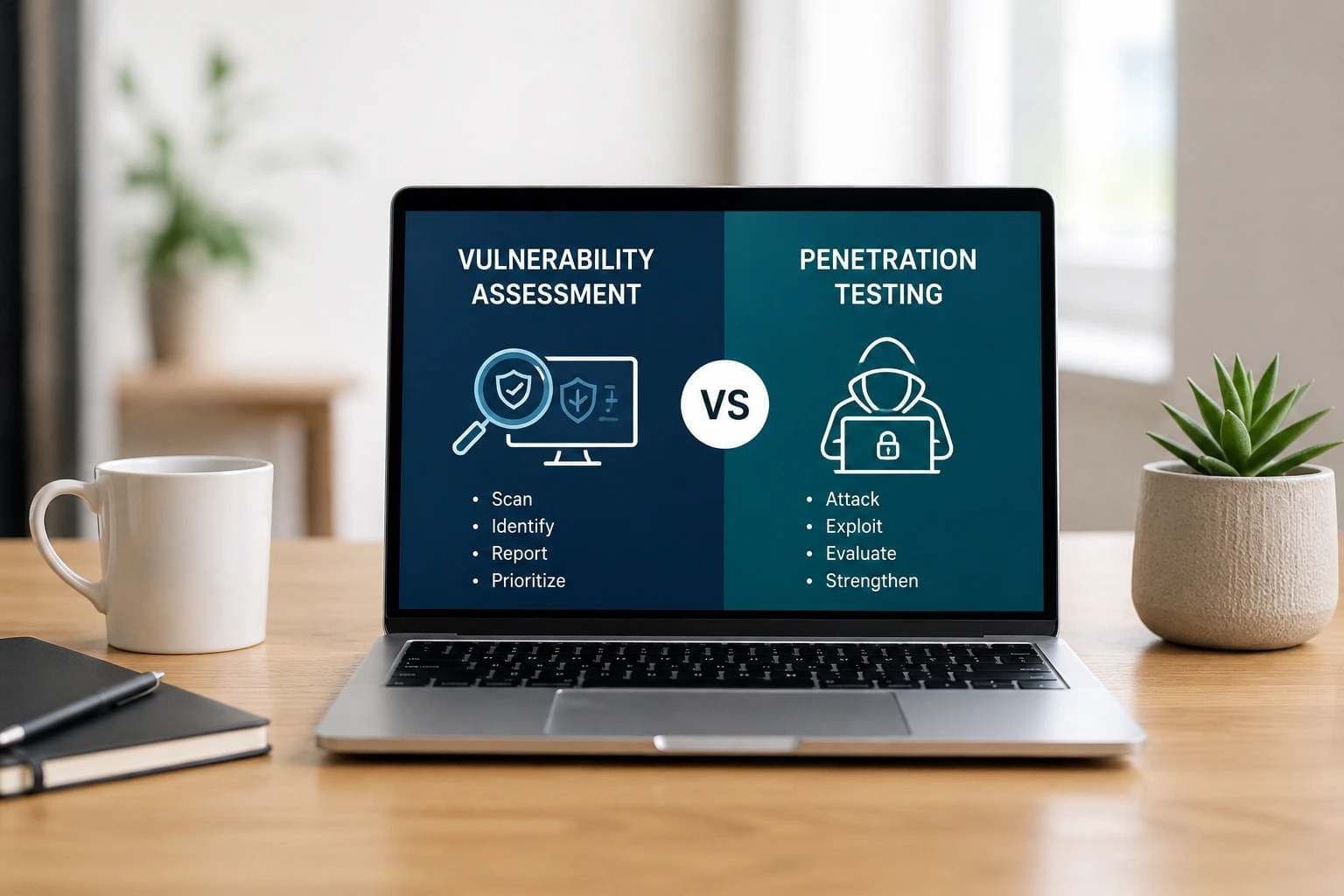
A vulnerability assessment is mainly about finding weaknesses across your systems. Penetration testing takes a smaller set of those weaknesses and asks a harder question: could someone actually use them to get into your environment or reach something important?
That difference is worth understanding because a long vulnerability report does not always tell you where your biggest risk is.
A scanner may flag 50 problems. Some may be minor. Some may be false positives. One issue that looks less serious on paper may become much more dangerous when combined with weak permissions or exposed credentials.
So the real conversation around penetration testing vs vulnerability assessment is not about choosing a winner. It is about knowing what each one tells you and when you need that information.
What a Vulnerability Assessment Actually Does
A vulnerability assessment gives you a broad look at weaknesses across your digital environment.
That may include servers, employee devices, applications, websites, APIs, cloud systems, databases, network equipment, IP addresses, domains, and other assets connected to your business.
The assessment may uncover issues such as:
outdated software
missing security patches
unsafe configurations
open ports
exposed services
weak encryption
known software vulnerabilities
login weaknesses
network security issues
poorly configured web applications
Most assessments use automated vulnerability scanning because automation can review a large number of systems much faster than a person could do manually.
But running a scanner is only the beginning.
A useful security assessment should also review the findings, remove obvious false positives, understand which systems are affected, and decide what deserves attention first.
That last part matters more than people sometimes realize.
If a scanner gives your team 300 findings without context, it has found problems, but it has not necessarily helped you make a better security decision.
-20260811113019.webp&w=1080&q=75 "Penetration Testing vs Vulnerability Assessment")
Start With the Assets You Actually Have
Before scanning begins, you need a clear picture of what exists in your environment.
This is often called asset discovery.
It sounds basic, but businesses regularly have old servers, forgotten cloud resources, test applications, or internet-facing services that are still running long after people stopped thinking about them.
If your security team does not know an asset exists, that does not make it invisible to an attacker.
A solid vulnerability assessment should therefore start by identifying the systems that matter and making sure important assets are actually included in the scope.
Scanning Finds Weaknesses, but Context Tells You What Matters
Vulnerability scanners are good at checking systems for known problems. They may detect old software, missing updates, unsafe services, known CVEs, weak encryption, or common configuration errors.
They are especially useful when you need broad coverage and regular checks.
Still, automated tools have limits.
A scanner may report an issue that does not really apply to your system. That is a false positive. It may also miss a real weakness because the issue does not match what the tool knows how to detect. That is a false negative.
This is one reason manual review matters.
It is also why vulnerability assessment should not be treated as nothing more than downloading a scanner report.
Risk Ratings and CVSS Scores
Most vulnerability reports rank findings as Critical, High, Medium, Low, or Informational.
You may also see a CVSS score, which helps describe the technical severity of a vulnerability.
Both are useful, but neither should make the final decision for you.
A vulnerability on a public-facing payment server is not the same as a similar vulnerability on an isolated test machine.
When deciding what to fix first, your team should also look at things such as:
whether the system is exposed to the internet
how easy the issue is to use
whether an exploit already exists
what data is stored on the system
how important the asset is to the business
what protections are already in place
what could realistically happen if the system were compromised
This is where vulnerability prioritization becomes more useful than simply counting findings.
A lower-scored issue on the wrong system can sometimes matter more than a technically higher-scored problem somewhere else.
What Penetration Testing Adds
A penetration test, often called a pentest, is different because it is more hands-on.
Instead of stopping at “this weakness exists,” the tester tries to understand what could happen if someone actually used it.
That may mean safely testing whether a vulnerability can provide access, whether a limited account can gain more permissions, or whether one compromised system could lead to another.
The goal is not to cause damage.
The goal is to show you where a real attack path may exist.
This is where vulnerability assessment and penetration testing begin to answer very different questions.
A vulnerability assessment asks:
What security weaknesses do we have?
A penetration test asks:
What could an attacker actually do with them?
-20260811113618.webp&w=1080&q=75 "How a Penetration Test Usually Starts")
How a Penetration Test Usually Starts
Most penetration tests begin with some form of reconnaissance.
The tester looks at information that may be visible to an outside attacker, including domains, subdomains, IP addresses, login pages, public services, remote access systems, and the technologies being used.
From there, the tester begins looking for likely entry points.
Automated tools may be part of this stage, but a proper penetration testing methodology should not depend on scanners alone.
A skilled tester may notice a relationship between findings that an automated tool treats as unrelated.
For example, a weak password by itself may not look catastrophic. An exposed internal service may also look manageable.
But if that password allows access to the service, and that service exposes another credential with higher permissions, several small weaknesses have now become one serious attack path.
That kind of connection is where manual testing becomes valuable.
Exploitation and Proof of Concept
Exploitation is one of the clearest differences in penetration testing vs vulnerability assessment.
Imagine a scanner reports a possible SQL injection issue.
A vulnerability assessment may identify the finding and assign a risk level.
A pentester may safely go further and check whether that weakness can actually be used to reach database information.
If it can, the conversation changes.
You are no longer dealing with a theoretical issue. You now know that the weakness may expose real data.
When a finding is confirmed, the report may include a Proof of Concept, or PoC. That evidence may show what was tested, what access was gained, which system was affected, and how far the issue could potentially go.
For a business owner or IT manager, this often makes the risk much easier to understand than a severity score alone.
Privilege Escalation, Lateral Movement, and What Happens After Access
Attackers rarely stop the moment they gain access to one account or one machine.
They usually try to do more.
A pentester may check whether a low-level user can become an administrator. That is known as privilege escalation.
They may also test whether access to one system can lead to another. That is lateral movement.
A simple path might look like this:
Employee Account
→ Internal Application
→ Exposed Credentials
→ Server Access
→ Higher Privileges
→ Sensitive Data
The individual weaknesses may not look severe when viewed separately. Together, they may expose something much more important.
This is one of the biggest reasons companies use penetration testing. It helps reveal the full path, not just the first problem.
Vulnerability Assessment vs Penetration Testing at a Glance
| Area | Vulnerability Assessment | Penetration Testing |
|---|---|---|
| Main Goal | Find weaknesses | Test what those weaknesses can lead to |
| Coverage | Broad | More focused |
| Depth | Moderate | Deeper |
| Automation | Heavy use | Used alongside manual testing |
| Exploitation | Usually limited or none | May be performed when approved |
| False Positives | More common | Often reduced through validation |
| Business Impact | Usually estimated | May be demonstrated |
| Frequency | Often regular | Usually periodic |
| Cost | Usually lower | Usually higher |
| Best Use | Ongoing vulnerability management | Real-world attack validation |
Neither one replaces the other.
They are simply designed to answer different questions.
What Can Be Tested?
Both vulnerability assessments and pentests can cover many parts of an organization, depending on the scope.
Network Testing
Internal network testing looks at systems inside the company.
This can help answer questions like:
What happens if an employee account is stolen?
Could malware on one workstation reach something more important?
Does a normal user have access to systems they should not be able to reach?
External network testing looks at what is visible from the internet, including public IP addresses, VPNs, exposed servers, firewalls, and remote access services.
Web Application Testing
Web application penetration testing focuses on the application itself rather than only the server underneath it.
Testing may include login security, password reset, user permissions, session handling, file uploads, input handling, access controls, and business logic.
This is an area where automated scanning alone may miss important issues.
A scanner can look for known patterns. It does not always understand how your application is supposed to behave.
API Testing
Modern applications often depend heavily on APIs.
API penetration testing may look for problems such as weak authentication, poor permission checks, exposed data, missing rate limits, or endpoints that allow users to access information they should not see.
A front-end application may look secure while the API behind it quietly exposes too much.
Cloud Security Testing
Cloud penetration testing and cloud vulnerability assessment can cover environments such as AWS, Microsoft Azure, and Google Cloud.
The focus may include exposed storage, weak permissions, identity settings, public services, network rules, and cloud configuration mistakes.
In cloud environments, many serious problems come from settings and permissions rather than traditional software flaws.
Mobile Application Testing
Mobile security testing may look at local data storage, login controls, API communication, app permissions, sensitive information, and how the app communicates with back-end systems.
The mobile app and the systems behind it often need to be considered together.
Wireless Security Testing
Wireless assessments can look at Wi-Fi encryption, guest access, unsafe network settings, and whether unauthorized users could get onto the network.
Active Directory Penetration Testing
For many businesses, Active Directory penetration testing is especially important because Active Directory often controls users, devices, permissions, and administrative access across the environment.
Testing may uncover:
weak passwords
exposed credentials
poor administrative controls
excessive user permissions
unsafe configurations
paths that could lead to domain-level access
A small Active Directory weakness can sometimes open the door to much wider access.
Social Engineering and Physical Testing
Some engagements also include people and physical controls.
Authorized social engineering testing may involve phishing simulations, fake login pages, or other agreed scenarios designed to test how employees respond.
Physical security testing may look at whether someone can reach restricted areas or equipment.
Both require careful planning, written permission, and a clearly defined scope.
Black Box, White Box, and Gray Box Testing
Not every penetration test starts with the same amount of information.
In a black box test, the tester receives little or no internal information. This is closer to the view an outside attacker might have.
In a white box test, the tester receives much more information, which may include source code, architecture, technical documents, or test accounts. That allows deeper testing.
A gray box test sits somewhere in between. The tester may receive limited access, such as a standard employee account.
You may also hear the terms authenticated and unauthenticated testing.
Authenticated testing uses a valid account to look for problems that appear after login. Unauthenticated testing begins without credentials and focuses more on what an outsider can reach.
The right approach depends on what you are trying to learn.

What Happens During a Vulnerability Assessment?
The exact process varies, but a well-run assessment usually follows a practical flow.
First, the team defines the scope and identifies the assets that need to be reviewed.
The systems are then scanned for known weaknesses and unsafe configurations.
Important findings should be checked for accuracy rather than accepted blindly.
After that, the issues are ranked using technical severity, asset importance, exposure, and business context.
The report should explain what was found, which systems are affected, what should be fixed first, and what remediation is recommended.
Once the fixes are complete, rescanning can confirm whether the vulnerabilities have actually been removed.
That final step is important. A fix should be verified, not assumed.
What Happens During a Penetration Test?
A pentest usually starts with planning.
The organization and testing team agree on the goal, scope, approved systems, testing window, and any actions that are off-limits.
These rules are often documented in the Rules of Engagement.
The tester then gathers information, identifies possible weaknesses, and decides which findings are worth testing further.
Where it is safe and approved, vulnerabilities may be exploited to confirm whether they provide access.
From there, the tester may check for privilege escalation, lateral movement, sensitive data exposure, or other attack paths.
Evidence is collected along the way.
Anything created or changed during testing should be cleaned up afterward.
The final report should explain the findings in a way that both technical teams and decision-makers can understand.
After remediation, retesting can confirm whether the same attack still works.
What Should a Good Report Include?
The quality of the report matters almost as much as the testing itself.
A good report should not leave you staring at pages of technical output and wondering where to start.
At minimum, it should explain the overall risk, which assets were affected, what evidence supports the findings, and what needs to be fixed.
For penetration testing, confirmed issues may also include Proof of Concept details and a description of the attack path.
Useful reports often include:
executive summary
technical findings
affected assets
severity and risk ratings
screenshots or supporting evidence
root cause
business impact
remediation steps
remediation priority
retest results
The best reports help your team move from “we found a problem” to “we know what to do next.”
Benefits and Limits of Vulnerability Assessment
Vulnerability assessment works well when you need scale.
It can cover many systems, help track known weaknesses, support patch management, and fit into a regular vulnerability management program.
It is also usually faster and less expensive than full penetration testing.
The tradeoff is depth.
A scanner may identify a weakness without proving whether it can actually be used.
It may also miss business logic problems, unusual access paths, or combinations of smaller weaknesses.
So vulnerability assessment is excellent for visibility and regular monitoring, but it does not tell the whole story.
Benefits and Limits of Penetration Testing
Penetration testing gives you deeper context.
It can validate whether vulnerabilities are actually exploitable, uncover chained weaknesses, test security controls, and show what an attacker may be able to reach.
It can also reduce the noise caused by false positives because important findings are manually checked.
The tradeoff is that pentesting takes more time, requires skilled testers, and usually costs more.
It is also limited by the scope and time available.
A test performed this month cannot guarantee that a new vulnerability will not appear next month.
No penetration test can prove that a system is completely secure.
That is not a weakness in the process. It is simply the reality of cybersecurity.
How Often Should You Run Each Test?
There is no perfect schedule for every company.
How often should vulnerability assessments be performed?
Many organizations scan monthly or quarterly. Environments that change quickly or carry higher risk may scan more often.
A new assessment also makes sense after major infrastructure changes, large software updates, cloud migration, or the addition of important systems.
How often should penetration testing be performed?
Many organizations perform penetration testing annually, but a calendar alone should not drive the decision.
You may also want a pentest:
before a major product launch
after a major application update
after significant network changes
after moving important systems to the cloud
following a security incident
when a customer asks for independent testing
when a compliance or contract requirement calls for it
If your environment changes significantly, last year’s test may not tell you much about today’s risk.
Cost and Time: What Should You Expect?
The cost of vulnerability assessment vs penetration testing depends heavily on scope.
A small web application does not require the same effort as a large cloud environment with internal networks, APIs, Active Directory, and multiple public-facing systems.
Pricing may be affected by:
number of assets
network size
application complexity
cloud environment
type of testing
testing depth
reporting requirements
retesting
compliance needs
Vulnerability assessment is usually less expensive because automation handles more of the work.
Pentesting is normally more expensive because it requires deeper manual testing.
The same applies to time.
A vulnerability scan can cover many systems quickly. A penetration tester may spend far longer understanding a single weakness because the important question is not only whether the vulnerability exists, but where it can lead.
For details - Hoplon Infosec
Vulnerability Assessment vs Vulnerability Scanning
These terms are often used interchangeably, but there is a useful distinction.
A vulnerability scan is the automated part of the process.
A proper vulnerability assessment adds human review, validation, risk context, prioritization, reporting, remediation guidance, and often rescanning.
Put another way, the scanner finds possible problems.
The assessment helps you decide what those problems mean.
Penetration Testing vs Red Teaming
Pentesting and red teaming are also different.
A penetration test usually focuses on technical weaknesses within an agreed scope.
A red team engagement tends to be broader and more goal-driven.
Instead of simply proving that vulnerabilities exist, a red team may try to reach a specific business objective while staying unnoticed.
That can also test whether your security team detects and responds to the activity.
Penetration Testing vs Security Audit
A security audit usually looks at controls, policies, processes, records, and compliance.
A pentest looks at technical attack paths.
Both can be valuable, but they answer different questions.
A company can pass an audit and still have exploitable vulnerabilities.
Penetration Testing vs Bug Bounty
A bug bounty program allows approved external researchers to report security issues, often over a longer period.
A penetration test usually has a fixed scope, selected testing team, defined timeline, planned methodology, and formal report.
Some organizations use both.
They solve different parts of the security problem.
Vulnerability Assessment and Penetration Testing in DevSecOps
Security testing does not have to wait until a product is finished.
In a DevSecOps environment, automated security checks may be added throughout development.
That can include:
code scanning
dependency scanning
container scanning
cloud configuration checks
pre-release vulnerability scanning
For high-value applications, penetration testing can add deeper manual review around major releases.
This combination helps find common issues early while still giving important systems a closer look before they reach users.
Do You Need Vulnerability Assessment, Penetration Testing, or Both?
If you mainly want to know what weaknesses exist across a large environment, vulnerability assessment is often the better starting point.
If you want to know which weaknesses can actually lead to unauthorized access or sensitive data, penetration testing gives you more depth.
For many organizations, using both makes the most sense.
A practical security cycle might look like:
Asset Discovery → Vulnerability Assessment → Prioritization → Remediation → Penetration Testing → Retesting → Ongoing Monitoring
The assessment gives you visibility.
The pentest gives you context.
Together, they help you spend less time reacting to long lists of findings and more time fixing the risks that actually matter.
How to Choose the Right Approach for Your Business
There is no one-size-fits-all answer.
A small company with a handful of systems may not need the same testing program as a financial services company with thousands of users and sensitive customer data.
Think about:
the size of your environment
how sensitive your data is
how many public-facing systems you have
your industry
compliance or customer requirements
how often your systems change
your security maturity
your budget
the importance of the systems being tested
If your business handles payments, customer records, health information, or other sensitive data, deeper testing may be worth the additional cost.
If your environment is large and changes constantly, regular vulnerability assessment becomes even more important.
Compliance Matters, but It is Not the Whole Story
Vulnerability assessment and penetration testing may support programs related to:
PCI DSS
ISO 27001
SOC 2
HIPAA-related security work
GDPR-related risk management
other industry or contract requirements
The exact requirement depends on the framework and the environment.
One point is worth keeping in mind: passing a compliance review does not automatically mean your systems are secure.
Compliance can give you a baseline.
Real security still requires understanding what can actually go wrong.
Who Should Perform the Testing?
Tools matter, but the people using them matter more.
A qualified tester should understand networks, applications, APIs, cloud systems, identity controls, operating systems, common attack methods, and remediation.
For penetration testing, practical judgment is especially important.
The tester needs to know when to push further, when a finding has enough evidence, and when continuing could create unnecessary risk.
When choosing a penetration testing company or vulnerability assessment provider, look beyond price.
Ask how much manual testing is involved. Look at the reporting quality. Ask about retesting, data handling, Rules of Engagement, and how findings are validated.
A cheap automated scan sold as a full pentest may give you plenty of pages without giving you much useful insight.
Independent third-party testing can also be valuable because an outside team may notice assumptions or weaknesses that internal teams have grown used to.
A Simple Real-World Example
Imagine your company has an employee portal running outdated software.
A vulnerability scanner identifies a known security issue and marks it as High Risk.
That is useful information.
But it still leaves a question:
What can someone actually do with it?
A penetration tester checks the issue within the approved scope and gains limited access to the server.
From there, exposed credentials are discovered.
Those credentials provide access to another internal system.
The tester then finds a path to higher permissions and reaches sensitive customer information.
The attack path now looks like this:
Outdated Software
→ Server Access
→ Exposed Credentials
→ Internal System Access
→ Higher Permissions
→ Sensitive Data
That is the difference between knowing a weakness exists and understanding what it could mean for the business.
A Few Common Misunderstandings
A vulnerability assessment is not always just a scan. A proper assessment adds validation, context, prioritization, reporting, and remediation guidance.
A penetration test is not just a collection of security tools either. The value comes from how the tester thinks, validates findings, and connects weaknesses.
A clean scan does not prove that a system is secure. Automated tools can miss business logic flaws, access control problems, custom application issues, and chained attack paths.
A successful pentest also does not prove that everything is safe forever. The environment will change, new vulnerabilities will appear, and configurations will be updated.
Security testing works best when it is treated as an ongoing process rather than a one-time box to check.
Need to Know Which Weaknesses Could Actually Lead to an Attack?
If you already run vulnerability scans but still struggle to tell which findings create real business risk, penetration testing can help close that gap.
Hoplon Infosec provides penetration testing services for organizations that want a clearer view of exploitable weaknesses, possible attack paths, and what should be fixed first.
Why Choose Hoplon Infosec for Penetration Testing?
- Hands-on manual penetration testing
- Certified cybersecurity professionals
- Real-world attack path validation
- Customized testing scope
- Clear technical and executive reports
- Remediation and retesting support
- Experience across multiple industries
- Practical, risk-focused recommendations
A useful penetration test should leave you with more than a long technical report. You should understand what was confirmed, which systems were affected, what the real impact could be, and what your team needs to do next.
If you are preparing for a major launch, protecting sensitive systems, reviewing your current defenses, or trying to understand how an attacker might move through your environment, a focused penetration test can give you a much more practical view of the risk.
Final Thoughts
The easiest way to remember the difference is this:
A vulnerability assessment tells you where weaknesses may exist.
A penetration test shows you what some of those weaknesses may allow an attacker to do.
You may need one today and the other later. In many cases, you will eventually need both.
Regular vulnerability assessments help you keep track of a changing environment. Periodic penetration testing helps you understand which weaknesses can turn into real attack paths.
Then comes the part that matters most: fix the problems, verify the fixes, and keep watching for what changes next.
That is what turns security testing from a report into something your business can actually use.
Related Articles