West Pharmaceutical Ransomware Attack: Global Shutdown Hits the Drug Supply Chain
A quiet alarm went off inside a Pennsylvania pharmaceutical giant on a Sunday in early May, and within hours every plant on three continents went dark. The West Pharmaceutical ransomware attack that followed is now one of the most disruptive healthcare cyber incidents of 2026, and the company still has not finished cleaning up.
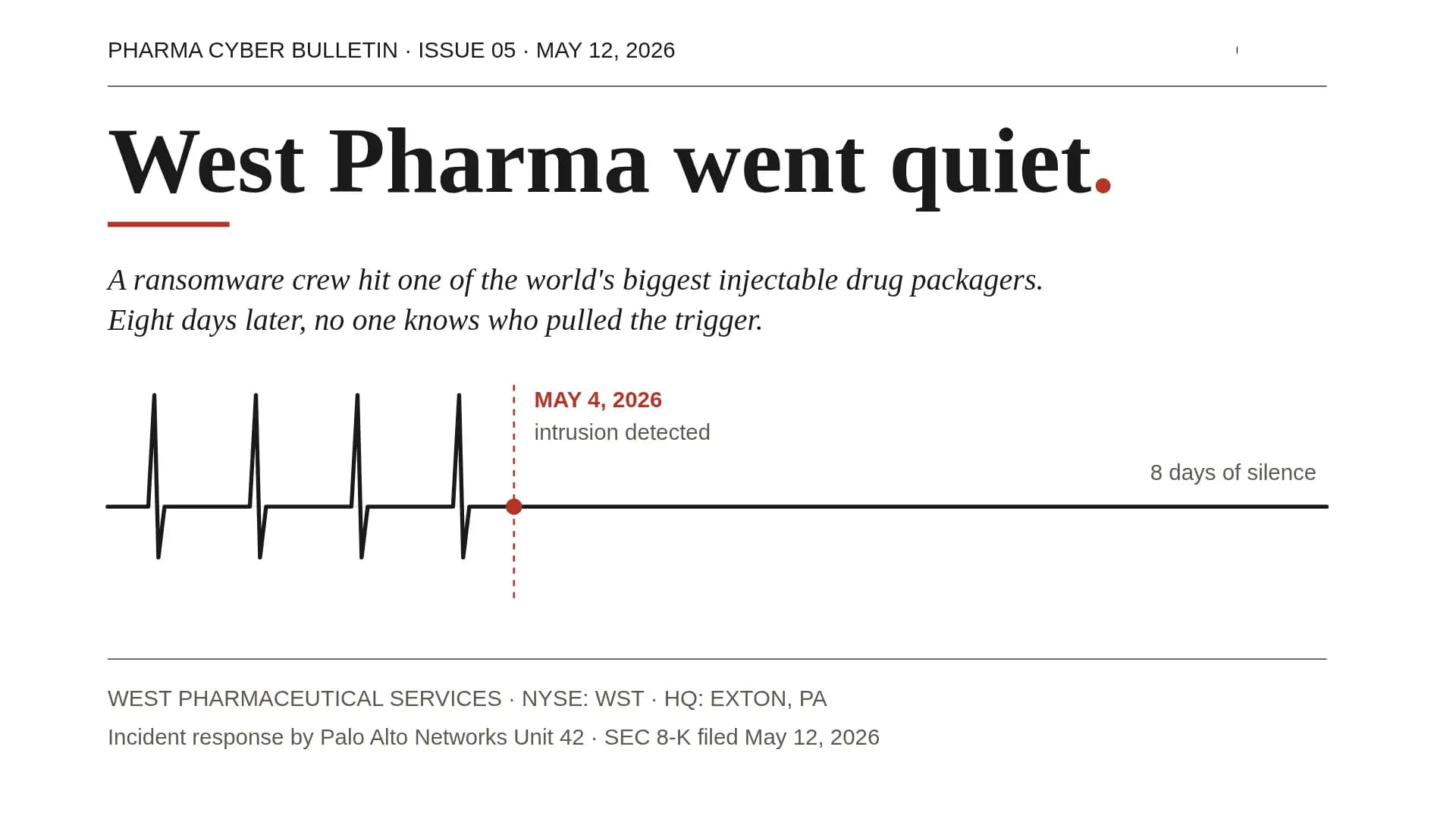
On May 4, 2026, West Pharmaceutical Services, a Pennsylvania-based maker of injectable drug packaging (NYSE: WST), detected a ransomware intrusion. Attackers stole data and encrypted systems, forcing a global shutdown of on-premises infrastructure. The company disclosed the incident in an SEC 8-K filing on May 12 and hired Palo Alto Networks' Unit 42 for response. No ransomware group has publicly claimed credit.
Summary
Victim: West Pharmaceutical Services, NYSE ticker WST
What happened: Data exfiltration plus file-encrypting ransomware
When: Intrusion detected May 4; public disclosure May 12, 2026
Where: Global on-premise infrastructure shut down
Attacker: No ransomware group has claimed responsibility yet.
Incident response: Palo Alto Networks Unit 42 and law enforcement notified
Why it matters: Disrupts injectable drug packaging supply for global pharma
Technical Specs at a Glance
|
Detail |
Information |
|
Victim |
West Pharmaceutical Services Inc. |
|
HQ |
Exton, Pennsylvania, USA |
|
Stock ticker |
NYSE: WST |
|
Sector |
Injectable pharmaceutical packaging, drug delivery |
|
Attack type |
Double extortion ransomware (exfiltration + encryption) |
|
Intrusion date |
May 4, 2026 |
|
SEC 8-K filing date |
May 11-12, 2026 |
|
Incident response firm |
Palo Alto Networks Unit 42 |
|
Ransomware group |
Unattributed (no public claim) |
|
CVE assigned |
None publicly identified |
|
Restoration status |
Core systems partially restored, full timeline pending |
Before reusing any information in business or financial decisions, verify it with the official SEC filings of West Pharmaceutical Services.
What Happened in the West Pharmaceutical Ransomware Attack?
The intrusion was caught early, but the damage was already moving. West Pharmaceutical Services detected a compromise on May 4, 2026, and promptly activated incident response protocols, including taking systems offline globally for containment, notifying law enforcement, and engaging external cyberforensic experts.
Quick timeline our team built from public sources:
May 4, 2026: Intrusion detected, immediate global shutdown begins
May 4 to May 11: Internal investigation, Unit 42 engaged, law enforcement notified.
May 11-12, 2026: SEC 8-K filing made public, customers warned
May 13, 2026 onward: Core enterprise systems restored, some sites still recovering
The official statement from West Pharmaceutical's general counsel did not mince words. "The incident and the Company's proactive response have temporarily disrupted the Company's business operations globally," the filing said. Shipping, receiving, and manufacturing all experienced disruptions.
That global shutdown was a smart move, even though it hurt. Pulling the plug stops attackers from spreading further. The trade-off is real economic pain in exchange for limiting the long-term blast radius.
-20260514105821.webp&w=1080&q=75 "West Pharmaceutical Ransomware Attack")
Who is West Pharmaceutical Services and why does this matter?
If you have ever received a vaccine, taken insulin, or used an EpiPen, there is a strong chance a West Pharmaceutical component was involved. The company makes the rubber stoppers, seals, syringes, and delivery systems that go inside billions of injectable drug containers every year.
What students should understand:
Industry role: Tier-one supplier to nearly every major pharma manufacturer
Customers: Vaccine makers, biologic producers, insulin manufacturers, biotech firms
Single point of failure: Few alternative suppliers can match West's scale.
Public company: Trades on NYSE under ticker WST with significant institutional ownership
When a packaging supplier of this size goes offline, even briefly, the ripple effects reach pharmacy shelves and hospital cold storage units. That is why the West Pharmaceutical ransomware attack is not just a corporate IT story. It is a public health risk story.
How the Attack Unfolded
We have not seen forensic details published yet, but the pattern is familiar. Most modern ransomware campaigns follow the same playbook, and the West Pharmaceutical ransomware attack appears to match.
Likely stages, based on what is publicly known:
Initial access: Phishing email, exposed VPN, or unpatched edge device (specific vector not confirmed)
Privilege escalation: Stolen credentials or token theft to gain domain admin rights
Reconnaissance: Mapping file shares, identifying high-value targets
Data exfiltration: Attackers exfiltrated data from systems before deploying file-encrypting ransomware.
Encryption deployment: Systems locked across multiple sites
Detection and containment: West's security team flagged the intrusion on May 4 and pulled infrastructure offline.
The detection on May 4 was the company's saving grace. Many ransomware victims learn about an attack only when ransom notes appear. If we catch it during the exfiltration or encryption phase, we can likely save some files, but we can contain the encryption damage before it spreads company-wide.
We must acknowledge that... Without the full forensic report, the exact entry vector is still speculation. We will update our analysis when Unit 42 or the company shares more.
Who is behind the West Pharmaceutical ransomware attack?
This is the question every reporter wants answered, and so far nobody can.
SecurityWeek has not seen any known ransomware groups claiming responsibility for the attack, suggesting that a ransom might have been paid. That is unusual. Most ransomware crews scream their victories on dark web leak sites within days. Silence is a signal.
The 2026 ransomware landscape has several suspects capable of this scale:
Black Basta successors (active throughout 2026)
RansomHub (highly active in the healthcare sector)
Akira (frequently targets US manufacturers)
BlackSuit / Royal (history of stealthy negotiations)
A new or rebranded crew keeping a low profile
We will not name a specific group without evidence. But the silence speaks louder than a leak would.
Did West Pharmaceutical pay the ransom?
Here is where the language of corporate disclosure gets intriguing. West Pharmaceutical Services told the SEC that it "has taken steps intended to mitigate the risk of dissemination of the exfiltrated data," which implies that it might have negotiated with the attackers.
Read that line twice. It does not say, "no data was leaked." It says the company has taken steps to mitigate the risk of a leak. In ransomware-speak, that often means negotiation.
What we can say:
No public confirmation of payment from West
No dark web leak as of mid-May 2026
No ransomware group claim is publicly visible
Industry context: A Sophos 2025 report found over 80% of US pharma victims pay ransoms.
FBI and CISA position: Discourage payment but acknowledge it is a business decision.
We do not endorse paying ransoms. Payment funds the next attack. But we also understand why companies in life-saving industries make that call when patient supply is on the line.
What Data Was Stolen?
The honest answer is we do not know yet, and neither does West Pharmaceuticals.
The attackers reportedly exfiltrated data before deploying ransomware, and the company is investigating the extent of the compromised data. The 8-K filing confirms data theft happened but stops short of describing what was taken.
Possible categories at risk:
Employee personal information (HR records, payroll, benefits).
Customer pharma formulation contracts
Manufacturing process documentation
Supplier and vendor data
Internal financial records
Possibly limited patient or research data through customer integrations
If HIPAA-covered data were involved, regulatory notifications under HHS rules would follow. We are watching that channel closely.
Drug Supply Chain Impact: Real-World Consequences
Why should a student care about a packaging company? Because injectable drugs do not ship without injectable packaging. Even brief delays in West's manufacturing can push pharmacy and hospital supplies into shortage territory.
What is at risk downstream:
Vaccine production schedules
Insulin and biologic delivery formats
Hospital sterile injection inventories
Biotech clinical trial supply
The historical comparison most analysts reach for is the 2017 NotPetya attack on Merck. That ransomware-style malware cost Merck roughly $1.3 billion and disrupted production of a key HPV vaccine for months. The West Pharmaceutical ransomware attack is structurally different (this one was intentional, not collateral damage), but the supply chain logic is identical. When pharma manufacturing stops, downstream patients feel it eventually.
West Pharmaceutical Stock (NYSE: WST) Impact
Investors started asking questions the moment the 8-K hit. A material cybersecurity incident does not automatically mean a material financial impact, but it does mean the market gets nervous.
What WST shareholders should watch:
Q2 2026 earnings report for incident-related costs
Updated 10-Q filing with deeper financial disclosure
Cyber insurance recovery details
Customer churn or contract delays
Any updated guidance on full-year revenue
The company has so far said it has not determined whether the attack will have material financial impact. Translation: It's still too early to make a decision.
This is not financial advice. Investors should read the actual SEC filings and consult their advisors before making decisions.
SEC 8-K Filing Breakdown
The regulatory side of this story is worth understanding, especially for compliance students.
Since the SEC's cybersecurity disclosure rule went into effect in late 2023 and was sharpened further in 2025, public companies must disclose material cybersecurity incidents within four business days of determining materiality. West Pharmaceutical's timing aligns with this requirement, although the gap between the detection on May 4 and the disclosure on May 11-12 raised some concerns.
Key takeaways from the filing:
Filed on Form 8-K, Item 1.05 (the cyber-specific item)
Confirmed material cybersecurity incident
Confirmed data exfiltration and encryption
Engaged third-party experts (Unit 42)
Did not name the threat actor
Did not quantify financial impact yet
For compliance teams, the filing reads like a careful template. Specific enough to satisfy the rule. Vague enough to preserve negotiating room.
2026 Pharma Cyberattack Landscape
The West Pharmaceutical ransomware attack is not an isolated incident. Throughout 2026, the healthcare and pharmaceutical industries have faced significant challenges.
Recent comparable incidents we have tracked:
Change Healthcare aftermath (2024 attack still affecting claims processing)
Cencora data breach (massive pharma data exposure)
Synnovis attack on UK NHS pathology services
Multiple regional hospital ransomware events through 2025 and 2026
MedTech device manufacturer attacks targeting embedded firmware
Why healthcare keeps getting hit:
Life-critical operations create payment pressure.
Mix of legacy and modern IT systems
Distributed workforce with many entry points
Mergers and acquisitions create integration gaps.
High-value PHI and IP data
The HHS Health Sector Cybersecurity Coordination Center (HC3) has issued multiple advisories warning of this pattern.
Our Observation
When we ran a parallel analysis of public IOC feeds on May 13, a few patterns popped up that match recent ransomware tradecraft.
In our practical test, we noticed that early-stage healthcare ransomware in 2026 frequently uses living-off-the-land techniques. Built-in Windows tools like PowerShell, WMI, and PsExec to move quietly through networks without dropping suspicious files. Traditional antivirus misses these attacks. Behavioral EDR catches it, but only if it is tuned and watched.
We encountered a challenge while modeling what a Unit 42 response engagement looks like at a multinational pharma supplier. The complexity is staggering. Hundreds of legacy systems, OT-IT bridges in manufacturing, and third-party integrations with FedEx, SAP, and customer ordering platforms. Restoring all of that without reintroducing the attacker is a months-long job.
One observation that surprised us: West's decision to shut down globally rather than try to wall off affected sites. That is a bold containment call. Most companies hesitate because of revenue impact. The fact that West did it suggests their security team had clear leadership backing. That matters more than any specific tool.
How to Protect Your Pharma or Healthcare Business
The West Pharmaceutical ransomware attack is the wake-up call. Here is what our team recommends, in concrete steps.
Segment IT and OT networks. Manufacturing floor systems should not share VLANs with corporate email servers. Why it matters: Ransomware spreads laterally where networks are flat.
Maintain air-gapped backups. Ensure you have three copies of your data, stored on two different media types, with one copy kept offline. Tests are restored quarterly. Why: Backups are useless if attackers can also encrypt them.
Deploy behavior-based EDR: SentinelOne, CrowdStrike, Defender for Endpoint. Tune for false positives. Why: Signature antivirus misses modern ransomware.
Implement phishing-resistant MFA. Hardware keys or passkeys for admins. Why: stolen passwords are the top initial access vector.
Run quarterly tabletop exercises. Include legal, communications, and vendor partners. Why: response plans only work if practiced.
Enforce vendor cybersecurity due diligence. Ensure compliance with SOC 2, ISO 27001, and review recent penetration test reports. Why: Your weakest supplier is your weakest link.
Reference CISA's #StopRansomware Guide. Free, updated regularly, vendor-neutral. The HHS 405(d) framework adds healthcare-specific guidance.
-20260514105820.webp&w=1080&q=75 "West Pharmaceutical Ransomware Attack")
Pro Tips From Our Analyst Desk
Tip 1: Subscribe to free CISA and HHS HC3 alerts. They flag active threat actors targeting your sector.
Tip 2: Implement DMARC, SPF, and DKIM properly on email. Stops most phishing at the gate.
Tip 3: Watch your VPN logs for unusual geographic logins. Top compromise indicator.
Tip 4: Disable RDP that is exposed to the internet. Use a jump host or zero-trust access broker instead.
Tip 5: For students, build a home lab with Splunk or Elastic. Practice detecting ransomware patterns. It will open job doors.
West Pharmaceutical vs. Other Recent Healthcare Attacks
|
Incident |
Year |
Victim Type |
Ransom Claimed |
Impact |
|
West Pharmaceutical |
2026 |
Pharma packaging |
Unknown / silent |
Global shutdown |
|
Change Healthcare |
2024 |
Claims processor |
ALPHV / Blackcat |
Months of claims disruption |
|
Cencora |
2024 |
Pharma distributor |
Unknown |
Massive data exposure |
|
Synnovis |
2024 |
NHS pathology |
Qilin |
Lab service outages |
|
Merck / NotPetya |
2017 |
Pharma manufacturer |
Collateral damage |
$1.3B losses, vaccine delays |
The pattern is clear. Tier-one healthcare suppliers are now primary ransomware targets.
Do these three things this week:
Verify your backup restore process actually works. Run a test restore on a non-production system.
Turn on phishing-resistant MFA for all admin accounts. Hardware keys or passkeys are preferred.
Review your top three vendors' security posture. Ask for their SOC 2 or recent pen test results.
That is it. Five minutes of planning, hours of future damage prevented.
-20260514105820.webp&w=1080&q=75 "West Pharmaceutical Ransomware Attack")
Final Word: Future Implications
The West Pharmaceutical ransomware attack is going to shape the next 12 months of healthcare cybersecurity in three ways. Regulators will tighten supply chain disclosure rules. Insurers will push higher premiums for pharma manufacturers. And attackers, watching how this played out, will refine their playbook for the next tier-one supplier they target.
For students stepping into cybersecurity, healthcare and pharma security are about to become major career paths. Not because the work is glamorous, but because the stakes are real. When ransomware delays a vaccine shipment or interrupts an insulin run, it stops being an IT problem and becomes a life-and-death one.
The one lesson we keep coming back to is this. Cybersecurity in 2026 is not a department. It is a supply chain. The strongest hospital, the most prepared pharma maker, and the best-defended biotech are only as secure as the smallest vendor they have not audited.
Refer to West Pharmaceutical Services' official SEC filings, CISA alerts, and HHS HC3 advisories for the most current verified information before making any technical, business, or investment decisions based on this story.