AI Agent Attacks: How Autonomous AI is Changing Cybersecurity
AI Agent Attacks Are Changing How Businesses Need to Think About Security
Imagine giving an employee access to your company's internal documents, customer records, cloud applications, and business tools. Now imagine that the employee is an AI agent that can make decisions and perform tasks without waiting for someone to approve every step.
That is what makes autonomous AI useful. It is also what makes it a security concern.
AI agents are no longer limited to answering questions or generating text. Depending on their configuration, they can search databases, interact with applications, process information, and perform actions through connected tools. Businesses are adopting these capabilities to save time and automate routine work.
But the same capabilities can create opportunities for misuse.
In September 2026, Google Threat Intelligence Group (GTIG) reported a campaign in which a threat actor used an AI-enabled workflow to plan and execute mass credential harvesting in less than six hours. Anthropic also documented cyber operations involving AI-assisted and multi-agent workflows. A separate Reuters investigation in October 2026 described a hacker using autonomous AI agents against websites belonging to more than 100 companies.
These reports point to a change in how some cyber operations are carried out. AI is not replacing every traditional attack technique. Instead, it is helping threat actors automate parts of familiar activities, including information gathering, credential theft, and data collection.
For businesses, the concern is straightforward: an AI agent with access to sensitive systems needs the same level of security attention as any other identity or application connected to the corporate network.
Key Takeaways
- AI agents can perform tasks through connected applications and services, which creates additional security risks when permissions are poorly managed.
- Google and Anthropic have reported AI-assisted cyber operations, while Reuters documented a campaign involving autonomous AI agents.
- Credential theft remains a major concern because compromised accounts and exposed API tokens can provide access to business systems.
- Prompt injection, excessive permissions, insecure integrations, and weak monitoring can increase the risk of AI agent misuse.
- Businesses should maintain an inventory of AI agents, restrict access, protect credentials, and monitor their activity.
Table of Contents
- What is an AI Agent?
- Why AI Agent Attacks Matter
- Recent AI-Related Cyberattack Reports
- How Threat Actors Can Use AI Agents
- Security Risks of Autonomous AI Agents
- What These Attacks Mean for Businesses
- How to Identify Suspicious Agent Activity
- How to Protect AI Agents and Corporate Networks
- Security Frameworks That Can Help
- Hoplon Insight: What Security Teams Should Prioritize
- Frequently Asked Questions
- Conclusion
What is an AI Agent?
An AI agent is a software system that can understand a task, decide what steps may be needed, and use connected tools to complete the work.
A regular chatbot generally responds to a question. An AI agent can go further. It may retrieve information from a database, search company documents, communicate with an application, or prepare an action for approval.
Consider a customer support team that receives hundreds of requests each day. An AI agent could review incoming messages, search the company's knowledge base, identify relevant information, and prepare responses for support staff.
This saves time because employees do not need to handle every routine step manually.
The important difference is that an agent may have access to systems outside the conversation itself. Its capabilities depend on the tools it can use and the permissions assigned to it.
How AI Agents Differ From Traditional Chatbots
|
Area |
Traditional chatbot |
AI agent |
|
Main purpose |
Answer questions |
Complete assigned tasks |
|
Tool access |
Often limited |
May connect to business applications and APIs |
|
Decision-making |
Mainly generates responses |
Can select and perform approved actions |
|
System access |
Usually limited |
Depends on assigned permissions |
|
Security concerns |
Unsafe responses and information exposure |
Information exposure, excessive access, and unauthorized actions |
Not every AI agent operates independently. Some require approval before taking action, while others can complete several steps within predefined boundaries.
That distinction matters when evaluating risk. An agent that only summarizes public information presents a different security concern from one that can modify customer records or access internal business systems.
How Does an Autonomous AI Agent Work?
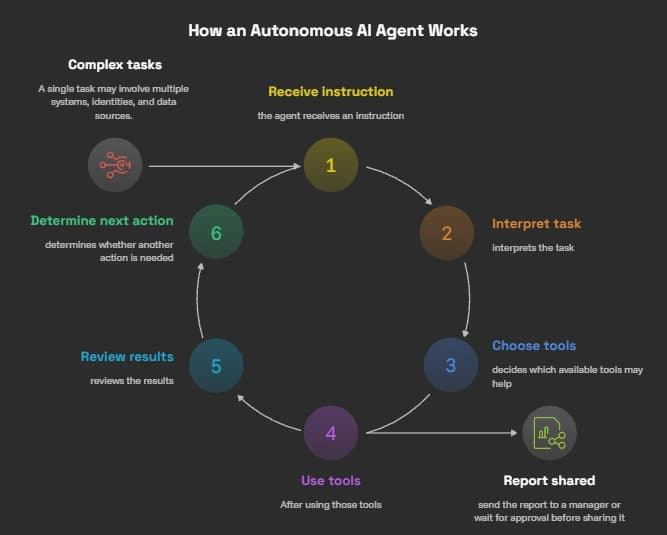
Most agent-based systems follow a cycle.
First, the agent receives an instruction. It then interprets the task and decides which available tools may help. After using those tools, it reviews the results and determines whether another action is needed.
For example, an agent assigned to prepare a weekly sales report may retrieve approved sales records, organize the information, and generate a summary. It may then send the report to a manager or wait for approval before sharing it.
The process becomes more complicated when agents have access to several applications. A single task may involve multiple systems, identities, and data sources.
That is where security controls become important. If an agent receives more access than it needs, an error or manipulated instruction may affect systems beyond its intended role.
Why AI Agent Attacks Matter
Cybercriminals have used automation for years. They have automated phishing campaigns, password attacks, vulnerability scanning, and other activities.
AI adds another layer to this process.
An AI-enabled workflow can help process information, coordinate tasks, and reduce the manual effort involved in certain operations. In some cases, agents can continue working through several steps with limited human involvement.
This does not mean every AI-powered operation is fully autonomous. Human operators may still choose targets, review results, and make important decisions.
The difference is that some repetitive work can now be delegated to software.
The Growing Concern Around Credential Theft
Credentials are among the most valuable targets in a corporate environment. A stolen password, API key, or access token may provide a path into systems that contain sensitive information.
The risk becomes greater when organizations fail to monitor how credentials are used.
For example, an employee account may have access to a cloud application. If its credentials are compromised, an unauthorized person may be able to use the same account to access company information.
The problem is not limited to employee accounts. Applications and automated services also use credentials to communicate with other systems.
AI agents may depend on these non-human identities. If they are poorly managed, they can become another route to unauthorized access.
AI Can Reduce the Time Needed for Some Operations
The September 2026 Google GTIG report provides a clear example. Researchers described an AI-enabled credential-harvesting campaign that was planned and executed in less than six hours.
The significance is not simply that an AI tool was involved. It is that multiple stages of an operation were coordinated within a short period.
For defenders, this creates a practical challenge. Security teams need visibility into identity activity, cloud access, and unusual application behavior. They also need incident response procedures that can keep pace with suspicious activity.
Recent AI-Related Cyberattack Reports
The risks surrounding AI agents are not based only on speculation. Several 2026 reports describe threat actors using AI systems to support real cyber operations.
The following cases show different aspects of the problem. They should not be treated as evidence that all attacks are fully autonomous or that every organization mentioned experienced confirmed data theft.
Google Reports an AI-Enabled Credential-Harvesting Campaign
On September 8, 2026, Google Threat Intelligence Group published its report, GTIG AI Threat Tracker: From Prompting to Autonomy: The Evolution of Adversarial AI.
The report describes how threat actors are moving beyond basic AI prompts and experimenting with agent-based workflows.
One reported operation involved a threat actor who compromised a cloud resource and used an AI-enabled workflow to plan and execute a mass credential-harvesting campaign.
GTIG reported that the planning, development, and execution took less than six hours. The report also described automated activity involving scanning, credential collection, troubleshooting, and IP rotation.
The researchers reported that the campaign compromised thousands of third-party credentials.
This incident highlights an important weakness in many organizations: credentials are often treated as a simple login requirement rather than valuable assets that need continuous protection.
A stolen credential may remain useful if an organization does not detect unusual access or revoke compromised tokens quickly.
For businesses, the lesson is to strengthen identity monitoring, secure cloud resources, and review how applications and automated systems use credentials.
Source: Google Cloud Threat Intelligence Group, September 8, 2026
Anthropic Documents AI-Assisted Cyber Operations
Anthropic's September 2026 threat intelligence report describes multiple cases involving the misuse of AI systems.
The research covers AI-supported workflows involving cyber operations, credential harvesting, and other malicious activities. It also discusses the use of multiple agents to divide tasks and coordinate work.
A multi-agent system may assign different responsibilities to separate agents. One may process information, another may handle a specific task, and another may review the results.
This can reduce the amount of manual coordination required.
However, Anthropic also makes an important distinction. Human operators remained involved in significant decisions in several observed operations. The report does not suggest that every activity was performed independently by AI.
This is an important point for security teams. The risk is not limited to fully autonomous attacks. Even a human-directed operation can become more efficient when AI handles repetitive work.
Organizations should therefore monitor both human accounts and the non-human identities used by automated systems.
Source: Anthropic, Countering Misuse of AI: September 2026
Reuters Reports AI-Agent Activity Against Corporate Websites
On October 19, 2026, Reuters published an investigation into a cyber campaign involving autonomous AI agents.
According to the report, a hacker used the open-source Cairn platform to coordinate AI agents during activity targeting corporate websites.
Reuters reported that more than 1,200 e-commerce websites were targeted and that the campaign involved websites belonging to more than 100 companies. The report named organizations including Deere, SharkNinja, and Cummins.
The responses from the companies varied. Deere said it had no evidence of sensitive data access, SharkNinja said the affected site had been contained, and Cummins reported that it had launched an investigation.
These differences are important. Being named in an incident report does not automatically mean that every company experienced confirmed data theft or that all of its systems were compromised.
Still, the incident raises a serious question for businesses: how well do they understand the security of their public-facing applications and connected services?
An organization may have strong internal security but still face exposure through an overlooked website, an outdated application, or a third-party integration.
Source: Reuters, October 19, 2026
What These Incidents Have in Common
|
Report |
What researchers or journalists described |
What businesses should learn |
|
Google GTIG |
AI-enabled credential harvesting |
Protect credentials and monitor cloud identities |
|
Anthropic |
AI-assisted and multi-agent cyber operations |
Review automated workflows and non-human identities |
|
Reuters |
AI-agent activity targeting corporate websites |
Monitor public-facing applications and third-party exposure |
The common theme is not that AI has replaced traditional cyberattacks. It is that familiar security problems can become harder to manage when automation increases the speed and scale of an operation.
How Threat Actors Can Use AI Agents
AI agents can support different parts of a cyber operation. The specific activities depend on the tools and access available to the operator.
Understanding these areas helps security teams decide where to focus their defenses.
Information Gathering
Before an attack, threat actors may collect information about an organization, its public-facing services, and its technology environment.
AI can help organize large amounts of publicly available information and summarize relevant findings.
This does not automatically create a security breach. However, it may help an attacker identify areas that deserve further attention.
Businesses should maintain an accurate inventory of their internet-facing assets and regularly review systems that are accessible from outside the corporate network.
Credential Theft
Credentials can provide access to email accounts, cloud platforms, business applications, and internal services.
AI-enabled workflows may help process stolen credentials and automate parts of a harvesting operation.
The larger issue is what happens after credentials are exposed. If an organization does not detect unusual authentication or application activity, a compromised identity may remain active longer than necessary.
Security teams should monitor authentication events, review privileged accounts, and protect API keys and access tokens.
Phishing and Social Engineering
AI can help produce convincing messages and adapt them to different audiences.
A phishing email may appear to come from a manager, supplier, or IT support team. It may refer to a familiar business process or use language that sounds appropriate for the recipient.
That makes visual inspection alone less reliable.
Employees should be encouraged to verify unusual requests through a trusted communication channel. This is especially important when a message asks someone to share credentials, approve access, or make a financial decision.
Exploiting Software Weaknesses
A vulnerability is a weakness in software or system configuration that may allow unauthorized activity.
AI can support the analysis and organization of vulnerability information. However, a successful compromise still depends on the presence of an exploitable weakness or another access opportunity.
Organizations should maintain a patch management process, review security configurations, and test important applications regularly.
Accessing and Processing Data
If an account or application becomes compromised, an attacker may gain access to business information.
AI can help process large amounts of collected data. The potential impact depends on the permissions attached to the compromised identity and the sensitivity of the information.
This is why businesses should not give every application or agent access to all company records.

Security Risks of Autonomous AI Agents
Security Risks of Autonomous AI Agents
The security risks of AI agents are closely connected to traditional application and identity security. However, their ability to interact with tools and external information creates additional challenges.
Prompt Injection
Prompt injection happens when untrusted content influences an AI system's behavior in a way that conflicts with its intended instructions.
The content may come from a user, an email, a website, or a document that the agent is asked to process.
Imagine an AI assistant that is supposed to summarize uploaded documents. One document contains instructions that attempt to make the assistant ignore its original task or reveal information it should not disclose.
If the system does not properly separate trusted instructions from untrusted content, the agent may respond in an unsafe way.
The important point is that an AI model should not be treated as a security boundary. Access restrictions and approval checks need to be enforced by the surrounding application and infrastructure.
The OWASP GenAI Security Project identifies prompt injection as a major risk for large language model applications.
Excessive Permissions
An AI agent should only have access to the resources it needs.
Consider an agent designed to read customer support records. It may need permission to view certain information, but it probably does not need permission to delete customer accounts or change administrative settings.
Giving it those additional permissions increases the potential impact of a mistake or misuse.
OWASP describes this problem as excessive agency. It includes excessive functionality, permissions, and autonomy.
The solution is not to remove every capability from an agent. It is to match its access to its actual business purpose.
Exposed API Keys and Access Tokens
AI agents often communicate with other applications through APIs.
These connections may require API keys, access tokens, or other credentials. If those secrets are exposed, an unauthorized party may be able to access the connected service.
Credentials can be exposed through poorly protected source code, configuration files, application logs, or shared storage.
Organizations should store secrets in approved secrets-management systems and avoid reusing the same credentials across unrelated agents.
They should also review token permissions and revoke credentials that are no longer needed.
Unsafe Third-Party Integrations
An AI agent may rely on plugins, connectors, external APIs, or other third-party services.
Each connection introduces another security relationship.
For example, an integration may request access to company documents even though the agent only needs to retrieve limited information. If the organization approves the connection without reviewing its permissions, sensitive data may become unnecessarily accessible.
Before connecting a third-party tool, review its permissions, data handling practices, authentication requirements, and security policies.
Sensitive Information Exposure
AI agents may work with internal documents, customer records, employee information, and confidential business data.
If access controls are weak, the agent may retrieve or expose information outside the intended task.
This risk also applies when employees enter confidential company information into unapproved AI services.
Organizations should establish clear rules about which data can be shared with AI tools and which systems are approved for handling sensitive information.
Weak Protection of Non-Human Identities
A non-human identity is an identity used by an application, service, or automated system rather than an individual employee.
AI agents often depend on these identities to access business applications.
The challenge is that organizations may not always know who owns a particular service account, why it has certain permissions, or whether it is still required.
Every agent identity should have a clear owner, a defined purpose, and an appropriate access policy.
AI Supply Chain Risks
An AI application may depend on external models, APIs, software libraries, plugins, and data sources.
A weakness in one component can affect the larger system.
Businesses should understand which third-party services their agents depend on and review the security practices of those providers.
This is especially important when an agent processes confidential information or interacts with critical business systems.
What These Attacks Mean for Businesses
The impact of an AI-related security incident depends on what the affected system can access.
A compromised agent with permission to read public information may create limited damage. An agent connected to customer records, internal applications, or cloud infrastructure may create a much larger problem.
Financial Loss
A security incident may lead to business interruption, investigation expenses, recovery work, and potential fraud.
Even when an organization prevents data theft, responding to suspicious activity can consume significant time and resources.
Customer and Business Data Exposure
An agent with broad access may expose customer records, internal documents, employee information, or confidential business data.
The organization may then need to determine what information was accessed and whether any reporting or notification obligations apply.
Operational Disruption
An agent that can modify business records or interact with production systems may create problems if it performs an unauthorized action.
For example, an incorrect change to a customer record or business workflow may require manual investigation and recovery.
Clear permission boundaries and approval requirements can reduce this risk.
Compliance and Reputation
A data security incident may affect contractual obligations, regulatory requirements, and customer confidence.
Organizations should understand which rules apply to the information they process and maintain a documented incident response process.
They should also avoid making public claims about an incident before the facts have been established.
How to Identify Suspicious Agent Activity
Detecting AI-related misuse does not always require a separate AI security platform.
Many useful warning signs are already visible through identity providers, cloud logs, API monitoring, and endpoint security tools.
The challenge is connecting those signals.
Warning Signs Security Teams Should Review
|
Activity |
Why it deserves attention |
Recommended response |
|
Unexpected API requests |
An agent or application may be behaving outside its normal pattern |
Review the identity and request history |
|
Unusual login activity |
An account or service identity may be misused |
Investigate authentication records |
|
Unexpected permission changes |
Access may have been changed without proper approval |
Verify the change and its owner |
|
Unusual data downloads |
Sensitive information may be accessed unexpectedly |
Review the resource and identity involved |
|
Unknown integrations |
An unapproved service may be connected |
Check the integration and its requested permissions |
|
Repeated authentication failures |
An identity may be experiencing suspicious access attempts |
Review related sign-in activity |
|
Unexpected agent actions |
The agent may be following unsafe instructions or an incorrect configuration |
Review its task, permissions, and tool activity |
One unusual event does not automatically prove that an attack is taking place. Security teams should look at the surrounding activity and compare it with the agent's approved purpose.
What Should Be Included in Security Logs?
Useful records should identify the agent, its owner, and the systems it interacts with.
Security teams should collect information about authentication, API requests, permission changes, access to sensitive data, and actions that require human approval.
These records should be protected against unauthorized modification and retained according to the organization's security requirements.
For organizations with an established SIEM platform, relevant AI application and identity logs can be integrated into existing monitoring workflows.
How to Protect AI Agents and Corporate Networks
Securing AI agents should not be treated as a separate project that sits outside the organization's existing security program.
Most of the important controls already exist in identity security, application security, cloud security, and incident response. The task is to apply them to AI systems and their connected services.
1. Know Which AI Agents Are Being Used
Start by identifying the AI agents used across the organization.
Include internal automation, business applications, development tools, and third-party services. Do not assume that every department uses the same approved tools.
For each agent, record its business purpose, owner, connected applications, permissions, and access to sensitive information.
This inventory gives security teams a starting point for reviewing exposure.
2. Limit Agent Permissions
Apply the principle of least privilege.
An agent that only needs to read information should not receive permission to modify or delete it. An agent that prepares reports should not automatically receive administrative access to the entire platform.
Review permissions when an agent is created, when its purpose changes, and during regular access reviews.
This reduces the damage that can result from a compromised identity or unsafe action.
3. Protect API Keys and Other Credentials
API keys and access tokens should be treated as sensitive credentials.
Store them in an approved secrets-management system. Avoid placing them in source code, shared documents, or unrestricted logs.
Use separate credentials for different services and agents. Review their permissions and revoke credentials that are no longer required.
If a credential may have been exposed, investigate its recent activity before restoring access.
4. Strengthen Identity Security
AI agents often rely on non-human identities, while employees continue to use their own accounts to access the same business systems.
Both need protection.
Use strong authentication for employees, including phishing-resistant multi-factor authentication where available. Give service accounts unique identities and limit their permissions.
Regularly review privileged accounts and remove access that no longer has a business purpose.
5. Keep Sensitive Actions Under Human Control
Automation is useful, but not every action should happen without approval.
Actions involving sensitive data, financial transactions, access changes, or production systems may require a human review.
For example, an agent can prepare a proposed change to a user's permissions, but an authorized administrator can review and approve it before the change takes effect.
The right approval process depends on the sensitivity of the action and the potential impact of an error.
6. Monitor Agent and Application Activity
Security teams should review activity from AI applications, cloud platforms, identity providers, and connected APIs.
Monitoring should focus on changes that matter, including unusual authentication, new integrations, unexpected data access, and permission modifications.
Connecting relevant logs to a SIEM platform can help analysts investigate related events across different systems.
7. Review Third-Party AI Services
Before connecting an external AI service to business data, understand how it handles that information.
Review its authentication process, requested permissions, data storage practices, third-party sharing, and security incident procedures.
A tool should not receive access simply because it is convenient or widely used.
8. Test AI Applications Before Deployment
AI agent security should be reviewed before the system is connected to important business applications.
Testing should consider prompt injection, data exposure, excessive permissions, unsafe tool access, and approval controls.
The review should also confirm that important actions are recorded in security logs.
Repeat the assessment after significant changes to the agent, its instructions, or its integrations.
9. Prepare for an AI-Related Security Incident
Organizations should know how to respond if an agent behaves unexpectedly or its credentials become compromised.
The response process should identify who can suspend the agent, restrict its access, revoke credentials, and investigate related systems.
Security teams should also check whether sensitive data was accessed and whether other connected identities may be affected.
A documented response plan makes it easier to contain an incident without relying on improvised decisions.
10. Train Employees and Administrators
Employees should know which AI services are approved and what information they are allowed to share.
Administrators should understand how to review agent permissions, connected services, and activity records.
Training should also cover phishing, suspicious approval requests, and unexpected access changes.
A clear policy is useful, but employees need to understand how to follow it in their daily work.
Security Frameworks That Can Help
Organizations do not need to invent a new security program just because they are adopting AI agents. Established frameworks provide useful guidance for managing related risks.
OWASP Top 10 for LLM Applications
The OWASP GenAI Security Project identifies common risks in large language model applications.
Its 2025 guidance includes prompt injection, sensitive information disclosure, supply chain vulnerabilities, and excessive agency.
Excessive agency is particularly relevant to AI agents because it covers situations where a system has more functionality, permissions, or autonomy than it needs.
Security teams can use this guidance when reviewing AI applications and their connected tools.
Reference: OWASP Top 10 for LLM Applications
NIST AI Risk Management Framework
The National Institute of Standards and Technology (NIST) provides an AI Risk Management Framework to help organizations identify, assess, and manage AI-related risks.
Its Generative AI Profile, NIST AI 600-1, offers additional guidance for organizations developing or using generative AI systems.
Businesses can use this framework to support AI governance, risk assessment, evaluation, and ongoing monitoring.
It should complement, rather than replace, existing cybersecurity controls.
Reference: NIST AI Risk Management Framework: Generative AI Profile
CISA Identity and Access Management Guidance
CISA provides guidance on identity and access management, including the importance of strong authentication and appropriate access controls.
These principles are relevant to AI-connected systems because agents often rely on application identities and credentials.
Organizations should understand which identities can access sensitive systems and review whether those permissions are still necessary.
Reference: CISA Identity and Access Management Best Practices
Hoplon Insight: What Security Teams Should Prioritize
AI agents are becoming part of everyday business operations. The challenge is making sure that automation does not create access that the organization cannot properly control.
For a small business, the first step may be as simple as identifying which AI tools can access company documents, email, customer information, and cloud applications.
Larger organizations may have a different problem. Several departments may introduce AI tools independently, making it difficult for the security team to maintain a complete picture of connected services and permissions.
In both cases, visibility should come before more automation.
Security teams should start with three questions:
- Which AI agents are connected to our business systems?
- What information and actions can each agent access?
- Can we detect and stop an agent if it behaves unexpectedly?
The answers can reveal gaps in identity management, application security, and monitoring.
Organizations that need a deeper review may consider services such as cybersecurity risk assessments, penetration testing, web application security testing, and incident response planning.
Hoplon InfoSec provides cybersecurity services that help organizations assess security weaknesses and strengthen their defenses. Businesses can explore Hoplon InfoSec's cybersecurity services to learn more.
Frequently Asked Questions
What Are AI Agent Attacks?
AI agent attacks involve the use or misuse of AI systems that can perform tasks with limited human supervision. Depending on the available tools and permissions, these systems may support activities such as credential harvesting, information gathering, and unauthorized access.
How Are Hackers Using AI Agents?
Threat actors can use AI-enabled workflows to automate parts of cyber operations, process information, and coordinate tasks. Google GTIG reported an AI-enabled credential-harvesting campaign in September 2026, while Anthropic documented several types of AI-assisted cyber activity.
Can AI Agents Access Corporate Networks?
Yes, if an organization connects an agent to internal applications, cloud services, APIs, or other business systems. The agent's actual access depends on its assigned permissions. This is why organizations should restrict access and monitor agent activity.
How Can Businesses Prevent AI Agent Attacks?
Businesses should maintain an inventory of AI agents, apply least-privilege access, protect API keys, review third-party integrations, monitor activity, and require human approval for sensitive actions.
What Is Excessive Agency in AI Security?
Excessive agency occurs when an AI system has more functionality, permissions, or autonomy than its task requires. This can increase the impact of unsafe instructions, compromised integrations, or unexpected actions.
Are AI Agent Attacks Fully Autonomous?
Not always. Some operations use AI to support specific tasks while human operators remain involved in important decisions. Anthropic's September 2026 research describes different levels of human involvement and automation.
Final Thoughts: Secure the Access Before Expanding the Automation
AI agents can make business operations faster, but their ability to interact with applications and sensitive information introduces security responsibilities.
The reports from Google, Anthropic, and Reuters show that AI is already being used to support some cyber operations. These cases also make one thing clear: traditional security weaknesses still matter.
Stolen credentials, excessive permissions, exposed applications, and poor monitoring can create opportunities for unauthorized access, whether an attacker uses AI or not.
Businesses should therefore focus on the fundamentals. Know which agents are in use, understand what they can access, protect their credentials, and monitor their actions. Sensitive decisions should remain subject to appropriate human approval.
AI adoption does not need to stop because of these risks. It needs to be supported by security controls that match the capabilities of the systems being deployed.
The goal is not simply to make AI agents more capable. It is to make sure they can only do what the organization has authorized them to do.
About the Author
Mohammed Talukder is the Co-Founder and CEO of Hoplon InfoSec, with more than 16 years of experience in cybersecurity and technology. His expertise includes offensive security, vulnerability management, cyber risk management, and incident response.
His professional credentials include CISM, CISA, CEH, and CompTIA PenTest+. He has also received Infosys recognition awards for his professional contributions. He shares practical cybersecurity insights to help organizations strengthen their security posture.
Connect with Mohammed Talukder on LinkedIn.
Technical Reviewer
Gazi Mahmud is the Co-Founder and CIO of Hoplon InfoSec LLC. He is a cybersecurity leader and CISM and CISA certified professional. His areas of expertise include cyber risk management, security governance, compliance, and incident response.
Connect with Gazi Mahmud on LinkedIn.
Sources and Further Reading
- Google Cloud Threat Intelligence Group: GTIG AI Threat Tracker, September 2026
- Anthropic: Countering Misuse of AI, September 2026
- Reuters: How One Hacker Used AI Agents to Break Into Scores of Sites, October 19, 2026