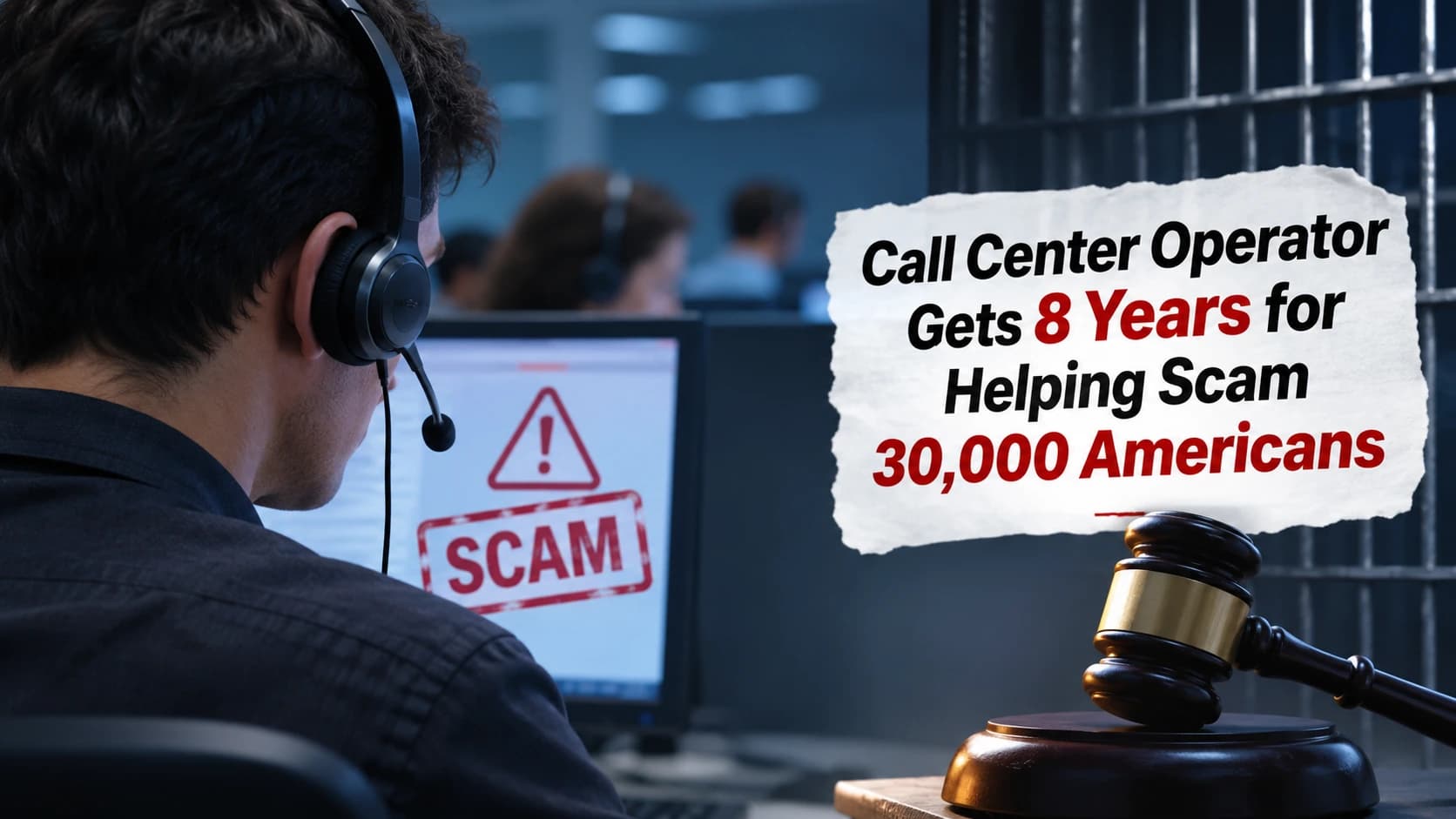
How did a call center operator help defraud more than 30,000 Americans of approximately $15 million? On November 18, 2026, a U.S. federal court sentenced Carla Magaly Alcedo Mendoza, a Peruvian call center operator, to eight years in prison for her role in a transnational fraud conspiracy.
The operation targeted Spanish-speaking U.S. residents through misleading product offers, fabricated payment obligations, and threats from people posing as government officials and lawyers.
The case highlights how government impersonation scams can turn ordinary phone calls into financial fraud. It also offers important lessons about recognizing suspicious calls, verifying official claims, and protecting personal information.
According to the U.S. Department of Justice (DOJ), the broader conspiracy affected more than 30,000 consumers and caused approximately $15 million in losses.
Key Takeaways
- A large-scale fraud operation: A Peru-based call center operator received an eight-year prison sentence for participating in a scheme that targeted more than 30,000 Spanish-speaking U.S. residents.
- False authority drove the fraud: Callers offered supposedly free products, created fraudulent payment obligations, and impersonated government officials or lawyers to pressure consumers.
- Verification can interrupt the scam: Consumers should independently confirm unexpected government communications, avoid suspicious payment demands, and report fraudulent activity through official channels.
Table of Contents
- What Happened in the $15 Million Call Center Scam?
- How Did the Call Center Fraud Work?
- Why Was Government Impersonation Effective?
- What Are Government Impersonation Scams?
- Government Impersonation Scam Examples
- How to Identify Scam Calls
- What Consumers Can Learn From the Case
- How to Avoid Government Impersonation Scams
- What to Do If You Paid a Scammer
- How International Call Center Scams Operate
- Emerging Government Impersonation Threats
- What Businesses Should Learn
- Frequently Asked Questions
What Happened in the $15 Million Call Center Scam?
A phone call offering free educational materials may not seem threatening. Yet federal investigators uncovered a fraud operation that used such offers to draw consumers into a scheme involving false debts and legal intimidation.
The operation involved call centers in Peru that contacted Spanish-speaking consumers across the United States. Callers falsely claimed that recipients had won or qualified for free products, including computer tablets and English-language courses.
Later, the same consumers could receive calls claiming that they were legally required to pay substantial amounts to receive those products.
When victims questioned the charges, perpetrators impersonated officials and attorneys. They threatened court proceedings, arrest, and immigration-related consequences.
The DOJ described the operation as a years-long conspiracy involving multiple participants. Its reported $15 million in losses reflects the broader scheme, not an amount attributed solely to one operator.
Who Was Carla Magaly Alcedo Mendoza?
Carla Magaly Alcedo Mendoza, 45, lived in Lima, Peru.
According to federal prosecutors, she owned and operated a call center that participated in fraudulent telephone solicitations targeting U.S. consumers.
The DOJ reported that Alcedo admitted her involvement in the scheme, including operating a call center that contacted Spanish-speaking residents and falsely represented that they had qualified for free products.
Her role was not limited to making isolated calls. She oversaw call center operations connected to the broader conspiracy.
The case eventually resulted in her extradition to the United States, guilty plea, and federal prison sentence.
How Were More Than 30,000 Americans Targeted?
The operation used unsolicited telephone calls to reach Spanish-speaking consumers.
A victim might initially believe the call concerned an educational offer. However, the supposed benefit could later become the basis for a fraudulent payment demand.
Callers claimed that consumers had contractual obligations related to the products.
Those who resisted payment could face threats from individuals pretending to have legal or government authority.
The intimidation sometimes involved references to immigration consequences, making the threats particularly serious for consumers concerned about their legal circumstances.
The DOJ reported that the conspiracy affected more than 30,000 U.S. residents and caused approximately $15 million in losses.
What Was the Court's Decision?
On November 18, 2026, Alcedo received an eight-year prison sentence followed by three years of supervised release.
The sentence followed her guilty plea in connection with the transnational fraud conspiracy.
The investigation involved cooperation between U.S. and Peruvian authorities.
The case demonstrates how an international fraud operation can involve multiple jurisdictions, participants, and supporting services.
Key Developments in the Case
|
Date |
Development |
|
2013–2018 |
Period associated with Alcedo's call center operations in the DOJ's earlier case reporting |
|
March 2023 |
Alcedo was arrested in Peru |
|
2025 |
She was extradited to the United States |
|
August 2026 |
She pleaded guilty |
|
November 18, 2026 |
She received an eight-year prison sentence and three years of supervised release |
Source: U.S. Department of Justice, official sentencing announcement.
How Did the Call Center Fraud Work?
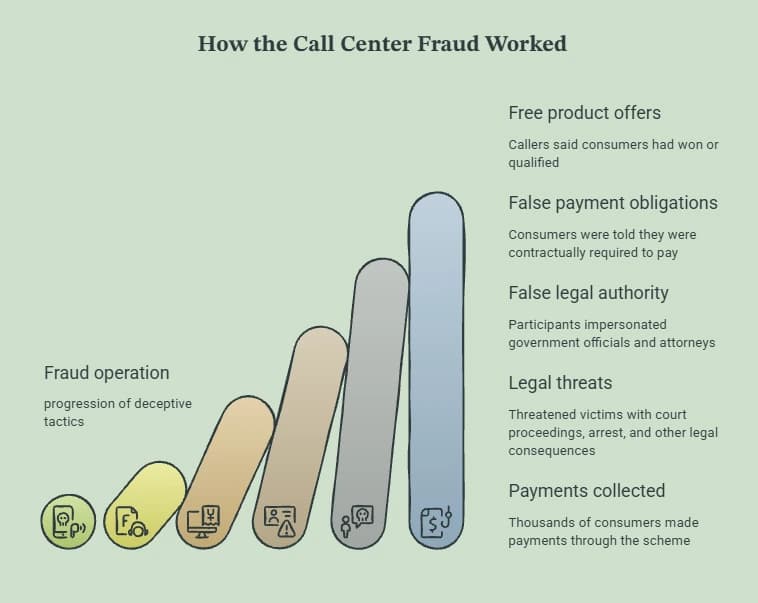
The operation followed a progression that made the deception increasingly difficult for some consumers to recognize.
The initial contact offered something valuable. Later communications introduced unexpected financial obligations. Finally, callers used false legal authority to pressure victims into paying.
Understanding these stages is useful because similar tactics appear in other types of telephone fraud.
Stage 1: Attracting Victims With Free Products
The scheme began with offers involving computer tablets and English-language learning materials.
Callers falsely told consumers that they had won or qualified for these products.
At first, the communication could resemble an ordinary promotional offer.
A consumer interested in educational resources might have little reason to expect that the conversation would lead to legal threats.
The risk began with trusting an unsolicited offer without independently confirming the organization behind it.
Stage 2: Creating False Payment Obligations
After the initial offer, the fraudsters introduced a new claim.
Consumers were told they were contractually required to pay substantial amounts to receive the products.
This created an apparent contradiction.
Something presented as free suddenly carried a payment obligation.
The callers used that alleged obligation as the basis for further demands.
The important distinction is that a caller's claim does not establish a legitimate contract or debt.
Consumers should independently verify any unexpected financial obligation before making payment.
Stage 3: Impersonating Government Officials and Lawyers
The operation escalated when consumers questioned the demands.
According to the DOJ, participants impersonated government officials and attorneys to intimidate victims.
A caller claiming to represent a government agency can appear more authoritative than an ordinary salesperson.
That claimed authority may discourage consumers from challenging the demand.
However, an official title or professional manner does not prove that the caller represents a legitimate institution.
Identity and authority must be confirmed independently.
Stage 4: Threatening Arrest and Legal Consequences
The fraudsters also threatened victims with court proceedings, arrest, and other legal consequences.
Some threats involved immigration-related concerns.
These statements attempted to transform a disputed payment into an urgent legal problem.
A consumer facing such threats might focus on avoiding the alleged consequences rather than examining whether the demand is genuine.
This is an important feature of authority-based fraud.
The scammer tries to influence the consumer's decision before the consumer has verified the underlying claim.
Stage 5: Collecting Payments
The operation ultimately sought money from victims.
The DOJ reported that thousands of consumers made payments through the scheme.
Related proceedings also documented supporting activities involving distribution centers, payment processing, and telecommunications services.
These activities show that organized fraud may involve several participants with different responsibilities.
The person demanding payment may not be the same individual who receives or processes it.
How the Fraud Developed
|
Stage |
Fraudulent Activity |
Consumer Risk |
|
Initial contact |
Free-product offer |
Trusting an unverified organization |
|
False obligation |
Unexpected payment demand |
Accepting an unsupported debt |
|
Authority impersonation |
Fake officials and lawyers |
Believing false legal claims |
|
Intimidation |
Arrest and court threats |
Paying under pressure |
|
Payment collection |
Money transferred through the operation |
Financial loss |
The case shows that a fraudulent transaction may develop across multiple conversations.
Recognizing an early warning sign can prevent the situation from reaching the payment stage.
Why Did Government Impersonation Make the Scam Convincing?
The operation relied heavily on social engineering.
Social engineering is the use of deception or manipulation to influence people's decisions, often to obtain money, information, or access.
In this case, the fraudsters combined misleading offers with false legal authority.
That combination helped turn an apparent product transaction into a threatening financial demand.
Fear of Arrest and Legal Action
The documented threats included arrest and court proceedings.
These consequences can be frightening, particularly when a caller claims that immediate payment will resolve the problem.
The danger is making a decision based on the threat rather than the legitimacy of the alleged debt.
A genuine legal matter should be verified through an independent and appropriate channel.
Paying an unidentified caller does not establish that a legal obligation has been resolved.
Misuse of Government Authority
The fraudsters impersonated people associated with institutions that exercise real legal powers.
This is a common feature of government impersonation scams.
A caller may present an official-sounding title, claim to possess government records, or refer to legal procedures.
Such details can make the conversation appear credible.
However, a legitimate government employee's identity cannot be confirmed simply through statements made during an unsolicited call.
Independent verification remains essential.
Pressure to Make Immediate Payments
Urgency can discourage consumers from checking information.
A caller who threatens immediate consequences may try to prevent the recipient from contacting an actual agency, attorney, or trusted person.
The Peru-based scheme used legal intimidation to pressure victims.
Consumers should treat demands for immediate payment during threatening unsolicited calls as serious warning signs.
Immigration-Related Intimidation
The operation targeted Spanish-speaking consumers and included immigration-related threats.
This aspect of the case requires careful interpretation.
The fact that the scheme targeted Spanish-speaking residents does not establish that those consumers were inherently more vulnerable to fraud.
Instead, the documented conduct shows that perpetrators used immigration-related concerns as part of their intimidation.
The distinction matters when explaining how targeted fraud works.
What Are Government Impersonation Scams?
Government impersonation scams are fraudulent attempts in which someone falsely claims to represent a government agency or official to obtain money, personal information, or another benefit.
These scams can begin through telephone calls, emails, text messages, or social media.
The impersonator may claim that a person owes taxes, faces arrest, has problems with government benefits, or must resolve an urgent legal issue.
Other schemes involve promises of refunds, prizes, or financial assistance.
Although the specific stories differ, the underlying deception is similar.
The scammer uses apparent government authority to encourage the recipient to act without proper verification.
The Federal Trade Commission warns that government impersonators may use real agency names, official-looking telephone numbers, and personal information to appear convincing.
Government Impersonation Scam Examples: Common Types and Warning Signs
Understanding different government impersonation scam examples can help consumers recognize fraud beyond the Peru-based case.
The FTC documents several impersonation scenarios involving federal agencies and public institutions.
IRS Impersonation Scams
A caller claims to represent the Internal Revenue Service and says the recipient owes unpaid taxes.
The scammer may threaten arrest, deportation, or other consequences unless payment is made immediately.
However, the IRS has established procedures for contacting taxpayers and resolving legitimate tax obligations.
An unexpected threatening call should be verified through official IRS channels.
Social Security Impersonation
Someone claims that a person's Social Security number has been suspended or connected to criminal activity.
The impersonator may demand payment or sensitive identifying information.
The FTC warns that such claims are common features of Social Security impersonation fraud.
Consumers should contact the Social Security Administration directly when concerned about their accounts.
Immigration-Related Impersonation
A fraudster claims to represent immigration authorities and demands payment to resolve an alleged problem.
The caller may reference applications, immigration status, or possible enforcement action.
The Peru-based conspiracy demonstrates how immigration-related threats can be used alongside other fraudulent claims.
Consumers should verify immigration matters through official government channels or qualified legal assistance.
Law Enforcement Impersonation
A caller claims to be a police officer, federal investigator, or another law enforcement representative.
The supposed issue may involve a warrant, investigation, or unpaid penalty.
The caller then demands money to prevent arrest or further action.
An actual legal concern should be addressed through independently verified authorities, not through a suspicious caller's payment instructions.
Court and Jury Duty Scams
A scammer claims that the recipient missed jury duty or violated a court requirement.
The caller may threaten arrest unless a penalty is paid.
These claims can sound serious because they refer to genuine legal responsibilities.
Consumers should contact the relevant court directly using official contact information.
Comparison of Common Scam Types
|
Scam Type |
Common False Claim |
Main Risk |
|
IRS impersonation |
Immediate tax payment required |
Financial loss |
|
Social Security impersonation |
Account or benefits are suspended |
Identity theft or payment fraud |
|
Immigration impersonation |
Legal status is at risk |
Financial coercion |
|
Law enforcement impersonation |
Arrest can be avoided by paying |
Payment under threats |
|
Court impersonation |
An unpaid penalty or warrant exists |
Fraudulent payment |
These examples are general consumer fraud patterns. They should not all be interpreted as tactics used in the specific Peru-based operation.
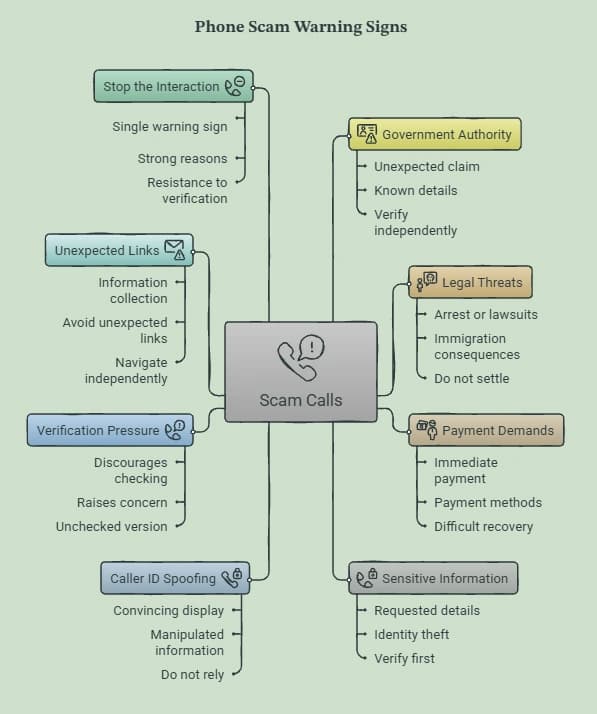
How to Identify Scam Calls: Phone Scam Warning Signs
Learning how to identify scam calls starts with examining what the caller wants you to do.
A legitimate-looking phone number, official title, or professional voice is not enough to establish trust.
The FTC identifies several warning signs associated with impersonation and payment fraud.
1. Unexpected Claims of Government Authority
A person calls without warning and claims to represent a government agency.
The caller may already know your name or address.
That information does not establish legitimacy.
Treat the identity claim as unverified until you contact the agency independently.
2. Threats of Arrest or Legal Consequences
A caller threatens arrest, lawsuits, or immigration consequences unless you cooperate.
Such threats are common phone scam warning signs.
The FTC specifically warns consumers about impersonators who use legal threats to demand payment.
Do not attempt to settle the alleged matter through the suspicious caller.
3. Immediate Payment Demands
The caller claims that payment must occur immediately.
You may be instructed to use gift cards, cryptocurrency, wire transfers, or payment applications.
These payment methods can make recovery difficult.
The FTC warns that government impersonators frequently demand payments through such methods.
4. Requests for Sensitive Information
The caller asks for Social Security numbers, banking credentials, account passwords, or verification codes.
Sharing this information can expose consumers to identity theft or unauthorized financial activity.
Even when the caller already knows some personal details, additional information should not be disclosed without proper verification.
5. Caller ID Spoofing
A government agency's name or telephone number appears on your screen.
That display may look convincing.
However, caller ID information can be manipulated.
The FTC advises consumers not to rely on caller ID to establish a caller's identity.
6. Pressure Against Independent Verification
The caller discourages you from hanging up, speaking with someone else, or contacting the agency directly.
That behavior should raise concern.
A suspicious caller benefits when the recipient accepts the caller's version of events without checking.
7. Unexpected Links or Payment Instructions
A message may direct the recipient to a website that appears official.
The site could be designed to collect personal or financial information.
Avoid following unexpected links to resolve alleged government problems.
Navigate to the relevant agency's website independently.
Important: A single warning sign does not establish every detail of a fraud attempt. However, threatening payment demands, false authority claims, and resistance to verification are strong reasons to stop the interaction.
What Can Consumers Learn From the $15 Million Call Center Scam?
The most useful lesson from this case is that the fraud developed in stages.
Consumers were not necessarily confronted with the full deception during the first conversation.
Instead, the operation moved from an attractive offer to an alleged obligation and then to intimidation.
Each stage created an opportunity to identify suspicious behavior.
Lesson 1: Verify Unexpected Offers
An unexpected offer deserves independent verification before personal information is shared.
Consumers should confirm the organization's identity and review the terms of the offer.
A promise of a free product does not automatically establish that the organization is legitimate.
Lesson 2: Question Unverified Financial Obligations
If someone claims that a free product created a payment obligation, request appropriate documentation.
The consumer should verify the alleged agreement through an independent source.
An unexpected caller's assertion does not prove that a debt exists.
Lesson 3: Confirm Government Authority Independently
A caller claiming to represent a government agency or legal institution should not control the verification process.
Consumers should contact the relevant organization through independently verified contact details.
This prevents a fraudster from supplying both the allegation and the supposed evidence supporting it.
Lesson 4: Recognize Pressure-Based Threats
Threats involving arrest or legal action can create urgency.
The appropriate response is to verify the underlying claim rather than making an immediate payment.
A threatening statement is not proof of a valid legal obligation.
Lesson 5: Verify Before Paying
Financial transactions can be difficult to reverse.
Consumers should confirm the recipient, payment purpose, and legitimacy of the request before transferring money.
The more pressure a caller applies, the more important independent verification becomes.
Lesson 6: Preserve Evidence and Report Fraud
If a suspicious interaction occurs, preserve relevant records.
These may include telephone numbers, messages, transaction details, and written demands.
Report suspected fraud through official channels.
Case-to-Prevention Framework
|
Fraud Stage |
Warning Sign |
Verification Action |
Safer Response |
|
Product offer |
Unexpected reward |
Verify the organization |
Avoid disclosing sensitive information |
|
Payment obligation |
Unexplained charges |
Request and verify documentation |
Do not pay an unsupported claim |
|
Government impersonation |
Unverified official identity |
Contact the real agency |
End the suspicious call |
|
Legal intimidation |
Threats of arrest |
Verify through official channels |
Avoid acting under pressure |
|
Payment collection |
Immediate transfer demand |
Verify recipient and obligation |
Withhold payment until confirmed |
|
Aftermath |
Possible financial loss |
Review records and accounts |
Report and seek recovery |
This framework connects the documented fraud stages with general consumer protection recommendations.
It does not imply that investigators recorded every victim's individual experience.
How to Avoid Government Impersonation Scams
Knowing how to avoid government impersonation scams involves more than blocking suspicious telephone numbers.
Scammers can change numbers, impersonate different agencies, and contact people through multiple communication channels.
The most useful protective habit is verifying unexpected requests independently.
Step 1: Stop the Suspicious Conversation
If someone unexpectedly claims government authority and demands money or sensitive information, end the interaction.
Do not provide account credentials or identification details.
Avoid making payments while the caller is pressuring you.
Step 2: Verify the Agency
Find the relevant agency's official website.
Use contact information published there rather than the telephone number supplied by the caller.
If the claim concerns a government account, review the issue through the agency's verified service.
Step 3: Confirm the Alleged Obligation
Ask whether a genuine payment obligation exists.
If the matter concerns taxes, benefits, or a legal proceeding, contact the appropriate institution directly.
Do not accept a demand simply because someone uses official terminology.
Step 4: Protect Personal and Financial Information
Avoid sharing sensitive information during unsolicited calls.
Use strong, unique passwords for important accounts.
Enable multi-factor authentication when available.
Review financial accounts if you believe information has been exposed.
Step 5: Report Suspicious Activity
Consumers can report suspected government impersonation to the FTC.
Reports may help authorities identify patterns and investigate broader fraud operations.
Reporting does not guarantee financial recovery, but it provides information that may assist enforcement efforts.
Prevention Methods and Their Limitations
|
Protection Method |
Primary Benefit |
Limitation |
|
Independent verification |
Helps expose false identity claims |
Requires contacting a trusted source |
|
Avoiding immediate payment |
Reduces pressure-based financial risk |
Does not resolve legitimate obligations |
|
Protecting sensitive information |
Reduces identity theft exposure |
Cannot undo all prior disclosures |
|
Reviewing financial accounts |
Helps identify suspicious activity |
Some losses may occur before detection |
|
Reporting suspicious calls |
Supports fraud investigations |
Does not guarantee reimbursement |
No single measure prevents every possible fraud attempt.
A combination of verification, secure account practices, and prompt reporting offers stronger protection.
What to Do If You Paid a Scammer: Recovery and Reporting Guide
Understanding what to do if you paid a scammer can make a significant difference when a fraudulent transaction has already occurred.
The appropriate response depends on the payment method and the information exposed.
The FTC advises consumers to contact the company used to send the money as soon as possible and ask whether the transaction can be reversed.
If You Paid With a Credit or Debit Card
Contact the card issuer or bank immediately.
Explain that the transaction involved suspected fraud.
Ask whether the payment qualifies for a dispute, reversal, or refund.
Review recent transactions for additional unauthorized activity.
If You Sent a Bank or Wire Transfer
Contact the relevant financial institution or transfer provider immediately.
Provide the transaction details and explain what happened.
Ask whether the payment can be recalled or reversed.
Recovery depends on the circumstances and applicable payment protections.
If You Used a Payment App
Report the transaction directly through the payment provider's official support process.
Request a reversal or refund if available.
Avoid contacting anyone who claims to offer guaranteed recovery for an upfront fee.
If You Paid With Gift Cards
Contact the gift card issuer as soon as possible.
Provide the card number and available transaction details.
Keep receipts and other relevant documentation.
Some issuers may be able to assist, although recovery is not guaranteed.
If You Sent Cryptocurrency
Contact the exchange or service used for the transaction.
Report the fraud and provide any relevant transaction information.
Cryptocurrency transfers can be difficult or impossible to reverse, depending on how the payment occurred.
Be cautious of individuals or organizations promising guaranteed cryptocurrency recovery.
If You Shared Personal Information
If you disclosed sensitive identifying information, review the potential identity theft risks.
The FTC recommends using IdentityTheft.gov for personalized recovery guidance.
If passwords were exposed, change them promptly.
Review financial accounts and take additional protective measures where appropriate.
If the Scammer Continues Contacting You
Stop communicating with the suspected scammer.
Preserve relevant messages, call records, and payment information.
Report the activity through appropriate official channels.
If threats involve an immediate physical danger, contact local emergency services.
Recovery Checklist
- Stop communicating with the suspected fraudster.
- Identify what money or information was exposed.
- Contact the relevant bank or payment provider immediately.
- Ask about transaction reversal or refund options.
- Secure potentially compromised accounts.
- Preserve evidence of the incident.
- Report the fraud to the FTC.
- Remain alert for follow-up recovery scams.
Official Resource: FTC, What To Do if You Were Scammed.
How International Call Center Scams Operate
International call center scams can involve participants working across different countries and handling separate parts of a fraud operation.
The Peruvian case provides a documented example.
Federal investigators identified overseas call center activities alongside supporting operations involving product distribution, payments, and telecommunications.
Overseas Call Center Operations
The Peru-based call centers contacted U.S. consumers through internet-based telephone services.
Callers used false offers and later introduced fraudulent payment demands.
Operating from outside the United States did not prevent the operation from reaching American consumers.
Internet-based communications can connect callers and recipients across national borders.
Supporting Distribution Activities
Related federal proceedings documented U.S.-based distribution operations connected to the wider conspiracy.
These activities involved educational products, including tablets associated with the fraudulent offers.
Product distribution helped support the broader operation.
A physical product, however, does not establish that a disputed payment obligation is legitimate.
Payment Processing
Payment collection was another important component.
Related DOJ proceedings documented participants who processed payments connected to the fraud.
These activities demonstrate how a wider criminal operation can separate telephone contact from financial transactions.
Not every participant necessarily performs the same role.
Telecommunications and Caller ID Manipulation
In related proceedings, the DOJ described telecommunications services that supported fraudulent call centers.
These included internet-based calling and allegations involving caller ID manipulation and official-sounding recordings.
Such capabilities can make a fraudulent call appear more credible.
However, consumers should not assume that an authentic-looking telephone number proves the caller's identity.
International Investigation and Prosecution
The case required coordination between authorities in different countries.
Alcedo's extradition allowed the U.S. criminal proceedings to move forward.
The resulting sentence illustrates the potential criminal consequences of participating in a transnational fraud conspiracy.
However, prosecution generally occurs after investigators have identified and developed evidence of criminal activity.
Consumers should therefore focus on prevention and prompt reporting rather than assuming that enforcement will prevent every attempted scam.
How Are Government Impersonation Scams Evolving?
Government impersonation scams are not limited to traditional telephone calls.
Fraudsters can also use text messages, emails, social media, and websites that imitate legitimate organizations.
Although the communication channels may change, the central deception remains the same.
The perpetrator claims authority that has not been established and attempts to obtain money or information.
Telephone Impersonation
Telephone calls allow fraudsters to pressure consumers directly.
A caller can respond to questions, introduce additional claims, and attempt to create urgency.
The Peru-based operation demonstrates how threatening telephone conversations can become part of organized fraud.
Independent verification remains an important defense.
Text Message Impersonation
Fraudulent text messages may claim that a government payment is overdue or an official account requires attention.
The message may contain a link directing the recipient to a fraudulent website.
Consumers should avoid using unexpected links to resolve alleged government obligations.
Instead, they should independently locate the official website or service.
Email and Website Impersonation
A fraudulent email may contain official-looking logos or familiar agency names.
A linked website may imitate a real government service.
These visual details do not establish authenticity.
Consumers should carefully verify the sender and destination before sharing information or making payments.
AI Voice Impersonation
AI-generated audio introduces additional risks.
Voice-cloning technology can imitate aspects of a person's speech, potentially making voice-based identity judgments less reliable.
However, the DOJ's publicly available announcements do not establish that AI-generated voices were used in Alcedo's operation.
The distinction is important.
The criminal case documents telephone impersonation and intimidation. AI-assisted impersonation is a separate, broader risk that requires its own supporting evidence.
Where to Find Current Scam Alerts
The FTC publishes consumer alerts and official fraud prevention guidance.
Government agencies may also provide warnings about impersonation involving their services.
Consumers should use verified official sources rather than relying on forwarded messages or unverified claims.
What Should Businesses Learn From Government Impersonation Fraud?
Although this case focused on individual consumers, its lessons are relevant to organizations.
Employees responsible for payments, customer support, and sensitive records may also encounter false authority claims.
A caller might pretend to represent a government agency, financial institution, or legal authority.
The associated risk is that an employee acts on an unverified request.
Establish Independent Verification Procedures
Organizations should have clear procedures for verifying unexpected requests.
A caller's title or telephone number should not serve as the only evidence of identity.
Employees can contact the relevant institution through previously verified channels.
Strengthen Payment Approval Processes
Payment requests should follow established authorization procedures.
For sensitive or unusual transactions, organizations can require additional review.
These controls reduce reliance on the judgment of one employee during a pressured interaction.
Train Employees to Recognize Scam Calls
Security awareness training should address telephone impersonation alongside email and other communication risks.
Employees should recognize threats, urgent payment demands, and attempts to discourage verification.
Training can use documented cases to demonstrate how a fraudulent interaction develops.
Protect Customer Information
Organizations should limit unnecessary disclosure of personal and financial information.
Employees should verify authorization before sharing sensitive records or changing account details.
Effective identity verification and access controls can reduce the consequences of impersonation attempts.
Frequently Asked Questions About Government Impersonation Scams
What is a government impersonation scam?
A government impersonation scam involves someone falsely claiming to represent a government agency or official to obtain money, personal information, or another benefit.
How did the $15 million call center scam target Americans?
The operation used false educational product offers to contact Spanish-speaking U.S. consumers. Callers later introduced fraudulent payment obligations and threatened legal consequences to pressure victims.
Why was Carla Magaly Alcedo Mendoza sentenced to eight years?
She received an eight-year federal prison sentence on November 18, 2026, for her role overseeing a transnational fraud conspiracy that used government impersonation tactics against U.S. consumers.
Can scammers fake government phone numbers?
Yes. Caller ID spoofing can make a call appear to originate from a government agency. The FTC recommends verifying suspicious contacts through independently obtained official information.
How can I verify a government call?
End the unexpected call and contact the agency using information from its official website. Do not rely solely on the number displayed on your phone or provided by the caller.
What should I do if someone threatens me with arrest over the phone?
Do not send money or disclose sensitive information in response to an unverified threat. Contact the relevant agency or qualified legal professional through an independent channel.
Can victims recover money lost to impersonation scams?
Recovery may be possible depending on the payment method and circumstances. Contact the relevant bank or payment provider immediately and ask about reversal or refund options.
Where can I report a government impersonation scam?
Consumers can report suspected fraud to the Federal Trade Commission at ReportFraud.ftc.gov. Those concerned about identity theft can use IdentityTheft.gov for recovery guidance.
What the $15 Million Call Center Scam Teaches Us About Fraud Prevention
The November 2026 sentencing of a Peruvian call center operator highlights the consequences of an international fraud operation that affected thousands of U.S. consumers.
The scheme began with misleading offers and developed into fraudulent payment demands backed by false legal authority.
Its most important lesson is that trust should not depend on what an unexpected caller claims.
A convincing voice, professional title, or official-looking number does not independently establish legitimacy.
Government impersonation scams rely on deception, urgency, and the misuse of authority. Recognizing these tactics can help consumers avoid financial loss and protect sensitive information.
Before sending money or sharing personal details, verify the claim through an official and independent channel.
If fraud has already occurred, contact the relevant financial provider promptly and report the incident.
The central principle is straightforward: verify the authority before acting on the demand.
Hoplon Insight: Strengthening Business Defenses Against Impersonation Fraud
Government impersonation scams often exploit weaknesses in employee awareness and payment verification procedures. Businesses should prepare employees to recognize suspicious authority claims, verify unexpected financial requests, and report potential fraud before sensitive information or money is exposed.
Hoplon InfoSec offers several services that can help organizations address these risks:
Security Awareness Training: Helps employees recognize social engineering tactics, suspicious communications, and fraudulent payment requests.
Cybersecurity Gap Assessment: Evaluates existing security controls and identifies weaknesses in organizational security practices.
Incident Response & Recovery: Supports organizations investigating and responding to security incidents involving compromised accounts, systems, or sensitive information.
These services can help strengthen organizational defenses, although no security program can guarantee complete protection against fraud.
Organizations seeking to improve their readiness against impersonation-related threats can explore Hoplon InfoSec's cybersecurity services and consult its security team.
Learn more: Hoplon InfoSec Cybersecurity Services
Author Bio and Review
Author: Mohammed Talukder is the Co-Founder and CEO of Hoplon InfoSec, with over 16 years of experience in cybersecurity and technology. His expertise includes offensive security, vulnerability management, cyber risk management, and incident response. His professional credentials include CISM, CISA, CEH, and CompTIA PenTest+. He has also received Infosys recognition awards for his professional contributions. He shares practical cybersecurity insights to help organizations strengthen their security posture.
Technical reviewer: Gazi Mahmud,
Co-Founder
and CIO of Hoplon InfoSec LLC, cybersecurity leader, and CISM & CISA
certified professional with expertise in cyber risk management, security
governance, compliance, and incident response.