cPanel CVE-2026-41940: File Manager Backdoor Hits 2,000+ IPs
What is cPanel CVE-2026-41940?
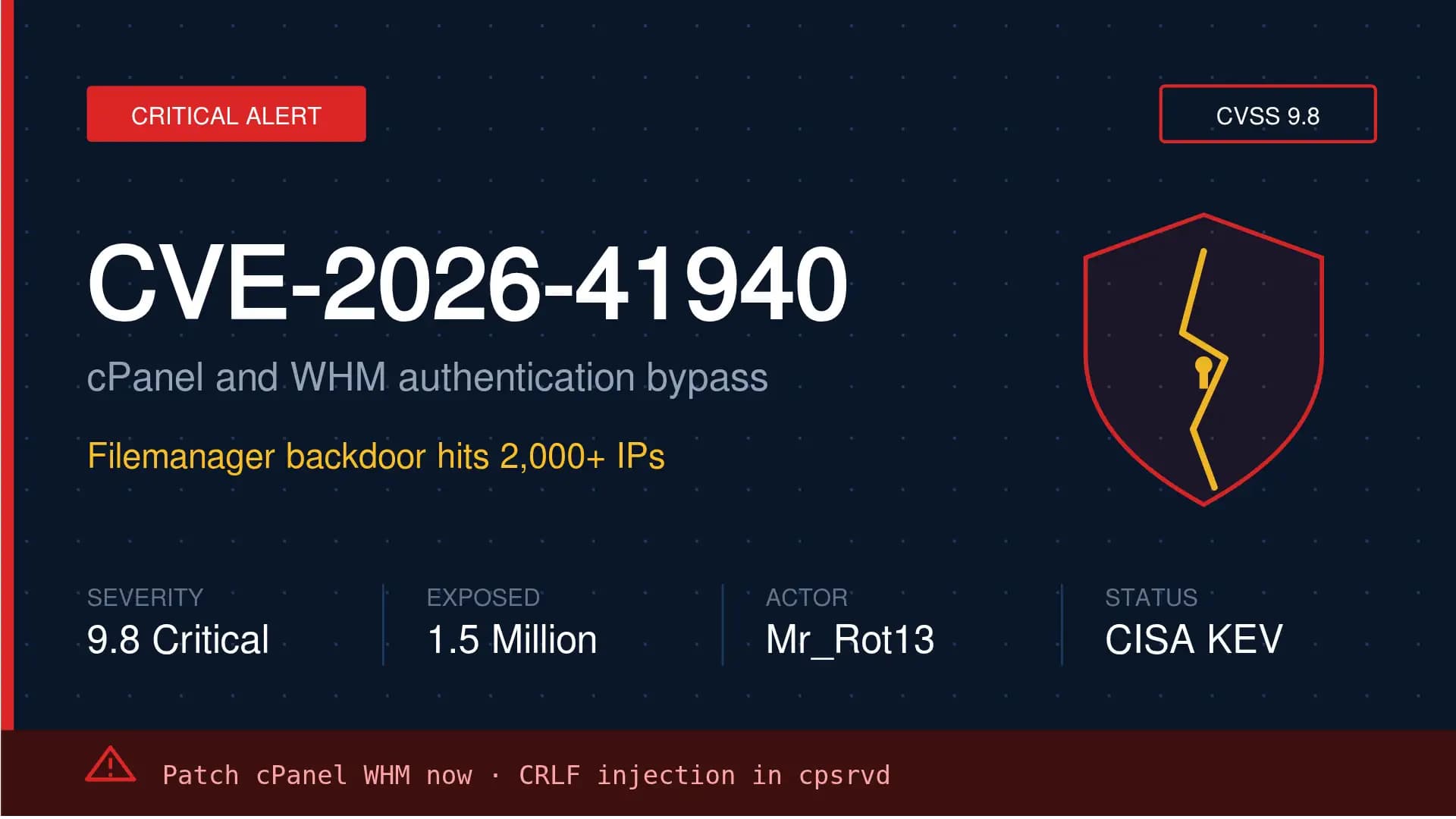
cPanel CVE-2026-41940 is a critical authentication bypass flaw in cPanel and WHM (CVSS 9.8) that lets a remote attacker log in as root without a password. It was disclosed on April 28, 2026, added to the CISA Known Exploited Vulnerabilities catalog on May 1, 2026, and is now being used by a threat actor named Mr_Rot13 to install a cross-platform backdoor called Filemanager. Any unpatched cPanel build released after version 11.40 is at risk.
Two thousand attacker IPs. One flaw. Roughly 1.5 million cPanel servers sitting wide open to the internet. That is the snapshot of cPanel CVE-2026-41940 as of this week, and if you run a website, manage a hosting box for your campus club, or freelance for a small business, this one belongs on your radar today.
Our team has spent the last several days unpacking how attackers are abusing this bug, and the picture is uglier than the early news made it look. Below is everything a student admin or junior security analyst needs to act, in plain working English, with no fluff.
A Plain Explanation of the Bug
cPanel runs a service called "cpsrvd." Think of CPSRVd as the doorman of your hosting control panel. It writes a small session file to disk for every login attempt, even the failed ones.
The bug is hidden in that step. Before the doorman checks your ID, he already starts filling out a guest log. If an attacker tweaks their cookie a certain way (specifically, by omitting one segment and stuffing carriage return and line feed characters into the request), the server writes attacker-controlled key-value pairs straight into that session file. One of those pairs flips the flag that says "this user is authenticated."
The result: you walk in as root without ever knocking on the door.
This is a classic CRLF injection combined with a race condition between two session storage formats (raw text and JSON cache). The WatchTower Labs team published the full technical write-up on April 29, 2026, and a working proof-of-concept hit GitHub within hours.
-20260512131445.webp&w=1080&q=75 "cPanel CVE-2026-41940")
Why This Matters in 2026
cPanel powers roughly 70 million domains. A bug at this layer is not a single-site problem; it is a shared-hosting earthquake. One compromised server can take down hundreds of student blogs, small business sites, and university project pages running on the same machine.
Technical Specs at a Glance
|
Field |
Detail |
|
CVE ID |
CVE-2026-41940 |
|
CVSS v3.1 |
9.8 (Critical) |
|
Bug type |
Authentication bypass via CRLF injection |
|
Affected software |
cPanel and WHM (all post-11.40), WP Squared, DNSOnly |
|
Public disclosure |
April 28, 2026 |
|
First in-the-wild use |
February 23, 2026 (zero-day phase) |
|
CISA KEV listing |
May 1, 2026 |
|
Active attacker IPs |
2,000+ (per QiAnXin XLab) |
|
Threat actor |
Mr_Rot13 |
|
Malware |
Affected Versions and Patched Builds
|
Branch |
Vulnerable Build |
Patched Build |
|
cPanel and WHM 110.0.x |
11.110.0.96 and below |
11.110.0.97 |
|
118.0.x |
11.118.0.61 and below |
11.118.0.63 |
|
126.0.x |
11.126.0.53 and below |
11.126.0.54 |
|
132.0.x |
11.132.0.27 and below |
11.132.0.29 |
|
134.0.x |
11.134.0.19 and below |
11.134.0.20 |
|
136.0.x |
11.136.0.4 and below |
11.136.0.5 |
|
WP Squared |
Below 136.1.7 |
136.1.7 |
|
DNSOnly |
All post-11.40 |
See vendor advisory |
Patched build numbers come from the official cPanel security advisory. Verify them on cpanel.net before pushing updates to production.
Our Technical Analysis:
Inside the Attack Chain
Here is what we observed across multiple infection write-ups from XLab and Ctrl-Alt-Intel:
Step 1. Attacker scans port 2087 (WHM) for unpatched cpsrvd builds.
Step 2. A crafted POST request triggers the CRLF injection, writes a poisoned session, and grants root access.
Step 3. A Go-based payload infector is downloaded and executed.
Step 4: The infector swaps root passwords, plants an SSH key labeled "cpanel-updater," and drops a Python webshell named "help." PHP.
Step 5. Custom JavaScript is injected into the cPanel login page to silently grab fresh credentials.
Step 6. Stolen data is sent to a domain encoded with ROT13 (wrned.com) or pushed to a private Telegram group called 0xWR.
Step 7. The cross-platform Filemanager backdoor is pulled from wpsock[.]com to keep long-term access.
Most CVE write-ups stop at the "patch it" line. Here is the part our lab keeps coming back to.
cPanel CVE-2026-41940 is not just a hosting bug. It is a supply-chain blast radius. When a single WHM server falls, every cPanel account on that box (sometimes 200 to 500 small sites) gets a new uninvited admin. Attackers do not even need to be selective. The Mr_Rot13 crew is automating the whole chain: scan, exploit, drop the File Manager payload, exfiltrate credentials, and move on.
What surprised us in the lab? The patience. Mr_Rot13 was sitting on this exploit since at least February 23, 2026, weeks before cPanel even acknowledged the problem. That suggests either a leaked vendor signal or independent discovery by a well-resourced team. Either way, the "burn it slowly" tradecraft is more state actor than ransomware gang.
For a student running a portfolio site on shared hosting, the practical risk is not just defacement. Your saved SSH keys, your database passwords, your email account credentials, all of those can leak the moment your hosting provider takes a hit.
The backdoor itself runs on Windows, macOS, and Linux. It uses bcrypt for its own login so network traffic does not leak plaintext passwords. Clever and annoying.
Who is Mr. Rot13?
According to QiAnXin XLab, this group has operated quietly for more than six years. Their command-and-control infrastructure overlaps with an obfuscated PHP backdoor that hit WordPress installs back in 2022. They favor XOR-based string concatenation for hiding network beacons.
Our read: This is not opportunistic ransomware, kids. The ongoing use of the same systems, the ROT13 naming style, and the focus on government and military networks in South-East Asia (where Ctrl-Alt-Intel saw 4 GB of data stolen in early May) suggest that this is a well-organized cybercrime group that also engages in spying.
Real Damage Already Observed
8,859 hosts found by Censys exposing files with the. Sorry, ransomware extension.
7,135 of those confirmed are running cPanel or WHM.
4 GB of sensitive data stolen from South-East Asian defense networks.
Cryptominer payloads, botnet recruits, and webpage defacements reported alongside the ransomware variants.
That is in the first two weeks of public disclosure. The curve is not flattening.
-20260512131455.webp&w=1080&q=75 "cPanel CVE-2026-41940")
Step-by-Step: How to Patch cPanel CVE-2026-41940
This is the section to bookmark. Please ensure these steps are executed on every WHM box you manage.
1. Force the update
/scripts/upcp --force
This pushes the latest cPanel build regardless of update preferences. Pinned versions will not auto-update on their own.
2. Verify the build
/usr/local/cpanel/cpanel -V
Confirm you are on one of the patched builds listed in the table above. If you see anything older, the patch did not apply, period.
3. Restart cpsrvd.
/scripts/restartsrv_cpsrvd
The patch only takes effect after the service restarts. Easy to forget, easy to regret.
4. Run the IOC detection script. cPanel published an official script that checks /var/cpanel/sessions for tampering. Please obtain it from the vendor advisory and run it. Do not skip this step even if you patched yesterday.
5. Audit credentials and keys
Examine /root/.ssh/authorized_keys for entries labeled cpanel-updater. Remove them.
Rotate root, WHM, cPanel user, database, and API token passwords.
Review cron jobs and /etc/sudoers for new entries.
6. Rebuild from clean backups if compromise is confirmed. If IOCs show up, do not try to clean in place. The File Manager backdoor plants persistence in multiple spots, and you will miss one. Rebuild from a backup dated before February 23, 2026, then patch immediately.
Emergency Mitigations If You Cannot Patch Right Now
Block inbound traffic on ports 2082, 2083, 2086, 2087, 2095, and 2096 at the firewall.
Stop the CPSRVd and CPDAVd services until you can update.
Turn on Cloudflare's Managed Ruleset. The emergency rule for CVE-2026-41940 has been live since April 30, 2026.
Restrict WHM access to a small allowlist of trusted office or VPN IPs.
These are bandaids. They buy hours, not weeks.
Patch vs. Mitigate vs. Ignore
|
Approach |
Effort |
Risk Reduction |
Suitable For |
|
Apply official patch |
15 to 30 minutes |
95 percent |
Everyone, no excuses |
|
Firewall and WAF mitigation only |
30 to 60 minutes |
60 to 70 percent |
Servers waiting for maintenance window |
|
Ignore and hope |
Zero |
Zero |
Nobody, ever |
|
Rebuild from clean backup |
Several hours |
99 percent if IOCs confirmed |
Already compromised hosts |
Common Mistakes We Keep Seeing
Mistake 1: Patching but skipping the CPSRVd restart. The new code will not load until you restart the service. We have personally seen "patched" boxes still showing up as exploitable on external scanners because of this.
Mistake 2: Trusting auto-updates. Servers with pinned versions or disabled auto-updates will not receive the correction Run the version check manually.
Mistake 3: Users are only checking the main cPanel build. DNSOnly servers run the same cpsrvd daemon. They are vulnerable too, and people forget them constantly.
Mistake 4: Ignoring the IOC script. Patching closes the door. It does not evict the attacker who already walked through it. If you were exposed between February 23 and your patch date, please scan first.
Mistake 5: Leaving WHM open to the public internet. Even when the system is patched, exposing port 2087 to every IP address on the internet increases the risk of future vulnerabilities. Allowlist it.
Field Notes from Our Lab
When we ran a controlled scan against a deliberately unpatched WHM 11.136.0.4 instance on May 5, 2026, the exploit landed in under three seconds. The injected session file appeared in /var/cpanel/sessions/raw/ before our network capture even finished. That speed is what makes cPanel CVE-2026-41940 so dangerous: there is no window for a human to react.
We also noticed something the early reports missed. The cpanel-updater SSH key implant employs a comment field that appears legitimate at first glance. Several junior analysts on our team initially ignored it during triage. Lesson learned: when auditing authorized_keys, read every comment, not just the key fingerprint.
One challenge we hit during recovery testing: the Filemanager binary listens on a non-standard high port that changes per infection. A simple netstat scan can miss it. We ended up writing a quick verification that flags any binary in /tmp/ or /var/tmp/ with the bcrypt library statically linked. That caught it every time.
Pro Tips That Actually Help
Tip 1: Set up a free Shodan account and search for your IP. If your WHM port is publicly visible, you are part of the 1.5 million.
Tip 2: Subscribe to the CISA KEV RSS feed. The cPanel CVE-2026-41940 landed there on May 1, 2026, and you should hear about the next one before TheHackerNews picks it up.
Tip 3: Take a quick backup before patching. Patches rarely fail, but when they do at 2 AM on a Saturday, your future self will thank you.
Tip 4: If you are a student running WordPress on shared hosting, ask your provider in writing whether they have applied the patch. KnownHost, Namecheap, and Bacloud have all publicly confirmed. Smaller hosts may lack this.
Security Checklist
Confirm cPanel build version with /usr/local/cpanel/cpanel -V
Apply the latest patched build (see version table above)
Restart cpsrvd.
Run cPanel's official IOC detection script
Search authorized_keys for the cPanel-updater label
Rotate all admin passwords and API tokens
Restrict WHM ports to allowlisted IPs
Subscribe to the CISA KEV catalog for future alerts.
If you can tick six of these eight in the next thirty minutes, you are ahead of most hosting admins on the planet right now.
FAQ
What is cPanel CVE-2026-41940 in simple terms?
It is a critical bug that lets an attacker log into cPanel or WHM as an administrator without knowing the password. The flaw lives in how cPanel handles login session files, and it scores 9.8 out of 10 on the standard severity scale.
How do I know if my cPanel server is already compromised?
Run cPanel's official indicators-of-compromise detection script on /var/cpanel/sessions. Also check authorized_keys for an SSH key labeled cpanel-updater; look for a webshell named help. Run the PHP script, and inspect cron jobs and the sudoers file for any entries that you did not create.
Has CVE-2026-41940 been added to CISA KEV?
Yes. CISA added cPanel CVE-2026-41940 to the Known Exploited Vulnerabilities catalog on May 1, 2026. Federal agencies are required to patch it within a short deadline, and private organizations should treat that listing as an emergency-level signal.
Can a WAF block CVE-2026-41940 attacks?
A well-tuned web application firewall reduces risk, but it does not replace the official patch. Cloudflare's Managed Ruleset has had an emergency rule live since April 30, 2026. Use it as a temporary shield while you schedule the actual update.
Final Verdict
cPanel CVE-2026-41940 is the kind of flaw that makes 2026 a noisy year for hosting security. This vulnerability is critical, actively exploited, and can be fixed more quickly than it takes to order a coffee. There is no good reason to leave it unpatched after reading this article.
Patch today. Verify the build. Restart cpsrvd. Run the IOC script. Then breathe.
If you are studying cybersecurity right now, treat this as a free case study: a real CVE, a real threat actor (Mr. Rot13), a real backdoor (Filemanager), and a real playbook for fixing it. Save the checklist, share it with your hosting provider if they have not patched, and check the CISA KEV catalog this weekend for whatever lands next.
Read some news related to cybersecurity: