What exactly happened in the Kash Patel email hack FBI reward case, and why does it matter right now?
The Kash Patel email hack FBI reward situation has quickly become one of the most talked-about cybersecurity incidents, especially after official confirmation from authorities. The FBI acknowledged that a personal email account linked to Kash Patel was accessed by threat actors. However, they also clarified something important. No government data was compromised.
This changes the narrative. What initially looked like a major national security breach now appears more controlled, but still serious enough for the US to offer a large reward for information on the hackers involved.
In the past, any mention of a government figure being hacked would immediately trigger panic. People assumed classified data leaks, intelligence exposure, and large-scale risk.
Now things are a bit different.
Old way → Panic and speculation
New way → Verified investigation and transparency
Result → Better understanding of real risk vs perceived threat
The Kash Patel email hack FBI reward case shows how official confirmation can reshape public understanding. It is not just about a hack. It is about how cyber threats are handled, communicated, and controlled.
Key Takeaways
- FBI confirmed access to Kash Patel’s personal email account
- No government or classified information was exposed
- The compromised data appears to be older, not recent
- A hacker group linked to Iran claimed responsibility
- The US is offering up to $10 million for information
- The case highlights growing cyber threats targeting individuals
- It reinforces the importance of personal email security
Quick Summary
The Kash Patel email hack FBI reward case involves unauthorized access to a personal Gmail account. Authorities confirmed the breach but emphasized that sensitive government systems remained untouched. The reward reflects the seriousness of tracking foreign-linked cyber groups.
What is the Kash Patel Email Hack FBI Reward Case?
At its core, the Kash Patel email hack FBI reward incident is about unauthorized access to a personal email account belonging to a high-profile individual.
The FBI publicly stated that malicious actors targeted Patel’s personal email. They also confirmed that the data involved was historical in nature and did not include government-related information.
This distinction matters. A personal email breach is very different from a government system breach.
Why This Happened
Cyber attackers often target individuals rather than systems. It is usually easier.
In this case, the attackers appear to have focused on a personal Gmail account. That suggests a shift in strategy. Instead of attacking secure government infrastructure, threat actors may look for weaker entry points.
There is also context. Reports indicate that similar accounts may have been targeted earlier as part of broader campaigns linked to political activities.
So this was not random. It was part of a pattern.
Who is Behind the Attack
The group claiming responsibility is known as Handala.
They describe themselves as a hacktivist group with political motives. However, many analysts believe the group operates as a front for a government-linked entity.
Authorities have associated this group with Iran’s intelligence structure.
That raises the stakes. This is no longer just about hackers. It touches geopolitical tensions.
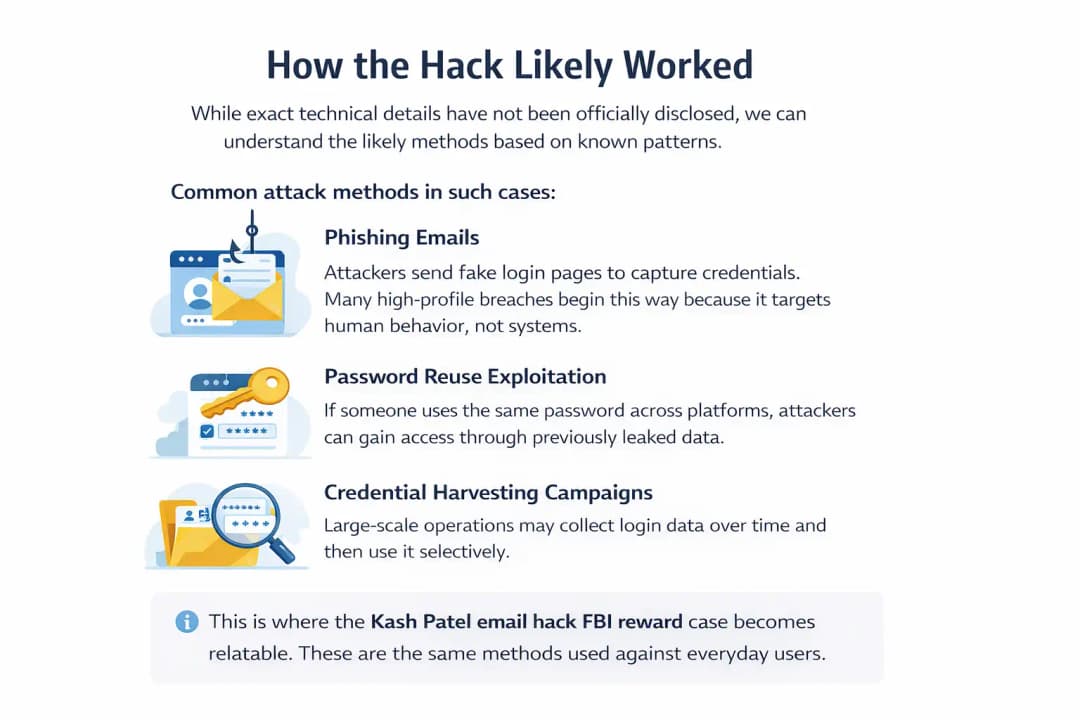
How the Hack Likely Worked
While exact technical details have not been officially disclosed, we can understand the likely methods based on known patterns.
Common attack methods in such cases:
- Phishing emails
Attackers send fake login pages to capture credentials. Many high-profile breaches begin this way because it targets human behavior, not systems. - Password reuse exploitation
If someone uses the same password across platforms, attackers can gain access through previously leaked data. - Credential harvesting campaigns
Large-scale operations may collect login data over time and then use it selectively.
This is where the Kash Patel email hack FBI reward case becomes relatable. These are the same methods used against everyday users.
What Was Actually Compromised
This is where clarity is important.
The FBI confirmed that:
- The account was personal
- The data was not recent
- No government information was involved
So while the breach is serious, it is not catastrophic.
There were claims about sensitive files, but some reports suggest those claims may be exaggerated or not fully verified.
This highlights a key issue in cybersecurity reporting. Not everything claimed by attackers is accurate.
Why the US is Offering $10 Million
The reward is not just about this one incident.
The US government has a long-standing program that offers financial incentives for information on cybercriminals targeting critical systems.
In this case, the reward specifically mentions groups linked to foreign operations, including the one believed to be behind this attack.
This tells you something important.
The focus is not just on punishment. It is on intelligence gathering.
Real-World Example: Before vs After
Imagine this.
Before awareness of such threats, a professional might use a simple password for personal email. No multi-factor authentication. No monitoring.
After incidents like the Kash Patel email hack FBI reward, behavior changes.
- People enable two-factor authentication
- Organizations train employees on phishing
- Email security becomes a priority
The difference is not just technical. It is behavioral.
Who is Affected
This type of incident affects multiple groups.
Individuals
Anyone using personal email accounts is at risk. This case shows that even high-profile individuals are not immune.
Businesses
Companies must consider how employee accounts can become entry points for larger attacks.
Governments
Even if systems are secure, personal accounts can still create indirect risks.
Benefits and Limitations of the Current Response
There is a clear benefit to how this case was handled.
Authorities communicated early and clarified the scope of the breach. That reduces misinformation.
However, there are limitations.
Not all details are public. And without full technical disclosure, some uncertainty remains.
This is common in cybersecurity cases. Transparency must be balanced with security.
What You Should Do Now
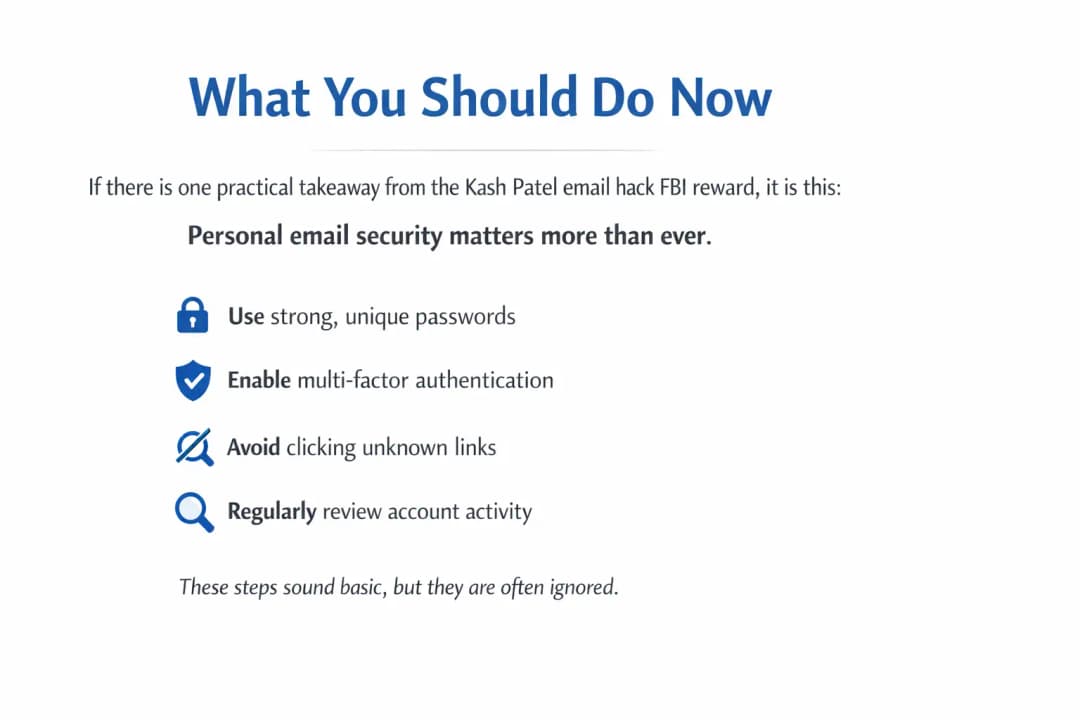
If there is one practical takeaway from the Kash Patel email hack FBI reward, it is this.
Personal email security matters more than ever.
- Use strong, unique passwords
- Enable multi-factor authentication
- Avoid clicking unknown links
- Regularly review account activity
These steps sound basic, but they are often ignored.
Frequently Asked Questions
Was government data leaked?
No. Authorities confirmed that no government information was compromised.
Who hacked the account?
A group called Handala claimed responsibility, but some claims remain unverified.
Why is there a $10M reward?
It is part of a broader effort to identify and track foreign cyber threat actors.
Was the email account secure?
It was a personal Gmail account, not part of government infrastructure.
Conclusion
The Kash Patel email hack FBI reward case is not just about one breach. It is a reminder.
Cyber threats are evolving. Attackers are no longer focusing only on systems. They are targeting people.
And sometimes, the weakest link is not technology. It is human behavior.
If there is one takeaway, it is
simple.
Security starts with you.
Trusted Source
- FBI official statement summary via cybersecurity reporting
Insight Box
What this case teaches:
- Personal accounts can be high-value targets
- Not all breaches lead to critical damage
- Verification matters more than headlines
Recommendation:
Treat your personal email like a critical asset. Because in today’s world, it
is.