Apple AI Discovered WebKit Vulnerabilities: What Really Happened in June 2026
Content Summary
| Item | Detail |
|---|---|
| What happened | Apple released iOS 26.5.2, iPadOS 26.5.2, macOS Tahoe 26.5.2, and Safari 26.5.2 on June 29, 2026 |
| Total vulnerabilities patched | Nearly 30, spanning WebKit, Kernel, WebRTC, libxslt, Web Extensions, WebKit Canvas, and IOGPUFamily |
| AI discovered WebKit flaws | Four: CVE-2026-43707, CVE-2026-43716, CVE-2026-43745, CVE-2026-43715 |
| Who found them | OpenAI Codex Security for three, Anthropic researchers Milad Nasr and Nicholas Carlini working with Claude for one |
| Exploitation status | None of the patched flaws have been reported as actively exploited in the wild |
| Why it matters | Apple told Reuters it is shortening its patch release window because AI tools can speed up how fast an exploit gets built once a fix is public |
If you own an iPhone, an iPad, or a Mac, this update affects you directly, and the story behind it says a lot about where cybersecurity is heading in 2026.
What is Going On With Apple AI Discovered WebKit Vulnerabilities
So here is the question everyone in the security world is asking right now. Can artificial intelligence find software bugs faster than the people who built the software in the first place? Based on what just happened with Apple, the answer is starting to look like yes, and that is changing how fast vendors have to move.
On June 29, 2026, Apple quietly pushed out a fairly large batch of security fixes across its entire ecosystem. iOS 26.5.2, iPadOS 26.5.2, macOS Tahoe 26.5.2, and Safari 26.5.2 all dropped on the same day. Buried inside that update were nearly 30 individual fixes, and four of them stood out for a very specific reason.
They were not found by a human sitting at a keyboard combing through code line by line. They were found with help from AI security tooling, specifically OpenAI's Codex Security and Anthropic's Claude.
I have been tracking Apple AI discovered WebKit vulnerabilities coverage across several outlets this week, and most of it reads like a copy paste of Apple's own changelog. A CVE number, a one line description, and that is it. What gets left out is the part that actually matters to anyone running a security team or trying to understand what these bugs do under the hood. So let's actually walk through it properly.

The Four AI Found Bugs, One By One
WebKit is the rendering engine that powers Safari and every other browser on iOS, since Apple requires all iOS browsers to use it under the hood. That single fact is why a WebKit bug carries weight far beyond just Safari users. When something goes wrong in WebKit, it potentially touches every browsing app on every Apple device.
CVE-2026-43707 turned out to be a type confusion issue. In plain terms, that means the WebKit engine momentarily treated a piece of memory as if it were a different kind of object than it actually was. When that happens, an attacker who controls the web content being processed can sometimes manipulate how that memory gets interpreted, which opens the door to memory corruption. Apple credited this one to OpenAI Codex Security researcher Amy Burnett, and fixed it with what Apple describes as improved checks.
CVE-2026-43716 was a bit murkier on the technical description side, listed only as an issue that could cause an unexpected Safari crash. What is interesting here is that it was independently flagged by multiple parties, including researchers Tuan and Duc from Calif.io, Evan Lambert, and again OpenAI Codex Security's Amy Burnett. When several independent researchers, human and AI assisted, land on the same bug around the same time, that is a meaningful signal about how predictable certain classes of WebKit bugs have become to modern tooling.
CVE-2026-43745 was an out of bounds write problem. Think of it like a program trying to write data into a box that is too small, so the extra data spills out and overwrites whatever happens to be sitting next to it in memory. That neighboring memory could hold important pointers or control data, so overwriting it can crash Safari or, in a worse case scenario, give an attacker a foothold to manipulate program behavior. Apple fixed this through improved input validation and credited OpenAI Codex Security's Amy Burnett along with Khai Tran.
CVE-2026-43715 is the one that has gotten the most attention, and for good reason. It is a use after free vulnerability, and it is the bug specifically credited to Anthropic, named researchers Milad Nasr and Nicholas Carlini, working alongside Claude. A use after free bug happens when a program frees up a chunk of memory it no longer needs, but somewhere a pointer still points back to that now empty space.
If an attacker can sneak fresh, malicious data into that freed memory before the dangling pointer gets used again, the program ends up trusting attacker controlled data without realizing it. That is a classic recipe for memory corruption, and in the worst cases, a path toward remote code execution. Apple addressed it through what it calls improved memory management.
What makes CVE-2026-43715 stand out from a credibility standpoint is the credit structure itself. The other three bugs are attributed purely to an AI security product, OpenAI Codex Security. This one names actual human researchers working in tandem with Claude. That distinction matters if you care about how these tools are actually being used, since it points to a human in the loop model rather than a fully autonomous one.
It Was Not Just Four Bugs
Here is where a lot of coverage falls short. Apple did not just patch four AI found WebKit bugs that day, it patched close to 30 issues across its entire stack, and ignoring the rest leaves a very incomplete picture.
On the kernel side, Apple fixed three separate issues. CVE-2026-43724 could let a malicious app crash the system or write to kernel memory, and was credited to Hyunwoo Kim, the same researcher known for previously discovering the Dirty Frag exploit in the Linux kernel.
CVE-2026-43722 could leak sensitive kernel state, credited jointly to Feng Xue and XGPT of ThreatBook along with Hyunwoo Kim again. CVE-2026-39868 involved kernel memory corruption and pulled in credit from Positive Technologies, Baidu Security, and STAR Labs SG, three well established names in vulnerability research.
There was also a meaningful set of sandbox escape and cross origin data leak issues inside WebKit itself, separate from the four AI discovered bugs. CVE-2026-43725 could let a malicious website break out of its sandbox and touch restricted content it should never see.
CVE-2026-43735 and CVE-2026-43700 both dealt with cross origin data exfiltration, where a malicious site could potentially read data it has no business accessing from another site open in the same browser. CVE-2026-43720, a use after free bug in WebKit Canvas, and CVE-2026-43721, a clipboard hijacking issue tied to flawed state management, rounded out the WebKit specific patches.
WebRTC, the protocol that powers real time video and voice calls inside browsers, picked up four fixes of its own, including out of bounds access and use after free issues, with researcher Nan Wang credited on several. The libxslt component and Web Extensions framework each got their own double free and use after free fixes too.
One detail worth flagging because it almost never makes it into coverage. CVE-2026-43663, a separate WebKit fix, lists credit that includes the phrase "Using GLM From Z.AI" alongside the DEVCORE Research Team and several independent researchers. That tells you something bigger is happening here.
It is not just Anthropic and OpenAI poking at WebKit. Multiple AI labs and their tooling are now independently converging on the same kinds of bug classes inside the same codebase, often around the same release window.
Why Apple is Suddenly Moving Faster
Apple told Reuters directly that it is shrinking the time between when a fix becomes public and when it actually reaches your device. That sentence sounds simple but it carries real weight if you understand how patch cycles traditionally work.
Historically, there has been a known gap problem in software security. Once a vendor publishes a patch, attackers can sometimes reverse engineer the difference between the old code and the new code to figure out exactly what was broken, then build a working exploit before everyone has actually installed the fix. That gap used to take attackers days or weeks to close. Apple's stated concern is that modern AI coding and security tools can now compress that same process down to a matter of hours.
That is genuinely a different threat model than what the industry was planning around even two years ago. If the time between patch release and exploit availability shrinks to hours, then how fast an organization can roll out an update becomes just as important as whether the patch exists at all. This is not a hypothetical concern anymore, it is shaping how Apple, one of the largest software vendors on the planet, is now structuring its own release cadence.
How These AI Tools Actually Find Bugs
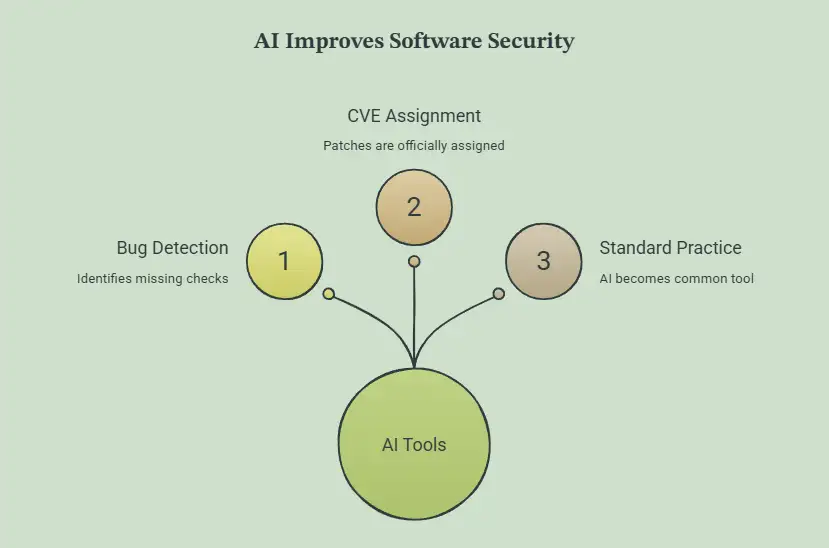
People sometimes imagine AI bug hunting as some kind of magic black box, but the mechanics are fairly grounded. These systems generally combine large scale automated fuzzing, which means throwing huge volumes of malformed or unexpected input at a program to see what breaks it, with a model's ability to read and reason about source code the way an experienced engineer would, spotting patterns like a missing bounds check or a pointer that gets used after it has already been released.
Anthropic has actually been running this kind of work at scale for a while now, not just on Apple's WebKit. Through its coordinated vulnerability disclosure program, the company has used a Claude model to scan open source software broadly since February 2026. As of the most recent published figures, that effort had surfaced over 1,500 candidate findings across more than 280 open source projects, with dozens already turned into officially patched, CVE assigned fixes. The CVE-2026-43715 credit on Apple's WebKit is one visible piece of a much larger ongoing program, not a one off event.
OpenAI's Codex Security effort appears to be running a parallel track, focused enough on WebKit specifically to land credit on three separate CVEs in this single Apple release alone. Put together, what you are watching is the early stage of AI assisted vulnerability research becoming a standard part of how major tech companies harden their products, alongside traditional bug bounty researchers and dedicated firms like DEVCORE, STAR Labs, and Talence Security, all of whom also appear in this same patch batch.
Severity, Scoring, and What is Actually Confirmed
A quick honesty note here, because a lot of articles on this topic quietly make up numbers that were never published. Apple's security advisories for this release do not include public CVSS scores for these vulnerabilities. So if you see a piece claiming a specific CVSS rating for CVE-2026-43715 or any of the other three, treat that figure with suspicion unless it links back to an actual scoring source, because Apple itself did not publish one in this advisory.
What Apple did confirm clearly is that none of the patched vulnerabilities, including all four AI discovered WebKit bugs, have been reported as actively exploited in the wild. That is good news, and it means this round of patches represents proactive prevention rather than damage control after an active attack campaign.
In terms of real world impact if these bugs had gone unpatched, here is the breakdown by category:
- Process crash issues, like several of the bugs above, mainly create a denial of service style annoyance where Safari or a system process unexpectedly quits
- Memory corruption bugs, including the type confusion and use after free issues, carry a higher ceiling of risk because they can potentially be chained into code execution by a sufficiently motivated attacker
- Sandbox escape issues, like CVE-2026-43725, are particularly serious because WebKit's sandbox exists specifically to contain damage from malicious web content, and breaking out of it removes that containment layer entirely
What You Should Actually Do Right Now
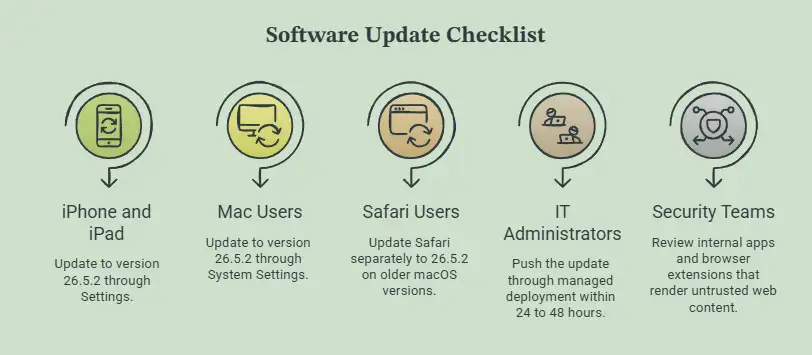
If you are reading this and have not updated yet, here is the practical checklist.
- iPhone and iPad users on iOS or iPadOS 26.x should update to version 26.5.2 immediately through Settings, General, Software Update
- Mac users running macOS Tahoe should update to 26.5.2 through System Settings, General, Software Update
- Safari users on older macOS versions like Sonoma or Sequoia need to update Safari separately to 26.5.2, since Safari ships independently of the OS on those versions
- IT and MDM administrators managing fleets of Apple devices should push this update through managed deployment within 24 to 48 hours rather than waiting for the next scheduled cycle, given Apple's own stated rationale around shrinking exploit windows
- Security teams should take this moment to review any internal apps or browser extensions that render untrusted web content, since several of the patched bugs specifically involve processing maliciously crafted web content
What This Means If You Run a Security Team
The patch gap problem Apple is responding to is not unique to Apple. Any organization that relies on vendor patches as its primary line of defense needs to seriously rethink how fast it can move from patch release to full deployment. If AI tooling really is compressing exploit development down to hours in some cases, then a patch validation and rollout process that takes a week is no longer good enough on its own.
This is exactly the kind of gap that structured vulnerability management closes, by giving teams visibility into which systems are exposed, how critical each exposure actually is, and how to prioritize rollout without breaking production systems in the rush. Pairing that with ongoing penetration testing and ongoing cyber threat intelligence monitoring gives a far more realistic picture of risk than just trusting that "we installed the update" is the end of the story.
For organizations managing a large mobile device fleet, this also reinforces the value of dedicated mobile security and threat defense, since a meaningful share of these WebKit bugs are reachable simply by a device rendering a malicious webpage, something that happens constantly across a typical workforce. And for teams responsible for the broader attack surface beyond just patching, ongoing attack surface management helps catch unmanaged or forgotten devices before they become the weak link nobody noticed.
Hoplon Insight Box
From where we sit, the real story here is not that four bugs got found by AI, it is that the discovery to disclosure to patch timeline is visibly shrinking across the entire industry, and most organizations are not yet structured to move at that pace.
Our recommendation is simple. Treat any Apple security advisory, especially one explicitly tied to AI assisted discovery, as a same week priority rather than a routine monthly patch item.
If your current patch management process measures rollout in weeks, this is the moment to compress that timeline, and a proper vulnerability management workflow combined with regular cyber resilience assessment is the fastest way to get there without guessing at your own exposure.
A Few Things People Get Wrong About This Story
There is a misconception going around that AI found bugs are somehow more dangerous than human found bugs. That is not really accurate. The underlying vulnerability classes here, type confusion, use after free, out of bounds writes, are decades old categories of memory safety bugs. What is genuinely new is the speed and scale at which they are being found, not their fundamental nature.
Another misconception worth correcting is the idea that this means AI is now finding bugs that no human ever could have found. In reality, several of these same bugs, like CVE-2026-43716, were independently flagged by multiple human researchers around the same time as the AI tooling. What seems to be happening is convergence, where AI assisted research and traditional research are increasingly landing on the same weak spots, just faster and at higher volume than before.
Frequently Asked Questions
What is CVE-2026-43715 and why is everyone talking about it? It is a use after free vulnerability in WebKit that Apple patched in its June 29, 2026 update. It is notable because it was discovered through a collaboration between named Anthropic researchers, Milad Nasr and Nicholas Carlini, and Claude, rather than being attributed to AI tooling alone.
Did Anthropic or OpenAI find more of Apple's vulnerabilities? OpenAI Codex Security received credit on three of the four AI discovered WebKit bugs, CVE-2026-43707, CVE-2026-43716, and CVE-2026-43745. Anthropic, through Claude working with human researchers, received credit on CVE-2026-43715.
Were any of these vulnerabilities actively exploited before the patch? No. Apple's advisory states that none of the vulnerabilities patched in this release, including the four AI discovered WebKit bugs, were known to be actively exploited in the wild at the time of disclosure.
What versions actually fix these bugs? iOS 26.5.2, iPadOS 26.5.2, macOS Tahoe 26.5.2, and Safari 26.5.2, all released on June 29, 2026.
Why is Apple releasing patches faster than it used to? Apple told Reuters it is responding to growing evidence that AI coding and security tools can dramatically shorten the time it takes attackers to turn a public patch into a working exploit, sometimes down to a matter of hours.
What does a use after free vulnerability actually mean in simple terms? It happens when a program frees up a piece of memory it no longer needs, but a reference to that memory still exists somewhere in the code. If an attacker manages to put their own data into that freed space before the dangling reference gets used again, the program can end up trusting malicious data without knowing it.
How is AI actually finding these software bugs faster than people? By combining large scale automated testing, where huge volumes of unusual input get thrown at software to see what breaks, with a language model's ability to read and reason through source code looking for the kinds of patterns experienced engineers learn to recognize, like a missing bounds check or a pointer used after it was already freed.
Official References
Apple Security Releases page, support apple About the security content of macOS Tahoe 26.5.2, support apple About the security content of Safari 26.5.2, support apple About the security content of iOS 26.5.2 and iPadOS 26.5.2, support apple Reuters reporting on Apple's statement regarding accelerated update timelines Anthropic's coordinated vulnerability disclosure dashboard
If your organization is still treating monthly patch cycles as good enough, this is your sign to change that before an AI assisted exploit beats you to it. Reach out to Hoplon InfoSec to set up a proper vulnerability management program and a full cyber resilience assessment so your patch timeline is measured in hours, not weeks.




-20260925120840.webp&w=3840&q=75)