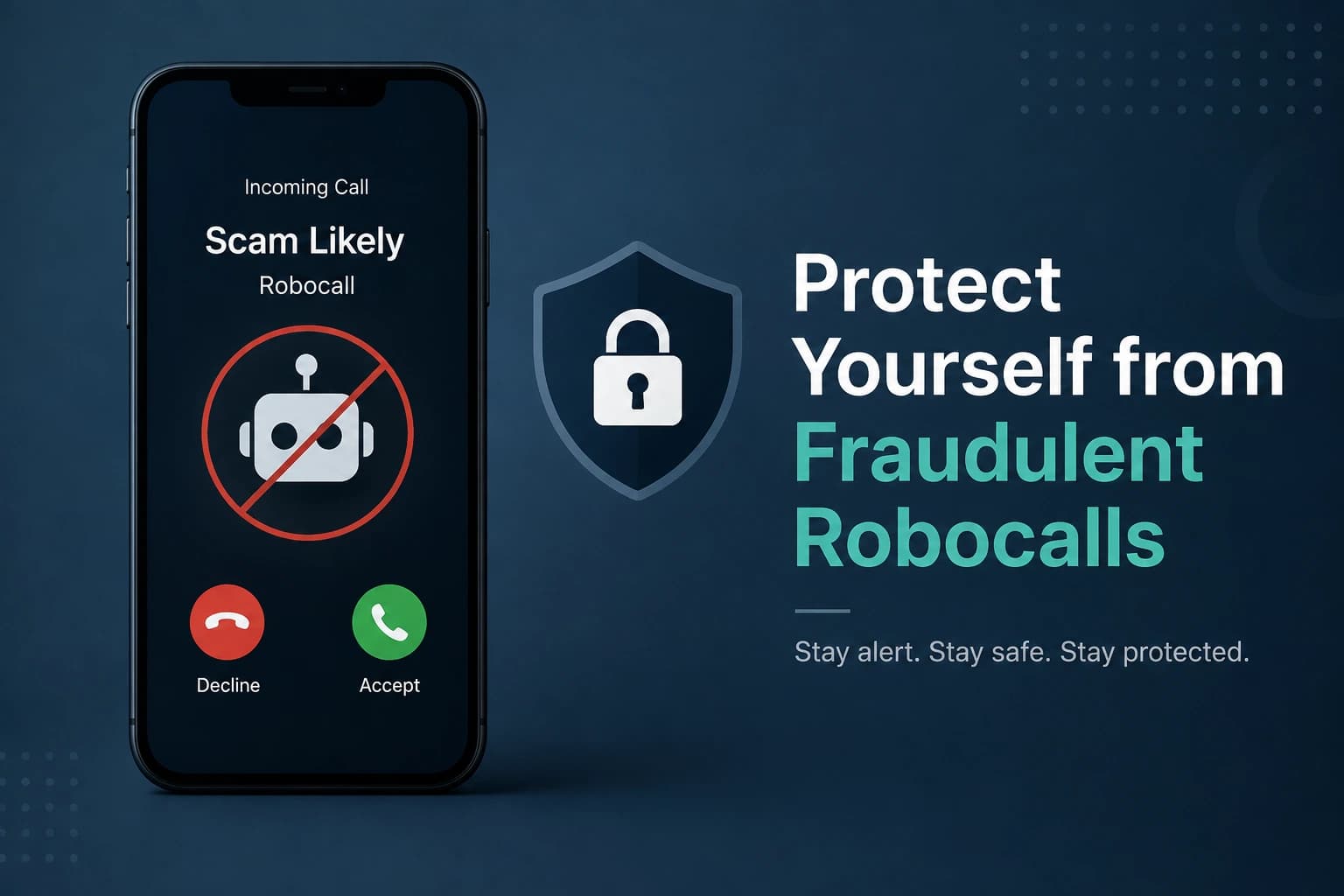
How to Protect Yourself from Fraudulent Robocalls and Caller Scams
Fraudulent robocalls and caller scams are easier to handle when you follow one rule: never let an unexpected caller control how you verify them.
If a call asks for money, passwords, verification codes, account information, remote access, or an urgent decision, end the conversation. Then contact the person or organization independently using a phone number, app, website, statement, or contact record you already trust.
Caller ID alone is not proof. Scammers can spoof names and phone numbers, including local numbers and numbers associated with legitimate organizations. These tactics are part of a wider family of social engineering attacks that exploit trust, authority, fear, or urgency rather than relying only on technical vulnerabilities.
A safe response usually looks like this:
Do not provide sensitive information.
Do not press buttons in an unexpected robocall.
End the call.
Verify the request through a separate trusted channel.
Block or filter the caller when appropriate.
Report suspected fraud.
Act quickly if you already sent money or exposed an account.
A Robocall Is Not Automatically a Scam
A robocall uses an automated or prerecorded message. Some automated calls can be legitimate. Others violate telemarketing rules or are used as part of fraud schemes.
USAGov's guidance on robocalls and phone scams explains how consumers can deal with telemarketers, unwanted calls, and suspected scam calls in the United States.
The important question is therefore not simply:
“Is this a robocall?”
Ask:
“Is this caller asking me to do something I can safely verify?”
That distinction keeps you from trusting or rejecting a call solely because it is automated.
Warning Signs That a Phone Call May Be a Scam
Phone scams use different stories, but several behaviors deserve immediate caution. Similar manipulation also appears across different phishing attack types, including voice phishing, fake login requests, SMS scams, and executive impersonation.
| Warning sign | Safer response |
|---|---|
| Caller demands immediate payment | End the call and verify independently |
| Caller threatens arrest or another severe consequence | Do not pay; contact the agency independently |
| Caller asks for a verification code | Do not share it |
| Caller asks for a password or PIN | End the call |
| Caller tells you to keep the situation secret | Verify with another trusted person |
| Caller insists on gift cards, crypto, wire transfer, or payment app | Stop before paying |
| Caller says money must be moved to “protect” it | Contact your financial institution yourself |
| Caller ID shows a trusted organization but the request is unusual | Ignore caller ID as proof and verify separately |
| Familiar voice unexpectedly asks for emergency money | Contact the person using a known number |
The FTC's phone scam guidance covers common warning signs, including impersonation, pressure, suspicious payment demands, and spoofed caller IDs.
Why Caller ID Can Look Completely Legitimate
A caller can deliberately falsify the information displayed as their caller ID. This is known as caller ID spoofing.
The number might appear to belong to:
Your bank
A local business
A government agency
A nearby resident
A healthcare provider
A company executive
Someone with the same area code as you
The FCC's caller ID spoofing guidance explains that spoofing occurs when a caller deliberately falsifies caller ID information to disguise their identity.
For that reason, seeing the correct company name on your screen should not end the verification process.
If your bank appears to call about suspicious activity, for example, end the call and contact the bank through its official mobile app, the number printed on your card, or another trusted source.
What STIR/SHAKEN Can and Cannot Tell You
Phone networks use a caller-authentication framework known as STIR/SHAKEN.
Its purpose is to help validate caller ID information as calls move through supported phone networks. The FCC explains how STIR/SHAKEN caller authentication works and how it forms part of the effort to reduce illegal caller ID spoofing.
But there is an important limitation.
Caller authentication is not the same as caller trustworthiness.
A malicious caller can still use a legitimate number or find other ways to make a request appear convincing.
Think of STIR/SHAKEN as one signal within a larger defense, not as a guarantee that every authenticated call is safe.
AI Voice Cloning Makes Voice Recognition Less Reliable
A familiar voice used to feel like powerful evidence.
That assumption is becoming less safe.
AI-generated or cloned voices can be used in impersonation attempts. This means a suspicious caller might sound like:
Your child
Your parent
Your manager
Your CEO
A colleague
Another person you know
The voice itself should not be your only authentication method.
If a supposed family member calls asking for emergency money, end the call and contact that person using the number you normally use. If you cannot reach them, contact another trusted family member.
For workplaces, apply the same principle to executives and vendors.
A familiar voice asking for a wire transfer should still go through the normal approval process.
This is especially important because voice scams often overlap with other forms of social engineering scams targeting employees.

What to Do When You Receive a Suspicious Call
1. Do Not Let Urgency Make the Decision
Fraudsters often want a decision before you have time to verify their story.
An account problem that is genuine can still be investigated after you end an unexpected call.
2. Do Not Give Away Authentication Secrets
Never give an unexpected caller:
Passwords
PINs
One-time verification codes
MFA codes
Account recovery codes
Unexpected authentication requests can also appear as repeated approval prompts. Understanding how MFA fatigue attacks work can help you recognize why approving an authentication request you did not initiate is risky.
3. Hang Up Instead of Following Robocall Prompts
For suspicious or illegal robocalls, do not rely on instructions provided by the recording itself.
The FTC recommends using appropriate call blocking and call labeling options to reduce exposure to unwanted and potentially fraudulent calls.
4. Contact the Organization Yourself
Do not use:
A callback number provided by the caller
A number sent in a suspicious text
A link sent during the call
Instead, find official contact information independently.
Be particularly cautious if the caller follows up by SMS. Attackers can combine phone calls with smishing attacks designed to push you toward a fake login page, payment page, or support channel.
5. Verify the Request, Not Just the Person
A scammer may already know your name, employer, address, relatives, job title, or account provider.
Knowledge is not authentication.
Ask whether the request itself makes sense.
Would your CEO normally call you personally to bypass the payment process?
Would your bank need your login verification code?
Would a government agency demand immediate payment using a gift card?
When the request breaks the normal process, verify it separately.
Use Call Blocking and Call Labeling
Call-blocking and call-labeling tools can reduce unwanted calls before you interact with them.
Your options may include:
Carrier spam filtering
Built-in smartphone spam detection
Unknown-caller screening
Call labeling
Individual number blocking
Reputable third-party filtering services
These tools reduce exposure. They do not prove that every call allowed through is safe.
A legitimate-looking call that passes a spam filter should still be verified when it makes an unusual request.
Call filtering is only one part of mobile security. If you use your phone for email, banking, work accounts, or authentication, Hoplon Infosec's guide to protecting your phone from hackers covers broader mobile security measures.
Should You Register With the National Do Not Call Registry?
For U.S. users, registration can still be useful, but its purpose needs to be understood correctly.
The National Do Not Call Registry is intended to reduce unwanted sales calls from companies that follow telemarketing rules.
It does not technically block all phone calls, and scammers making illegal calls can ignore it.
The FTC's National Do Not Call Registry FAQs explain what registration does, which calls it covers, and its limitations.
Use the Registry as one layer, alongside filtering, independent verification, and reporting.
Report Fraudulent and Unwanted Calls
Reports can help authorities identify patterns of fraud and unwanted calls.
When possible, keep useful information such as:
Your number that received the call
The caller ID displayed
Any callback number provided
The date and time of the call
The organization or person the caller claimed to represent
What the caller requested
Even if you believe the displayed number was spoofed, it can still be useful to include the information in your report.
If you believe the call involved fraud, you can report suspected fraud to the Federal Trade Commission.
Do not continue interacting with the caller simply to collect more evidence.
What If You Already Shared Information or Sent Money?
The next action depends on what the scammer obtained.
If You Sent Money
Contact the bank, card issuer, payment app, gift-card company, wire-transfer service, or other payment provider immediately.
Ask whether the payment can be stopped or reversed. Recovery may not always be possible, so acting quickly matters.
If You Shared a Password
Change the password immediately through the real service.
If you reused that password elsewhere, change those accounts as well.
Use a unique password rather than another variation of the compromised one. Hoplon Infosec's guide on how to create a strong password explains practical password-security habits.
Then review your authentication settings. Understanding the difference between 2FA and MFA can help you choose stronger protection for important accounts.
If You Shared a Verification Code
Contact the affected service immediately because the code may have been used to access or change the account.
Review:
Recent sign-ins
Connected devices
Active sessions
Password changes
Recovery email addresses
Recovery phone numbers
MFA settings
A stolen code can sometimes be part of a wider account-takeover attempt. Hoplon's guide to identity attacks and prevention provides additional context on protecting accounts and identities from attacker misuse.
If Identity Information Was Exposed
If a caller obtained information that could be used for identity theft, use the official recovery process at IdentityTheft.gov.
The site provides step-by-step guidance for reporting identity theft, limiting damage, and creating a recovery plan.
Businesses Need a Phone-Verification Process, Not Just Awareness
Caller scams become more dangerous inside businesses because employees can authorize payments, reset accounts, disclose data, or provide access.
Attackers may pretend to be:
Executives
IT support
Banks
Suppliers
Customers
Payroll staff
Service providers
The safest response is to remove important decisions from a single unexpected phone conversation.
Organizations should consider controls such as:
Independent callback procedures
Approved internal contact directories
Two-person approval for sensitive payment changes
Separate verification for new banking instructions
Rules against sharing MFA codes
Clear escalation paths for suspicious requests
Employee social-engineering training
A simple way to report suspicious calls
The principle is straightforward:
A phone call can start a request. It should not automatically authenticate a high-risk request.
For organizations that need to turn these practices into documented governance, risk, training, and response processes, Hoplon Infosec's Virtual CISO services provide a relevant path to broader security leadership and risk-management support.
When Professional Security Help Makes Sense
Most consumers do not need a cybersecurity consultant simply because they receive a robocall.
Professional help becomes more relevant when the problem affects an organization, especially when:
Employees are repeatedly targeted
Executive impersonation is occurring
Payment procedures can be changed by phone
Attackers obtained business credentials
An account compromise followed the call
Sensitive business information was exposed
Existing reporting and escalation processes are unclear
The organization needs security-awareness or incident-response procedures
A qualified provider should first understand what happened, identify what was exposed, help contain any resulting compromise, and improve the process that allowed the scam to progress.
It should not promise that all fraudulent calls can be prevented.
Businesses without enough internal security expertise can also explore Hoplon Infosec's on-demand cybersecurity experts when specialist support is needed for security planning, investigation, or risk management.
The Simple Rule to Remember
You cannot control who calls.
You can control what happens next.
Do not trust a caller because the number looks familiar. Do not trust an urgent story because the caller knows personal details. Do not trust a voice simply because it sounds right.
Stop the interaction, verify the request independently, and only continue after you know who you are dealing with.
Caller-scam protection works best as part of broader digital security habits. For a wider checklist covering phishing, account security, privacy, and common online threats, see Hoplon Infosec's guide on how to stay safe online.
Frequently Asked Questions
Are All Robocalls Scams?
No. Some automated or prerecorded calls can be legitimate or permitted. The risk comes from illegal or deceptive calls and from callers using automation as part of fraud.
Can Scammers Make a Real Company's Number Appear on Caller ID?
Caller ID information can be spoofed, so a legitimate-looking number does not by itself prove who is calling.
Should I Press a Number to Be Removed From a Suspicious Robocall List?
Do not depend on instructions inside a suspicious robocall. End the call and use trusted call-blocking, reporting, or official contact channels instead.
Does the Do Not Call Registry Stop Scam Calls?
No. It can reduce certain unwanted sales calls from legitimate companies that follow the rules, but scammers making illegal calls may ignore the Registry.
What Is the Safest Way to Verify a Caller?
End the unexpected call and contact the organization or person using contact information you already know or independently obtain from a trusted official source.
For sensitive requests, especially those involving money, credentials, authentication codes, or account changes, verification through a separate trusted channel is safer than relying on caller ID, the caller's voice, or information the caller already knows.