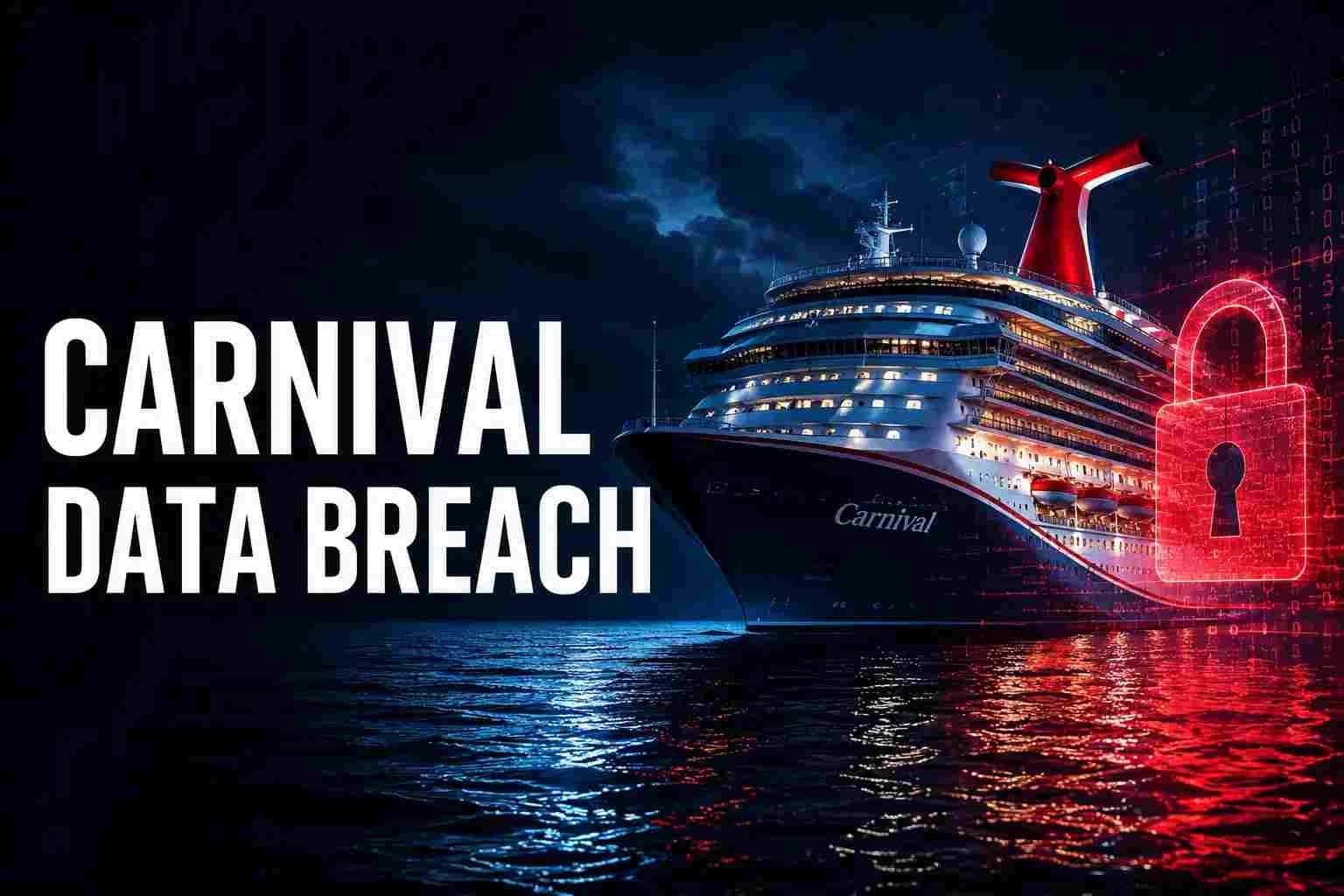
The Carnival data breach has put nearly 6 million people at risk after attackers accessed personal information through a compromised employee account. Some exposed records reportedly included government-issued ID details, which makes the breach more serious than a basic email leak.
This guide breaks down what happened, what data may have been exposed, who may be affected, and what U.S. customers should do now.
Brief Summary
Carnival Corporation disclosed a cybersecurity incident tied to unauthorised access involving an employee account. The company’s notice said attackers used social engineering to deceive an employee and gain access to a limited part of its IT system. Carnival reported 5,995,277 affected individuals in a Maine attorney general filing, and the company offered two years of TransUnion credit monitoring to eligible U.S. customers.
Was the Carnival Data Breach Real?
Yes. The Carnival data breach was real. Carnival Corporation published a data breach notice and filed details with the Maine Attorney General’s Office. The official filing lists the breach discovery date as April 14, 2026, and identifies Carnival Corporation as the reporting entity.
The company said an unauthorised actor used social engineering to trick an employee and access a limited part of Carnival’s IT system. Carnival discovered that someone had copied personal information on April 22, 2026. Public notification began on May 27, 2026.
For regular travellers, the key point is simple: this was not just a rumour on social media. It was confirmed through public breach notification channels.
Key Technical Details
|
Detail |
Verified Information |
|
Incident name |
Carnival Data Breach |
|
Year |
2026 |
|
Company |
Carnival Corporation |
|
Discovery date |
April 14, 2026 |
|
Data copying confirmed |
April 22, 2026 |
|
Public notice date |
May 27, 2026 |
|
Affected people |
5,995,277 individuals |
|
Attack vector |
Social engineering against an employee account |
|
Threat actor |
ShinyHunters claimed responsibility, but Carnival has not publicly confirmed that attribution |
|
Malware documented |
No confirmed malware named in official notice |
|
CVE documented |
No CVE reported in official notice |
|
Data type |
Personal information, contact details, and some government-issued ID details |
|
Customer support |
Notification process and credit monitoring for eligible affected U.S. customers |
|
Credit monitoring |
Two years of TransUnion monitoring reported for eligible customers |
Sources include Carnival’s public notice, the Maine Attorney General listing, Reuters, TechRadar, and other cybersecurity reporting.
What is the Carnival Data Breach?
The Carnival data breach is a 2026 cybersecurity incident where attackers gained unauthorised access to part of Carnival Corporation’s IT environment and copied personal information.
Think of it like this. If someone tricks a staff member into opening a locked office door, the problem is not only the door. The problem is also the trick, the access level, and what files were inside that office.
That is why this breach matters in 2026. Modern cyberattacks often do not start with a dramatic “hack the firewall” moment. Many start with a person getting tricked.
This is why the Carnival breach social engineering attack stands out. It shows how one compromised user account can become a doorway into a much bigger customer data problem.
What Happened in the Carnival Data Breach?
The short answer: attackers tricked an employee, accessed a limited part of Carnival’s IT system, and copied personal data.
Carnival said its IT security team identified unauthorised activity on April 14, 2026. The company blocked the activity, brought in third-party cybersecurity experts, and began an investigation. On April 22, Carnival determined that personal information had been illegally copied.
This became one of the most watched cyber incidents in the travel sector because of the scale. The phrase 'Carnival's breach affected 6 million customers' is not exact down to the last person, but it reflects the public impact. The official number reported through the Maine filing was 5,995,277 affected individuals.
Carnival Data Breach Timeline
|
Date |
Event |
Why It Matters |
|
April 14, 2026 |
Carnival detected unauthorized activity involving an employee account |
This is when the company says it discovered the suspicious activity |
|
April 22, 2026 |
Carnival determined personal information had been copied |
The incident moved from unauthorized access to confirmed data exposure |
|
May 27, 2026 |
Carnival issued public notice and began customer notification |
Affected users started receiving information and protection options |
|
Late May 2026 |
Public reports linked the incident to nearly 6 million people |
The breach became a major travel industry cyber attack story |
This Carnival data breach timeline is important because it helps customers understand the delay between detection, confirmation, and notification.
How Was the Carnival Hack Executed?
The Carnival cyber attack was reportedly carried out through social engineering. That means the attacker manipulated a person instead of only attacking software.
Carnival’s notice says an unauthorised actor deceived an employee to gain access to a limited part of the company’s IT system.
What is Social Engineering?
Social engineering is when a criminal tricks someone into doing something unsafe, such as the following:
Sharing a password
Approving a login request
Clicking a fake support link
Giving access to a system
Believing a fake internal message
A simple example: an attacker pretends to be from the company’s IT help desk and says, “Your account is locked. Approve this login request so we can fix it.” One tired employee clicks approve. That small action can open the door.
This is why the Carnival security breach matters beyond Carnival. It shows that people, not just software, are part of the security system.

Why Are Social Engineering Attacks Increasing?
Social engineering attacks are increasing because they are cheap, fast, and effective.
Attackers know that many companies already use firewalls, endpoint detection tools, and cloud security systems. So they go after the human layer.
Common methods include:
Phishing: Fake emails that steal login details
Spear phishing: Targeted phishing against one person or team
Pretexting: A fake story used to gain trust
Business Email Compromise: Fake executive or vendor emails
MFA fatigue: Repeated login approval requests until someone clicks yes
Ask yourself this: would every employee in a large company stop and verify a realistic IT support request during a busy workday? That is the gap attackers exploit.
What Customer Information Was Compromised?
The short answer: personal information was exposed, and the exact data may vary by person.
Reports say the exposed data included names, addresses, contact details, birthdates, and government-issued identification numbers such as passport or driver’s licence details.
Personal Information Exposed
The Carnival customer data leak may have included:
Full names
Home addresses
Email addresses
Phone numbers
Dates of birth
Gender
Loyalty or membership information in some reporting
Sensitive Identification Data Exposed
The more serious part is the possible exposure to the following:
Passport numbers
Driver’s licence numbers
Government-issued ID numbers
That is why searches for Carnival passport data breach and Carnival breach passport numbers are rising. A password can be changed in five minutes. A passport number is different. Replacing or monitoring ID documents takes more effort.
What Data Was Stolen in Carnival Breach?
Based on public notices and reporting, the data that was stolen in the Carnival breach may include contact details and identity-related information. Not every person had the same data exposed. Customers should read their own Carnival breach notification carefully because individual exposure can vary.
How Many People Were Affected?
The Carnival data breach affected 5,995,277 individuals, according to the Maine Attorney General breach listing and related reporting.
That number makes this a major cruise line data breach, not a small internal incident.
For context, nearly 6 million people is larger than the population of many U.S. states. If even a small percentage of those people receive phishing attempts later, the downstream risk can continue for months.
Was ShinyHunters Behind the Carnival Breach?
The short answer: ShinyHunters reportedly claimed responsibility, but Carnival has not publicly confirmed that attribution in the official notice.
Several cybersecurity reports connected the incident to the ShinyHunters Carnival breach claim. Have I Been Pwned also lists a Carnival breach entry and says ShinyHunters claimed to have obtained and published a large volume of Carnival-related data.
A careful writer should not overstate this. The safe wording is:
ShinyHunters claimed responsibility, according to cybersecurity reporting, but Carnival’s official notice focused on social engineering and unauthorised access rather than confirming the actor.
That distinction matters. Good cybersecurity writing separates confirmed facts from claims.
Was This a Carnival Ransomware Attack?
Some reports describe the incident in the context of extortion and a possible Carnival ransomware attack, but the official notice does not name ransomware, malware, or file encryption.
That matters.
Traditional ransomware usually means attackers encrypt systems and demand payment. In many modern cases, criminals skip encryption and focus on stealing data, then use public leaking as pressure.
For this incident, the better phrase is the following:
A data theft and extortion-linked incident involving social engineering
That is more accurate than saying “classic ransomware” unless official investigators confirm encryption or named malware later.
Our lab view is simple: this breach is dangerous because it combines scale with identity data.
A leaked email address is annoying. A leaked phone number is useful for scammers. But a leaked passport or driver’s licence number can create longer-term identity risk.
For a regular traveller, this means the following:
More phishing texts that look travel-related
Fake Carnival refund emails
Fake credit monitoring messages
Calls claiming to verify passport information
Attempts to reset travel or loyalty accounts
For a business, the lesson is different. The breach shows how one employee account can create public, legal, and reputational damage. A single user compromise can become a board-level problem.
That is the real story behind the Carnival hacked customer data issue. The attacker did not need to compromise every system. They needed enough access to copy sensitive files.
From the Lab: What We Noticed While Reviewing This Incident
When we reviewed the public breach notice and compared it with reporting from cybersecurity outlets, one detail stood out: the attack path was not described as a complex software exploit.
No CVE was named. No malware family was confirmed. No public technical advisory described a vulnerable software version.
That does not make the breach less serious. It makes it more relatable.
In our practical phishing simulations, we often see the same pattern:
The fake message looks normal.
The request feels urgent.
The employee thinks they are helping.
The attacker gets the access they need.
We encountered the same challenge in training exercises: people can spot obvious scam emails, but they struggle with realistic internal messages. A fake “IT support” request sent at the wrong moment can work better than a technical exploit.
That is why employee training must be tested, not just assigned once a year.
What is Carnival Doing to Protect Customers?
Carnival said it blocked unauthorised activity, engaged third-party cybersecurity experts, and notified law enforcement. The company also issued public breach notices and began notifying affected individuals.
Customer Notification Process
The Carnival breach notification process includes direct notice where contact details are available. For some people, public notice may be used if the company cannot reach them directly.
Customers should look for official communication from Carnival, but they should be careful. Criminals often send fake breach emails after real incidents.
Free Credit Monitoring Services
Carnival is offering two years of credit monitoring through TransUnion for eligible affected U.S. customers, according to public reporting.
The keyword many users are searching for is 'Carnival TransUnion credit monitoring'. If you receive an enrolment offer, do not click random links from texts or social posts. Go through official Carnival notice instructions.
Dedicated Customer Support
Affected users may receive support resources through the notification letter or public notice. Before publishing a final news article, verify current phone numbers and enrolment links from Carnival’s official website or breach notice page.
How to Check If Affected by Carnival Breach
The fastest way to check is to look for an official notice from Carnival and compare it with official public breach information.
Step 1: Search Your Email Carefully
Action: Search your inbox for “Carnival Corporation Notice of Data Breach” or similar wording.
Why it matters: Carnival may notify affected people by email.
Tip: Check spam and promotions folders too.
Step 2: Do Not Click Suspicious Links
Action: Avoid clicking links in unexpected texts or emails.
Why it matters: Scammers may copy the breach story to steal more data.
Tip: Visit Carnival’s official website manually instead of trusting a link.
Step 3: Read the Notice for Your Specific Data
Action: Look for the section that says what information about you was involved.
Why it matters: Not every affected person had the same data exposed.
Tip: If your passport or driver’s licence number is listed, take stronger action.
Step 4: Enrol in Credit Monitoring if Eligible
Action: Use the official instructions for the TransUnion offer.
Why it matters: Monitoring can alert you to suspicious credit activity.
Tip: Save your enrolment confirmation.
Step 5: Check HaveIBeenPwned.
Action: Search your email address on Have I Been Pwned.
Why it matters: The site lists breach exposure based on known leaked datasets.
Tip: Use it as a signal, not the only source of truth. Have I Been Pwned lists a Carnival breach entry tied to April 2026 reporting.
How to Protect Yourself After the Carnival Data Breach
The Carnival data breach is not something customers can undo. But they can reduce the damage.
1. Monitor Financial Accounts
Check bank and credit card activity at least twice a week for the next few months.
Why it matters:
Identity criminals may wait before using stolen data.
Small test charges can appear before larger fraud.
Early reporting makes disputes easier.
2. Check Your Credit Reports
U.S. consumers can check credit reports from major credit bureaux. If you see accounts you did not open, act quickly.
Tip: Consider a credit freeze if your government-issued ID details were exposed.
3. Watch for Phishing Attempts
After a breach, fake emails often look like this:
“Claim your Carnival data breach compensation now”
“Verify your passport to avoid account closure”
“Your cruise refund is ready."
“TransUnion enrolment failed. Click here."
These messages are dangerous because they use real news to sound believable.
4. Secure Online Accounts
Change passwords for:
Carnival account
Cruise-related travel accounts
Email account
Bank account
Loyalty accounts
Any account using the same password
Use a password manager if possible.
5. Enable Multi-Factor Authentication
Turn on MFA for important accounts. Use an authenticator app where available instead of SMS codes.
Why? If your email and personal details are exposed, criminals may try to reset other accounts.
uick Comparison Table: What Customers Should Do
|
Risk |
Warning Sign |
Best Action |
|
Identity theft |
New credit account you did not open |
Freeze credit and report fraud |
|
Phishing |
Fake Carnival refund or verification email |
Do not click, report it |
|
Account takeover |
Password reset emails you did not request |
Change password and enable MFA |
|
Document misuse |
Passport or license number exposed |
Monitor official accounts and consider replacement guidance |
|
Credit fraud |
Unknown loan, card, or inquiry |
Contact credit bureau and lender |
Common Mistakes After a Data Breach
Mistake 1: Ignoring the Notification
Some people see a breach email and think, “Nothing has happened to me yet.”
That is risky. Data can be used later. Criminals often wait until public attention fades.
How to avoid it:
Read the full notice. Save a copy. Follow the official protection steps.
Mistake 2: Clicking the First Link You See
Scammers love breach chaos.
A fake Carnival data leak explanation article or fake monitoring link can lead to another theft.
How to avoid it:
Type official website addresses yourself. Do not trust random links in texts.
Mistake 3: Only Changing Your Carnival Password
Changing one password helps, but it is not enough if your email, phone number, date of birth, or ID data was exposed.
How to avoid it:
Secure your email account first. Then secure travel, bank, and loyalty accounts.
Mistake 4: Assuming Compensation Is Automatic
Many users search for Carnival data breach compensation. At this stage, public reporting focuses on notification and credit monitoring, not guaranteed cash compensation.
How to avoid it:
Watch official notices, state attorney general updates, and verified legal developments. Do not pay anyone who promises instant compensation.
Lessons Businesses Can Learn From the Carnival Data Breach
The Carnival data breach gives companies several hard lessons.
Employee Security Training Must Be Practical
Annual slideshow training is not enough.
Companies need:
Realistic phishing simulations
Help desk verification drills
MFA approval training
Reporting channels that do not punish honest mistakes
Access Controls Must Be Tight
A single compromised account should not unlock large amounts of sensitive data.
Better controls include:
Least privilege access
Conditional access policies
Strong MFA
Session monitoring
Privileged access management
Continuous Monitoring Matters
Carnival said its IT security team identified unauthorised activity. Detection is critical, but speed also matters.
Companies should monitor:
Unusual login locations
Impossible travel patterns
Large data downloads
New device logins
Repeated MFA prompts
Incident Response Planning Must Be Tested
A written plan is not enough. Teams should run tabletop exercises.
Who contacts legal?
Who writes the customer notice?
Who checks if passport numbers were exposed?
Who talks to law enforcement?
Those answers need to be ready before a breach.
What happened in the Carnival data breach?
The Carnival Data Breach was a 2026 cybersecurity incident where attackers used social engineering to compromise an employee account and access part of Carnival Corporation’s IT system. Carnival later confirmed that personal information had been copied and reported 5,995,277 affected individuals.
3-Point Security Checklist
Before you close this page, do these three things:
Check your notice: Confirm whether your personal information, passport number, or driver’s licence number was involved.
Lock down your accounts: Change reused passwords and enable MFA on email, banking, and travel accounts.
Watch for scams: Treat refund, compensation, and credit-monitoring emails with caution. Use official sources only.
The Carnival data breach is a reminder that one tricked employee account can expose millions of people. For customers, the best response is not panic. It is fast, careful action.