-20260731111414.webp&w=3840&q=75)
Picture a security team that never sleeps, never gets bored reading the same crash log twice, and can read every line of a browser's source code in less time than it takes you to finish your morning coffee.
That is not a thought experiment anymore. That is what happened inside Chrome over the last two release cycles, and the numbers are honestly a little hard to believe until you see where they came from.
In Chrome 149 and Chrome 150 alone, Google's engineers fixed 1,072 security bugs. To put that in context, that single number is larger than the total bugs fixed across the previous 23 Chrome milestones combined. That is not a typo, and it is not marketing spin either.
It is the direct result of a multi year bet Google made on teaching artificial intelligence to find, triage, and fix software vulnerabilities faster than any human team ever could, and it is exactly what people mean when they talk about Chrome AI vulnerability management today.
This piece walks through how that system actually works, the strange 13 year old bug it uncovered, what it means if you are the one responsible for patch decisions at your own company, and why every enterprise security team, not just browser engineers, should be paying attention to what Google just proved is possible.
Quick Summary
|
Aspect |
Detail |
|
What changed |
Chrome moved from manual bug hunting to an AI agent pipeline covering discovery, triage, patching, and release |
|
Headline number |
1,072 security bugs fixed across Chrome 149 and 150, more than the prior 23 milestones combined |
|
Key discovery |
A sandbox escape bug hidden in Chrome's code for more than 13 years, found by a Gemini powered agent harness |
|
Core AI systems |
Naptime in 2024, Big Sleep in 2025, and the Gemini agent harness in 2026 |
|
Human role |
Humans still approve every fix before it ships, AI proposes, critiques, and tests, people sign off |
|
Why it matters to enterprises |
Faster patch cycles and dynamic patching shrink the window attackers get to exploit known bugs |
What Chrome AI Vulnerability Management Actually Means
Strip away the jargon and Chrome AI vulnerability management is simply this. Instead of a human security researcher manually reading through millions of lines of code looking for mistakes, Google now runs large language models over that same code, again and again, teaching them to reason about how a browser's internal trust boundaries work.
When those models spot something that looks wrong, a separate set of agents takes over to confirm it is real, rate how dangerous it is, write a fix, test that fix, and hand it to a human developer for final approval.
The Chrome Security team has actually been experimenting with this for years, it just took a while to reach the scale we are seeing now. Back in 2023, the team started using language models to make their existing fuzzing tools smarter, generating better test inputs than random mutation alone could produce. That early work planted the seed for everything that followed.
Google Big Sleep and Project Zero: How the Story Really Started
The next real leap came in 2024 with a project called Naptime, built in partnership with Google Project Zero, the company's elite bug hunting unit. Naptime was the first serious attempt to give a language model actual tools, things like debuggers and code navigation utilities, so it could investigate a piece of software the way a human researcher would rather than just guessing from static text.
Then in 2025, that work evolved into Big Sleep, a joint effort between Google DeepMind and Project Zero. Big Sleep is the agent that put this whole field on the map. It went after real, complex targets, including Chrome's V8 JavaScript engine and its graphics stack, two of the most heavily scrutinized and hardest to crack parts of any modern browser.
Big Sleep has a genuinely impressive track record outside Chrome too. In August 2025 it independently flagged a critical use after free flaw in the ANGLE graphics library, tracked as CVE-2025-9478, which Google's own human researchers then verified before shipping a fix.
Even more strikingly, Big Sleep helped catch a SQLite vulnerability, CVE-2025-6965, that threat intelligence indicated was already known to attackers and at risk of active exploitation, meaning Google patched a hole before criminals could weaponize it.
Google has called that the first known case of an AI agent directly stopping a real world exploitation attempt before it happened.
By early 2026, Google scaled this idea up dramatically by building what it calls a Gemini agent harness, capable of scanning the entire Chrome codebase rather than just a handful of high value targets, and doing so with fewer false alarms than earlier tools produced.
Chrome Sandbox Escape 13 Year Bug: The Discovery That Changed Everything
Here is where the story gets genuinely wild. While running early scans with that new Gemini harness, engineers turned up a critical logic flaw sitting quietly in Chrome's sandbox architecture, a bug that had survived, completely undetected, for more than 13 years across countless versions of the browser.
The technical root cause sat in the Inter Process Communication layer, the internal messaging system that lets Chrome's low privilege renderer process, the part of the browser handling the actual web page you are looking at, talk to the much more powerful browser process behind it.
A compromised renderer could construct a malformed message that tricked the browser process into reading local files on the victim's machine, effectively letting an attacker step outside the sandbox that is supposed to contain them entirely.
Why did fuzzers and static analysis tools miss this for over a decade? Because the bug did not live in a single obviously broken line of code. It required understanding the semantic intent behind a multi step interaction across a process boundary, exactly the kind of reasoning that language models turn out to be unusually good at and that traditional coverage guided fuzzing simply is not built to find.
For the Chrome team, this single discovery is widely seen as the moment that proved AI powered vulnerability detection was not a novelty experiment anymore.
From where I sit watching enterprise security programs, this bug is the most useful case study in the whole announcement, and it is worth pulling apart on its own merits rather than just repeating the headline.
A 13 year survival time tells you the flaw was never caught by any static analyzer, any manual code review, or any fuzzing campaign run against Chrome in over a decade, and Chrome has had some of the most heavily resourced fuzzing infrastructure in the industry that whole time. That is a signal about the limits of pattern matching tools generally, not just Chrome's tooling specifically.
Most static analyzers and fuzzers are built to catch bugs that look like other bugs they have already seen, memory corruption patterns, known unsafe function calls, malformed input handling. A logic error that only becomes dangerous when two trusted components interact in a specific undocumented sequence does not look like anything in that training set, which is exactly why it survived.
If your own organization relies mainly on scanner output and periodic audits to sign off on custom internal tooling, this is the kind of gap that tends to hide in exactly the same place, at the seams between systems that individually look fine.
Gemini Agent Harness Fuzzing and the Multi Agent Remediation Pipeline
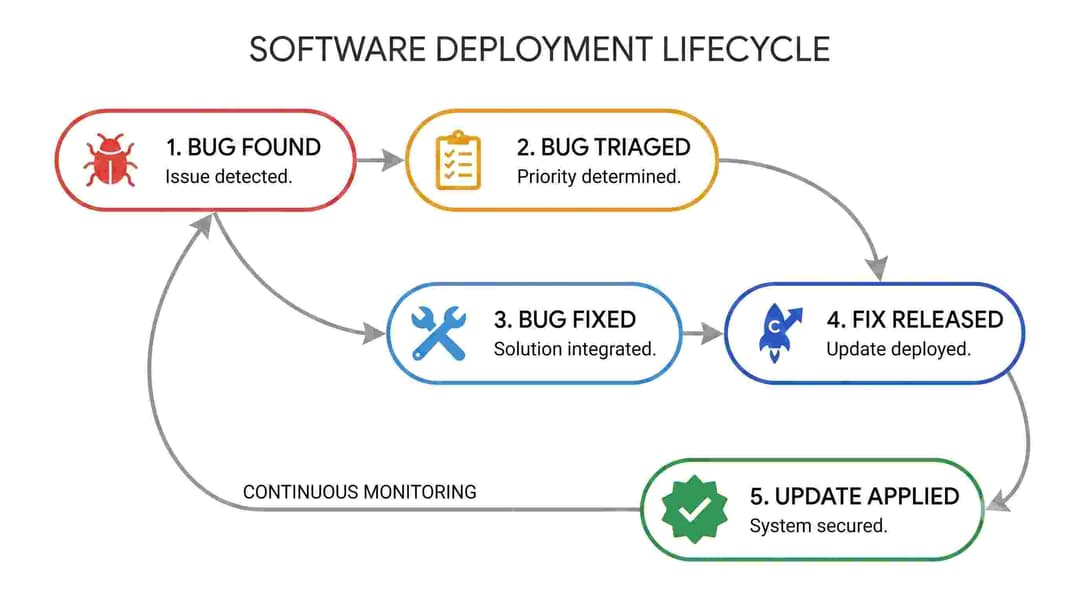
Finding a bug is only step one. What makes the current Chrome system so different is what happens next, an entirely automated relay race that runs from discovery all the way to a patch candidate landing on a human developer's desk. Here is roughly how a bug moves through that pipeline once it is flagged.
- Discovery agents, built on Big Sleep and the Gemini harness, scan the codebase continuously, running every 24 hours across every code change to catch problems before they even ship.
- A triage agent filters out spam and duplicate reports, reproduces the bug using an isolated proof of concept environment, attaches a severity score, and routes the confirmed issue to the right team, all without a human touching it first.
- A fixing agent then generates several candidate patches for the confirmed bug.
- A separate critic agent reviews those candidates, checking for regressions, performance side effects, and whether the fix actually addresses the root cause rather than just papering over the symptom.
- Test writing agents automatically build regression tests that run across every platform Chrome supports, Windows, macOS, Linux, and Android, before a developer ever opens the patch.
- Only then does a human developer review and approve the final merge.
Google says this automated triage process alone is saving hundreds of developer hours every single month, hours that used to be spent on the repetitive, exhausting work of confirming whether a bug report was real before anyone could even start fixing it.
Historically, triaging a single security report by hand could eat up anywhere from 5 to 30 minutes, and that is before any actual fixing began. In May 2026 alone, this pipeline blocked more than 20 vulnerabilities from ever reaching production, including one critical severity issue that never had the chance to become a real world problem.
The Quiet Role of SECURITY.md in AI Powered Automated Vulnerability Triage
One detail that rarely makes headlines but genuinely deserves more attention is a simple text file called SECURITY.md.
Google has been encouraging developers across the Chromium project to write these files directly into the source tree, and they do something surprisingly powerful, they explain, in plain language, what parts of the code are trusted, what the threat model assumes, and which functions carry elevated privilege.
Think of it as handing the AI a map of the building's security guards before asking it to walk through and check for unlocked doors. Without that context, a model might flag something as dangerous when it is actually working exactly as intended, or worse, miss a real boundary violation because it did not understand which side of the wall it was looking at.
A dedicated critic agent reads these SECURITY.md files in its own separate context specifically to reason about privilege boundaries, which is a big part of why the newer Gemini harness produces so many fewer false positives than earlier scanning attempts.
Google also runs its vulnerability finding models repeatedly over the same code, precisely because language models are non deterministic and can catch something on one pass that they missed on another.
This detail is easy to skip past, but it is the part I think most application security teams should actually copy first, before they touch any AI tooling at all. An AI agent scanning your codebase without documented trust boundaries is guessing at intent, and guessing produces noise, either missed bugs or a flood of false positives that trains your team to ignore the tool entirely.
Writing SECURITY.md style documentation is not glamorous work and it will not show up in a vendor demo, but it is the unglamorous groundwork that decides whether an AI powered scan is actually useful or just an expensive way to generate tickets nobody reads.
-20260731110607.webp&w=1080&q=75)
Chrome Patch Gap Dynamic Patching: Closing the Window Attackers Rely On
Finding and fixing a bug faster only helps if the fix actually reaches users faster too. This is where something called the patch gap comes in, and it is a problem every security professional should understand, not just Chrome engineers.
Once a fix lands in Chrome's public open source repository, attackers can simply compare the old code to the new code, work out exactly what was wrong, and race to build a working exploit before ordinary users have even updated their browser.
These are known in the industry as N day attacks, and they are a genuinely serious threat precisely because the fix is sitting right there in public for anyone to study.
Google is attacking this problem from two directions at once. On the release side, Chrome is shifting from a four week major release cycle down to two weeks, backed by weekly security updates, and the team is actively piloting a move to twice weekly security releases for the most urgent fixes.
On the delivery side, Google is building what it calls dynamic patching, which hot swaps background processes like the renderer and GPU process with updated, patched binaries while the browser keeps running, without forcing a full restart.
On macOS specifically, Chrome 150 introduced a feature that detects when the browser has no open windows and quietly restarts itself in the background to apply a pending update, closing the gap between when a fix ships and when it actually protects the user.
If you support this kind of infrastructure inside your own organization, this is a genuinely useful pattern to borrow. Reducing the human decision point between patch available and patch applied is one of the highest leverage things any security program can do, and it is exactly the kind of gap that penetration testing exercises are designed to expose before an attacker finds it for you.
Vulnerability Reward Program AI Impact: What Bug Bounty Hunters Are Seeing
All of this automation has also reshaped the human side of Chrome security research. As internal AI tooling started catching more and more routine bugs on its own, Google noticed something interesting happening in its external Vulnerability Reward Program, the bug bounty system that pays independent researchers for finding flaws.
Report volumes climbed steadily through early 2026, and by March, the shift became undeniable, Google had already received more bug reports that year than it had across the entirety of 2025.
In response, Google restructured the VRP's rules to steer external researchers away from the kinds of straightforward bugs its internal AI pipeline was already catching efficiently, and toward the genuinely novel, architecturally complex issues that still require creative human thinking to uncover.
It is a practical acknowledgment that human researchers and AI agents are now hunting the same territory, and the reward structure had to evolve so both could keep contributing meaningfully instead of duplicating each other's work.
Legacy Security Practices vs the AI Augmented Chrome Pipeline
|
Capability |
Legacy Approach |
Modern AI Pipeline |
|
Vulnerability discovery |
Coverage guided fuzzing and manual code audits |
Continuous multi agent reasoning layered on top of existing fuzzers |
|
Bug triage |
Manual review by human security engineers, 5 to 30 minutes per report |
Automated spam filtering, PoC reproduction, severity scoring, and routing |
|
Patch generation |
Days to weeks of developer time per fix |
Candidate patches generated automatically within hours, reviewed by critic agents |
|
Release cadence |
Monthly or four week milestones |
Two week milestones, weekly security patches, piloting twice weekly releases |
|
Update delivery |
Requires full browser restart |
Dynamic in memory patching plus automatic idle state restarts |
Frequently Asked Questions
Does AI replace traditional fuzzing in Chromium?
No. The two approaches complement each other rather than compete. Fuzzing is still especially good at surfacing crashes that come from long range, unpredictable interactions between completely unrelated parts of the codebase.
Language models, on the other hand, are stronger at understanding meaning, intent, and complex logic flows across system boundaries, which is exactly the kind of reasoning that caught the 13 year old sandbox escape bug.
How does Google deal with AI models giving inconsistent answers?
Chrome's security team runs its discovery models repeatedly over the same code sections to account for this non determinism, and every output is checked against deterministic proof of concept sandboxes before a human ever sees it.
A separate critic agent then reviews proposed fixes for side effects before anything reaches a developer for final sign off.
Is a human still involved in approving these AI generated fixes?
Yes, at every level. AI agents propose, critique, and test candidate patches, but a human developer always performs the final review and merge approval.
Google has been explicit that automation handles the repetitive heavy lifting so human engineers can focus their judgment on the decisions that actually need it.
What is the patch gap and why should enterprise security teams care?
The patch gap is the window of time between when a security fix becomes publicly visible in source code and when it actually reaches a user's device.
Attackers use that window to reverse engineer working exploits, known as N day attacks. Any organization managing browser fleets should treat rapid patch deployment and verification, not just patch availability, as the real security metric.
The Bigger Picture for Enterprise Security Teams
What Google has built inside Chrome is not just a browser story, it is a preview of where vulnerability management across the entire software industry is heading. The lesson for any enterprise security program is not that you need to build your own Gemini powered fuzzing harness tomorrow.
It is that the gap between finding a vulnerability and actually closing it is where real world damage happens, and shrinking that gap, through faster triage, faster patch validation, and faster deployment, is where the highest value security work now lives.
If your organization is still relying on monthly patch cycles and manual triage while the browsers and applications your employees use every day are being defended by systems like this, that gap in tempo is worth taking seriously.
Regular penetration testing can confirm whether your deployed patches actually closed the holes they were meant to close, a cyber resilience assessment can show you exactly where your own patch gap is widest, and strong endpoint security coverage ensures the devices running these browsers are protected even in the hours before an update lands.
Google is running a very similar AI patching philosophy on the code repair side through a system called CodeMender, and our own breakdown of Google CodeMender AI patching is a natural next read if you want to see how that companion technology works.
Official Reference
Google Chrome Security Team, Stronger with every update: How we're making Chrome and the web safer in the AI Era, blog.google, July 30, 2026
Read More Articles
How Hackers Compromise Accounts and How to Stay Safe
Critical Android Vulnerabilities Reported by Google
Salt Typhoon Cyberattacks on AT&T and Verizon
Remote Desktop Credential Prompt Issues After Microsoft Update
Hackers Bypassing Outlook Spam Filters
GitHub AI-Powered Bug Detection for Security