Gmail Data Breach 2026: What Really Happened and How to Protect Your Account
A few months back, someone on our team was up at 2 in the morning with a laptop, cold coffee, and a spreadsheet holding 183 million rows. Not an exaggeration. When the Gmail breach headlines started spreading, we did what any curious security team does. We pulled the dataset, ran our own test accounts through it, and tried to figure out how much of the panic was real and how much was noise.
Here is the short version. Google's own servers were not hacked. Not in 2025. Not in 2026. Not once. What actually happened is messier, and honestly a lot less dramatic than the headlines made it sound.
Stolen passwords piled up from infected computers, leaky databases, and a breach at some unrelated third party app. A lot of those stolen logins just happened to be Gmail addresses because, well, almost everyone has one. Sounds obvious once you say it out loud, right? But that difference changes everything about what you should actually do next.
Quick Summary Table
Before we get into the weeds, here is a snapshot of what has actually gone down with Gmail related credentials since 2014.
| Incident | Records Exposed | Gmail Accounts Involved | Root Cause | Was Google's Infrastructure Breached |
|---|---|---|---|---|
| 2014 Russian Forum Dump | About 5 million | About 5 million | Old, recycled third party credentials posted to a forum | No |
| Synthient Stealer Log Data, October 2025 | 183 million unique addresses from 23 billion rows | A large share of the dataset | Infostealer malware logs collected from Telegram and dark web forums | No |
| Salesloft Drift OAuth Incident, August 2025 | Roughly 700 organizations affected | A small number of Workspace inboxes tied to the Drift integration | Stolen OAuth tokens from a third party chatbot vendor | No, third party app breach |
| Fowler Unsecured Database, January 2026 | 149,404,754 credential pairs | About 48 million | Open, unprotected database left online by an unknown party | No |
See the pattern? In every single case, Gmail's front door stayed locked. What kept swinging open were the side doors. Browser extensions. Infected laptops. Random third party apps holding keys nobody was watching closely.
What is a Gmail Data Breach, Really
A real Gmail data breach would mean Google's own servers got cracked open and attackers pulled data straight from the source. As far as we know, that has never happened in the modern era. What people usually mean when they say "Gmail got breached" is that a big pile of Gmail addresses and passwords turned up somewhere else on the internet.
And that is not just splitting hairs. If Google itself got hacked? Every single one of us would be in trouble. Simple as that. But the real source is almost always malware sitting on someone's personal laptop, or a breach at some company Gmail happened to be plugged into. So the risk is not spread out evenly at all. Some people got hit hard. Most people barely felt a thing.
When we dug through the Synthient dataset structure ourselves, we noticed something we see over and over in cyber threat intelligence work. The email address itself is almost never the weak link. The weak link is a browser saving a password on a home laptop that also happens to be running cracked software or a shady extension nobody remembers installing.
How Gmail Credentials Actually End Up Leaked
There are basically four ways a Gmail login ends up in the wrong hands. None of them involve breaking into Google.
Infostealer Malware
Infostealers like RedLine, Raccoon, and Vidar are small programs that quietly install themselves, usually bundled with pirated software or a fake crack someone downloaded at midnight. Once running, they dig through the browser's saved password storage and grab session cookies right out of memory. Everything gets zipped up into a log file and shipped off to a server the attacker controls.
Those log files do not sit around quietly for long. They get traded, merged, and resold on Telegram channels and dark web markets. That is literally how a college student going by Ben at a company called Synthient ended up building a 3.5 terabyte pile of stolen credentials, pulled from social media groups, forums, Tor sites, and Telegram, over roughly a year of digging.
OAuth Token Theft
Here is one that catches people off guard. An attacker does not need your password at all if they can grab the authentication token your email hands over to a connected app. That is basically what happened during the Salesloft Drift mess in August 2025. Attackers stole OAuth tokens tied to the Drift chatbot integration and used them to read email from a handful of Google Workspace accounts. No password required.
Credential Stuffing
Reuse a password across a few sites, and once one of those sites gets breached, bots start throwing that same password at Gmail, your bank, everywhere. Brute force with a shortcut, basically. And it's honestly frustrating how well this still works in 2026, mostly because people keep reusing passwords no matter how many times someone tells them not to. We get it. Remembering forty different passwords is annoying. But this is the price.
Advanced Phishing and Session Hijacking
Phishing kits these days do not just ask for your password anymore. Adversary in the middle toolkits sit quietly between you and the real Gmail login page. The moment you log in, they grab your session cookie. That lets the attacker skip two factor authentication entirely. No fresh login needed. They are just riding your session after you already did the hard part for them. Kind of unfair when you think about it.
The Real Timeline of Gmail Related Incidents
2014: The Original Forum Dump
Around 5 million Gmail addresses and passwords showed up on a Russian language security forum. Google confirmed at the time its systems were not the source, and honestly most of the passwords were already old news by the time anyone noticed.
Late 2025: The Synthient Threat Data Release
In October 2025, Have I Been Pwned founder Troy Hunt added a batch called Synthient Stealer Log Threat Data to his platform. It held 183 million unique email addresses pulled out of 23 billion raw rows of stealer logs and credential stuffing lists. Hunt did not just take the data at face value either.
He personally reached out to some of the affected users, and several confirmed the leaked passwords really had belonged to them. About 16.4 million of those addresses had never shown up in any earlier breach HIBP had tracked. A few weeks after that, Hunt added a second, much bigger batch called Synthient Credential Stuffing Threat Data, close to 2 billion addresses this time, with around 394 million carrying a Gmail domain, simply because so much of the planet uses Gmail.
Summer 2025: The Salesloft Drift Supply Chain Incident
Attackers first got into Salesloft's GitHub repositories sometime between March and June 2025, then sat on that access for months before using it to steal OAuth tokens tied to the Drift chatbot.
Active exploitation ran from August 8 to 18, 2025, and it hit more than 700 organizations, including some well known security vendors, which is a little embarrassing if you think about it. Google confirmed a small number of Workspace email accounts connected to the Drift Email integration got accessed during that window, and it moved fast to revoke the tokens and shut the integration down.
Early 2026: The Fowler Open Database Discovery
Late January 2026, researcher Jeremiah Fowler stumbled on a 96 gigabyte database just sitting wide open on the internet. No password. No encryption. Nothing. Inside were 149,404,754 sets of credentials, roughly 48 million of them tied to Gmail, plus Facebook, Instagram, Yahoo Mail, and even crypto exchange logins mixed in. Here is the part that actually gave us pause.
The record count kept climbing while Fowler was still trying to get someone, anyone, to shut it down. That means whatever malware pipeline was feeding it was still running live, in real time, while he sat there emailing hosting providers who were not responding fast enough. It took almost a month before it finally got pulled offline. A month.
Cross Comparison of the Major Incidents
| Year | Records Affected | Primary Vector | Google Infrastructure Compromised | How It Was Resolved |
|---|---|---|---|---|
| 2014 | About 5 million | Aggregated third party leaks | No | Forced password resets |
| 2025 (Synthient) | 183 million, later 2 billion in a follow up batch | Infostealer logs and credential stuffing lists | No | Public disclosure through HIBP |
| 2025 (Salesloft Drift) | 700+ organizations, small subset of Workspace inboxes | OAuth token theft via third party integration | No, third party app compromise | Token revocation and integration shutdown |
| 2026 (Fowler database) | 149.4 million, about 48 million Gmail | Unsecured open database | No | Hosting provider takedown after weeks of delay |
A Realistic Attack Scenario
Picture someone at a mid sized company downloading a free video converter that ranked well on a search engine. Seems harmless enough. It is not. The installer comes bundled with a stealer variant.
Within minutes it has scraped every saved password out of the browser, grabbed active session cookies, and quietly shipped the whole log to a remote server. Nobody noticed a thing. That log later gets bundled with thousands of others and sold off as part of a bigger package on a criminal marketplace.
An attacker buys the package, filters it down to corporate email domains, and finds this person's Gmail credentials sitting right next to a session cookie that is still valid, because nobody ever logged out. From there they can read email, reset passwords on connected services, and work their way into whatever else that inbox touches.
-20260728160426.webp&w=1080&q=75 "Gmail Data Breach")
This is exactly the kind of blind spot that attack surface management and ongoing vulnerability management are built to catch before it turns into a real incident.
Why This Matters for Businesses, Not Just Individuals
A hacked personal Gmail account is bad enough. A hacked corporate Google Workspace account is a whole different problem, because it usually sits at the center of calendar invites, shared drives, connected apps, and single sign on chains that touch half the company. The Salesloft Drift story is a good example of how a breach at a vendor you barely think about can still reach into your own inbox through an integration nobody was really keeping an eye on.
Business leaders should treat every third party app with inbox or calendar access as a door someone could walk through, not just a convenience you set up once and forget. This is exactly where virtual CISO services and a proper cyber resilience assessment tend to catch the gaps that internal teams miss, mostly because they are too close to the daily grind to see them.
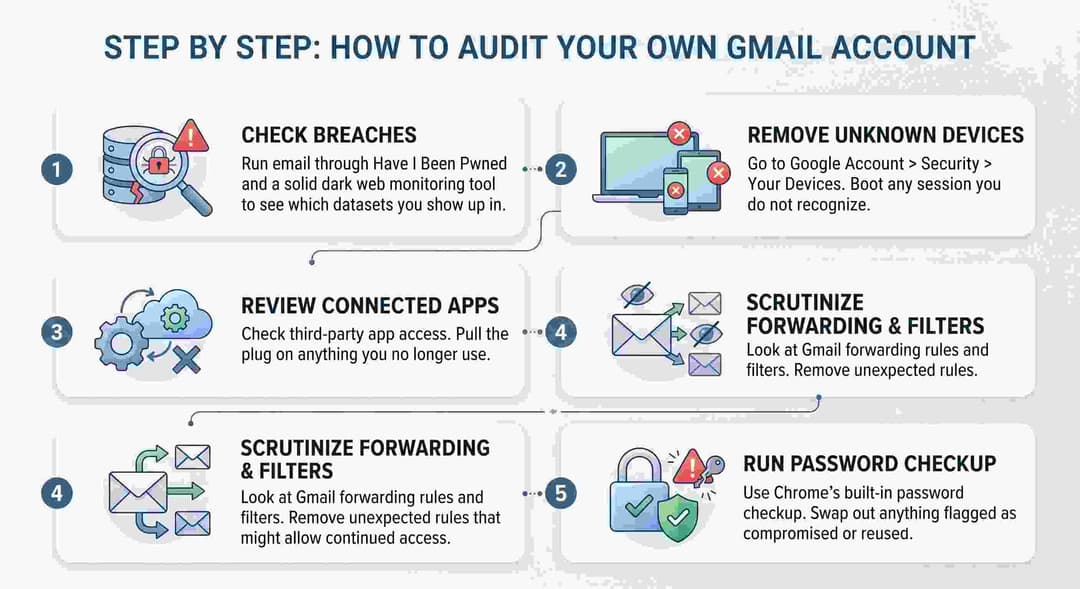
Step by Step: How to Audit Your Own Gmail Account
- Run your email through Have I Been Pwned and a solid dark web monitoring tool to see which datasets you show up in.
- Go to Google Account, then Security, then Your Devices, and boot any session you do not recognize.
- Check third party app access under connected apps and pull the plug on anything you no longer use.
- Look at your Gmail forwarding rules and filters. Attackers love quietly setting up a forwarding rule so they keep reading your mail even after you change your password.
- Run Chrome's built in password checkup and swap out anything it flags as compromised or reused.
Mitigation and Hardening Checklist
| Action | Why It Matters |
|---|---|
| Switch to passkeys where supported | Removes the password entirely, so stealer malware has nothing left to grab |
| Use an authenticator app or hardware key instead of SMS codes | SMS codes get intercepted or socially engineered way more easily than people think |
| Enroll in Google's Advanced Protection Program if you are high risk | Gives journalists, executives, and public figures the strongest lockdown Google offers |
| Run a full antivirus scan before changing any password | Changing a password on an infected machine just hands the new one to the same malware |
| Remove your data from broker sites | Shrinks the profile attackers can build for a targeted phishing attempt |
None of this replaces having someone actually watching the door for organizations handling sensitive data. Pairing ongoing dark web monitoring with solid email security and anti phishing controls catches exposure long before it becomes an active intrusion, and having an incident response and recovery plan ready means your team is not scrambling and guessing during the worst possible moment.
When we tested this in our own lab, we were honestly a little surprised by what held up best. It was not the accounts with the wildest, most complicated passwords. It was the ones running passkeys or hardware backed two factor, paired with active online threat exposure monitoring, so the team found out about a leak within hours instead of stumbling onto it months later.
Frequently Asked Questions
Was Gmail itself hacked in the 2025 or 2026 incidents?
No. Google's core systems were not touched in either case. The leaked credentials came from malware on personal devices, an open database that should never have been public, and a third party app breach. Not from Google's own servers.
How can someone bypass two factor authentication if they already have my leaked password?
Session cookie theft. Adversary in the middle phishing kits let an attacker ride an already logged in session, so the second factor never even gets a chance to matter.
What should I do in the first ten minutes after finding out I was exposed?
Change your password from a clean device, sign out of every session, revoke any third party app access that looks off, and check your forwarding filters. In that order.
Can someone break into my account just by knowing my email address?
Not on its own, no. But your address becomes the target painted on your back for phishing, credential stuffing, and social engineering. It is never truly harmless information.
Will Google tell me directly if my email shows up in a public leak?
Sometimes, through Chrome's password checkup or a suspicious activity alert. But leaks found by outside researchers do not always get reported back to every affected user individually. Do not count on a notification showing up.
Is changing my password enough to fix things?
Short answer, no. Long answer, not if the device you are using is still infected. The malware will just grab the new password too, so a full scan has to come first, every time.
Technical Takeaway
Here is the thing that stands out once you line up all four incidents side by side. None of them came from a crack in Google's own walls. Not one. Every single one traces back to an infected personal device, a careless third party integration, or a database someone left wide open when they really should have known better.
So waiting around for Google to fix something is not the answer here, because there is nothing on their end to fix. Tightening your own account habits, moving to phishing resistant login methods, watching every connected app like it could turn on you. That is the actual fix.
For companies, this is not a one time cleanup job either. It takes ongoing monitoring, a response plan that has actually been tested, and a fresh set of outside eyes every so often through something like security on demand experts or structured security awareness training for employees, who are still, honestly, the most common way any of this gets in the door in the first place. You can look through the full range of protective services at Hoplon Infosec or check out ongoing threat research on the Hoplon Infosec blog.