Why Agentic AI Control Needs Attention Now
Agentic AI banking security means applying identity, access, and monitoring controls to AI agents the same way banks apply them to human employees, closing the gap between how fast agents are being deployed and how slowly governance is catching up.
Talk to IT leaders at mid sized banks today and agentic AI comes up almost immediately as a top operational concern. The issue is not that the technology lacks potential. It is that adoption is moving much faster than the security protocols meant to contain it, and a growing number of institutions are running active agents against production systems while the governance frameworks that should manage them are still sitting in a draft policy document somewhere.
Accenture's Banking Top Trends 2026 report puts a number on this gap. Looking three years out, only 37 percent of banks expect agents to be governed through formal lifecycle and access models with enterprise wide controls, and just 28 percent plan to fold agents into their broader identity and access management setup. Most banks know where this needs to go. The road just is not built yet.
Agents that can move money, edit account records, or approve transactions are functionally new employees with system access. They do not sleep, they do not push back on a strange instruction the way a cautious employee might, and they can be steered off course by a cleverly worded prompt buried inside an ordinary looking document.
The rest of this guide covers what tends to go wrong once agents get that kind of access, and what a defensible governance program looks like in practice.
What Makes Agentic AI Different From a Chatbot
A generative AI chatbot drafts a response and waits for a human to act on it. An agent reads a request, checks a policy document, queries a handful of internal systems, drafts a resolution, and increasingly, carries that resolution out on its own without anyone signing off in real time. That shift from suggestion to action is exactly where banking risk multiplies.
A wrong answer from a chatbot is embarrassing. A wrong action from an agent with write access to a core banking system can move real money before anyone notices, and by the time someone does notice, the transaction has already cleared. Chatbots have essentially none of this risk because a human is always the last checkpoint. Agents remove that checkpoint in exchange for speed, which is the entire tradeoff banks need to reckon with before scaling them.
Banks are responding by standing up centralized agent building platforms, internal app stores where employees assemble agents from pre approved components instead of building from scratch. That is sensible because it puts guardrails at the construction stage rather than trying to police thousands of individually built agents afterward. A platform is only as safe as the identity model underneath it though, and that is where most banks are still catching up.
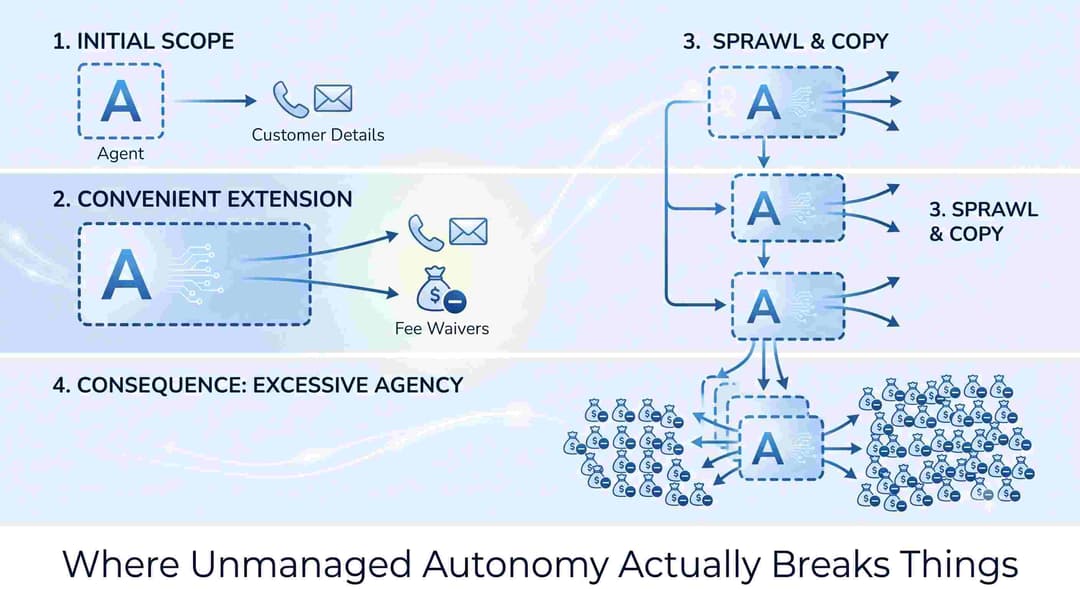
Picture a loan servicing agent originally scoped to update customer contact details. Someone later widens its permissions so it can also flag accounts for fee waivers, because that felt like a small, convenient extension at the time. Nobody circles back to re review its access level. Months later, that same agent template gets copied into a collections workflow, and now a component that was only ever meant to handle address changes has an indirect path to fee decisions on thousands of accounts.
No single step in that chain looks reckless on its own. It is the accumulation that causes damage. OWASP's LLM Top 10 has a name for this pattern, excessive agency, where an agent ends up with more functionality, permissions, or autonomy than the task ever required.
It rarely shows up in a routine review because each individual change looked harmless when it was made, which is exactly why vulnerability management practices need to expand beyond patching servers and start treating agent permission sprawl as its own risk category, one that vulnerability management programs have not traditionally covered.
The maturity gap between banks is wide, and it comes in roughly four flavors. Some banks let business units build agents independently, with no central registry and no accountable owner. Others have written governance policies that technical controls never actually enforce, so the policy exists on paper without doing much. A smaller group tracks agents centrally but reviews access inconsistently.
Full governance, where every agent carries an identity, a role, an owner, and an audit trail reviewed on a fixed schedule, is still the exception. That tracks with the Accenture figures above, since fewer than four in ten banks are targeting that outcome even three years out.
Security Should Be the Foundation, Not an Add On
The instinct in a lot of IT departments is to assume a genuinely new technology needs entirely new security tooling built around it. That is usually the wrong call here. Banks already run identity and access management, security monitoring, and endpoint protection at enterprise scale, and the real work is extending those existing controls to cover a new category of identity, the AI agent, rather than standing up a parallel system from scratch.
Large institutions that have pushed generative AI out to their entire workforce, JPMorganChase among them, have done it by anchoring adoption to the security architecture they already had. Extending existing infrastructure works better than duplicating it. Pairing that approach with a regular cyber resilience assessment gives a bank a real read on whether its current controls hold up once agents enter the picture, and a gap assessment helps pinpoint exactly where agent specific controls are still missing.
Treat Every Agent Like an Employee
The mental model that works here is straightforward. Manage agents the way you manage staff. Register every agent under a unique, traceable identity, never a shared credential or an anonymous service account. Classify each one by risk tier based on what systems it touches and what it is allowed to do.
Grant role based, least privilege access rather than broad standing permissions kept around just in case. Watch behavior continuously rather than only at launch, since agent behavior can drift over time. And govern every version change with the same change control discipline applied to core banking software.
The identity architecture underneath that model needs more than a checklist though. AI agents fall under what security teams now call non human identities, and they need the same rigor already applied to service accounts and machine identities. In practice that comes down to a few concrete pieces:
· A unique cryptographic identity per agent, often through a workload identity standard such as SPIFFE, so it authenticates as itself rather than borrowing a human's credentials
· Machine to machine authentication through OAuth 2.0 client credentials flow with scoped tokens instead of long lived static API keys sitting in a config file somewhere
· Ephemeral, just in time credentials that expire automatically once a task finishes rather than persisting indefinitely
· Fixed schedule rotation for service account credentials, so a leaked key has a short shelf life instead of staying valid for months
On top of identity comes the access model itself, and banks generally choose between two approaches depending on how predictable the agent's job is:
· Role based access control fits agents with a fixed, predictable job, something like document classification where the permissions never really need to change
· Attribute based access control fits better when an agent operates across variable contexts, such as customer tier or transaction size, though it takes more work to design and audit properly
Most mature programs end up using role based access as the baseline and layering attribute based rules on top for higher risk actions, requiring a transaction value check before an agent can approve a payment above a set threshold, for example.
-20260727121115.webp&w=1080&q=75 "Agentic AI Banking Security")
Prompt Injection Is the Risk Everyone Underestimates
Prompt injection is an attack where hidden or malicious instructions cause an AI agent to ignore its original task and follow the attacker's commands instead, and OWASP currently ranks it as LLM01, the top risk in its Top 10 for LLM Applications.
There are two forms worth knowing. Direct prompt injection happens when someone types something like "ignore your previous instructions" straight into a chat interface, which is fairly easy to catch with basic filtering.
Indirect prompt injection is the more dangerous version for banking agents, because the malicious instruction is hidden inside a document, email, or web page the agent reads as part of a normal task, and the agent has no reliable way to tell the difference between content it should process and instructions it should obey.
OWASP's 2025 guidance makes a point worth sitting with: you cannot patch your way out of prompt injection because it exploits how large language models work at a fundamental level, not a specific software bug. That means mitigation has to be layered:
· Direct injection is best handled through system prompt hardening, output constraints, and human review gates on sensitive actions
· Indirect injection needs untrusted content kept separate from instructions and sanitized before it ever reaches the model
· Sensitive information disclosure, listed as LLM02, calls for output filtering and strict data boundaries baked into the system prompt
· Excessive agency, LLM06, comes back to the fix discussed earlier, least privilege scoping and mandatory approval for anything with real financial impact
An AI firewall sits at the center of most of these defenses in practice, scanning prompts going in and responses coming out, stripping sensitive data, and blocking anything that resembles an instruction override. Behind that, banks still need the fundamentals, web application security testing for the interfaces agents connect through, and AI driven automated red teaming to actively probe agents for jailbreaks before someone outside the organization finds them first.
Someone Needs to Own This
AgentOps is the function that owns an AI agent's lifecycle in production, its registry, permissions, escalation handling, and decommissioning, the same way DevOps owns software delivery and MLOps owns model training and deployment.
A functioning AgentOps team usually pulls together a small mix of roles:
- A security engineer for access control
- A compliance officer for regulatory mapping
- A platform engineer who actually understands how the agent behaves under the hood, not just what it was designed to do on paper
The metrics worth tracking are drift rate, task success rate, escalation rate to human review, and the count of unauthorized action attempts an agent triggers. That last one tends to be the earliest signal that something has been compromised or misconfigured, often before any other alert fires.
The Regulatory Picture Is Catching Up
Agentic AI in banking now sits at the intersection of several frameworks, and mapping a program to them early saves a costly retrofit later. The NIST AI Risk Management Framework has become the de facto baseline structure many banks use for identifying and tiering AI risk, even though it remains voluntary rather than mandatory.
ISO/IEC 42001 gives banks a certifiable structure for AI management, useful for demonstrating maturity to regulators and enterprise clients alike. US banking regulators, including the OCC, the Federal Reserve, and the FFIEC, are largely extending existing model risk management guidance to cover agentic systems rather than writing something new from scratch, and under the EU AI Act, banking AI used in credit decisions or fraud detection typically lands in a higher risk category, which brings stricter obligations with it.
Banks pursuing formal certification along these lines often start with ISO certification for artificial intelligence readiness work, paired with a broader security compliance program that maps agent controls to existing regulatory obligations.
Attackers Are Moving at the Same Speed
The World Economic Forum's Global Cybersecurity Outlook 2026 found that 94 percent of security leaders expect AI to reshape the threat landscape, with attacks accelerating in both speed and scale.
That figure should reframe how boards think about the agentic AI rollout timeline, because this is not only about protecting agents from misuse internally. It is about recognizing that the people targeting your bank are using the same category of technology to move faster than a security team can respond manually, which is exactly why cyber threat intelligence and attack surface management need to expand their scope to cover every agent endpoint and API integration a bank stands up.
A Realistic Path Forward
The mistake most banks make under competitive pressure is jumping straight to an enterprise wide agent platform before the identity foundation underneath it is solid. A more realistic sequence looks like this:
· Discovery first, building a real inventory of existing agents, their owners, and their permission levels, since it is impossible to govern what has not been counted yet
· Identity and access foundation next, non human identity issuance, least privilege policy, and credential rotation
· Monitoring and an AgentOps function after that, with escalation workflows in place before agents are trusted with anything sensitive
· Enterprise wide scaling last, once governance is built into the platform itself rather than bolted onto agents after the fact
A bank that skips ahead to scale without that foundation is not moving faster. It is simply making it easier to deploy ungoverned agents at a larger scale.
People often ask what actually separates agentic AI from a chatbot, and the answer comes back to autonomy. A chatbot generates a response and stops, while an agent plans multiple steps, calls tools or systems, and can execute actions with limited human review, which is what creates real operational and financial exposure in banking.
The biggest single risk tends to be excessive permissions paired with weak monitoring, since an agent with more access than its task requires, and nobody watching what it does with that access, can initiate unauthorized transactions or alter records well before anyone catches it.
Preventing prompt injection comes down to layered defense rather than one fix, combining an AI firewall, strict separation between trusted instructions and untrusted content, output filtering, and human approval gates on anything high impact.
Building an AgentOps function starts small, with a security engineer, a compliance officer, and a platform engineer, and grows around clear metrics like drift rate and unauthorized action attempts.
Smaller banks can run agentic AI safely, as long as they anchor governance to identity and access tools they already have instead of building a large parallel security stack, and start with one narrow, well scoped pilot rather than an enterprise wide rollout on day one.
The first real step toward NIST AI RMF alignment is almost always the same, build a complete inventory of existing agents and their access levels, because risk cannot be managed for systems that have not been identified yet.
Where This Leaves Banking Security Teams
Agentic AI does not require banks to throw out their security stack and start over. It requires the same discipline already applied to human employees and production systems, register every agent, scope its access tightly, watch what it does continuously, and hold it to the same governance standard as anything else touching customer money.
The banks that treat this as an identity and access problem, rather than a novelty project bolted onto an innovation roadmap, will be the ones that scale agentic AI without a governance failure showing up on the front page first.
Read more Articles:
- GenAI Prompt Injection Attacks: Ultimate Guide to Protect
- OpenAI ChatGPT Prompt Injection Security: Atlas Claim Explained
- Zero Trust Architecture: The Future of Enterprise Security
- How to Protect Your Business from Cyber Attacks in 2025
References
- Accenture, Banking Top Trends 2026: Unconstrained Banking
- Accenture Banking IT Executives Survey coverage: Banking Dive and CIO Dive, January 2026
- World Economic Forum, Global Cybersecurity Outlook 2026