
CMMC compliance Illinois is no longer a future concern. As of November 10, 2025, Phase 1 of the Cybersecurity Maturity Model Certification program went live, and Department of Defense contracts across the state are already reflecting it. If your company touches any DoD work, from machining parts in Rockford to supplying logistics from Rock Island Arsenal, this certification now determines whether you can bid on federal contracts at all.
This guide is written for Illinois defense contractors, subcontractors, and small manufacturers who need clear, honest answers about what CMMC is, what it costs, how long it takes, and how to get moving without making expensive mistakes.
What is CMMC Compliance and Who Needs It in Illinois?
CMMC stands for Cybersecurity Maturity Model Certification. It is a framework created by the U.S. Department of Defense to ensure that every company in the defense supply chain properly protects sensitive government information.
Any Illinois company that holds a DoD contract and handles Federal Contract Information (FCI) or Controlled Unclassified Information (CUI) needs CMMC certification. This includes manufacturers, IT vendors, aerospace suppliers, logistics firms, and engineering contractors. If your contract flows through a prime like Boeing or Lockheed Martin, the requirement flows down to you too.
Bottom line: If your company has anything to do with a DoD contract in Illinois, you almost certainly need CMMC compliance.
Understanding the Cybersecurity Maturity Model Certification in 2026
Before 2025, many defense contractors self-attested to cybersecurity compliance. That system relied on the honor code. Predictably, it failed. The DoD found that a significant number of contractors were claiming compliance they had not actually achieved. CMMC was built to fix that.
The cybersecurity maturity model certification Illinois contractors must now meet is structured across three levels:
• Level 1 (Foundational): Covers 17 basic security practices. Applies to companies handling FCI only. Annual self-assessment required.
• Level 2 (Advanced): Covers all 110 security controls from NIST SP 800-171. Applies to companies handling CUI. Third-party assessment by a Certified Third-Party Assessor Organization (C3PAO) required every three years.
• Level 3 (Expert): Adds 24 advanced controls from NIST SP 800-172. Applies to the most sensitive national security programs. Government-led assessment required.
DoD data shows that 99% of certifications will be at Levels 1 and 2. Most Illinois defense contractors need Level 2.
Why Illinois Defense Contractors Face Unique Pressure
Illinois is one of the most active defense contracting states in the Midwest. The scale of the local defense industrial base is easy to underestimate.
Major military installations driving contract activity across the state include:
• Rock Island Arsenal (Rock Island) - one of the largest government-owned weapons manufacturers in the U.
• Scott Air Force Base (Belleville) - headquarters for U.S. Transportation Command
• Naval Station Great Lakes (North Chicago) - the Navy's only boot camp, with a large surrounding contractor ecosystem
• 182nd Airlift Wing (Rockford) - creating significant subcontractor demand in the Rockford aerospace and manufacturing sector
Prime contractors like Boeing maintain major operations in the Chicago metro area. Their supplier chains in Schaumburg, Aurora, Elgin, and Joliet now face direct flow-down requirements. Boeing has already told its suppliers that CMMC certification is a condition of continued business.
CMMC compliance for defense contractors in Illinois is not optional anymore. It is a contract condition.
How CMMC Phase 1 Affects Illinois Contractors Right Now
Phase 1 of the CMMC rollout runs from November 10, 2025 through November 9, 2026. Here is what that means practically:
• Self-assessments are appearing in new solicitations now. DoD contracting officers are including CMMC requirements in contracts during this phase.
• C3PAO third-party assessments can already be required. For high-priority acquisitions, DoD can mandate full third-party certification even during Phase 1.
• Prime contractors are not waiting. Lockheed Martin and Boeing have already issued compliance directives to their supply chains. Subs that cannot prove CMMC status are being cut from consideration.
The CMMC deadline Illinois contractors should care about is not some distant future date. The filtering is happening right now, in active procurement cycles.
Average preparation time for Level 2 certification is 6 to 12 months. If you have not started, you are already behind.
CMMC Level 1 vs Level 2: Quick Comparison
|
Factor |
Level 1 (Foundational) |
Level 2 (Advanced) |
|
Information type |
Federal Contract Info (FCI) |
Controlled Unclassified Info (CUI) |
|
Number of controls |
17 controls |
110 controls (NIST 800-171) |
|
Assessment type |
Annual self-assessment |
C3PAO third-party every 3 years |
|
SPRS filing required |
Yes |
Yes |
|
Average prep time |
1-3 months |
6-12 months |
|
Estimated cost (small biz) |
~$6,000 |
$30,000 - $105,000+ |
|
Who needs it |
FCI-only contractors |
Most IL defense contractors |
What is CUI and Does Your Illinois Company Handle It?
CUI, or Controlled Unclassified Information, is sensitive government data that is not classified but still requires protection. Many Illinois manufacturers handle CUI without realizing it.
Common examples of CUI in defense contracting include:
• Engineering drawings and technical specifications
• Defense-related design files and CAD data
• Military personnel records
• Contract performance data and bid information
• Export-controlled technical data (often overlapping with ITAR requirements)
If your company receives any of these categories from a DoD prime or government agency, you almost certainly handle CUI and need CMMC Level 2 certification. CUI compliance Illinois is not a gray area. Check your contract language and talk to a qualified consultant if you are unsure.
What is NIST 800-171 and How Does It Connect to CMMC?
NIST SP 800-171 is the security control framework published by the National Institute of Standards and Technology. It defines 110 security controls across 14 practice domains. CMMC Level 2 is built entirely on NIST 800-171 compliance.
The 14 domains include:
• Access Control
• Awareness and Training
• Audit and Accountability
• Configuration Management
• Identification and Authentication
• Incident Response
• Maintenance
• Media Protection
• Personnel Security
• Physical Protection
• Risk Assessment
• Security Assessment
• System and Communications Protection
• System and Information Integrity
NIST 800-171 compliance Illinois contractors pursue is essentially the prerequisite for CMMC Level 2 certification. If you are starting from scratch, begin with a NIST 800-171 gap assessment. Many consultants offering NIST 800-171 consulting Chicago and statewide can help you map your current controls against these 110 requirements.
What is an SPRS Score and Why Does It Matter?
The Supplier Performance Risk System (SPRS) is the DoD database where contractors file their self-assessment scores. Your SPRS score is a number between -203 and +110, representing how fully you meet NIST 800-171 requirements.
DoD contracting officers review SPRS scores before awarding contracts. A low or missing score is a red flag. A zero score often signals that a contractor has not even started their compliance process.
To improve your SPRS score Illinois contractors should:
1. Conduct a formal gap assessment against all 110 NIST 800-171 controls
2. Remediate identified gaps and implement missing security controls
3. Document everything in a System Security Plan (SSP)
4. File your score directly in the SPRS portal at sprs.pm.dla.mil
5. Maintain a Plan of Action and Milestones (POA&M) for any unresolved gaps
SPRS scoring defense contractors should know: the DoD assumes you have already implemented NIST 800-171 if you are in a contract with DFARS 7012 requirements. Filing an honest score is better than not filing at all
What is a CMMC Gap Assessment and Do You Need One?
A CMMC gap assessment is a structured evaluation of your company's current cybersecurity posture against CMMC Level requirements. It identifies which controls you already meet, which controls you are missing, and what steps you need to take before a formal certification assessment.
Think of it as a practice test before the real exam.
A quality CMMC gap assessment Illinois contractors can rely on will deliver:
• A full inventory of your information systems and data flows
• A control-by-control analysis against NIST 800-171
• A prioritized remediation roadmap
• A draft System Security Plan (SSP)
• A Plan of Action and Milestones (POA&M) for unresolved items
CMMC gap analysis for defense contractors typically costs between $5,000 and $25,000 depending on company size and complexity. This is money well spent. It prevents expensive surprises during the formal C3PAO assessment.
Step-by-Step: How to Get CMMC Certified in Illinois
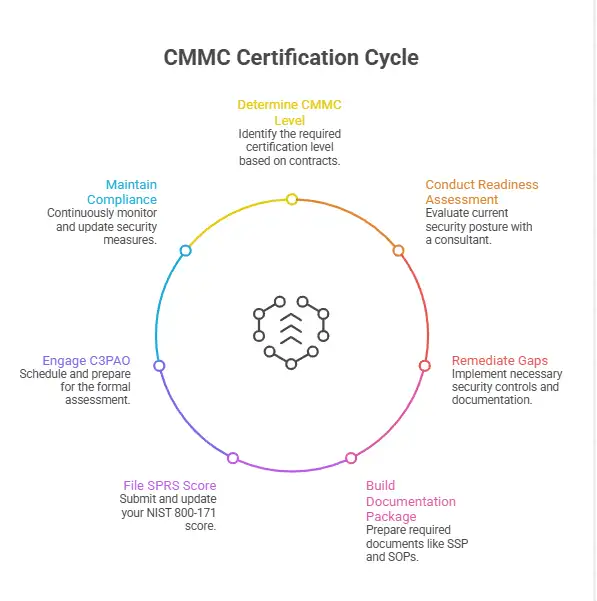
Step 1: Determine Your Required CMMC Level
Check your contracts and talk to your prime contractor or DoD contracting officer. If your contract mentions FCI, you need Level 1. If it mentions CUI or references DFARS 252.204-7012, you need Level 2. When in doubt, assume Level 2.
Step 2: Conduct a CMMC Readiness Assessment
Hire a qualified CMMC consultant or Registered Practitioner Organization (RPO) to run a formal gap assessment. This gives you an accurate picture of where you stand before spending money on remediation.
Step 3: Remediate the Gaps
Based on your gap assessment results, implement missing security controls. This includes technical fixes like multi-factor authentication, encryption, and access controls, as well as documentation work like writing policies and procedures. CMMC implementation in Illinois takes most small businesses 3 to 9 months at this stage.
Step 4: Build Your Documentation Package
Required CMMC SSP documentation Illinois contractors must prepare includes a complete System Security Plan, Standard Operating Procedures (SOPs), an Incident Response Plan, and a POA&M. Many consultants offer a CMMC compliance checklist and CMMC policy template to help structure this.
Step 5: File Your SPRS Score
Before your formal assessment, file your current NIST 800-171 score in the SPRS system. Update it as you remediate gaps.
Step 6: Engage a C3PAO for Level 2 Assessment
For Level 2, you must be assessed by a Certified Third-Party Assessor Organization. There are currently around 70 authorized C3PAOs nationwide. Engaging a CMMC C3PAO Illinois contractors work with requires planning, as wait times are growing. Many companies use a CMMC RPO or CMMC registered practitioner to prepare before the formal C3PAO audit preparation phase.
Step 7: Maintain Continuous Compliance
CMMC certification is not a one-time event. CMMC continuous monitoring Illinois programs offered by managed security service providers help you maintain your posture between assessments. Annual self-assessments are required even at Level 2.
Do Illinois Defense Subcontractors Need CMMC?
Yes. This is one of the most misunderstood aspects of the program.
CMMC flow down requirements mean that prime contractors must pass the CMMC obligation down to their subcontractors. If you supply to a Boeing, Northrop Grumman, or General Dynamics tier in Illinois, your prime contractor is required to ensure you are CMMC compliant. CMMC subcontractor compliance Illinois is not optional even if you never sign a direct government contract.
This also applies to lower-tier suppliers. If a subcontractor passes work to another vendor, the compliance requirement flows further down the CMMC supply chain compliance chain.
Do not wait for your prime to tell you what level you need. Review your teaming agreements and subcontract language today.
Can a Small Business Afford CMMC Compliance in Illinois?
This is the question we hear most often. And the honest answer is: it depends on your current security posture, but it is almost always achievable with the right plan.
CMMC for small business Illinois does not have to be a budget crisis. Options that reduce cost and complexity include:
• CMMC Enclave Solutions: A CMMC enclave is an isolated network segment where CUI is processed and stored. It limits the scope of your assessment to the enclave only, dramatically reducing the number of systems that need to meet compliance requirements. A CMMC enclave solution Illinois companies can implement through an MSSP is often the fastest path to certification.
• CMMC Compliant Cloud: Moving CUI handling to a FedRAMP-authorized cloud environment reduces the technical controls your internal team must manage directly.
• Managed Services: CMMC managed services Illinois providers can handle ongoing monitoring, security operations, and documentation updates for a predictable monthly fee. This is often cheaper than hiring in-house security staff.
• vCISO Services: A virtual CISO for defense contractors Illinois provides executive-level security leadership without the full-time salary. Many small businesses use vCISO services to lead their CMMC program from gap assessment through certification.
CMMC compliance small defense contractors can realistically pursue Level 2 with a budget of $40,000 to $80,000 total across a 12-month period, including assessment fees, depending on starting maturity.
CMMC Compliance Cost in Illinois: What to Budget
|
Cost Item |
Low Estimate |
High Estimate |
Notes |
|
Gap Assessment |
$5,000 |
$25,000 |
Depends on company size |
|
Remediation (technical) |
$10,000 |
$50,000 |
Varies by gap count |
|
Documentation (SSP, SOPs) |
$3,000 |
$15,000 |
Many consultants include this |
|
C3PAO Assessment Fee |
$5,000 |
$30,000 |
Only for Level 2 |
|
CMMC Enclave Setup |
$8,000 |
$40,000 |
Reduces long-term scope |
|
Ongoing MSSP/Monitoring |
$1,500/mo |
$5,000/mo |
Annual recurring cost |
|
vCISO Services |
$2,000/mo |
$7,000/mo |
Optional but high-value |
CMMC assessment cost Illinois contractors face for a full Level 2 engagement typically lands between $30,000 and $105,000 total when combining gap assessment, remediation, and C3PAO fees. These are DoD estimates. Your actual number depends heavily on your starting security maturity.
CMMC Compliance Across Illinois: City-by-City Context
Chicago
Chicago-area defense contractors range from Boeing's major operations to hundreds of aerospace and technology suppliers in the O'Hare corridor. CMMC compliance Chicago searches have grown sharply since November 2025. Suburbs like Schaumburg, Aurora, Elgin, and Joliet each host defense manufacturing operations that now require compliance. Cybersecurity compliance for DoD contractors in the greater Chicago Hoplon infosec is one of the most active local compliance markets in the Midwest.
Rockford
Rockford's defense sector revolves around the 182nd Airlift Wing and major employers like Collins Aerospace and Woodward. CMMC compliance Rockford IL is especially critical for companies supporting these operations. ITAR compliance intersects heavily with CMMC here, as many Rockford manufacturers produce export-controlled defense articles. CMMC compliance for aerospace defense contractors in the Rockford area is among the most underserved and highest-opportunity markets in Illinois.
Rock Island and the Quad Cities
Rock Island Arsenal is one of the most significant DoD installations in the country. CMMC compliance Rock Island Arsenal contractors face specific requirements tied to the Arsenal's manufacturing mission. The surrounding contractor ecosystem includes dozens of small and mid-size manufacturers that may not realize they fall under the CMMC umbrella.
Belleville and Scott Air Force Base
CMMC compliance Scott Air Force Base is critical for companies supporting U.S. Transportation Command. Many logistics, IT, and professional services firms in the Metro East region hold contracts flowing through Scott AFB. This is one of the most overlooked compliance markets in Illinois.
Other Illinois Cities
CMMC compliance Peoria IL, CMMC compliance Springfield IL, CMMC compliance Waukegan IL, and CMMC compliance Decatur IL each represent active or emerging DIB markets. Waukegan sits near Naval Station Great Lakes, creating contractor demand in Lake County. CMMC compliance Naval Station Great Lakes affects a wide range of North Chicago-area vendors.
Common CMMC Mistakes Illinois Contractors Make
Mistake 1: Waiting Until a Contract Requires It
By the time a contract arrives requiring CMMC Level 2, you have already lost the window. Preparation takes 6 to 12 months. Starting after the requirement appears means you cannot bid on that contract.
Mistake 2: Underestimating Documentation Requirements
Technical controls are only half the work. The SSP alone can run hundreds of pages for a mid-size company. Companies that skip documentation prep often fail their C3PAO assessment and must restart the process.
Mistake 3: Using Unqualified Consultants
Not every IT firm or compliance consultant is qualified for CMMC work. Seek out firms with Certified CMMC Professionals (CCPs) or Registered Practitioners (RPs) authorized by the Cyber Accreditation Body. Unqualified guidance can leave gaps that fail an assessment.
Mistake 4: Ignoring DFARS 7012 Obligations Already in Your Contracts
DFARS 7012 compliance requires contractors to report cyber incidents and implement NIST 800-171 controls. Many Illinois companies are already bound by this clause and do not realize it. CMMC compliance builds on these existing obligations. If you are not meeting DFARS 7012 requirements today, CMMC is not your first problem.
Mistake 5: Forgetting Subcontractor Obligations
If you are a prime, you are responsible for ensuring your subs are compliant. If you are a sub, you cannot assume your prime will tell you what you need. CMMC supply chain compliance flows both directions.
Field Notes: What We See When Working With Illinois Defense Contractors
When we run initial readiness assessments with Illinois manufacturers, the gaps cluster in a few consistent places. Access control and multi-factor authentication are almost universally incomplete. System Security Plans either do not exist or were written years ago and never updated. And SPRS scores, when they have been filed at all, often do not match the actual security posture.
We also see a lot of companies that handle CUI on personal laptops, shared drives, and email without any formal data handling procedures. This is an immediate red flag for any C3PAO assessor.
The companies that get through CMMC Level 2 certification with the least pain are the ones that treat the process like a business improvement project, not a compliance checkbox. They involve their IT team early, get executive buy-in on the cost, and budget for ongoing managed security, not just the initial certification.
Defense contractor cybersecurity Illinois is a specialized field. The best outcomes we have seen come from companies that partner with a firm that has defense-specific experience, not a general IT managed service provider that picked up CMMC as an add-on service.
Expert Tips for CMMC Compliance Success in Illinois
• Start with your SPRS score: File an honest self-assessment score immediately, even if it is low. A zero in SPRS is worse than a negative score in many procurement contexts.
• Scope before you spend: Define your assessment boundary before buying any new security tools. A CMMC enclave can dramatically reduce scope and cost.
• Ask your prime early: Contact your prime contractor and ask explicitly what CMMC level they are requiring from subs. Get it in writin
• Train your team: CMMC security awareness training is a required control (Practice AT.2.056). Do not skip it. Employees who understand why the controls matter make better compliance partners.
• Budget for the second year: Many companies get CMMC certified and then watch their posture decay. Build CMMC IT services and continuous monitoring into your annual budget.
• Consider ITAR overlap: If your company exports defense articles or services, ITAR CMMC compliance Illinois involves two separate regulatory frameworks. Address them together, not sequentially.
CMMC Compliance Checklist for Illinois Defense Contractors
• Confirm your required CMMC level (check contracts, talk to prime or contracting officer)
• Identify all systems that store, process, or transmit FCI or CUI
• Engage a qualified CMMC RPO or CCP for a formal gap assessment
• File your initial SPRS score in the DoD SPRS portal
• Build or update your System Security Plan (SSP)
• Create a Plan of Action and Milestones (POA&M) for all gaps
• Implement required technical controls (MFA, encryption, access controls, logging)
• Complete CMMC security awareness training for all personnel with system access
• Evaluate whether a CMMC enclave or compliant cloud solution fits your environment
• Engage a C3PAO for your Level 2 assessment (book 2 to 4 months ahead)
• Establish ongoing CMMC continuous monitoring or managed services
• Review subcontractor agreements and ensure flow-down requirements are documented
Trusted Sources and Official References
The following official sources should be consulted for the most current CMMC requirements, timelines, and assessment procedures:
• Department of Defense CIO CMMC Program
• DoD SPRS Self-Assessment Portal
• NIST SP 800-171 Rev 2 (the CMMC Level 2 control set)
The Bottom Line on CMMC Compliance Illinois
CMMC compliance Illinois is the new cost of doing business with the Department of Defense. The phased rollout is not a grace period. It is a countdown.
Companies that started their CMMC readiness assessment in 2024 are now either certified or close to it. Companies that are starting today are 6 to 12 months away from Level 2 readiness. Companies that have not started are already losing contract opportunities they do not know they are missing.
The good news is that Illinois has a strong ecosystem of qualified CMMC consultants, C3PAOs, and managed security service providers who understand the specific needs of defense manufacturers, aerospace suppliers, and technology contractors in this state. Whether you are in Chicago, Rockford, Rock Island, or anywhere in between, qualified help is available.
Start with a gap assessment. File an honest SPRS score. Build a realistic plan. The companies that approach CMMC as a business asset, not just a regulatory burden, will be the ones winning DoD contracts when their non-compliant competitors cannot even get in the door.




-20260925120840.webp&w=3840&q=75)