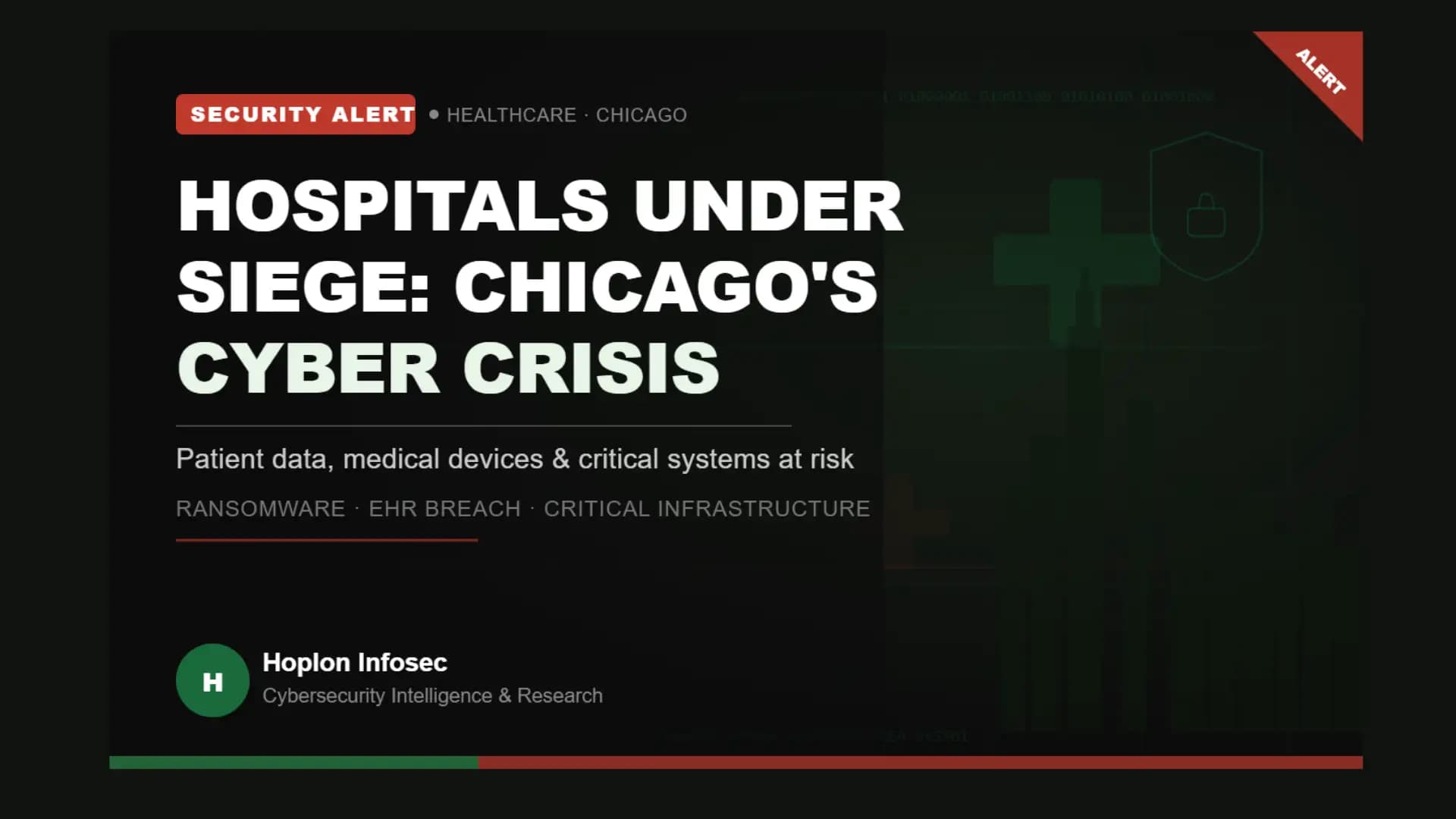
Hospitals and clinics do not get the luxury of “later.” One bad login, one weak email click, or one unpatched system can turn into a locked network, delayed care, and a very bad week for everyone involved. That is why cybersecurity for healthcare in Chicago is not just an IT topic. It is a patient safety issue.
What does cybersecurity for healthcare in Chicago mean?
It means protecting medical data, staff accounts, connected devices, cloud systems, and internal networks so a hospital or clinic can keep operating safely. In practice, that includes HIPAA safeguards, risk analysis, monitoring, training, backups, and fast incident response. HHS says the HIPAA Security Rule requires administrative, physical, and technical safeguards for electronic protected health information, while CISA publishes healthcare guidance built for the sector.
For Chicago healthcare organizations, the question is simple. Can your team prevent a breach, detect it fast, and keep patient care moving if something goes wrong? That is the standard that matters in 2026. HHS also continued updating Security Rule guidance in April 2026, and its January 2026 newsletter stressed accurate risk analysis and the danger of unpatched software.
Why this matters
Healthcare is treated as critical infrastructure, and federal agencies continue to warn the sector about ransomware, phishing, and weak access control. CISA’s healthcare pages focus on building a cyber-ready workforce, strengthening defenses, and preparing for incidents. The FBI also advises organizations to report active cybercrime through IC3 or a local field office.
Why it matters for Chicago providers
Chicago hospitals, specialty practices, outpatient centers, and clinics all hold sensitive records, move fast, and often depend on legacy systems, outside vendors, and 24/7 availability. That mix makes cybersecurity for healthcare in Chicago a high-urgency search for any team that wants to protect revenue, reputation, and patient trust. NIST’s Cybersecurity Framework 2.0 is built to help organizations manage risk across govern, identify, protect, detect, respond, and recover functions.
Why do healthcare organizations in Chicago need stronger cybersecurity now?
Because attackers usually go after the easiest path, not the biggest target. In healthcare, that path is often a rushed employee, a reused password, an exposed remote access portal, or a system that was never patched on time. HHS requires risk analysis for ePHI, CISA warns healthcare organizations to strengthen readiness, and the FBI treats ransomware as a serious and growing criminal threat.
If your organization handles patient records, scheduling, billing, imaging, telehealth, or connected devices, then cybersecurity for healthcare in Chicago should be treated as part of care delivery, not just IT maintenance.
-20260520191226.webp&w=1080&q=75 "healthcare cybersecurity protection for patient records")
What usually breaks first?
Here is the pattern we see most often in healthcare environments:
Email security fails first, usually through phishing or account takeover.
Access control fails next, especially when too many staff members share broad privileges.
Endpoints and servers become easy targets when patching is slow.
Backups turn out to be incomplete, disconnected, or untested.
Incident response is missing, so the team wastes time deciding what to do.
That sequence lines up with the safeguards HHS and CISA emphasize, especially risk analysis, training, access control, monitoring, and recovery planning.
Key technical details
|
Area |
What matters most |
Why it matters |
|
HIPAA Security Rule |
Administrative, physical, and technical safeguards |
This is the core compliance baseline for ePHI. |
|
Risk analysis |
Find threats, gaps, and exposed systems |
HHS says accurate risk analysis is the first step. |
|
Framework |
NIST CSF 2.0 |
Helps organize governance, protection, detection, response, and recovery. |
|
Incident reporting |
FBI IC3 or local field office |
Important when active cybercrime is underway. |
|
Sector guidance |
CISA healthcare resources |
Built for hospitals and public health entities. |
What this looks like in a real healthcare environment
A clinic may think the risk is just a phishing email. In reality, one click can expose the inbox, then the appointment system, then the billing tools, then the shared drive with patient files. That is why cybersecurity for healthcare in Chicago has to cover people, processes, and technology together. HHS and CISA both frame security as layered protection, not a single product.
The biggest threats healthcare teams keep facing
1. Phishing and credential theft
A fake login page or urgent email can give attackers direct access. That is still one of the cheapest ways in.
2. Ransomware
Ransomware can lock files, interrupt care, and force the team into emergency recovery mode. The FBI continues to treat ransomware as a major threat.
3. Unpatched systems
HHS specifically called out unpatched software in its January 2026 cybersecurity newsletter. That is a simple weakness with expensive consequences.
4. Weak vendor control
Healthcare depends on vendors for billing, labs, imaging, and cloud tools. One weak vendor can become everyone’s problem.
5. Poor recovery planning
Backups that are never tested are not real backups.

What a strong healthcare security stack should include
For cybersecurity for healthcare in Chicago, the strongest stack usually includes
Multi-factor authentication for email, VPN, cloud apps, and admin accounts
Risk analysis that maps ePHI, users, vendors, and devices
Endpoint detection and response
Email filtering and anti-phishing controls
Network segmentation
Regular patch management
Encrypted backups
Security awareness training
Incident response playbooks
24/7 monitoring or SOC support
CISA and HHS both stress layered defense, readiness, and practical response planning for healthcare organizations.
Step by step: how to protect your system
Step 1: Map every place patient data lives
Start with EHRs, EMRs, email, file shares, cloud storage, backup systems, and vendor portals. Why it matters: you cannot protect what you have not found. HHS says risk analysis is the first step.
Step 2: Turn on MFA everywhere possible
Email and admin accounts should never rely on passwords alone. Why it matters: stolen passwords are still a fast path into healthcare networks. CISA recommends strong layered defenses for the sector.
Step 3: Segment the network
Keep billing, guest Wi-Fi, medical devices, and administrative systems separated. Why it matters: If one area is hit, the blast radius stays smaller.
Step 4: Test backups; do not just store them
Run a restore test on real data. Why it matters: ransomware recovery depends on speed, not hope.
Step 5: Train staff to spot phishing
Make the training short, repeated, and realistic. Why it matters: people are still the first target in most healthcare breaches.
Step 6: Build an incident response path
Know who isolates machines, who contacts leadership, who talks to legal, and who reports externally. Why it matters: The first hour after an event shapes the whole recovery. FBI guidance makes it clear that active cyber incidents should be reported quickly.
Quick comparison table
|
Option |
Best for |
Strength |
Common mistake |
|
MFA only |
Basic access hardening |
Stops many simple account attacks |
Thinking it is enough by itself |
|
Managed security services |
Small or mid sized teams |
Adds monitoring and response coverage |
Buying it without clear SLAs |
|
Pen testing |
Finding weaknesses before attackers do |
Gives real attack style insight |
Treating it like a one time checkbox |
|
SOC monitoring |
Fast detection and escalation |
Helps catch threats early |
Not connecting alerts to action |
|
Backup and recovery |
Ransomware resilience |
Keeps operations moving |
Never testing restoration |
Common mistakes that hurt healthcare teams
Treating compliance as the finish line
HIPAA compliance matters, but compliance is not the same thing as being secure. The Security Rule gives a baseline, not a guarantee. HHS frames the rule around safeguards and risk management, which means ongoing work matters.
Leaving old systems exposed
Older software, forgotten test servers, and old accounts are easy to miss. HHS continues to stress risk analysis because those blind spots are where trouble hides.
Ignoring third-party access
A vendor login that is too broad can be just as risky as an internal one.
Waiting until after a breach to build a plan
That delay is expensive. CISA and the FBI both push readiness before the incident, not after it.
Expert tips from the field
Our team sees better results when healthcare organizations do three things early:
Start with a clean asset inventory.
Put MFA on the most sensitive accounts first.
Test one recovery scenario every quarter.
A lot of teams try to buy tools first. That usually creates noise. The cleaner move is to define what matters most, then protect that first. NIST CSF 2.0 supports that kind of risk-based approach.
-20260520191214.webp&w=1080&q=75 "how healthcare organizations stop ransomware attacks")
Field Notes
When we review a healthcare environment, the first weak spot is often not the firewall. It is the small stuff. A shared inbox. A forgotten admin account. A backup job that has not been tested in months. That is why cybersecurity for healthcare in Chicago works best when the team focuses on practical controls, not just software labels.
How to choose the right partner
If you are comparing providers for cybersecurity for healthcare in Chicago, look for these signs:
They understand HIPAA and ePHI.
They can explain risk analysis clearly.
They offer monitoring or response support.
They know how to work with medical workflows.
They can show real case work or a clear process.
HHS, CISA, and NIST all point toward structured risk management, not vague promises. A good provider should sound specific, not flashy.
Best step-by-step plan for the next 30 days
Inventory systems and data flows.
Turn on MFA for critical accounts.
Review patch status.
Test backups.
Run a phishing awareness refresh.
Draft a simple incident response contact tree.
Schedule a risk assessment.
Review vendor access.
This is the kind of practical work that supports cybersecurity for healthcare in Chicago without drowning the team in jargon. HHS says risk analysis is foundational, and CISA recommends readiness and workforce preparation.
Why local expertise matters
A Chicago-based healthcare team often needs fast coordination, practical guidance, and someone who understands how busy clinical operations really are. Local experience helps because security changes need to fit appointment schedules, staff shifts, and patient care workflows. That is where cybersecurity for healthcare in Chicago becomes a business decision, not just a technical one.
FAQ
Why is healthcare a target for cybercriminals?
Because healthcare data is valuable, systems must stay available, and downtime is hard to tolerate. CISA and the FBI both treat the sector as a high-risk target.
What is HIPAA cybersecurity compliance?
It is the set of administrative, physical, and technical safeguards required to protect ePHI. HHS describes this in the HIPAA Security Rule.
How do hospitals protect patient data?
They use layered controls like MFA, risk analysis, segmentation, training, backups, and monitoring. HHS and CISA both support that approach.
What should a healthcare team do after a cyber incident?
Contain the issue, protect patient operations, preserve evidence, and report through the proper channels. FBI guidance says active incidents should be reported to IC3 or a local field office.
Healthcare organizations in Chicago need layered protection because HIPAA compliance alone is not enough. Strong security means risk analysis, MFA, backups, staff training, monitoring, and fast incident response. HHS, CISA, and NIST all support that approach.
Wrap Up
The teams that win here do not wait for a breach to learn the lesson. They build a simple, disciplined plan, test it, and keep improving it. If your organization is serious about cybersecurity for healthcare in Chicago, the next step is a risk review, a backup test, and a clear response plan. That is how you protect patients, operations, and trust.
"Cybersecurity for healthcare in Chicago" should be the phrase that starts the conversation, not the one you search for after the damage is done.
Most healthcare organizations do not realize how exposed they are until something breaks.
One compromised account can interrupt appointments, delay treatment, expose patient data, and damage trust that took years to build.
If your organization has not reviewed its healthcare security posture recently, now is the right time to start.
Hoplon Infosec can help you identify hidden risks, strengthen HIPAA security controls, and build a practical defense strategy that fits how healthcare teams actually work.
A quick security assessment today is a lot cheaper than recovering from a ransomware attack tomorrow.