
OpenAI GPT-5.4: What Makes It Different From Previous AI Models?
What happens when an AI model is no longer limited to answering questions, but can also reason through a problem, write and debug code, use software tools, and work across long, complicated workflows?
That is the idea behind OpenAI GPT-5.4.
OpenAI released GPT-5.4 on March 5, 2026, describing it as its most capable and efficient frontier model for professional work at launch. The model brought together advances in reasoning, coding, tool use, and agentic workflows in a single model rather than treating these capabilities as separate systems.
The change is important because professional work rarely happens in one step.
A developer may need to understand a requirement, inspect an existing codebase, write code, test it, investigate an error, and then update the application. An analyst may need to examine spreadsheets, research information, prepare calculations, and create a presentation.
GPT-5.4 was designed around these kinds of workflows.
OpenAI also introduced native computer-use capabilities for GPT-5.4 in the API and Codex, allowing agents to interact with software environments using screenshots, keyboard and mouse actions, and other tools. The API version supports a context window of up to 1 million tokens in supported configurations.
That does not mean GPT-5.4 can safely perform every task without supervision. It means the model can participate in longer, more complex digital workflows with fewer manual handoffs.
And that creates a new cybersecurity question.
The more an AI system can see, understand, and do, the more important it becomes to control its permissions, tools, data, and actions.
What is OpenAI GPT-5.4?
OpenAI GPT-5.4 is a general-purpose frontier AI model designed for professional work across reasoning, coding, computer use, and tool-based workflows.
OpenAI released GPT-5.4 in ChatGPT as GPT-5.4 Thinking,
through the API as gpt-5.4,
and in Codex. OpenAI also released GPT-5.4 Pro for users and developers who
need higher performance on complex tasks.
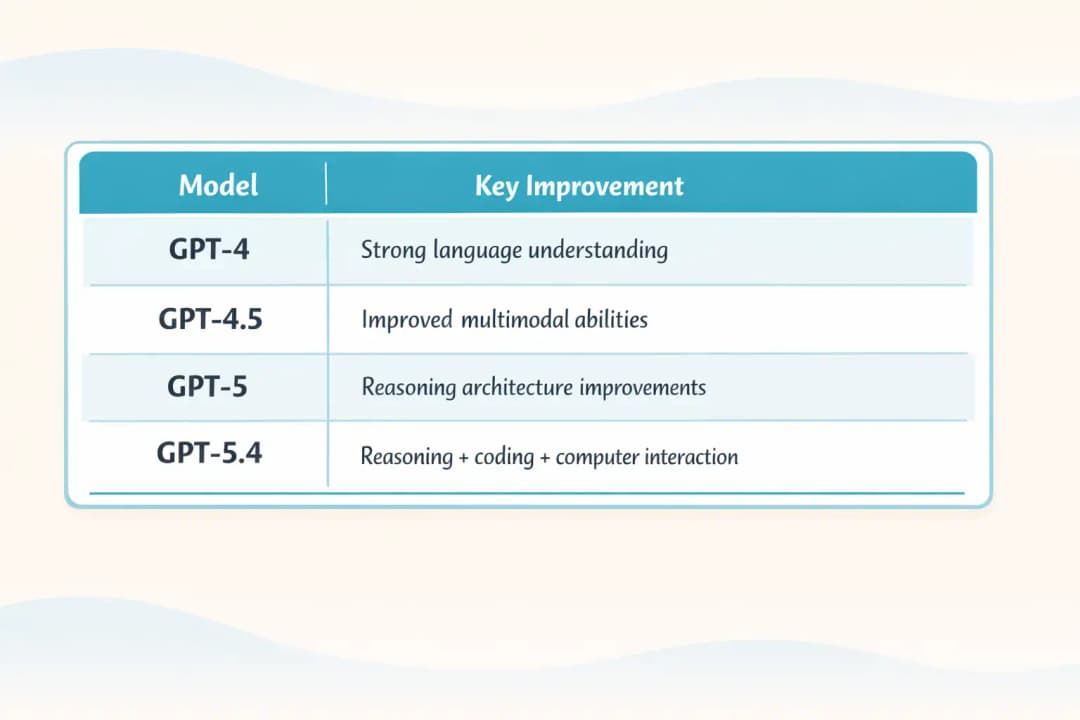
The model builds on capabilities from earlier GPT systems while incorporating the coding strengths of GPT-5.3-Codex.
That combination is one of the most important parts of the release.
Instead of having one model for reasoning and another specialized system for coding or agentic work, GPT-5.4 was designed to handle those capabilities within a unified model.
Why the Unified Approach Matters
Consider a typical software task.
A user might start by asking an AI system to understand a bug report. The next step could involve inspecting source code. Then the system may need to propose a fix, run tests, analyze the results, and revise the code.
Those steps are connected.
GPT-5.4 is designed to maintain context across this type of longer workflow while using tools and interacting with software environments.
This is where the model differs from a traditional chatbot.
It is not simply about producing a better paragraph or answering a single question. The broader goal is to make AI more useful for work that involves multiple connected actions.
Key Features of GPT-5.4
Several capabilities make GPT-5.4 notable.
1. Advanced Reasoning
GPT-5.4 Thinking is designed to spend more time working through difficult problems rather than immediately producing an answer.
In ChatGPT, the model can provide an upfront plan for longer tasks. Users can also redirect the work while the model is still processing the request instead of necessarily starting the task again from scratch.
This matters for complex work because the first interpretation of a problem is not always the right one.
For example, a user working on a large research or coding task can clarify an assumption while the model is working.
The model can then adjust its approach.
This makes the interaction more iterative and useful for professional workflows.
2. Stronger Coding
GPT-5.4 incorporates the coding capabilities developed with GPT-5.3-Codex.
OpenAI reported a 57.7% score on SWE-Bench Pro (Public) for GPT-5.4. The same release reported 56.8% for GPT-5.3-Codex and 55.6% for GPT-5.2 on that benchmark.
The practical value goes beyond a benchmark number.
GPT-5.4 can help developers:
- Understand existing code
- Generate new code
- Debug problems
- Work through larger software tasks
- Use development tools
- Iterate after testing
- Work with visual interfaces
- Connect reasoning with computer-use actions
That combination can reduce the number of separate steps a developer has to perform manually.
For cybersecurity teams, this capability can also be useful for defensive automation, security analysis, and development of internal security tools. However, code generated by an AI model still needs testing and security review before production use.
3. Native Computer Use
One of the most significant GPT-5.4 capabilities is computer use.
OpenAI describes GPT-5.4 as its first general-purpose model with native computer-use capabilities. In the API and Codex, the model can work with computer environments using screenshots and keyboard and mouse interactions.
This changes the relationship between an AI model and software.
A traditional chatbot might tell someone which buttons to click.
A computer-using AI can potentially interact with the interface itself.
That makes it possible to build agents that perform multi-step tasks across applications.
For example, an agent could potentially:
- Read information from a business system.
- Analyze the information.
- Open another application.
- Enter approved information.
- Review the result.
- Continue to the next step.
The important word here is approved.
Computer-use capability does not remove the need for access controls or human oversight.
The model may be capable of interacting with software, but organizations still need to decide what the AI is allowed to access and which actions require confirmation.
OSWorld-Verified Results
OpenAI reported a 75.0% success rate on OSWorld-Verified for GPT-5.4, compared with 74.0% for GPT-5.3-Codex and 47.3% for GPT-5.2 in the comparison published with the release. OpenAI also reported a 72.4% human performance reference for the benchmark.
The result is significant because OSWorld-Verified evaluates an AI system's ability to work with computer interfaces rather than simply answering text questions.
Still, a benchmark result should not be interpreted as proof that an AI agent will safely complete arbitrary real-world tasks.
Real environments contain permissions, unexpected application behavior, confidential information, and business rules that benchmarks cannot fully reproduce.
4. Better Tool Use
GPT-5.4 also improves how AI agents work with external tools.
OpenAI introduced tool search in the API, allowing GPT-5.4 to work with larger collections of tools without requiring every tool definition to be included in the prompt at the beginning.
This matters because modern AI agents can depend on many external services.
An enterprise agent might have access to:
- Internal databases
- CRM systems
- Cloud services
- Ticketing platforms
- Documentation
- Search systems
- File storage
- Communication tools
- Security platforms
The larger the tool ecosystem becomes, the harder it is to manage manually.
Better tool selection can make agents more practical, but it also increases the importance of tool permissions.
An AI agent should not automatically receive unrestricted access simply because it can technically use a particular tool.
5. Large Context and Longer Workflows
GPT-5.4 is designed to maintain context across complex tasks.
In Codex and the API, OpenAI says GPT-5.4 supports up to 1 million tokens of context in supported configurations.
A larger context window can be useful when working with:
- Large codebases
- Long technical documents
- Research materials
- Multiple files
- Extended conversations
- Complex project instructions
- Multi-step workflows
The benefit is not simply that the model can "remember everything."
The real advantage is that more relevant information can remain available while the model works through a longer task.
That can reduce the need to repeatedly provide the same background information.
GPT-5.4 Benchmark Results
Benchmarks provide one way to understand the model's capabilities, although they should always be interpreted in context.
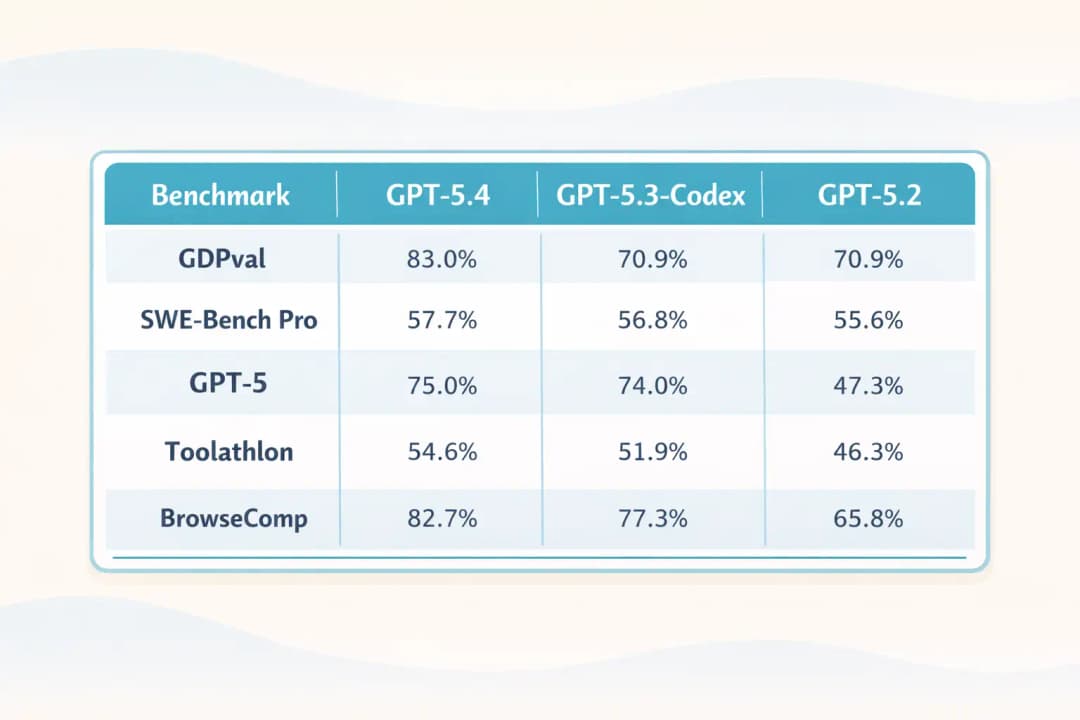
OpenAI reported the following results in its GPT-5.4 release:
|
Benchmark |
GPT-5.4 |
GPT-5.3-Codex |
GPT-5.2 |
|
GDPval |
83.0% |
70.9% |
70.9% |
|
SWE-Bench Pro (Public) |
57.7% |
56.8% |
55.6% |
|
OSWorld-Verified |
75.0% |
74.0% |
47.3% |
|
Toolathlon |
54.6% |
51.9% |
46.3% |
|
BrowseComp |
82.7% |
77.3% |
65.8% |
These are OpenAI's reported evaluation results from the March 5 release. Different benchmarks measure different capabilities, so no single number represents overall real-world performance.
GDPval
GDPval measures performance on professional tasks.
OpenAI reported an 83.0% result for GPT-5.4 on GDPval, based on its stated evaluation methodology.
The result is relevant because professional AI use is moving beyond simple question answering.
The challenge is no longer only whether a model can generate text.
It is whether the model can complete useful work.
GPT-5.4 and AI Accuracy
AI models can produce incorrect information even when they sound confident.
OpenAI reported that GPT-5.4 reduced factual errors compared with GPT-5.2 in its internal evaluation. According to OpenAI, individual claims were 33% less likely to be false, while complete responses were 18% less likely to contain errors on the tested set of de-identified prompts where users had previously flagged factual errors.
These figures are useful, but they should not be interpreted as meaning GPT-5.4 is always accurate.
An AI model can still:
- Misinterpret instructions
- Produce incorrect code
- Make an unsupported assumption
- Misread information
- Select an inappropriate tool
- Produce an incorrect conclusion
For security-sensitive work, human validation remains important.
This is especially true when an AI system can take actions rather than simply generate information.
GPT-5.4 and Cybersecurity
GPT-5.4 is particularly relevant to cybersecurity because AI is now involved in both defensive and offensive workflows.
OpenAI classified GPT-5.4 as having High capability in cybersecurity under its Preparedness Framework and deployed it with corresponding safeguards. The GPT-5.4 Thinking System Card describes these safety measures and builds on approaches used with GPT-5.3-Codex.
This is an important detail that is sometimes missed when discussing the model.
More capable AI creates opportunities for defenders, but the same capabilities can create additional security risks.
Organizations therefore need to think about two different problems:
Using AI to improve cybersecurity
and
Securing the AI systems themselves.
For a broader explanation of this distinction, Hoplon's guide on AI in cybersecurity covers how AI is being used for detection, investigation, threat intelligence, and response.
How GPT-5.4 Could Be Used in Cybersecurity
GPT-5.4's capabilities can support a range of defensive workflows.
Security Investigation
An AI system can help analysts organize large amounts of information, summarize alerts, and connect related evidence.
Instead of manually reviewing every piece of information independently, analysts can use AI to create an initial picture of an incident.
The analyst still needs to validate the findings.
Security Operations
Security operations centers generate huge amounts of data.
AI can help prioritize events, summarize alerts, and support analysts during investigations.
Hoplon's overview of AI-powered cybersecurity solutions explains how AI can be applied to threat detection, SOC automation, and threat intelligence.
Threat Intelligence
AI can help security teams process large amounts of threat intelligence and identify relationships between indicators, events, and campaigns.
This is particularly useful when analysts need to move quickly through large quantities of unstructured information.
Secure AI Development
As organizations build their own AI applications, security needs to be considered throughout the development lifecycle.
Hoplon's AI development services focus on building AI systems with security considerations across the development and deployment process.
The Security Risks of Computer-Using AI
Computer-use capabilities introduce a different class of risk.
A chatbot that only answers questions has limited direct access to an organization's environment.
An AI agent connected to email, databases, cloud platforms, or internal applications can potentially affect real systems.
That means an error can have consequences beyond an incorrect answer.
Excessive Permissions
An agent should receive only the permissions it needs.
If an AI assistant can read a database, modify records, send email, and access internal applications when it only needs to summarize information, the potential impact of an error becomes much larger.
Least privilege is therefore just as important for AI agents as it is for traditional applications.
Prompt Injection
AI agents may process information from external sources.
That information can contain instructions designed to influence the model.
This creates the possibility of prompt injection and other forms of manipulation.
Organizations should treat external content as untrusted input rather than assuming that everything an AI agent reads is safe.
OWASP's Top 10 for LLM Applications provides a useful reference for understanding security risks associated with large language model applications.
For agent-specific risks, the OWASP Top 10 for Agentic Applications focuses specifically on systems that can plan, act, and interact with tools.
Data Exposure
AI systems may process sensitive business information.
Depending on the architecture, that could include:
- Customer information
- Source code
- Internal documents
- Security logs
- Credentials
- Financial information
- Business strategy
Organizations need clear policies for what information can be provided to an AI system and where that information is stored or processed.
Unsafe Automation
Automation becomes risky when an AI system can make irreversible decisions without appropriate controls.
A safer architecture separates low-risk actions from high-impact actions.
For example, an AI system may be allowed to summarize a security alert automatically while requiring human approval before making a high-impact change.
GPT-5.4 vs Traditional AI Assistants
The most important difference is not simply that GPT-5.4 produces better answers.
It is the combination of reasoning, coding, computer use, and tool interaction.
|
Capability |
Traditional AI Assistant |
GPT-5.4 Approach |
|
Text generation |
Yes |
Yes |
|
Reasoning |
Varies |
Advanced reasoning |
|
Coding |
Supported |
Strong coding capability |
|
Tool use |
Often limited |
Expanded tool ecosystem |
|
Computer interaction |
Usually limited |
Native computer-use capability in API and Codex |
|
Long workflows |
Limited by system design |
Designed for extended workflows |
|
Agentic tasks |
Depends on implementation |
Built around agentic workflows |
|
Professional work |
Task-specific |
Broader professional workflow support |
The distinction does not mean every GPT-5.4 implementation automatically becomes a fully autonomous agent.
Developers still determine what tools the model can access and what actions it is permitted to perform.
GPT-5.4 for Developers
Developers can access GPT-5.4 through the OpenAI API.
The model is available as gpt-5.4, and OpenAI lists support for capabilities
including computer use, code interpreter, hosted shell, MCP, and tool search.
This gives developers the building blocks to create applications that go beyond standard chat interfaces.
Possible applications include:
- Coding assistants
- Research agents
- Business automation
- Document processing
- Data analysis
- Internal enterprise assistants
- Software testing workflows
- Customer support systems
- Security analysis tools
The important architectural question is not only what the model can do.
It is what the application allows the model to do.
A secure implementation should define permissions, monitor actions, protect sensitive information, and maintain logs that make AI activity auditable.
What Businesses Should Consider Before Deploying GPT-5.4
Organizations considering GPT-5.4 should treat it like a powerful software component rather than an employee with unlimited authority.
Before deployment, security teams should evaluate:
Identity and Access
Give AI systems unique identities and narrowly scoped permissions.
Data Security
Define what information the model can access and how sensitive data is handled.
Tool Controls
Review every external tool available to an AI agent.
Human Approval
Require approval for high-impact or irreversible actions.
Logging
Maintain records of important AI actions, tool calls, and decisions.
Monitoring
Watch for unusual behavior, excessive tool use, unexpected access patterns, and policy violations.
Testing
Test AI applications before production deployment and continue testing as models, prompts, tools, and integrations change.
NIST's AI Risk Management Framework provides a broader structure organizations can use to manage AI-related risks. Its Generative AI Profile also identifies risks and risk-management considerations specific to generative AI systems.
GPT-5.4 and the Future of AI Agents
GPT-5.4 reflects a broader shift in artificial intelligence.
The first generation of popular AI assistants was primarily conversational.
Users asked questions.
The system responded.
Modern AI systems are moving toward something different.
Users provide a goal.
The system reasons about the goal, uses tools, processes information, and completes multiple steps.
That is the foundation of agentic AI.
GPT-5.4 is part of that transition because its design brings together reasoning, coding, tool use, and computer interaction.
But greater autonomy also means greater responsibility.
The security model needs to evolve alongside the AI model.
An agent that can access ten systems is fundamentally different from a chatbot that can access none.
An agent that can change production systems is different again.
The more authority an AI system receives, the stronger the surrounding controls need to be.
For organizations already experimenting with AI agents, Hoplon's AI Agent Security Assessment Checklist provides a practical framework covering identity, permissions, memory, monitoring, human oversight, incident response, and governance.
Why GPT-5.4 Matters
GPT-5.4 matters because it represents a change in how AI models are designed.
Reasoning is no longer isolated from coding.
Coding is no longer isolated from tool use.
Tool use is no longer isolated from computer interaction.
These capabilities can work together inside a single workflow.
That opens the door to more useful AI applications, especially in software development, research, business operations, data analysis, and automation.
At the same time, it changes the security conversation.
Organizations need to secure not only the model but also the environment around it.
That includes:
- Prompts
- Context
- Data
- Memory
- APIs
- Connectors
- Tools
- Credentials
- Application permissions
- Logs
- Human approval processes
This is where AI security becomes part of normal enterprise cybersecurity rather than a separate experimental topic.
Frequently Asked Questions
What is OpenAI GPT-5.4?
OpenAI GPT-5.4 is a frontier AI model released on March 5, 2026. It combines reasoning, coding, tool use, and agentic workflow capabilities for professional tasks.
What makes GPT-5.4 different?
Its main distinction is the combination of advanced reasoning, strong coding, tool use, and computer-use capabilities in a general-purpose model.
Can GPT-5.4 use a computer?
Yes. OpenAI describes GPT-5.4 as its first general-purpose model with native computer-use capabilities. In the API and Codex, it can interact with computer environments using screenshots and keyboard and mouse actions.
Is GPT-5.4 useful for coding?
Yes. GPT-5.4 incorporates coding capabilities from GPT-5.3-Codex and achieved 57.7% on SWE-Bench Pro (Public) in OpenAI's reported evaluation.
Is GPT-5.4 safe for cybersecurity use?
GPT-5.4 includes security safeguards, and OpenAI treats the model as having High capability in cybersecurity under its Preparedness Framework. However, organizations still need their own access controls, monitoring, testing, and governance when deploying AI systems.
Can GPT-5.4 replace cybersecurity professionals?
No model benchmark establishes that GPT-5.4 can replace cybersecurity professionals across real-world environments. AI can automate and accelerate selected tasks, but security decisions still require appropriate human oversight and organizational controls.
What are the biggest risks of AI agents?
Important risks include excessive permissions, prompt injection, sensitive-data exposure, unsafe tool use, poor monitoring, and actions taken without sufficient human approval.
Key Takeaways
OpenAI GPT-5.4 is more than another language-model update.
It combines several capabilities that previously existed across different AI systems:
- Advanced reasoning
- Strong coding
- Native computer use in supported environments
- Expanded tool use
- Long-context workflows
- Agentic task execution
OpenAI's published evaluations show strong results across professional work, coding, computer use, and tool-use benchmarks.
But the most important change may be what these capabilities enable when they are connected together.
AI is moving from systems that primarily generate answers toward systems that can participate in real digital workflows.
That creates opportunities for developers and businesses, but it also raises the security requirements around AI.
The central lesson is simple:
More capable AI requires more capable security controls.
Organizations adopting GPT-5.4 or similar agentic systems should focus not only on what the model can accomplish, but also on what it is allowed to access, what actions it can take, and how those actions are monitored.
That is where the future of AI and cybersecurity increasingly meet.
Sources and Methodology
This article was reviewed against OpenAI's official GPT-5.4 announcement and GPT-5.4 Thinking System Card, with additional context from NIST and OWASP security guidance.
The benchmark figures in this article are attributed to OpenAI's published March 5, 2026 evaluation results. They should be understood as benchmark measurements rather than guarantees of performance in every real-world environment.
Official references:
- OpenAI: Introducing GPT-5.4
- OpenAI: GPT-5.4 Thinking System Card
- OpenAI GPT-5.4 API documentation
- NIST AI Risk Management Framework
- OWASP Top 10 for LLM Applications
- OWASP Top 10 for Agentic Applications
Internal Hoplon resources: