Can an iPhone 18 Pro running iOS 27.0.1 be jailbroken, even after a complete restart?
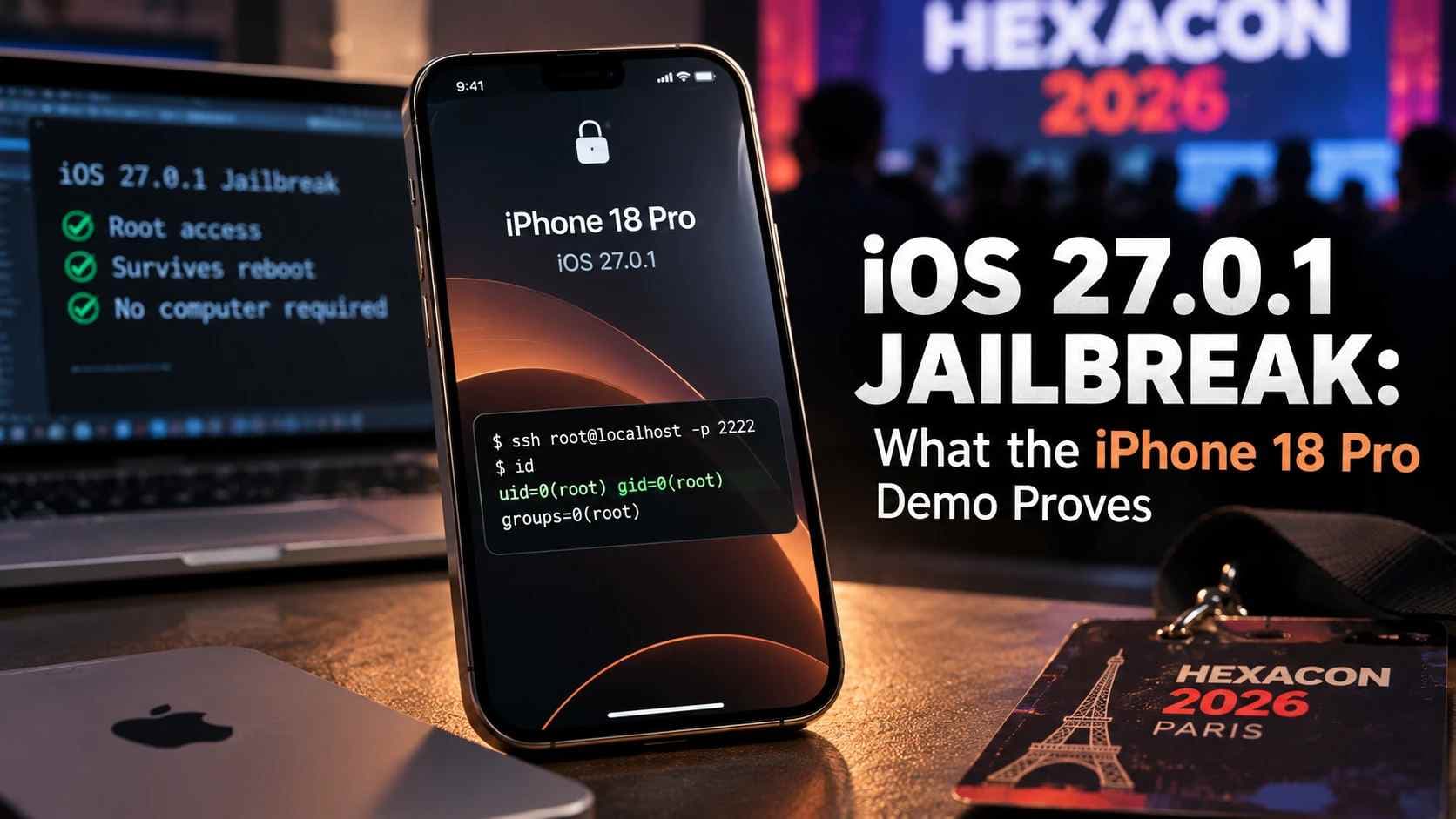
Apparently, yes. On October 16, 2026, security researchers from Calif demonstrated an iOS 27.0.1 Jailbreak at the Hexacon security conference in Paris. The demonstration showed an iPhone 18 Pro regaining root access after rebooting, without reconnecting to a computer.
That's a significant development in iPhone security research. Modern iPhones have multiple protections designed to prevent unauthorized system access, and getting around those restrictions is difficult enough. Making a jailbreak survive a restart presents another challenge.
There is one important limitation, though. Calif has not publicly disclosed the vulnerabilities behind the jailbreak, and no public installation tool has been confirmed.
For iPhone owners, the demonstration raises an obvious question: what does this discovery actually mean for their devices?
What Happened at Hexacon 2026?
The iOS 27.0.1 Untethered Jailbreak demonstration took place on October 16, 2026, during Hexacon, an offensive security conference held in Paris, France.
Researchers from Calif presented a working jailbreak on an iPhone 18 Pro running Apple's iOS 27.0.1 operating system.
The most interesting part wasn't simply obtaining root access. It was what happened after the device restarted.
During the presentation, the researchers rebooted the iPhone. The familiar Apple logo appeared, followed by the lock screen. After entering the normal passcode, they demonstrated that privileged system access was available again.
There was no need to reconnect the phone to a computer to reactivate the jailbreak.
That behavior is what makes an untethered jailbreak different from other jailbreak methods.
Normally, restarting an iPhone causes the operating system to initialize its security protections again. A jailbreak that automatically returns after rebooting must overcome additional technical obstacles.
The researchers demonstrated that capability on the iPhone 18 Pro.
However, the public demonstration does not establish that the same technique works on every iPhone model or every version of iOS 27.
Key Details of the iPhone 18 Pro Jailbreak
|
Detail |
Reported Information |
|
Demonstration date |
October 16, 2026 |
|
Conference |
Hexacon 2026 |
|
Location |
Paris, France |
|
Research organization |
Calif |
|
Device |
iPhone 18 Pro |
|
Operating system |
iOS 27.0.1 |
|
Jailbreak type |
Untethered |
|
Root access |
Demonstrated |
|
Persistence after reboot |
Demonstrated |
|
Public jailbreak tool |
Not confirmed |
|
Vulnerability identifiers |
Not disclosed |
|
Public exploit chain |
Not released |
These details are based on reporting of the live demonstration.
The exact vulnerabilities, installation process, and broader device compatibility remain unknown.
Source: Cyber Security News: iOS 27.0.1 Jailbreak Demonstrated.
How Did the iOS 27.0.1 Jailbreak Demonstration Work?
The researchers demonstrated two important capabilities: the iPhone could restart normally, and privileged system access could return afterward.
The demonstration followed a sequence that allowed observers to examine both results.
First, the researchers restarted the iPhone 18 Pro.
The device went through its normal startup process, displayed the Apple logo, and eventually reached the lock screen.
The researchers then entered the device's passcode.
After the phone started, they established a Secure Shell connection, commonly known as SSH.
SSH allows someone with appropriate access to communicate with another device through a command-line interface.
In this case, the researchers reportedly connected through port 2222.
Once connected, they ran the following command:
id
The command returned:
uid=0
That small piece of output is one of the most important technical details from the demonstration.
On Unix-based operating systems, uid=0 identifies the root user.
Root is an administrative account with extensive privileges over the operating system.
Ordinary iPhone users and applications do not normally receive that level of access.
Seeing uid=0
therefore provided evidence that the researchers had obtained privileged system
access.
The demonstration also included commands displaying the operating-system version and other technical information.
-20261016182653.webp&w=1080&q=75 "iOS 27.0.1 Jailbreak")
Technical Details Revealed During the Demonstration
|
Technical Information |
Reported Value |
|
iOS version |
27.0.1 |
|
Build number |
24A446 |
|
Darwin kernel version |
27.0.0 |
|
XNU kernel build |
13432.2.10 |
|
Device identifier |
iPhone19,2 |
|
Chip identifier |
T8160 |
|
SSH port |
2222 |
|
Root user identifier |
uid=0 |
|
Installed packages |
67 |
|
Reported uptime |
Approximately two minutes |
These values were reported from the demonstration's terminal output.
They provide useful information about the test environment, but they do not reveal how the underlying exploit worked.
Does the Two-Minute Uptime Mean the Jailbreak Takes Two Minutes?
Not necessarily.
One technical detail from the presentation could easily be misunderstood.
The device reportedly showed an uptime of approximately two minutes.
Uptime measures the time that has passed since a device last started.
It does not automatically tell us how long a particular exploit takes to execute.
In this case, the displayed uptime indicates that the device had been running for around two minutes when the information was collected.
It does not prove that the jailbreak requires exactly two minutes to activate.
The actual execution time, reliability, and conditions required for the exploit have not been publicly documented.
Until Calif releases additional technical information, those details cannot be established.
What is an Untethered Jailbreak?
An untethered jailbreak is a method of bypassing Apple's software restrictions that allows a jailbroken iPhone to restart without requiring a computer or manual jailbreak reactivation.
That sounds straightforward, but the distinction matters.
Apple normally restricts applications from modifying protected parts of iOS.
Applications run within isolated environments called sandboxes. These environments help prevent one application from accessing another application's private data or changing sensitive operating-system components.
A jailbreak bypasses some of those restrictions.
Depending on the vulnerabilities and method involved, jailbreaking can allow access to functionality that Apple does not normally expose.
However, different jailbreak methods behave differently after a device restarts.
Untethered vs. Tethered vs. Semi-Untethered Jailbreak
|
Jailbreak Type |
What Happens After Restarting? |
Computer Required? |
|
Tethered |
The modified environment requires computer-assisted booting |
Yes |
|
Semi-tethered |
The device can boot normally, but jailbreak reactivation requires computer assistance |
For reactivation |
|
Semi-untethered |
The device boots normally, but the jailbreak generally requires manual reactivation through an application |
Not normally |
|
Untethered |
The jailbreak returns automatically after rebooting |
No |
The main advantage of an untethered jailbreak is persistence across restarts.
Consider what happens when an ordinary iPhone restarts.
The operating system reloads, its security mechanisms initialize, and applications return to their normal restricted environments.
With an untethered jailbreak, the modified system state can become available again without the user repeating the original jailbreak process.
That's why the iOS 27.0.1 Jailbreak demonstration attracted attention.
It showed something more significant than a temporary session with elevated permissions.
The researchers demonstrated that privileged access could return after the device rebooted.
Why is Jailbreaking a Modern iPhone So Difficult?
Apple has spent years strengthening the security architecture of iPhones.
Modern devices use multiple layers of protection intended to restrict unauthorized code execution, safeguard sensitive information, and prevent untrusted software from modifying the operating system.
A jailbreak developer may need to bypass several of those protections.
The difficulty depends on the vulnerabilities involved and the level of access being attempted.
Apple's Secure Boot Process
One of the first obstacles is the iPhone's startup security architecture.
Apple uses a chain of trust during startup.
In simple terms, important software components are cryptographically verified before the system continues loading.
This helps prevent unauthorized modifications to critical operating-system components.
If an attacker changes protected startup software, the verification process is designed to detect unauthorized modifications.
For jailbreak researchers, gaining root access while iOS is running is already a difficult problem.
Making that access return automatically after the phone restarts adds another layer of complexity.
Apple explains these protections in its official platform security documentation.
Related reading: Apple's Secure Boot and Platform Security Documentation.
Kernel Security and Privileged Access
Another important component is the iOS kernel.
The kernel manages essential operating-system functions, including memory, running processes, and communication between software and hardware.
Because it operates with extensive privileges, vulnerabilities affecting the kernel can have serious consequences.
In some situations, an attacker who successfully exploits a kernel vulnerability may gain access beyond the restrictions applied to ordinary applications.
That is one reason kernel vulnerabilities receive substantial attention from cybersecurity researchers.
For a deeper explanation of this area, Hoplon Infosec previously examined iOS kernel exploitation and the Trigon vulnerability.
The Trigon research provides useful background on how kernel-level vulnerabilities can affect iPhone security.
However, there is no verified evidence connecting Trigon to Calif's Hexacon demonstration.
The exact vulnerabilities used in the iPhone 18 Pro Jailbreak remain undisclosed.
Apple's Code Signing and Memory Protections
Apple also uses code-signing requirements and hardware-assisted security technologies to make unauthorized software execution more difficult.
Code signing helps the operating system determine whether software is authorized to run.
Application sandboxing limits what ordinary applications can access.
Hardware-assisted protections make certain memory-manipulation attacks harder to exploit.
These protections operate together.
A successful jailbreak may require several vulnerabilities to be combined before researchers can obtain meaningful system-level access.
The public Hexacon demonstration establishes that Calif achieved privileged access.
It does not establish which individual security protections were bypassed or the specific order in which the researchers overcame them.
That distinction is important when evaluating the technical significance of the research.
Did Researchers Break Apple's Secure Boot?
The demonstration raises a reasonable question.
If the jailbreak returned after a full restart, does that mean the researchers permanently defeated Apple's Secure Boot protections?
Not necessarily.
An untethered jailbreak does not automatically prove that immutable boot components were modified.
Some persistence techniques can restore privileged access after the operating system starts.
Others may involve weaknesses affecting earlier stages of the startup process.
Without the underlying technical details, it is impossible to determine which mechanism Calif used.
This matters because hardware and software vulnerabilities can have very different implications.
A software vulnerability may potentially be addressed through an operating-system update.
A vulnerability in immutable hardware boot code can be more difficult to address on an existing device.
Hoplon Infosec has previously covered this distinction in its analysis of Apple SecureROM vulnerabilities and the usbliter8 exploit.
That research explains why vulnerabilities affecting hardware-based startup components are particularly important.
However, Calif has not established that the iPhone 18 Pro Untethered Jailbreak relies on an unpatchable hardware vulnerability.
For now, the responsible interpretation is that persistence was demonstrated, while the underlying mechanism remains unknown.
Does the Jailbreak Work Without the iPhone Passcode?
The demonstration does not prove that.
During the Hexacon presentation, the researchers entered the iPhone's normal passcode after restarting the device.
That detail matters because jailbreaking and bypassing device authentication are different technical problems.
A jailbreak concerns restrictions on operating-system access.
A lock-screen bypass concerns the authentication controls protecting a locked device.
One capability does not automatically establish the other.
For example, demonstrating root access after unlocking a device does not prove that someone could obtain the same access on a locked iPhone without knowing its passcode.
The iOS 27.0.1 Jailbreak Demonstration did not establish that Calif could bypass the device's normal authentication process.
It also did not establish that the technique could be triggered remotely through a website, application, or message.
Those possibilities would require additional evidence.
The distinction becomes clearer when compared with previously documented mobile vulnerabilities.
Hoplon Infosec has covered an Apple zero-day vulnerability affecting USB Restricted Mode, a separate security issue involving protections on locked devices.
That case involved different technical circumstances and should not be confused with the Hexacon jailbreak.
Which Vulnerabilities Were Used in the Jailbreak?
The exact vulnerabilities remain unknown.
As of October 16, 2026, Calif has not publicly identified the security weaknesses responsible for the demonstrated jailbreak.
No verified CVE identifier has been linked directly to the exploit.
A CVE, or Common Vulnerabilities and Exposures identifier, is a standardized reference used to identify publicly documented security vulnerabilities.
CVE identifiers help security researchers, vendors, and system administrators discuss the same vulnerability without confusion.
However, not every vulnerability is immediately assigned or publicly associated with a CVE.
Researchers sometimes delay publishing technical information while affected vendors investigate and prepare security fixes.
That may happen through a coordinated vulnerability disclosure process.
Whether Calif and Apple have established such an arrangement for this specific research has not been publicly confirmed.
There is also no reliable basis for assigning a previously published Apple vulnerability to this jailbreak.
-20261016182952.webp&w=1080&q=75 "iOS 27.0.1 Jailbreak")
What Apple's Security Advisories Confirm
Apple released iOS 27 on September 14, 2026.
The company's security advisory documented numerous vulnerabilities addressed in that release.
Apple then released iOS 27.0.1 on September 28, 2026.
According to Apple's official security releases page, iOS 27.0.1 has no published CVE entries.
That does not mean the operating system is free from vulnerabilities.
It simply means Apple did not publish individual CVE entries for that particular update.
The distinction matters because software can contain vulnerabilities that have not yet been discovered or publicly documented.
Apple's published security information does not identify the vulnerabilities behind Calif's demonstration.
Readers interested in how Apple handles documented vulnerabilities can explore Hoplon Infosec's previous coverage of Apple zero-day vulnerabilities and security patches.
That article explains how publicly disclosed vulnerabilities differ from weaknesses that remain under investigation.
Official reference: Apple Security Releases.
Is an iOS 27 Jailbreak Available for Download?
As of October 16, 2026, no publicly verified download for Calif's demonstrated jailbreak tool has been established.
This is one of the most important details for people searching for an iOS 27 Jailbreak.
A working research demonstration and a publicly released jailbreak application are not the same thing.
Researchers may demonstrate a technique using private code, specialized tools, or an environment prepared for security testing.
Even when the demonstration works successfully, the research may not be ready for public distribution.
It may also depend on technical conditions that have not been disclosed.
Therefore, the Hexacon presentation does not establish that ordinary iPhone users can download and install the jailbreak.
Be Careful With Unverified Jailbreak Websites
Following a high-profile jailbreak demonstration, users may encounter websites advertising tools that supposedly support the affected iOS version.
Such claims should be treated cautiously.
A website displaying a download button or a device compatibility list is not evidence that it has access to Calif's research.
Users should verify announcements through the researchers' official communications before trusting any software associated with the demonstration.
Installing software or configuration profiles from unfamiliar sources may introduce additional security risks.
The available evidence supports one clear conclusion: the iOS 27.0.1 Jailbreak was demonstrated, but a publicly available installation tool has not been confirmed.
Has Calif Announced an iOS 27.0.1 Jailbreak Release Date?
No verified public release date has been announced.
Reporting on Calif's October 16 social media statements includes the following comment:
Everything will be released in due time.
The statement indicates that additional information may become available.
However, it does not specify when that information will be released.
It also does not clarify whether the eventual release will include technical documentation, exploit code, a proof of concept, or a complete jailbreak tool.
These are separate possibilities.
A detailed technical write-up would help researchers understand the vulnerabilities.
A proof of concept could demonstrate part of the exploit.
A complete jailbreak application would be a different kind of release altogether.
The statement should not be interpreted as confirmation that a publicly downloadable jailbreak will arrive on a particular date.
Until Calif provides further details, the release schedule remains unknown.
What Does the iOS 27.0.1 Jailbreak Mean for iPhone Security?
The demonstration is significant because it shows researchers obtaining persistent privileged access on a recent iPhone and iOS combination.
However, the practical security implications depend on details that have not yet been disclosed.
Researchers have not publicly explained the initial entry point, the vulnerabilities involved, or the conditions required to reproduce the exploit.
Without that information, it is difficult to determine whether the technique could be used against an ordinary iPhone owner.
The demonstration also does not establish that attackers are currently exploiting the same vulnerabilities.
There is no publicly documented attack campaign connected to Calif's jailbreak in the sources reviewed.
This is an important difference between discovering a security weakness and observing that weakness being used in real-world attacks.
Why Persistent Root Access Matters
Root access can allow actions that ordinary applications are not permitted to perform.
Depending on the circumstances, privileged access could undermine restrictions intended to protect sensitive operating-system components.
That is why security researchers study privilege escalation and exploit chains so carefully.
A vulnerability affecting one security boundary may become more serious when combined with other weaknesses.
For example, an attacker might need one vulnerability to gain initial code execution and another to obtain elevated privileges.
However, the public demonstration does not establish that Calif used a particular sequence of vulnerabilities.
Nor does it establish that the same technique could be used remotely.
The iOS 27.0.1 Jailbreak should therefore be understood as an important research finding rather than evidence of a widespread compromise.
Is the Jailbreak Connected to Spyware?
There is no verified evidence connecting Calif's demonstration to an active spyware campaign.
Advanced spyware operations sometimes rely on vulnerabilities that bypass operating-system security restrictions.
That makes jailbreak research relevant to the broader study of mobile security.
But technical similarities do not establish that a particular research project is associated with surveillance activity.
A jailbreak demonstration does not mean the researchers created spyware.
It also does not prove that their technique has been used against real victims.
For readers who want to understand how targeted mobile surveillance differs from ordinary security research, Hoplon Infosec has published a guide covering Apple spyware warnings and protection measures.
That background is useful, but the cases should not be treated as directly connected.
Should iPhone 18 Pro Owners Be Worried?
The demonstration alone is not evidence that ordinary iPhone users are facing an immediate attack.
The exploit has not been publicly released, and there is no verified campaign connecting the technique to attacks against everyday users.
Still, the research demonstrates why Apple's security protections continue to face scrutiny.
Even devices with modern security features may contain vulnerabilities that researchers have not yet disclosed.
The appropriate response is to follow established security practices rather than assume that the demonstration means every iPhone is compromised.
For most users, that means keeping software updated, protecting account credentials, and avoiding unfamiliar installation packages.
It also means being careful about claims surrounding an unreleased jailbreak.
The biggest unanswered question is not whether Calif demonstrated privileged access.
The reporting indicates that it did.
The more important question is how the researchers achieved that result and whether those vulnerabilities could be exploited under different conditions.
How to Protect Your iPhone
Users do not need to make dramatic changes to their devices because of this demonstration.
However, several established security practices remain important.
1. Keep iOS Updated
Apple regularly releases software updates to address security vulnerabilities and improve system reliability.
To check for updates, open:
Settings > General > Software Update
Install an appropriate update when it becomes available.
According to Apple's security releases page, iOS 27.0.1 is the latest public iOS version as of October 16, 2026.
Users should continue monitoring official Apple announcements for subsequent updates.
Hoplon Infosec has previously explained why timely patches matter in its coverage of iOS security updates and the DarkSword exploit chain.
That incident involved different vulnerabilities, but it demonstrates the broader importance of installing security fixes.
2. Avoid Unverified Jailbreak Downloads
Do not assume that a website offering an iOS 27.0.1 jailbreak installer has access to Calif's research.
A legitimate public release should be supported by verifiable information from the researchers or developers responsible for it.
Be cautious with websites requesting Apple Account credentials, unfamiliar configuration profiles, or software installations without credible documentation.
The Hexacon demonstration does not establish that a public installer exists.
3. Consider Lockdown Mode if You Face Elevated Risk
Apple provides Lockdown Mode for users who believe they may be targeted by highly sophisticated attacks.
The feature restricts certain functions and communication paths to reduce potential exposure.
On supported devices, users can find it under:
Settings > Privacy & Security > Lockdown Mode
Apple explains that Lockdown Mode is intended for people facing unusually sophisticated threats.
It is not necessary for most iPhone users.
The feature should be considered according to individual security needs rather than activated solely because a jailbreak was demonstrated at a conference.
4. Verify Security Notifications
Security warnings deserve attention, but their source matters.
A legitimate notification from Apple should be verified through official Apple channels.
Random webpages claiming that an iPhone has been compromised are not reliable evidence of an actual security incident.
Users should be particularly careful when a warning instructs them to call an unfamiliar phone number or install unknown software.
Such messages may be attempts to obtain personal information.
5. Protect Important Accounts
A strong device passcode remains important.
Users should also maintain appropriate Apple Account security settings and avoid sharing authentication codes.
Access to email, cloud storage, and other important accounts can create security problems even when the device itself has not been jailbroken.
For a broader explanation of these precautions, see Hoplon Infosec's guide to iPhone security settings and protection against hackers.
These practices remain useful regardless of whether additional details about the Hexacon jailbreak are released.
What Should Organizations Do About the Demonstration?
Organizations managing employee iPhones should pay attention to the research, but the available evidence does not justify treating it as a confirmed enterprise security incident.
The initial exploit method has not been publicly disclosed.
There is also no verified evidence establishing that corporate iPhones are being targeted through the demonstrated technique.
Nevertheless, the research is relevant to organizations responsible for mobile-device security.
Security teams should know which iPhone models and operating-system versions are used across their environments.
That information helps administrators assess newly disclosed vulnerabilities when reliable technical details become available.
Organizations should also maintain clear policies concerning unauthorized operating-system modifications.
A jailbroken device may no longer provide all the security assurances expected from a normally managed iPhone.
For businesses handling sensitive information, mobile-device management, software update policies, and established incident-response procedures remain important.
The iOS 27.0.1 Jailbreak is a developing research story. Its significance for organizational security will become clearer if Calif publishes the vulnerabilities and conditions required for exploitation.
How Does This Compare With Earlier iPhone Jailbreak Research?
Untethered jailbreaks are not new.
Earlier generations of iOS had publicly available tools capable of maintaining a jailbroken state after the device restarted.
One notable example was Pangu's untethered jailbreak for iOS 9, released in October 2015.
That release provided users with a publicly available jailbreak tool.
Calif's October 2026 demonstration is different in an important respect.
The researchers demonstrated the capability on newer hardware and operating-system software, but a public installation tool has not been confirmed.
This distinction matters for anyone searching for an iPhone 18 Pro jailbreak.
A successful private demonstration establishes that researchers achieved a particular technical result.
A public jailbreak release would establish something additional: that software had been distributed for others to use.
Those are not interchangeable claims.
How Does This Compare With Other iOS Exploit Chains?
Jailbreaks and exploit chains can involve similar categories of security weaknesses.
However, they are not necessarily designed for the same purpose.
Jailbreak research may focus on removing operating-system restrictions or studying privileged access.
Malicious exploit chains may aim to obtain unauthorized access to devices or information.
The technical methods and consequences vary.
For example, Hoplon Infosec previously examined the Coruna exploit kit and its impact on older iOS versions.
That research provides background on how multiple vulnerabilities can be combined to compromise iPhone security.
There is no verified connection between Coruna and Calif's iOS 27.0.1 Jailbreak demonstration.
The comparison is useful for understanding the broader technical context, not for claiming that the same vulnerabilities were involved.
-(1)-20261016183305.webp&w=1080&q=75)
Could Apple Fix the Vulnerabilities Behind the Jailbreak?
Possibly.
Whether Apple can address the demonstrated technique through a software update depends on the vulnerabilities involved.
Many operating-system vulnerabilities can be corrected through software changes.
Apple regularly publishes security updates addressing weaknesses in different parts of iOS.
However, not every vulnerability has the same characteristics.
A flaw affecting an updateable software component is different from a weakness affecting immutable hardware.
The public information available about Calif's demonstration does not establish which category applies.
As a result, it is not possible to conclude that the jailbreak is permanently unpatchable.
It would also be premature to identify a specific Apple security update as a fix for the Hexacon research.
The vulnerabilities have not been publicly linked to an official advisory.
Until more technical information is released, the possibility of a software fix remains an open question.
What Happens Next?
The next important development will be additional verified information about how the jailbreak works.
Calif may publish technical documentation explaining the vulnerabilities and persistence mechanism.
Apple may eventually publish security information relevant to the research.
Independent researchers may also examine the technique if sufficient technical details become available.
However, none of those possibilities currently has a confirmed timeline.
There is also no verified date for a public jailbreak application.
For readers following the iOS 27.0.1 Jailbreak, future reporting should focus on documented findings rather than predictions.
Questions That Remain Unanswered
|
Question |
Current Status |
|
Which vulnerabilities enabled the jailbreak? |
Undisclosed |
|
Is the technique remotely triggerable? |
Not established |
|
Does it work without unlocking the phone? |
Not demonstrated |
|
Does it affect older iPhones? |
Not independently established |
|
Is a public jailbreak tool available? |
Not confirmed |
|
Can Apple patch the vulnerabilities through software? |
Unknown |
|
Is the technique being used in active attacks? |
No verified connection established |
|
Has a public release date been announced? |
No verified date |
These unanswered questions are important because they determine how the research should be interpreted.
The demonstration establishes a significant technical capability.
It does not yet provide enough information to assess every possible security implication.
Frequently Asked Questions
Is the iOS 27.0.1 jailbreak real?
Multiple reports document Calif demonstrating an untethered jailbreak on an iPhone 18 Pro at Hexacon 2026 on October 16.
The demonstration reportedly showed root access returning after a complete restart.
However, the complete exploit chain has not been publicly disclosed, and an independent technical reproduction has not been established in a published report.
Can I jailbreak my iPhone 18 Pro right now?
No publicly verified release of Calif's demonstrated jailbreak tool had been established as of October 16, 2026.
A live research demonstration does not necessarily mean a downloadable installation tool is available.
Users should verify any future release directly through credible developer or researcher announcements.
Does an untethered jailbreak survive a restart?
Yes.
An untethered jailbreak is designed to return to a jailbroken state after the device restarts without requiring a computer or manual jailbreak reactivation.
That persistence is what distinguishes it from tethered and semi-untethered jailbreak methods.
Does the jailbreak mean iOS 27.0.1 is unsafe?
The demonstration shows that researchers obtained privileged access on a test device running iOS 27.0.1.
It does not establish that every iPhone running that version is being attacked.
The vulnerabilities and methods involved remain undisclosed, and no related widespread attack campaign has been verified.
Users should continue following Apple's security recommendations and installing official updates.
Hoplon Insight: What This Research Actually Tells Us
The most important result from Hexacon 2026 is the return of root access after a complete iPhone restart.
That is what makes Calif's demonstration technically significant.
Modern iPhones use multiple security protections to limit unauthorized access, and the researchers showed that those restrictions could be overcome on the demonstrated device.
However, there is a difference between showing that something is technically possible and establishing how widely it can be exploited.
The presentation did not reveal the initial attack vector, the vulnerabilities responsible, or whether the technique could compromise a locked device without authentication.
Those missing details prevent a reliable assessment of its practical exploitation risk.
Hoplon Infosec recommends focusing on three things:
Keep iOS updated using official Apple releases.
Avoid unverified websites offering unreleased jailbreak installers.
Follow official security disclosures before drawing conclusions about device exposure.
The demonstration deserves attention because of its technical significance.
It does not justify unsupported claims about widespread iPhone compromise.
Final Thoughts
The iOS 27.0.1 Jailbreak demonstrated at Hexacon 2026 marks an important development in modern iPhone security research.
Calif reportedly showed an iPhone 18 Pro regaining root access after a complete restart without requiring computer assistance.
That is a meaningful technical achievement, particularly given the security protections built into recent iPhones.
Yet several important questions remain unanswered.
The researchers have not publicly disclosed the vulnerabilities, confirmed a public jailbreak tool, or established that the technique can bypass a locked iPhone's authentication.
There is also no verified evidence connecting the demonstration to an active attack campaign.
For ordinary users, the practical advice remains unchanged: install official security updates, protect important accounts, and be cautious about unverified software.
For security researchers, the most valuable information is still to come.
A detailed technical disclosure would help explain how the jailbreak achieved persistence and what its discovery means for Apple's security architecture.
Until then, the distinction between demonstrated capabilities and unverified claims remains essential.
References and Sources
The following sources provide the reporting, technical background, and security guidance used in this article.
1. Hexacon 2026
2. Jailbreak Demonstration Report
Cyber Security News: iOS 27.0.1 Untethered Jailbreak Demonstrated on iPhone 18 Pro
3. Security Research Organization
4. Official Apple Security Releases
Apple Security Releases and Updates
5. iOS 27 Security Documentation
Apple's iOS 27 Security Advisory
6. Apple Platform Security
Apple Platform Security Documentation
7. Apple Lockdown Mode
Apple's Official Lockdown Mode Guide
8. Additional Coverage
Calif Unveils iPhone 18 Pro Jailbreak at Hexacon
Read More Articles From hoplon Infosec:
Apple SecureROM Vulnerabilities
Apple Zero-Day Vulnerabilities