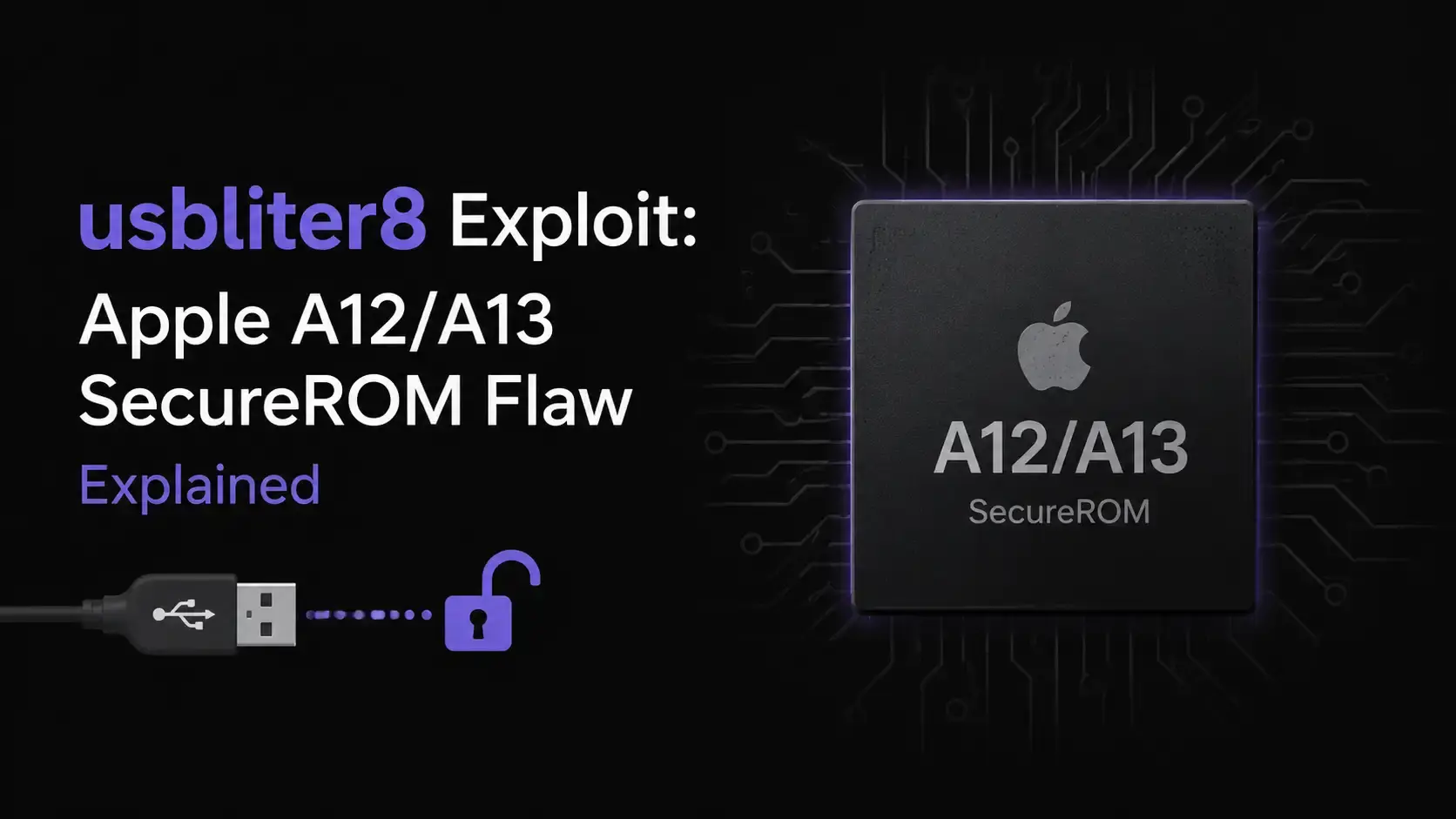
usbliter8 Exploit: The Unpatchable SecureROM Flaw Hitting Millions of Apple Devices
Content Summary
- A security research group called Paradigm Shift released a working exploit named usbliter8 on June 18, 2026. It runs malicious code inside SecureROM, the very first thing an Apple device boots.
- The flaw lives in the silicon itself, inside the A12 and A13 chips. Since it is burned into the chip at the factory, Apple cannot patch it with a software update, ever.
- iPhone XS, XS Max, XR, iPhone 11 series, several iPad and Apple Watch models, and the HomePod mini all carry one of the affected chips.
- The attacker needs the device in hand, in DFU mode, and connected to a special USB rig. It is not a remote attack, but once it runs, the damage is permanent for that hardware.
- This is the biggest public BootROM exploit since checkm8 hit older iPhones in 2019, and it raises real questions for anyone managing fleets of older Apple hardware.
| Quick Facts | Details |
|---|---|
| Exploit name | usbliter8 |
| Discovered by | Paradigm Shift |
| Disclosed | June 18, 2026 |
| Chips affected | A12, A13, S4, S5 |
| Attack type | Physical, USB DFU mode required |
| Patchable | No, hardware-level flaw |
| Secure Enclave impacted | No, but BootROM compromise widens future attack paths |
| Closest precedent | checkm8 (2019) |
What is usbliter8, Exactly?
Picture the moment you plug in an iPhone and hold the right buttons to force it into recovery mode. Before iOS even thinks about loading, a tiny piece of code called SecureROM wakes up first. Its only job is to check that everything Apple signed is genuine before letting the rest of the system start.
The usbliter8 exploit attacks that exact moment. Paradigm Shift, a research team that focuses on hardware and firmware security, found a way to feed an A12 or A13 chip a stream of malformed USB data that breaks SecureROM's memory handling and hands the attacker full code execution rights, before the operating system has even loaded. They worked with Apple Product Security ahead of time and released their findings and proof of concept publicly on June 18, 2026.
What makes this stand out from a typical iOS bug is where it lives. Most security flaws Apple deals with sit in software, things like apps, Safari, or iOS itself, and those get fixed the moment a patch ships. SecureROM is different. It is fused into the chip during manufacturing. There is no update channel that reaches it. Once a chip has this flaw, every single one of that chip type carries it for life.
If you want to understand why hardware flaws like this matter so much for organizations managing device fleets, it ties directly into attack surface management, since your attack surface now includes every physical device sitting in a drawer, not just what's connected to your network.
Why SecureROM Bugs Can Never Be Patched
To understand why usbliter8 is such a headache, it helps to understand how an Apple device actually starts up.
Every iPhone, iPad, and Apple Watch follows a strict handoff called the chain of trust. SecureROM runs first, checks the next piece of code called iBoot, and only loads it if Apple's signature checks out. iBoot then checks the kernel, and so on. Each link only hands off to the next if everything is properly signed by Apple. Break the first link, and the whole chain stops meaning anything.
SecureROM sits in a special kind of memory called read-only memory, written once at the factory and never touched again. iOS updates can replace iBoot, the kernel, and everything above it, but they cannot touch SecureROM. That is exactly why a SecureROM bug behaves so differently from a normal vulnerability. A normal bug gets a patch number and disappears from the next release. A SecureROM bug stays with the device until the device itself is retired.
This is the same reason checkm8 became such a big deal back in 2019, and why usbliter8 is being treated the same way now.
Which Devices Are Affected
The public proof of concept currently supports four chip families: A12, A13, S4, and S5. Paradigm Shift says support for A12X and A12Z is technically possible but has not been built yet.
| Chip | Devices Affected |
|---|---|
| A12 | iPhone XS, iPhone XS Max, iPhone XR |
| A13 | iPhone 11, iPhone 11 Pro, iPhone 11 Pro Max |
| S4 / S5 | Apple Watch Series 4, Apple Watch Series 5, Apple Watch SE (1st generation) |
| A12 (tablet) | iPad Air (3rd generation), iPad mini (5th generation), iPad 8th generation |
| A12 / A13 | HomePod mini |
Two things are worth repeating clearly here. The A11 chip and earlier are not affected, because their USB driver resets its memory pointer after every packet, so the bug never has a chance to build up. A14 and newer chips are also not affected, because Apple changed how a piece of hardware called DART is configured on those chips. We will get into exactly why that matters in the next section.
The Technical Bug, Explained
At the heart of usbliter8 is a flaw in the USB controller chip Apple uses, made by a company called Synopsys, model DWC2. Here's the simplest way to picture it.
When a device is in DFU mode and something talks to it over USB, the controller stores incoming data packets using a method called DMA, direct memory access, which lets data get written straight into memory without the main processor babysitting every byte. The controller is supposed to hold up to three of these packets and then reset itself cleanly on the fourth. Instead, it resets by stepping its write pointer back a fixed amount, 24 bytes, regardless of what actually happened.
Here's the catch. The controller also accepts USB packets that are smaller than the standard size, and when that happens it only moves its pointer forward by the actual bytes received, not the full expected size. Send enough of these undersized packets, and the math stops lining up. The write pointer slowly creeps backward through memory, 12 bytes at a time, with every cycle.
On most chips, this alone would not be exploitable, because a security feature called DART, short for Device Address Resolution Table (essentially the chip's IOMMU), is supposed to fence off which parts of memory DMA traffic is allowed to touch. The real problem with A12 and A13 is that Apple runs DART in bypass mode during SecureROM execution on those chips. That means the underflowing pointer is free to walk into SRAM it was never supposed to reach, and overwrite whatever sits there.
| Chip Generation | DART Behavior in SecureROM | Exploitable by usbliter8 |
|---|---|---|
| A11 and earlier | Manual DMA pointer reset after each packet | No, bug never accumulates |
| A12 / A13 / S4 / S5 | DART runs in bypass mode | Yes, confirmed working exploit |
| A14 and later | DART correctly configured | No, Paradigm Shift reports it as unexploitable |
Getting Code Execution: A12 vs A13
Once an attacker can write to arbitrary memory, the next step is turning that into actual code execution, and this is where A12 and A13 diverge.
On A12, the path is fairly direct. The DMA buffer happens to sit right next to the USB task's stack region. Overwrite a saved link register (the value that tells the processor where to return to after a function finishes) and the next time the system switches tasks, it jumps straight into attacker-controlled code.
A13 is a tougher nut to crack, because Apple added Pointer Authentication, known as PAC, on that chip. PAC is designed to detect tampered return addresses and block exactly this kind of attack. Paradigm Shift got around it in stages rather than with one clean trick:
- They corrupted memory structures tied to DART to gain a limited but usable write primitive.
- They overwrote a panic depth counter, which tricked the chip into looping on errors instead of restarting itself, buying time to work.
- They timed their DMA writes carefully so they never accidentally clobbered the very registers the USB task needed to keep running.
- The final move overwrote the pointer for the USB interrupt handler, sitting in a memory region called BSS. The next time a USB interrupt fired, it ran the attacker's code instead.
Either route ends the same way: code execution at EL1, the chip's privileged operating mode, while still inside SecureROM, before iOS has even started loading.
Quick glossary for these terms:
| Term | What It Means |
|---|---|
| DMA | Direct Memory Access, lets hardware write to memory without routing through the main CPU |
| DART | Apple's IOMMU, meant to restrict which memory regions DMA traffic can reach |
| PAC | Pointer Authentication Codes, a feature that protects return addresses from tampering |
| EL1 | Exception Level 1, a privileged CPU mode below the OS kernel's own level |
| BSS | A memory segment used for uninitialized global and static variables |
| SecureROM | The first, unchangeable code an Apple device runs at power-on |
| DFU mode | Device Firmware Update mode, a low-level recovery state used for restoring firmware |
What an Attacker Can Actually Do With This
Once usbliter8 has code execution inside SecureROM, it installs a custom USB request handler and stamps the text PWND:[usbliter8] into the device's USB serial string, a tradition that traces back to checkm8 and earlier jailbreak exploits, used as a visible marker that the device has been compromised at this level.
From there, an attacker with the device in hand can temporarily lower the chip out of production mode, or boot a completely unsigned iBoot image with zero signature checks. In plain terms, the entire chain of trust the device relies on is stepped around.
What it does not do is touch the Secure Enclave directly. Apple built the Secure Enclave as its own separate, isolated boundary specifically so a BootROM-level compromise like this could not automatically reach passcodes or encrypted user data. Paradigm Shift was careful to point that out themselves.
That said, they also flagged that BootROM control gives attackers a stronger position to go after the Secure Enclave indirectly down the road, which is worth taking seriously rather than dismissing.
This is also exactly the kind of flaw that has historically powered forensic data extraction tools used on seized or lost devices, the same way checkm8 did for years. If your organization handles devices that travel through customs, legal holds, or any kind of chain-of-custody process, this context matters more than it might first appear, and it overlaps heavily with the kind of work covered under digital forensic investigation .
usbliter8 vs checkm8: How They Compare
| checkm8 (2019) | usbliter8 (2026) | |
|---|---|---|
| Chips affected | A5 through A11 | A12, A13, S4, S5 |
| Attack vector | USB, DFU mode | USB, DFU mode |
| Patchable by Apple | No | No |
| Secure Enclave compromised | No | No |
| Physical access required | Yes | Yes |
| Common downstream use | Jailbreaking, forensics, research | Likely the same, jailbreak tooling already in motion |
This is not the first time Apple has faced an exploit it simply cannot fix in existing hardware. The lineage runs from limera1n, an earlier BootROM exploit affecting much older devices, through to checkm8 in 2019, which became one of the most influential iPhone exploits ever published because it hit an entire generation of unpatchable hardware at once. usbliter8 picks up almost exactly where checkm8 left off, moving the same category of problem two chip generations forward.
Where Things Stand Right Now
As of this writing, no CVE number, CVSS score, formal Apple security advisory, or CISA alert has been issued for usbliter8, and there are no public reports of it being used against real targets in the wild. Paradigm Shift coordinated with Apple Product Security before publishing, and both sides describe the disclosure process as cooperative.
That status can change quickly, so this is worth checking again before treating it as final, especially since the proof of concept code and full technical write-up are already public and jailbreak tooling tends to move fast once that happens.
Who Should Actually Worry About This
For the average person carrying one of these devices, the practical risk is genuinely low day to day. Someone needs your phone in their hands, in DFU mode, plugged into a specific piece of hardware, for a couple of seconds minimum. That is a high bar for casual theft or opportunistic attacks.
The picture looks different for a few specific groups:
- Executives, journalists, and anyone with a border-crossing or evil-maid threat model. A device left unattended in a hotel room or pulled aside at a checkpoint is exactly the scenario this exploit is built for.
- Organizations buying or reselling used iPhones, iPads, or Apple Watches. A12 and A13 devices are still common in the secondhand market, and there is no way to tell from the outside whether one has already been tampered with at this level.
- Anyone handling lost or stolen devices, including IT teams managing device recovery, since a compromised device stays compromised through resets, restores, and ownership changes.
- Security and compliance teams in regulated industries, where a single unpatchable hardware flaw across a fleet of older devices becomes a real audit and risk-management question, not just a headline.
This is the kind of scenario that mobile security and threat defense solutions are built around, since the threat here lives below the operating system layer that most mobile security tooling was originally designed to watch.
What Security Teams Should Actually Do
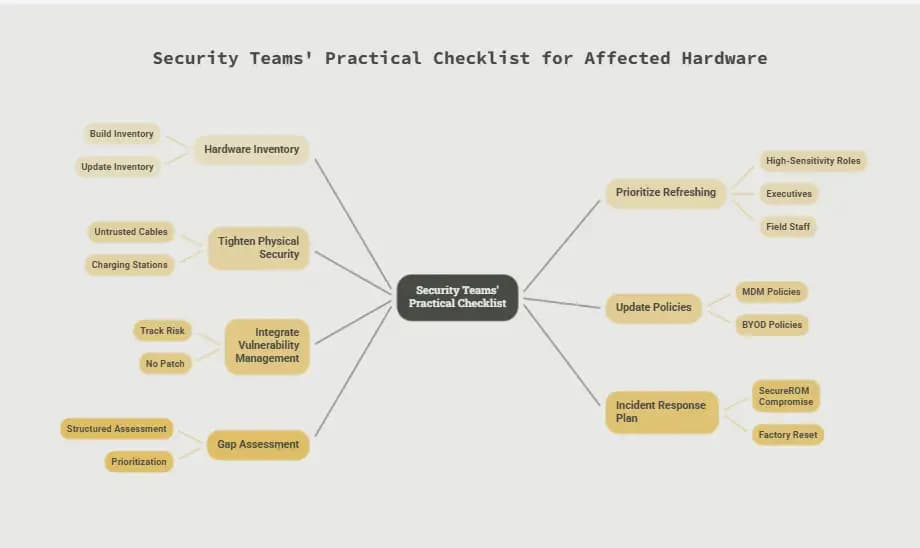
If your organization still has A12, A13, S4, or S5 hardware in active use, here is a practical checklist rather than a vague warning.
- Build or update your hardware inventory so you actually know which devices in your environment run an affected chip. You cannot manage a risk you cannot see, and this is a core part of any serious attack surface management program.
- Prioritize refreshing high-sensitivity roles, executives, field staff, anyone crossing borders regularly, toward A14 or newer hardware first.
- Tighten physical security policy around DFU mode specifically. Never plug an affected device into an untrusted cable, kiosk, or charging station while it is in or near that state.
- Update your MDM and BYOD policies to flag affected models explicitly, so employees and IT staff both know which devices carry the extra risk.
- Fold this into your existing vulnerability management process, even though there is no patch to deploy here. Tracking unpatchable hardware risk is still risk tracking.
- Make sure your incident response and recovery plan accounts for what happens if a device is confirmed compromised at the SecureROM level, since a factory reset will not undo it.
- If you are unsure how exposed your current device fleet really is, a structured gap assessment is a reasonable next step before deciding what to prioritize.
Can usbliter8 Be Detected?
There is one visible marker. A compromised device carries the text PWND:[usbliter8] inside its USB serial string, which is checkable if you know to look for it.
Beyond that one signal, detection gets difficult fast. Once SecureROM itself has been altered in memory at boot time, you are relying on a layer of the system that sits below anything iOS or a typical mobile device management tool can directly inspect.
Software-based detection from within a running, already-compromised device cannot be fully trusted, which is exactly why physical access control matters more here than any after-the-fact scanning tool would.
Key Takeaways
- usbliter8 is a real, working, publicly released exploit that runs code inside SecureROM on Apple A12, A13, S4, and S5 chips.
- It cannot be patched through software, because the flaw is physically built into the chip.
- It requires physical possession of the device, DFU mode, and specific USB hardware, so it is not something that spreads remotely.
- The Secure Enclave is not directly compromised, but BootROM-level control raises the stakes for future attacks against it.
- Organizations with A12 or A13 hardware in sensitive roles should inventory it, restrict DFU exposure, and start planning hardware refreshes.
If your organization needs help figuring out exactly where this kind of hardware-level exposure sits in your environment, or wants a second set of eyes on your device fleet and physical security policies, our team at Hoplon InfoSec works through this exact kind of risk through cyber resilience assessments and virtual CISO services built for situations like this.
You can also find more research breakdowns like this one on our blog.