
|
Quick Summary |
Details |
|
What happened |
CISA added CVE-2025-68686 to its Known Exploited Vulnerabilities catalog on July 27, 2026, flagging a FortiOS SSL-VPN flaw that lets attackers bypass an earlier symlink persistence patch |
|
Who is affected |
Organizations running FortiOS 7.6.0 through 7.6.1, 7.4.0 through 7.4.6, or any build in the 7.2, 7.0, and 6.4 branches with SSL-VPN previously enabled |
|
Why it matters |
Attackers who already gained filesystem access through a separate flaw can quietly keep that access alive even after an administrator applies the original fix |
|
Severity |
CVSSv3 5.3, rated medium by Fortinet, though the KEV listing raises the real world urgency significantly |
|
Deadline |
Federal civilian agencies must remediate by August 10, 2026 under Binding Operational Directive 26 04 |
|
Fix |
Upgrade to FortiOS 7.6.2 or later, or 7.4.7 or later, and migrate off unsupported 7.2, 7.0, and 6.4 builds |
A federal patch deadline tied to a five point three CVSS score sounds almost contradictory, and that contradiction is exactly why the CVE-2025-68686 FortiOS vulnerability deserves a closer look.
On July, 2026, the Cybersecurity and Infrastructure Security Agency added this flaw to its Known Exploited Vulnerabilities catalog alongside an unrelated Arista VeloCloud bug, giving federal civilian agencies until August 10, 2026 to remediate.
The vulnerability itself will not hand an attacker a shell on a clean box. What it does is far sneakier. It lets someone who already broke into a FortiGate appliance keep that access alive by slipping past the patch Fortinet built to shut down symlink based persistence.
I have spent enough hours picking through FortiOS filesystem structures during incident response work to know that persistence tricks involving symbolic links rarely get the attention they deserve, mostly because they look boring next to a flashy remote code execution headline. This one is worth the attention. It is a reminder that patching the original hole is not the same as evicting the attacker who already walked through it.
What is the CVE-2025-68686 FortiOS Vulnerability
CVE-2025-68686 is an information disclosure flaw in Fortinet FortiOS, tracked under CWE-200, exposure of sensitive information to an unauthorized actor. Fortinet published the advisory as FG-IR-25-934, titled SSL-VPN Symlink Persistence Patch Bypass, on February 10, 2026, with an update on March 12, 2026.
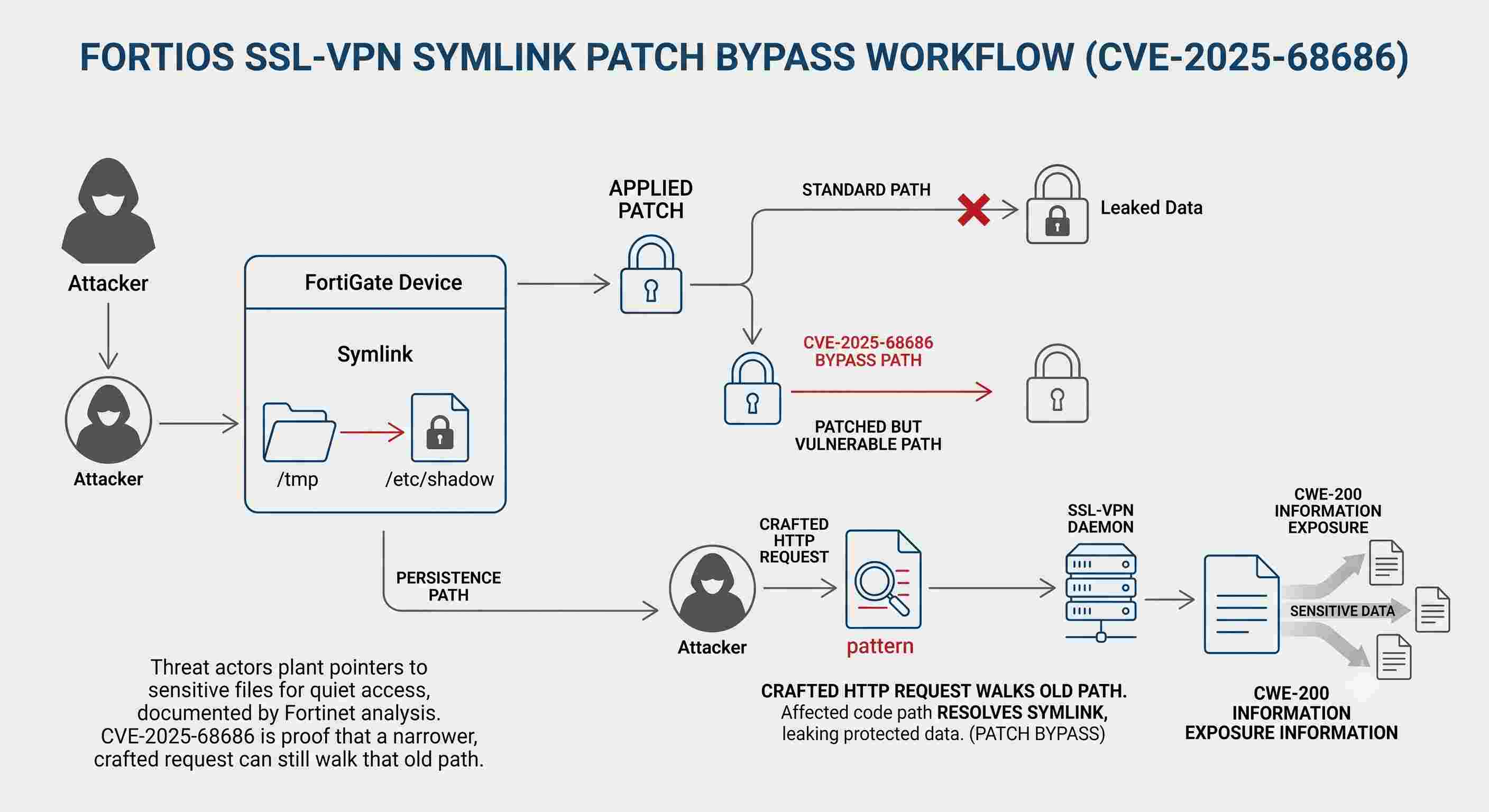
The short version: a prior FortiOS patch was supposed to stop attackers from using symbolic links to maintain a foothold on a compromised device. This new flaw shows that the patch did not fully close that door. A remote, unauthenticated attacker can send a specially crafted HTTP request to the SSL-VPN component and slip past the earlier fix, provided they already have filesystem level access from an unrelated prior compromise.
Fortinet credits Peter Gabaldon of ITRESIT with reporting the issue through responsible disclosure, and the company shipped a virtual patch named FG-VD-60389.0day through FMWP database update 26.033 ahead of the formal advisory.
Understanding CWE-200 in This Context
Exposure of sensitive information sounds abstract until you see it applied to a firewall's own filesystem. In this case, the underlying weakness sits in how FortiOS SSL-VPN handles certain HTTP requests once symbolic links have already been planted on the box. Instead of treating those links as untrusted, the affected code path follows them, which can leak data an administrator would assume was locked down after patching.
Why Symlinks Matter for FortiGate Persistence
A symbolic link is simply a pointer that tells the operating system where to actually find a file or folder. Threat actors who previously compromised FortiGate devices through SSL-VPN or admin interface flaws have been observed planting these pointers to keep a quiet channel open even after the entry vulnerability gets patched, a pattern Fortinet documented publicly in its own threat actor activity analysis referenced in the FG-IR-25-934 advisory.
Why the Original Patch Fell Short
Fortinet's first fix for this persistence technique closed the obvious paths but did not fully sanitize how the SSL-VPN daemon resolves symlink targets under every HTTP request pattern. CVE-2025-68686 is essentially proof that a narrower, crafted request can still walk that old path, which is why Fortinet is calling it a patch bypass rather than a brand new entry point.
Attack Prerequisites and Exploitation Vector Matrix
This is not a flaw that turns an internet facing FortiGate into an open door on its own. It needs a running start.
|
Metric |
Technical Detail |
|
CVE ID |
CVE-2025-68686 |
|
CWE Classification |
CWE-200, exposure of sensitive information to an unauthorized actor |
|
Affected Component |
FortiOS SSL-VPN |
|
Attack Vector |
Network, via crafted HTTP requests |
|
Attack Complexity |
High |
|
Authentication Required |
None |
|
Precondition |
Prior filesystem level compromise via a separate vulnerability |
|
CVSSv3.1 Score |
5.3, medium, vector AV:N/AC:H/PR:N/UI:N/S:U/C:H/I:N/A:N |
|
Impact |
Information disclosure, continued persistence past remediation |
Two phases have to line up for this to matter. First, an attacker needs initial access to the appliance through some other flaw, whether that is an authentication bypass, an unpatched remote code execution bug, or stolen admin credentials. Second, once inside, they plant a symlink and then use CVE-2025-68686 to keep quietly interacting with the system even after the administrator patches the original entry point. Devices that never had SSL-VPN enabled are not exposed to this specific flaw, according to Fortinet's own advisory.
A Realistic Scenario: Patched but Not Actually Clean
Picture a mid sized financial services firm running FortiOS 7.4.5. Back in late 2025, an attacker exploited an unrelated SSL-VPN authentication flaw and got a toehold on the device. The security team eventually caught wind of unusual login activity, applied every available Fortinet patch, rotated credentials, and closed the ticket.
Except the attacker had already planted a symbolic link during that earlier window. Because the original persistence patch did not fully account for the request pattern behind CVE-2025-68686, that link kept working.
Months later, log review during a routine cyber resilience assessment turns up traffic patterns that do not match anything in the current configuration, and the investigation traces back to a foothold nobody thought was still there.
This is the uncomfortable lesson buried in CVE-2025-68686. A patch closes the vulnerability that let someone in. It does not automatically evict someone who is already inside and holding a second key.
Industry and Business Impact Analysis
FortiGate appliances sit at network edges for organizations of every size, which is exactly why a persistence bypass matters more than its medium severity rating suggests. Edge devices rarely get the same endpoint monitoring coverage as workstations and servers, so an attacker who keeps a foothold there can operate with far less visibility for far longer.
- Financial services and healthcare organizations running FortiGate as a primary VPN gateway face regulatory exposure if a lingering foothold leads to data exposure covered under breach notification laws
- Managed service providers running FortiOS across multiple client environments face a multiplier effect, since one missed forensic step can leave persistence active across dozens of tenants
- Federal civilian agencies face a hard compliance deadline of August 10, 2026 under BOD 26-04, with penalties tied to continued noncompliance rather than the vulnerability itself
- Any organization that assumed patching alone closed out a prior FortiGate incident should treat that assumption as unverified until forensics confirm it
Teams already running attack surface management programs have an advantage here, since continuous visibility into internet facing FortiGate instances makes it far easier to spot when an appliance has drifted out of a supported, patched state.
Step by Step Forensics Triage Checklist for Fortinet Devices
Because this vulnerability only matters in combination with a prior compromise, the real work is forensic, not just administrative. CISA's forensics triage guidance under BOD 26-04 lines up closely with what any experienced incident responder would already recommend.
|
Triage Step |
What to Check |
|
Log Review |
Audit HTTP and HTTPS daemon logs for repeated or anomalous requests targeting static SSL-VPN paths |
|
Admin Auditing |
Review administrative login history and configuration change trails for anything unexplained |
|
Filesystem Sweep |
Search for symbolic links that point outside their expected sandboxed directories |
|
Account Verification |
Identify any administrative accounts or scheduled scripts that were not provisioned through normal change management |
|
Baseline Comparison |
Compare current configuration and firmware state against the last known good backup before the suspected compromise window |
Fortinet has not published a specific indicator of compromise list tied directly to CVE-2025-68686 at the time of this writing, so treat the checklist above as your primary forensic guide rather than waiting on a signature match.
Organizations without in house incident response capacity may want outside digital forensic investigation support to walk through this properly, since misreading a symlink as benign is an easy mistake to make under time pressure.
Comprehensive Mitigation and Hardening Roadmap
Step 1: Immediate Isolation and Perimeter Reduction
Where SSL-VPN is not actively required for business operations, disable it. For devices that must keep SSL-VPN running, apply strict IP allow listing on both the SSL-VPN and administrative management interfaces so they are not reachable from the open internet.
Step 2: Vendor Patch Deployment and Verification
Cross reference the affected versions table below against your fleet, apply the correct upgrade path, and confirm the update actually landed rather than assuming a scheduled job completed successfully.
|
FortiOS Branch |
Affected Versions |
Fixed Version or Action |
|
7.6 |
7.6.0 through 7.6.1 |
Upgrade to 7.6.2 or above |
|
7.4 |
7.4.0 through 7.4.6 |
Upgrade to 7.4.7 or above |
|
7.2 |
All versions |
Migrate to a fixed release |
|
7.0 |
All versions |
Migrate to a fixed release |
|
6.4 |
All versions |
Migrate to a fixed release |
Step 3: Network Decommissioning for Devices That Cannot Be Patched Yet
If an appliance cannot be upgraded on a reasonable timeline, isolate it from untrusted networks entirely rather than leaving it exposed while a change window gets scheduled. A temporarily offline firewall causes less damage than one running a known bypassable persistence patch on the open internet.
|
Mitigation Option |
Speed |
Effectiveness |
Operational Cost |
|
Full firmware upgrade |
Slower, needs change window |
Highest, closes root cause |
Moderate |
|
Disable SSL-VPN |
Fast |
High if VPN not required |
Low unless VPN is business critical |
|
IP allow listing |
Fast |
Reduces exposure, does not fix root cause |
Low |
|
Temporary network isolation |
Immediate |
Complete while isolated |
High if device is business critical |
Organizations building out a longer term strategy around this kind of edge device exposure should look at pairing patch management with ongoing vulnerability management and security compliance tracking, so BOD style deadlines stop being a scramble every time CISA publishes a new KEV addition. A structured gap assessment against current Fortinet hardening guidance is also worth running before assuming a patch alone closes the loop.
Frequently Asked Questions
Is CVE-2025-68686 a standalone remote code execution vulnerability?
No. It is an information disclosure and persistence bypass flaw. While it can be triggered without authentication, it only becomes meaningful after an attacker has already gained filesystem access through a separate vulnerability.
How does this affect an organization that already patched its earlier FortiGate compromise?
If a symbolic link was planted before the original persistence patch was applied, that link may still function, since the patch did not fully sanitize how symlink targets are resolved. Patching alone does not guarantee eviction.
Is CVE-2025-68686 currently linked to active ransomware campaigns?
Fortinet's advisory listed known exploitation as no as of its March 2026 update. CISA's decision to add the flaw to the KEV catalog on July 27, 2026 indicates evidence of exploitation activity has since been observed, though a direct ransomware tie has not been confirmed in official sources at the time of writing.
What is the BOD 26-04 remediation deadline for this vulnerability?
Federal civilian executive branch agencies must remediate by August 10, 2026. Private sector organizations are not legally bound by BOD 26-04 but should treat the same deadline as a strong best practice benchmark.
Do devices without SSL-VPN enabled need to worry about this flaw?
Fortinet states that products which never had SSL-VPN enabled are not impacted by this specific issue, though general FortiOS patch hygiene still applies.
Where can I find the official patch information?
Fortinet's PSIRT advisory FG-IR-25-934 is the authoritative source for affected versions, fixed builds, and updates as they are published.
Hoplon Technical Takeaway
CVE-2025-68686 is a small reminder wrapped in a big compliance deadline. The vulnerability itself will not open a door for someone standing outside your network. It quietly keeps a door open for someone who already found a way in and does not want to leave.
That distinction matters for how you respond. Patching the FortiOS build closes the mechanism CISA flagged, but it does not answer the harder question of whether a symlink from an earlier incident is still sitting on your appliance right now.
Treat this as a forensics problem first and a patching problem second. Run the triage checklist above against any FortiGate device with a compromise history, upgrade to 7.6.2, 7.4.7, or later depending on your branch, and lock down SSL-VPN exposure while you work through the backlog.
Teams that want a second set of eyes on this, particularly around confirming an appliance is genuinely clean rather than just patched, can lean on incident response and cyber threat intelligence support to validate the environment before signing off on the BOD 26-04 deadline.
For organizations weighing whether their broader Fortinet fleet needs an outside review, virtual CISO services from Hoplon InfoSec can help translate this kind of advisory into an actual remediation plan rather than a checkbox. You can also browse the Hoplon InfoSec blog for ongoing coverage of Fortinet advisories and other edge device threats as they develop.