Quick Summary
| Section | What You Will Learn |
|---|---|
| Human Error | Why phishing, weak passwords, and simple mistakes still open most breaches |
| Ransomware | How attackers get in, move sideways, and lock down entire networks |
| Insider Threats | The three types of insider risk and how to spot them early |
| Cloud Misconfiguration | Common setup mistakes that leave data sitting in public view |
| Vendor Risk | Why your security is only as strong as your weakest supplier |
| Compliance | PHI versus PII, HIPAA obligations, and what a BAA actually covers |
| Zero Trust | The modern architecture built to assume nothing and verify everything |
I have sat in more incident response calls than I can count, the kind where a CISO is on mute trying to keep their voice steady while their legal team asks how many records were touched. Almost every single time, the root cause was not some brilliant piece of malware nobody had ever seen before. It was something ordinary. A password that had been reused since 2019. A storage bucket someone forgot to lock down. An email that looked just real enough to click.
That is the uncomfortable truth about the root causes of data breaches. They are rarely exotic. They are boring, repeatable, and preventable, which is exactly why understanding them properly matters more than chasing headlines about the newest exploit.
This guide breaks down the five vectors that show up again and again in real investigations, the regulatory pieces that decide how much a breach actually costs you, and the architecture shift that is changing how serious organizations defend themselves. No filler, no recycled definitions, just what actually happens on the ground and what to do about it.
What Are the Root Causes of Data Breaches
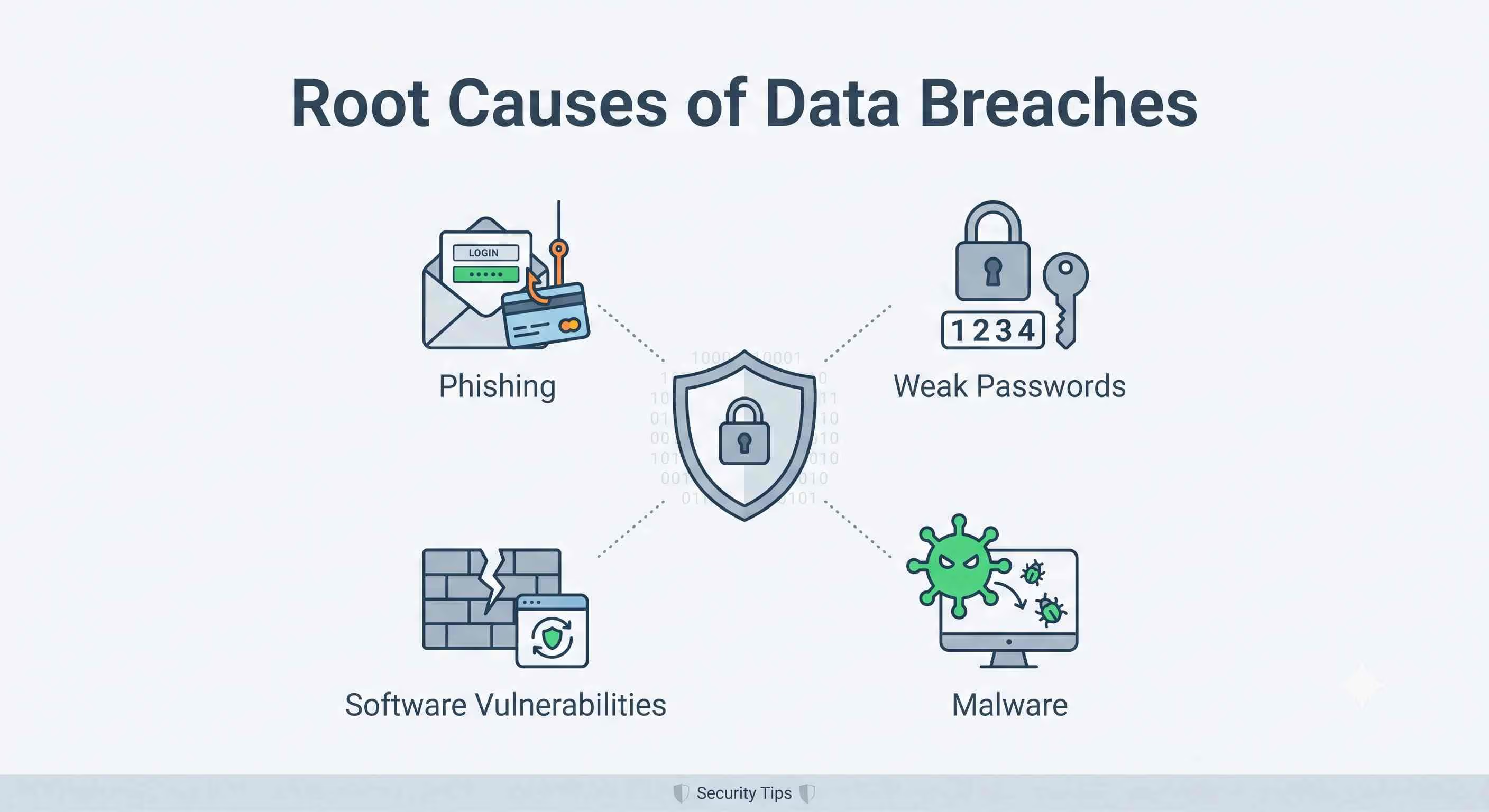
The root causes of data breaches fall into five recurring categories: human error, malicious attacks like ransomware, insider threats, system misconfigurations, and third party vendor weaknesses. Every major breach investigation traces back to one, or usually a combination, of these five.
None of these causes are new. What has changed is scale. A single misconfigured cloud bucket today can expose more records in one afternoon than an entire decade of paper filing errors ever could. The attack surface grew faster than most security teams' budgets did, and that gap is where breaches live.
Human Error in Cybersecurity: Psychological and Operational Mechanics
Human error remains the single largest contributor to data breaches worldwide, driven mainly by social engineering, weak credential habits, and accidental data exposure. It is not about people being careless. It is about attackers designing traps that exploit trust and time pressure.
Social Engineering and Identity Exploitation
Phishing has evolved well past the obvious scam email. Spear phishing targets a specific person with details pulled from LinkedIn or a company directory. Adversary in the Middle proxy attacks now sit between the user and the real login page, capturing session cookies in real time, which means even users with multi factor authentication enabled can still get compromised if the MFA method is not phishing resistant.
Business Email Compromise takes this further. Attackers register cousin domains that look almost identical to a real vendor's domain, then send invoice change requests that look completely routine. When SPF, DKIM, and DMARC records are not properly aligned, these spoofed emails sail straight into inboxes without a warning banner.
Credential Mismanagement and Authentication Weaknesses
Password reuse is still the quiet killer. One leaked password from an unrelated website breach gets tested against corporate logins through automated credential stuffing tools. NTLM relay attacks let a compromised low privilege account be used to authenticate as someone with far more access, entirely inside the network, without the user ever knowing.
OAuth consent phishing is another growing problem. Instead of stealing a password, attackers trick a user into approving a malicious third party app that requests broad access to their mailbox or files, and that access sticks around even after the password is changed.
Accidental Data Exposure and Misdirection
Sensitive files get pasted into the wrong Slack channel. Spreadsheets with customer data get sent to the wrong email address because autocomplete filled in a similar name. Developers push code to public GitHub repositories with hardcoded API keys and AWS credentials sitting right there in plain text, sometimes for months before anyone notices.
Hoplon Insight Box
Enforce FIDO2 or WebAuthn hardware based MFA rather than SMS codes, run automated secret scanning across every CI CD pipeline, and set Data Loss Prevention rules that flag patterns matching SSNs, card numbers, or medical record numbers before they leave the network. Programs like security awareness training software and email security and anti phishing protection close most of this gap when applied together rather than separately.
Ransomware Attack Vectors and Defense Mechanics
Ransomware today follows a predictable execution chain: initial access, lateral movement, data theft, then encryption, and understanding each stage is what allows defenders to interrupt it before damage spreads.
The Modern Ransomware Execution Chain
Initial access usually comes through exposed RDP ports, unpatched VPN appliances, or a malicious attachment that slips past filtering. Once inside, attackers rarely encrypt anything right away. They move laterally first, using tools like Cobalt Strike beacons and living off the land binaries that are already trusted by the operating system, so nothing looks out of place to basic antivirus.
Techniques like Pass the Hash and Kerberoasting let attackers escalate privileges without ever needing the actual plaintext password. By the time encryption starts, they have often already deleted volume shadow copies to block easy recovery, and pulled a full copy of sensitive files out through tools like rclone. That is the double extortion model. Pay or your data gets published, even if backups let you recover the systems themselves.
Advanced Persistent Threats
Persistent access techniques map cleanly to known MITRE ATT&CK categories, including Command and Control under T1071 and Persistence under T1098. Security teams that align their detection rules to this framework catch lateral movement far earlier than teams relying only on signature based antivirus.
Hoplon Insight Box
Maintain immutable, air gapped backups following the 3 2 1 1 0 rule, restrict PowerShell and script host execution through EDR policy, and segment critical networks so one compromised machine cannot see the entire environment. Solutions like extended detection and response combined with endpoint security protection services catch this chain at the lateral movement stage, well before encryption starts.
Insider Threat Detection Framework: Technical and Behavioral Analysis
Insider threats fall into three distinct categories, malicious, negligent, and compromised, and each requires a different detection approach because the intent behind the behavior is completely different.
Categorization of Insider Threats
Malicious insiders act with intent, often disgruntled employees pulling data before resignation or acting on behalf of a competitor. Negligent insiders are not trying to cause harm, they are just bypassing controls for convenience, saving files to personal cloud storage because it is faster than the approved system. Compromised insiders are legitimate accounts hijacked through stolen session cookies or a compromised laptop, meaning the person behind the keyboard is not actually the account owner anymore.
Telemetry and Behavioral Indicators
User and Entity Behavior Analytics tools flag the patterns that matter: unusual bulk downloads, access attempts far outside normal working hours, and export commands run against systems that person rarely touches. These signals, correlated through SIEM platforms, are what separate a real insider incident from routine noise.
Hoplon Insight Box
Roll out Privileged Access Management with Just In Time elevation, apply Role Based and Attribute Based access under least privilege, and lock down USB storage through endpoint DLP policy. Regular cyber resilience assessments reveal exactly where privileged access has quietly sprawled beyond what any job actually requires.
Cloud Misconfiguration Vulnerabilities and Technology Glitches
Cloud misconfiguration is now the leading cause of large scale data exposure in cloud environments, mainly because default settings favor convenience over security and nobody circles back to fix them.
Common Technical Misconfigurations
Publicly accessible AWS S3 buckets and exposed Azure Blobs remain shockingly common, often discovered by security researchers before the company that owns them even knows. Unauthenticated Elasticsearch and Redis instances sitting open on the internet are found within minutes by automated scanning bots. Firewalls set with wide open rules, like allowing SSH or RDP from any address, hand attackers a direct path in.
Example of an insecure versus secure storage policy pattern:
| Setting | Insecure Configuration | Secure Configuration |
|---|---|---|
| Bucket Access | Public read enabled for all users | Private, access limited to specific IAM roles |
| Encryption | Disabled or default only | Server side encryption enforced with managed keys |
| Logging | Access logging turned off | Full access logging sent to a monitored SIEM |
| Admin Ports | Open to 0.0.0.0/0 | Restricted to specific VPN or bastion IP ranges |
System Glitches, Race Conditions, and Software Bugs
Patch management failures leave known, high severity vulnerabilities sitting unaddressed for months. When a critical CVE scores above 8.0 on CVSS and remains unpatched past the point where exploit code is publicly available, that window is essentially an open invitation. Deployment updates can also silently reset access controls back to a weaker default state, something teams rarely catch unless configuration drift is actively monitored.
Hoplon Insight Box
Automate Cloud Security Posture Management and static analysis of Infrastructure as Code before deployment, set patch SLAs so critical CVEs are closed within 72 hours, and baseline configurations against CIS Benchmarks. Attack surface management and vulnerability management programs together give continuous visibility instead of a once a year snapshot.
Third Party Vendor Risk Management and Supply Chain Vulnerabilities
Third party and supply chain risk has become one of the fastest growing root causes of data breaches because vendors often hold broad access with far less oversight than internal systems receive.
Supply Chain Attack Surface Analysis
Dependency confusion attacks trick build systems into pulling a malicious package instead of the legitimate internal one, something that has repeatedly hit both NPM and PyPI ecosystems. In more sophisticated cases, attackers compromise a vendor's own update mechanism, meaning trusted software delivers malicious code directly to every downstream customer. Over privileged API integrations, where a vendor is granted far more access than their function actually requires, quietly expand the blast radius of any single vendor compromise.
Technical and Legal Vendor Governance
Proper vetting means reviewing a Software Bill of Materials, checking for a current SOC 2 Type II report, and reviewing recent penetration testing results before granting access, not after a contract is already signed.
HIPAA BAA Compliance Requirements for Health and Enterprise Data
Under 45 CFR 164.502(e), any vendor handling Protected Health Information on behalf of a covered entity must sign a Business Associate Agreement. This agreement legally obligates the vendor to implement the same category of safeguards required of the covered entity itself, and it defines exactly who is responsible for notification if that vendor is the one that gets breached.
Hoplon Insight Box
Run continuous vendor security scoring rather than annual questionnaires, scope every API key with rate limits and network restrictions, and require breach notification clauses with firm timelines in every contract. Gap assessments and SOC 2 compliance audits are the two checks most organizations skip until it is already too late.
PHI vs PII Data Classification: Regulatory Impact and Safeguards
PII is any data that can identify a person, while PHI is that same personal data once it is tied to health status, treatment, or payment for care, and the distinction determines which law governs the breach response.
| Feature | Personally Identifiable Information (PII) | Protected Health Information (PHI) |
|---|---|---|
| Primary Governing Law | GDPR, CCPA/CPRA, state privacy laws | HIPAA Privacy and Security Rules |
| Scope | Data that identifies a person, such as SSN or email | PII combined with health status, care, or payment details |
| Key Safeguards | Encryption, anonymization, pseudonymization | 18 specific identifiers plus strict technical safeguards under 164.312 |
| Breach Notification Window | Varies, GDPR requires 72 hours | 60 calendar days under the HIPAA Breach Notification Rule |
Performing a Security Risk Assessment aligned with NIST SP 800 30 and NIST SP 800 53 is the practical way organizations confirm they are actually meeting these requirements rather than assuming they are.
Implementing a Zero Trust Security Architecture
Zero Trust operates on the principle of never trust, always verify, meaning every access request is authenticated and authorized individually regardless of whether it originates inside or outside the traditional network perimeter.
Core Architecture Principles
Following NIST SP 800 207, access decisions are made dynamically, weighing user identity, device health, location, and the sensitivity of the data being requested, rather than granting broad access simply because someone is connected to the corporate VPN.
| Security Function | Key Technology | Primary Risk Mitigated |
|---|---|---|
| Identity and Access | IAM and PAM with FIDO2 MFA | Credential stuffing, phishing, identity takeover |
| Endpoint Protection | EDR/XDR with behavioral analysis | Ransomware execution and lateral movement |
| Data Protection | DLP plus enterprise rights management | Accidental exposure and exfiltration |
| Monitoring and Response | SIEM plus SOAR playbooks | Slow detection and delayed containment |
| Cloud Defense | CSPM plus microsegmentation | Cloud misconfiguration and exposed storage |
Real World Scenario: A Cloud Storage Exposure Case
_compressed-20260722172741.webp "Root Causes of Data Breaches")
Picture a mid sized healthcare provider migrating patient intake forms to a cloud storage bucket during a routine platform upgrade. The developer handling the migration copies a permission template from an older, less sensitive project, one that had public read access enabled for a marketing asset folder. Nobody flags it because the deployment pipeline has no automated policy check built in.
Three weeks pass. A security researcher running mass bucket enumeration finds it, reports it responsibly, and the organization scrambles to lock it down. In this scenario there was no sophisticated attacker at all, just a misconfiguration that sat exposed until someone happened to look. This is the pattern behind a large share of the healthcare sector's reported PHI exposures, and it is entirely preventable with automated configuration scanning before deployment ever completes.
Industry and Business Impact Analysis
The financial and operational cost of a breach extends well past the initial incident response bill. Regulatory fines, customer churn, legal exposure, and the sheer time cost of remediation compound over months, sometimes years. Organizations in healthcare and financial services face the steepest costs because of the additional regulatory layer sitting on top of standard incident response expenses.
Reputational damage tends to be underestimated at the planning stage and overestimated in the panic of the moment. What actually determines long term impact is how fast the organization detects, contains, and communicates, not whether a breach happened at all. Every organization eventually faces an attempted intrusion. The ones that survive without lasting damage are the ones who had already rehearsed the response.
Technical Steps During a Data Breach
Following the NIST SP 800 61 Rev 2 framework, incident response moves through six defined phases: preparation, detection and analysis, containment, eradication, recovery, and lessons learned.
Preparation: build the incident response plan, provision tooling, and confirm logging is actually capturing what you think it is
Detection and Analysis: triage alerts, review SIEM logs, and forensically isolate affected endpoints without tipping off the attacker
Containment: revoke compromised Kerberos tickets and reset credentials short term, apply temporary firewall blocks and patch the exploited vulnerability long term
Eradication: remove persistence mechanisms, clean malicious registry entries, and re image compromised assets from a known clean state
Recovery: restore from verified clean backups, validate monitoring is functioning, then carefully restore production traffic
Lessons Learned: run a post incident review, build a full forensic timeline, and complete regulatory notifications on schedule
Services like incident response and recovery and digital forensic investigation exist specifically to compress this timeline, because every hour spent figuring out what happened is an hour the attacker still has access, or an hour regulators are watching the notification clock tick.
Mitigation and Security Best Practices
No single control stops every root cause, which is exactly why layered defense matters more than any individual tool. A realistic mitigation program touches identity, endpoints, data, network, and process at the same time.
| Root Cause | Primary Mitigation |
|---|---|
| Human Error | Phishing resistant MFA, DLP rules, ongoing security awareness training |
| Ransomware | Immutable backups, EDR/XDR, network microsegmentation |
| Insider Threats | PAM with Just In Time access, UEBA monitoring, least privilege enforcement |
| Cloud Misconfiguration | CSPM, IaC scanning, CIS benchmark baselining |
| Vendor Risk | SBOM review, continuous vendor scoring, scoped API access |
Testing these controls matters as much as deploying them. Regular penetration testing, web application security testing, and AI driven automated red teaming reveal whether controls hold up against a real attacker, not just a checklist audit. For organizations with connected devices, IoT and embedded security reviews close a category of exposure that traditional IT audits routinely miss.
Frequently Asked Questions
What is the number one cause of data breaches in modern cloud environments
Cloud storage and identity misconfiguration, such as publicly accessible buckets and overly permissive IAM roles, leads the list, closely followed by credential theft through phishing.
How do ransomware attack vectors bypass traditional antivirus software
Modern ransomware uses fileless techniques, obfuscated PowerShell, and living off the land tools like certutil, along with kernel level vulnerable driver abuse, to slip past signature based detection entirely.
What is the technical difference between PHI and PII, and why does it matter
PII identifies a person on its own. PHI is that same data tied to medical records or healthcare payment, which shifts the governing law to HIPAA and triggers stricter technical safeguard requirements.
How does a Business Associate Agreement protect organizations technically and legally
It legally assigns compliance responsibility between a covered entity and a vendor, while technically requiring the vendor to implement matching safeguards and follow defined breach reporting timelines.
What metrics best measure an organization's breach readiness
Mean Time to Detect, Mean Time to Respond, patch SLA compliance rate, phishing simulation failure percentage, and the share of unused identity permissions actually revoked.
Can a small business really be a target for these attacks
Yes, and often more so, because smaller businesses tend to have weaker cloud configurations and fewer monitoring controls, making them a faster and less risky target for automated scanning tools.
Hoplon Technical Takeaway
Every root cause covered here shares one thing in common. They are all detectable and preventable well before data actually leaves the network, provided the right visibility exists at the identity, endpoint, cloud, and vendor layer simultaneously. Zero Trust is not a product you buy once, it is the operating model that ties these layers together so a single mistake, whether human or technical, does not turn into a full scale breach.
If your organization needs a clear picture of where these gaps currently sit, a virtual CISO engagement or a focused security on demand review is the fastest way to find out before an attacker does. Explore more technical breakdowns like this one on the Hoplon Infosec blog, or start directly at Hoplon Infosec to see the full range of assessment and defense services available.