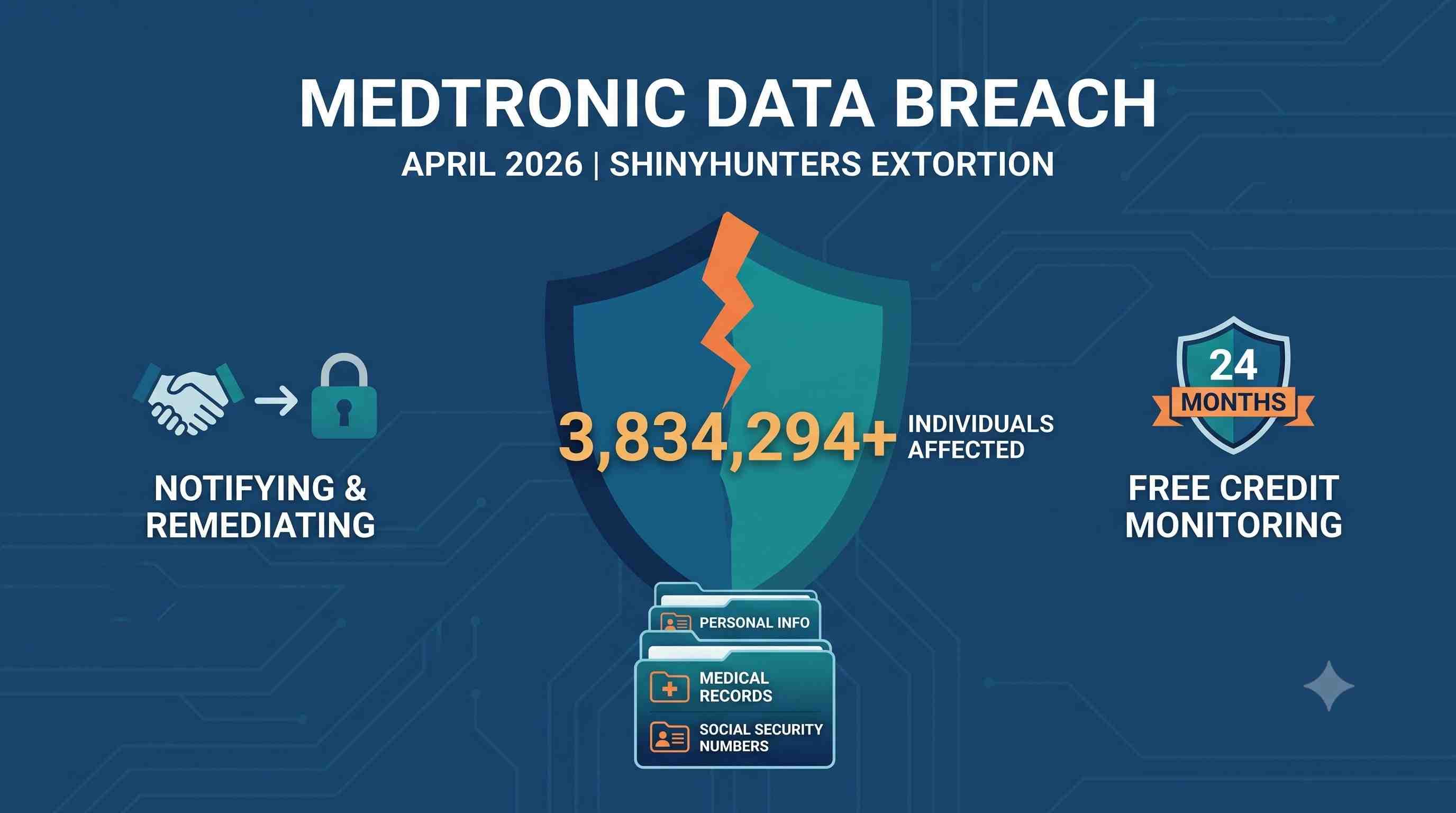
In April 2026, the world's largest medical device maker found an uninvited guest sitting inside its corporate network. Medtronic confirmed that the extortion group ShinyHunters had broken into certain corporate IT systems and walked away with personal and medical information belonging to millions of people.
The company later told the Indiana Attorney General's office that the true number affected was 3,834,294 individuals, a figure that turns a scary headline into a very personal problem for nearly four million patients, family members, and healthcare partners.
This matters right now because the notification letters are landing in mailboxes across the country, the credit monitoring windows are ticking, and the healthcare sector is once again staring at proof that a company's size and reputation do not automatically buy it protection from a determined data extortion crew.
| Item | Detail |
|---|---|
| Target Organization | Medtronic Inc, the world's largest medical device manufacturer |
| Total Affected Individuals | 3,834,294, confirmed through state Attorney General filings including Indiana |
| Threat Actor | ShinyHunters, a financially motivated data extortion group |
| Intrusion Window | April 13 to April 19, 2026 |
| Public Leak Site Listing | April 17 to April 18, 2026 |
| Public Confirmation | April 24, 2026 |
| Patient Notification | Began in late June and continued through July 2026 |
| Impacted Assets | Corporate IT systems and patient PII and PHI databases |
| Unimpacted Assets | Medical devices, therapies, manufacturing, and distribution operations |
| Remediation Offered | 24 months of free credit monitoring, dark web monitoring, and identity restoration |
Our own review of the incident matches Medtronic's public statements on one important point. There is no evidence that the intrusion reached the firmware or operational technology that runs pacemakers, insulin pumps, or other connected medical devices. That is a meaningful sign that network segmentation between corporate IT and clinical or manufacturing systems held up under real pressure, even while the corporate side was being emptied of sensitive records.
What is the Medtronic Data Breach 2026?
The Medtronic data breach 2026 refers to an unauthorized intrusion into Medtronic's corporate IT environment that ran from April 13 to April 19, 2026, resulting in the theft of personal and health information tied to millions of patients and individuals connected to the company. Medtronic became aware of unusual activity on April 15, 2026, and brought in outside forensic specialists to scope the incident before it went public.
Medtronic is not a small target. It is a publicly traded medical technology company with roughly 90,000 to 95,000 employees operating in about 150 countries, and it is the largest medical device manufacturer in the world by revenue. That scale is exactly why a breach here lands differently than a breach at a smaller vendor. Corporate IT at a company this size touches an enormous volume of patient records, HR data, and internal documentation, all of which sits in the same general risk category once an intruder gets a foothold.
The breach followed a pattern that has become familiar in 2026. A financially motivated group gains access to corporate systems, quietly siphons data over a period of days, then goes public with a threat to leak everything unless a ransom is paid. What made this incident different from a traditional ransomware attack is that no systems were encrypted. This was pure data theft and extortion, a method that has become the preferred approach for groups like ShinyHunters because it skips the noisy, detectable step of locking files and goes straight to pressuring the victim with the threat of public exposure.
How the ShinyHunters Attack Worked
ShinyHunters accessed Medtronic's corporate IT systems between April 13 and April 19, 2026, exfiltrated data quietly, then listed Medtronic on its Tor based leak site on April 17 with a claim of over 9 million stolen records and a ransom deadline of April 21. Medtronic has not confirmed the 9 million figure, and the exact technical entry point into its network has not been officially disclosed.
Security researchers tracking ShinyHunters throughout 2026 have documented a consistent set of tactics that the group and its affiliates use against large enterprises, and the Medtronic case fits the general shape of that pattern even though Medtronic itself has stayed quiet on specifics. The three attack paths researchers have mapped most often are worth understanding on their own merits.
- Credential and identity abuse, where stolen employee logins or compromised single sign on sessions through platforms like Okta give an attacker a legitimate looking way into cloud systems.
- Third party and vendor compromise, where attackers breach a connected vendor first, then use that vendor's stored access tokens to reach into the real target's cloud environment without tripping normal alarms.
- Social engineering through vishing, where a convincing phone call to an IT help desk or employee talks someone into handing over a one time code or resetting a credential that should never have moved that easily.
Multiple security outlets covering the April 2026 wave of attacks, including the parallel breaches at ADT and McGraw Hill during the same window, have noted that ShinyHunters affiliates leaned heavily on Salesforce integration abuse and Okta focused vishing during this period. Whether that specific combination was used against Medtronic remains unconfirmed, and this article treats it as an informed possibility rather than a fact.
Attack Flow at a Glance
| Stage | What Happened |
|---|---|
| Initial Access | Unconfirmed, plausibly credential or cloud identity abuse consistent with ShinyHunters' known TTPs |
| Discovery and Collection | Attacker locates and gathers patient and corporate records inside IT systems |
| Exfiltration | Data moved out between April 13 and April 19, 2026, reportedly without deploying ransomware |
| Extortion | Medtronic listed on ShinyHunters leak site April 17, ransom deadline set for April 21 |
| Delisting | Medtronic quietly removed from the public leak site, which analysts read as a possible sign of negotiation |
| Disclosure | Public confirmation and SEC Form 8 K filing on April 24, 2026 |
What This Looks Like for a Patient
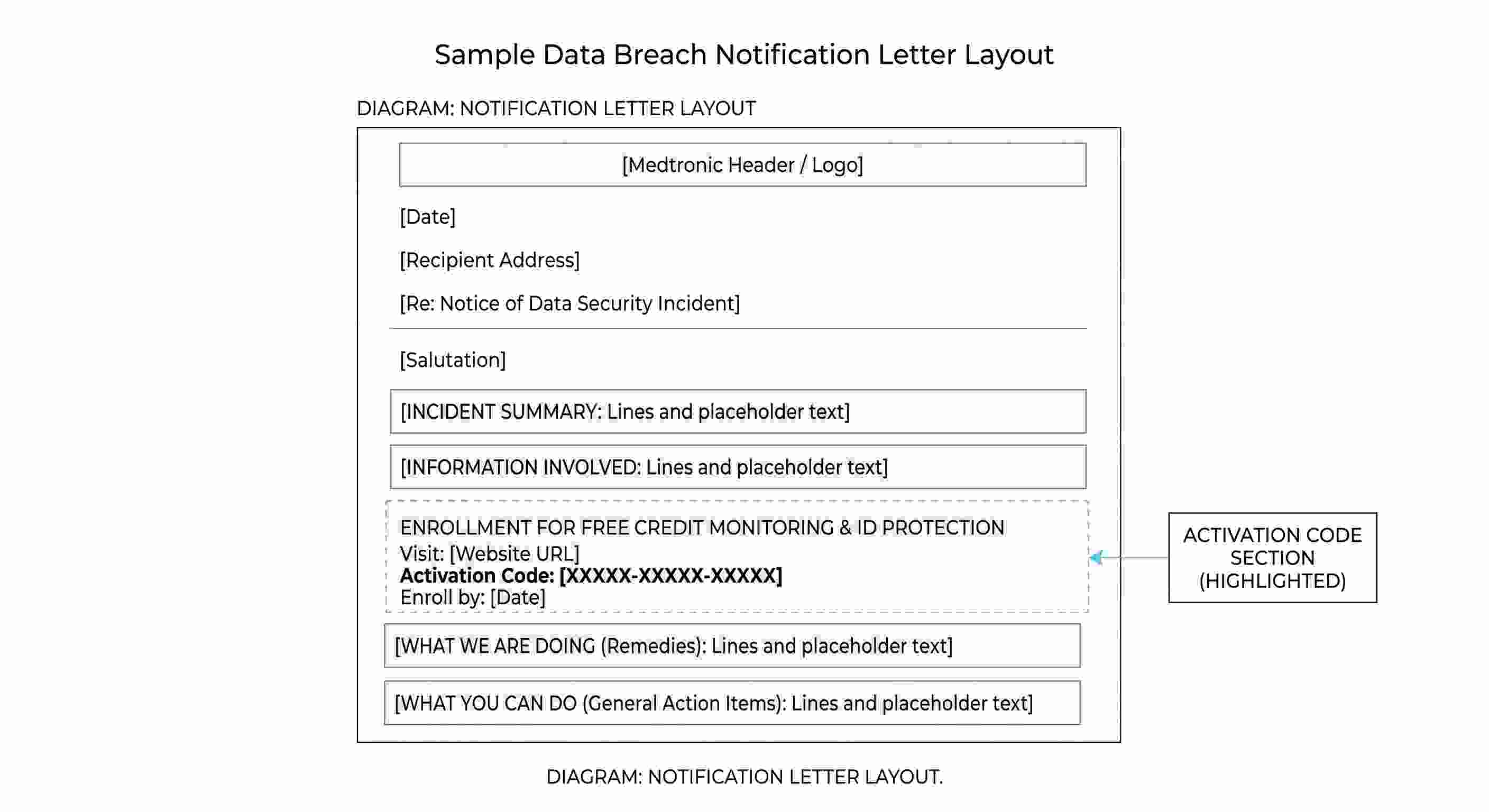
Picture a longtime Medtronic patient managing diabetes with an insulin pump. Their device keeps working exactly as it should, since it was never anywhere near the compromised systems. A letter arrives instead, explaining that their name, date of birth, contact details, Social Security number, and some health related information were part of the stolen data. That single letter is now the patient's entire warning system for a threat that could show up months later as a fraudulent medical claim, a fake tax return, or a phishing email that already knows enough real details to sound convincing.
This is the uncomfortable truth about medical data breaches that a lot of coverage skips past. The device is safe, but the person is not automatically safe just because the device is fine. Medical identity theft can mean a criminal using a stolen identity to receive treatment or prescriptions billed to the victim's insurance, which then contaminates the victim's own medical records with someone else's history. Untangling that mess with an insurer takes far longer than reversing a stolen credit card charge.
Industry and Business Impact Analysis
Healthcare has been one of the most heavily targeted sectors throughout 2026, and Medtronic's experience illustrates why regulators keep raising the bar for this industry specifically. A single corporate IT compromise at a company this size touches Social Security numbers, health records, and contact data all at once, which is exactly the combination criminals value most for identity fraud and targeted phishing.
For Medtronic itself, the exposure runs across several fronts. There is the direct cost of 24 months of credit monitoring for nearly 3.8 million people, the legal exposure from class action lawsuits that were filed within weeks of disclosure, and the regulatory scrutiny that comes with HIPAA covered entities reporting a breach of this scale. There is also a quieter reputational cost. Multiple state Attorney General filings, including Indiana, Texas, Massachusetts, Vermont, and others, mean this incident is now permanently part of the public record in a way that a smaller, quietly settled incident would not be.
For every other healthcare and medical device organization watching this unfold, the lesson is less about Medtronic's specific mistakes, since the exact entry point has not been disclosed, and more about the value of hard separation between corporate IT and clinical or manufacturing environments. That separation is precisely what kept this from becoming a patient safety story instead of a data privacy story. Organizations that have not tested whether their own segmentation would hold up the same way under a similar compromise now have a real world case study sitting in front of them, and a gap assessment is a reasonable first step to find out.
Compromised Data Classification
| Category | Data Types | Severity | Primary Risk |
|---|---|---|---|
| Personal Identifiable Information | Full name, contact details, date of birth, Social Security number | Critical | Identity theft, tax fraud, account takeover |
| Protected Health Information | Health conditions and other health related records | High | Medical identity theft, targeted phishing |
| Corporate Data | Internal documentation referenced in the threat actor's claims | Medium | Secondary exploitation, further social engineering |
Legal, Compliance, and Regulatory Consequences
Medtronic, as a HIPAA covered entity handling protected health information, faces notification obligations under the HIPAA Breach Notification Rule alongside a patchwork of state breach notification laws. The company disclosed the incident through an SEC Form 8 K filing on April 24, 2026, and separately notified multiple state Attorneys General, with Indiana's filing being the source of the precise 3,834,294 figure and other states, including Texas, Massachusetts, Vermont, Washington, and New Hampshire, receiving their own state specific breakdowns.
One detail legal analysts have focused on is the gap between detection and notification. Medtronic detected the intrusion within days, on April 15, but patient notification letters did not go out until late June and July, roughly eleven weeks later.
Detecting an incident quickly is a genuine security win, but a multi week gap before affected patients hear about it is precisely the kind of timeline regulators and plaintiffs' attorneys scrutinize most closely, since several class action lawsuits were already filed in the weeks following disclosure.
Organizations that want their own breach response timeline to hold up under similar scrutiny typically benefit from a dedicated security compliance review well before an incident, not after one.
Mitigation and Security Best Practices
The good news buried inside this incident is that the mitigation playbook is well understood, even if it is not always well funded or well rehearsed. Healthcare organizations and any company holding large volumes of PII should treat the following as a working checklist rather than a wish list.
- Adopt a zero trust identity and access management model so a single compromised credential cannot roam freely across the network.
- Require phishing resistant multi factor authentication, ideally FIDO2 hardware keys, on every account with elevated privileges.
- Enforce strict data loss prevention controls on cloud storage and SaaS endpoints where large data pulls should be rare and noticeable.
- Keep corporate administrative infrastructure genuinely separated from clinical, product, and manufacturing networks, the same separation that appears to have protected Medtronic's devices.
- Run continuous endpoint and extended detection and response monitoring so unusual data movement gets flagged in hours, not weeks.
- Regularly test your public facing footprint through attack surface management so forgotten cloud assets and misconfigured guest access do not become the easiest way in.
- Build a rehearsed incident readiness and response recovery plan long before an actual intrusion forces you to improvise one under pressure.
For patients and affected individuals, the recovery steps are simpler but still require follow through.
- Read the Medtronic notification letter carefully and locate the unique activation code before it expires.
- Enroll promptly in the 24 months of complimentary credit monitoring and identity theft protection being offered.
- Place a credit freeze with Experian, Equifax, and TransUnion so new accounts cannot be opened in your name without your direct approval.
- Consider an IRS Identity Protection PIN and monitor Social Security Administration records for unfamiliar activity.
- Treat any email or text referencing Medtronic or this breach with suspicion, and never click a link in an unsolicited message, since spear phishing campaigns often follow large breaches like this one within weeks.
Organizations that want an outside check on whether their monitoring would actually catch a similar intrusion in progress may find value in cyber threat intelligence services that track groups like ShinyHunters directly, paired with dark web monitoring to catch stolen credentials before they get reused elsewhere.
Frequently Asked Questions
Was my Medtronic medical device, such as a pacemaker or insulin pump, affected?
No. Medtronic has stated that its products, patient safety, manufacturing, and distribution operations were not affected. The confirmed compromise was limited to certain corporate IT systems, which the company says are kept separate from device and clinical networks.
Did Medtronic pay a ransom to ShinyHunters?
Medtronic has not publicly confirmed or denied paying a ransom. Medtronic's quiet removal from ShinyHunters' public leak site after the stated deadline has led some threat intelligence analysts to suspect behind the scenes negotiation, but this remains an inference, not a confirmed fact.
What data was exposed in the Medtronic 2026 breach?
Medtronic says the exposed data may include names, contact information, dates of birth, Social Security numbers, and health related information for 3,834,294 individuals.
How many people were affected by the Medtronic data breach?
Medtronic reported 3,834,294 affected individuals to the Indiana Attorney General's office. ShinyHunters separately claimed to have stolen over 9 million records, a figure Medtronic has not confirmed.
How do I sign up for the free credit monitoring Medtronic is offering?
Affected individuals receive a physical notification letter containing a unique activation code and instructions for enrolling in 24 months of complimentary credit monitoring, dark web monitoring, and identity theft restoration.
Is ShinyHunters the same group behind other 2026 breaches?
ShinyHunters has been linked to a wide string of 2026 data extortion incidents across retail, education, and technology sectors, generally using credential theft, cloud platform abuse, and social engineering rather than traditional ransomware.
Hoplon Technical Takeaway
The Medtronic data breach 2026 is a reminder that patient safety and patient privacy are two separate battles, and winning one does not mean winning the other. Medtronic's network segmentation appears to have kept a corporate IT compromise from ever touching a medical device, which is a real engineering success worth acknowledging.
At the same time, nearly 3.8 million people now have to spend months watching their credit reports and health records for signs of misuse, because identity and cloud access controls did not hold the same line that network segmentation did.
If your organization handles large volumes of PII or PHI, the practical question worth asking this week is not whether ShinyHunters could target you specifically, but whether your identity controls, vendor integrations, and help desk procedures would survive the same pressure Medtronic's did. A cyber resilience assessment or a conversation with Hoplon InfoSec's virtual CISO team is a practical way to find the gap before an extortion group finds it first.