AI Security and Ransomware Attacks Are Reshaping This Week's Threat Landscape
If you only have a minute, here is the short version. Ransomware crews are breaking in through firewalls and collaboration servers that were never patched on time, AI tools are being treated as a brand new kind of insider risk, a huge supplier breach just exposed unreleased Apple hardware details, and law enforcement finally caught up with one of the most damaging hacking crews of the last two years. Put together, these stories show exactly why AI security and ransomware attacks are now talked about in the same breath. They are no longer separate problems handled by separate teams.
I have been following cybersecurity news for years, and this particular week felt like a turning point. It was not one big headline. It was five or six medium sized stories that all point in the same direction, toward a threat landscape where firewalls, AI agents, meeting software, and supplier networks are treated as equally important attack surfaces.
Quick Summary Table
| Incident | What Happened | Why It Matters |
|---|---|---|
| FortiBleed campaign | FortiGate credentials from over 430,000 firewalls tied to INC and Lynx ransomware | First confirmed link between mass credential theft and actual ransomware deployment |
| SharePoint CVE-2026-45659 | On premises SharePoint servers actively exploited, added to CISA's KEV list | Federal agencies had until July 4 2026 to patch, private companies should treat it the same way |
| Microsoft Teams bot policy | New admin control forces external AI bots into the meeting lobby | Meeting security now includes governing what AI tools can listen in |
| Claude Fable 5 restoration | Anthropic resumed global access after US export controls were lifted | AI model availability is now tied to government policy, not just product decisions |
| Tata Electronics leak | Over 630GB stolen by extortion group World Leaks, exposing iPhone 18 Pro supplier data | Supplier breaches can leak a major brand's most closely guarded secrets |
| Scattered Spider arrest | Peter Stokes extradited from Finland to face US charges | Shows that international law enforcement pressure on ransomware crews is increasing |
Ransomware Groups Are Living Inside Your Firewall, Not Just Attacking It
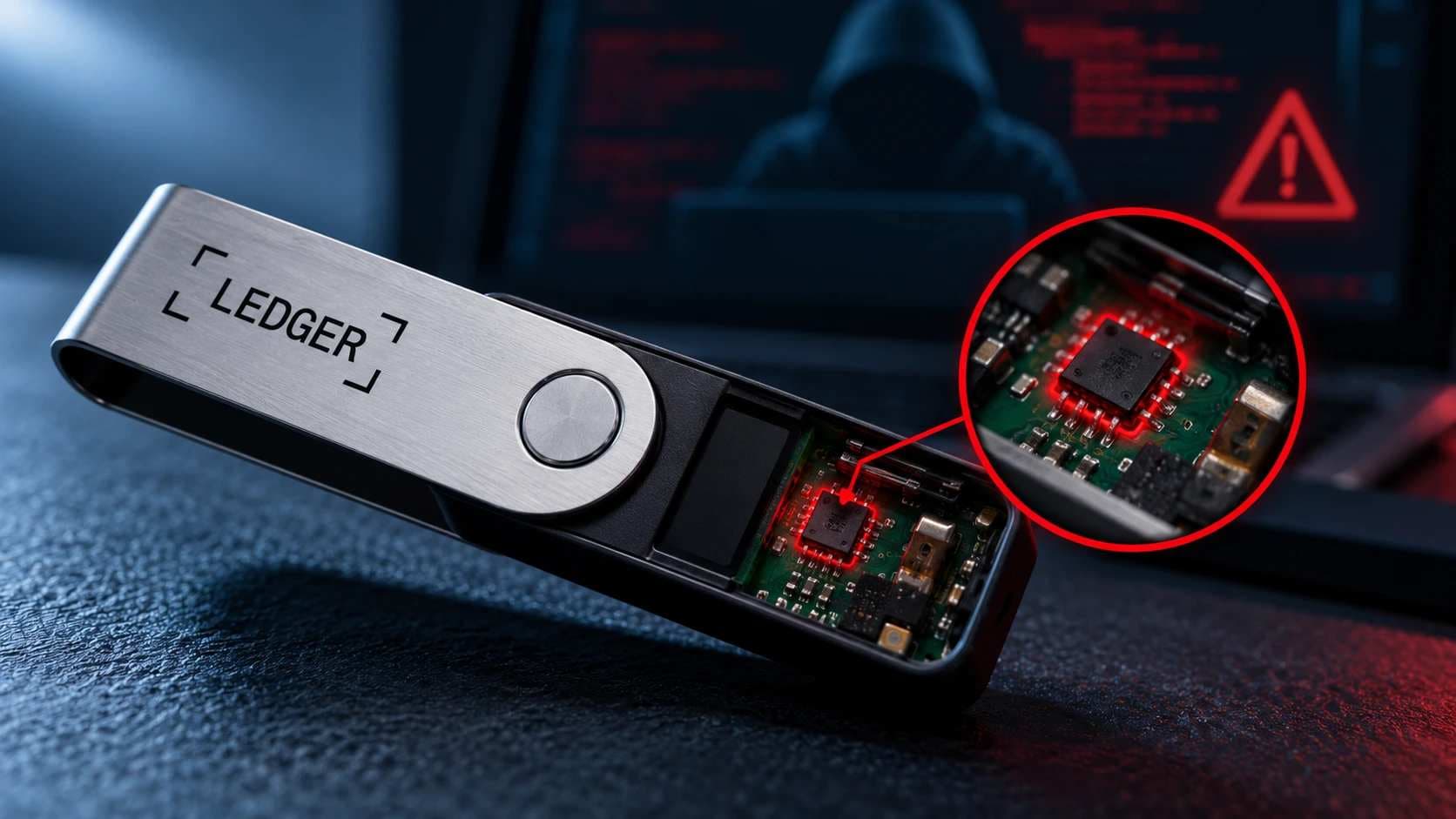
For years, people treated the firewall as the wall itself, the thing that keeps attackers out. That idea took a hit this week. Security firm SOCRadar published research tying a massive credential theft operation, nicknamed FortiBleed, directly to two active ransomware groups, INC Ransom and Lynx.
Here is the part that should worry any IT team running Fortinet gear. Researchers tracked scanning activity against more than 11,000 FortiGate portals across over 150 countries, gained visibility into an attacker's own infrastructure through an operational security mistake the criminals made, and found a single operator logged into the negotiation panels of both INC and Lynx at the same time. Victim data from the credential theft campaign overlapped with organizations that later showed up on INC's own leak site. That is not a coincidence, that is a supply chain of crime, where one group harvests access and hands it off, sells it, or uses it directly for extortion.
The scale is genuinely hard to picture. Over 430,000 FortiGate firewalls were targeted worldwide, and more than 110 million credentials were harvested using a custom sniffing tool that quietly intercepted authentication traffic. At least 12 confirmed ransomware deployments have already come out of this campaign, with hundreds of endpoints encrypted.
If your organization runs FortiGate appliances, this is not a story to read and move on from. Rotate admin and VPN credentials, enforce multi factor authentication on every external facing login, and treat any device that has ever been internet exposed as potentially compromised until proven otherwise. This is exactly the kind of exposure a proper attack surface management program is built to catch before an attacker does, and ongoing vulnerability management closes the gap between a patch being released and it actually being installed.
-20260703162140.webp "Ransomware groups inside your firewall")
A SharePoint Flaw Just Joined the List of Actively Exploited Bugs
While Fortinet gear was making headlines, Microsoft SharePoint quietly became a fresh entry point for attackers too. CISA added CVE-2026-45659, a deserialization vulnerability in on premises SharePoint Server, to its Known Exploited Vulnerabilities catalog on July 1, 2026, after confirming real world exploitation.
What makes this one uncomfortable is how little an attacker actually needs. Microsoft's own advisory says any authenticated user with nothing more than basic Site Member permissions can trigger remote code execution, no admin rights required. Microsoft had originally rated exploitation as "less likely" when it patched the flaw back in May. Reality disagreed. Federal agencies were given until July 4 to patch under Binding Operational Directive 26-04, and honestly, any private organization running on premises SharePoint should be working to that same deadline, not a slower internal one.
This story fits a pattern I keep seeing. Collaboration platforms sit at the center of company life, full of contracts, HR files, and internal communications, yet they often get patched slower than internet facing web servers because IT teams assume they are "internal." A web application security testing engagement against SharePoint and similar platforms usually turns up exactly this kind of gap before an attacker finds it first.
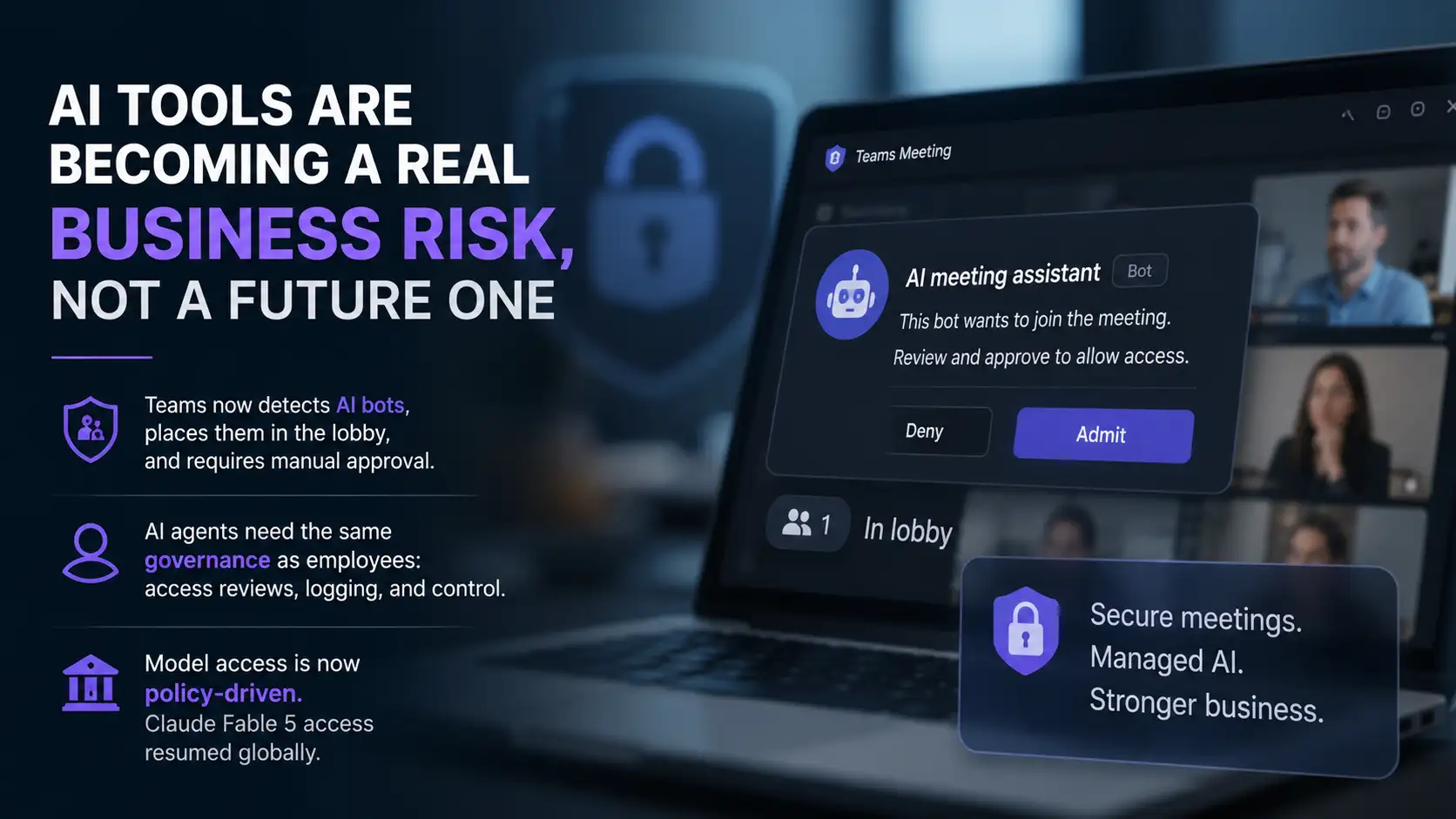
AI Tools Are Becoming a Real Business Risk, Not a Future One
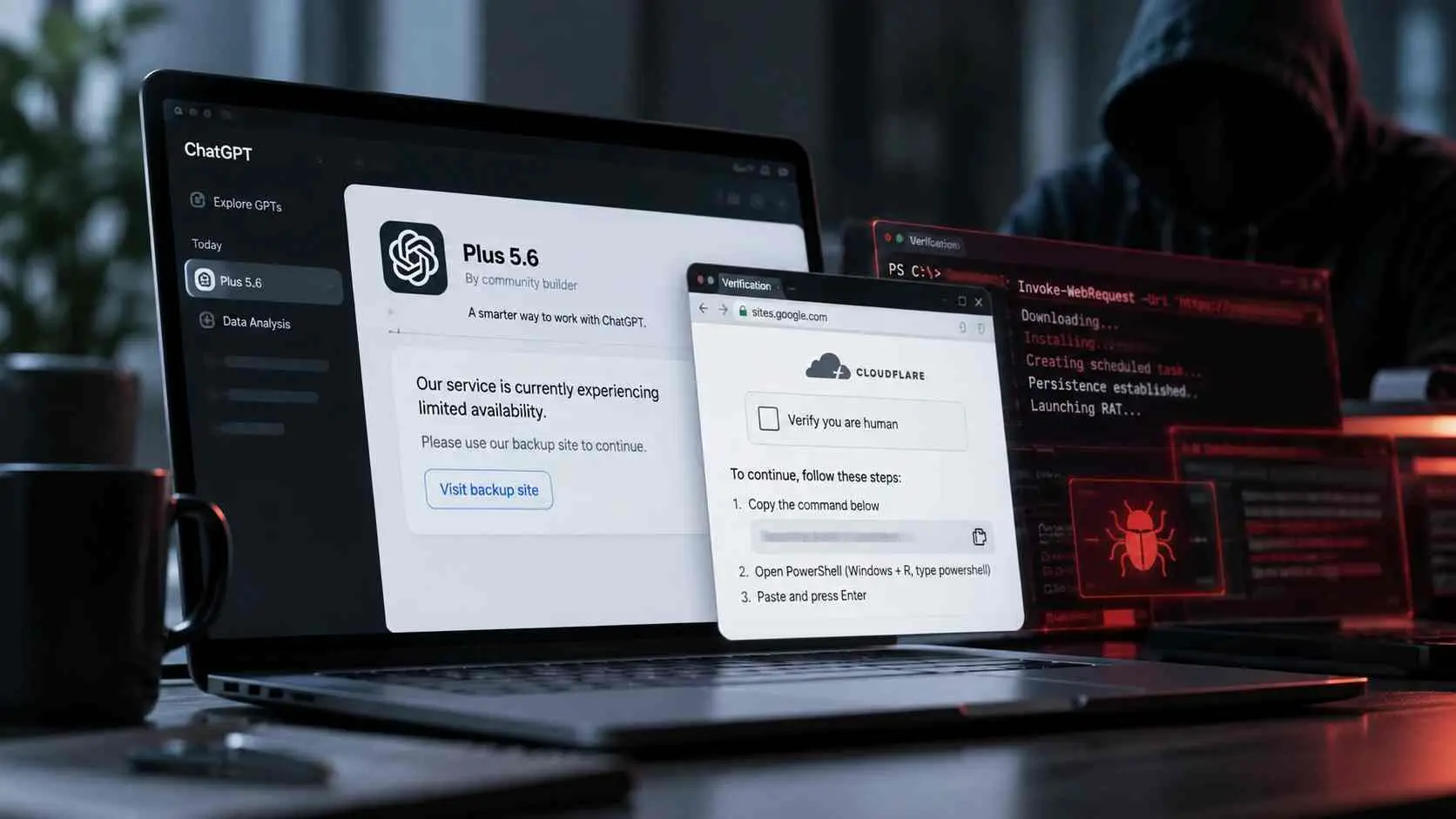
This is the part of the week's news that ties everything back to AI security specifically. Microsoft rolled out a new Teams admin policy called "Manage external bots and their access to meetings." In plain terms, Teams now automatically detects likely AI meeting assistants, drops them into the lobby, labels them clearly, and forces the meeting organizer to manually approve them before they can listen in, record, or transcribe anything.
Think about why this matters. AI note takers and transcription bots exploded in popularity over the last two years. They are genuinely useful, but they also introduce a category of participant that older meeting security models never accounted for. A human guest might misunderstand confidentiality. An AI bot can silently record, transcribe, and route sensitive conversation content to a cloud service the company never vetted. Microsoft even removed the old one click "Admit" shortcut specifically so organizers cannot accidentally wave a bot into a legal call or a board discussion without thinking about it.
This is the broader lesson businesses need to sit with. An AI agent that has access to a meeting, an inbox, or a shared drive should be managed the way you would manage a new employee with system access, not the way you would manage a piece of software you installed once and forgot about. That means access reviews, activity logging, and a governance framework, which is exactly the territory covered by AI driven automated red teaming and formal ISO certification for artificial intelligence programs.
On the model access side of things, Anthropic also confirmed that Claude Fable 5 access has resumed globally after United States export controls that briefly suspended it were lifted at the end of June 2026, with additional cybersecurity safeguards added during the restoration. It is a small detail compared to the ransomware stories, but it says something important, that AI model availability itself is now a matter of government policy, not just a product roadmap decision, and that AI vendors are visibly building stronger safety controls into these systems as they scale.
A Supplier Breach Just Exposed One of Apple's Most Guarded Secrets
Supply chain security stopped being an abstract compliance topic this week and became a very concrete problem for Apple. Tata Electronics, one of Apple's most important manufacturing partners in India, was hit by an extortion group called World Leaks, which stole and published more than 630 gigabytes of data, over 200,000 files in total.
Buried inside that leak were internal documents mapping hundreds of components in the still unreleased iPhone 18 Pro and Pro Max to the specific suppliers who make them, along with photographs of prototype devices undergoing drop testing. Some files carried Apple's own confidential watermarks. This is the kind of information Apple has spent years refusing to disclose publicly, precisely because it hands competitors and counterfeiters a map of exactly how the product is built and where the company's supply chain leverage sits.
Tata has restricted internal access to sensitive systems and brought in outside forensic investigators, and Apple is reportedly working with Tata on longer term security measures. But the reputational damage is already done. A breach at a third party supplier turned into a product secrecy crisis for one of the largest companies on earth, which is a lesson every business with an extended vendor network should take seriously.
Supplier risk cannot be managed with a signed contract alone. It needs active monitoring for leaked credentials and stolen files, which is where dark web monitoring and protection earns its keep, backed by digital forensic investigation capability for when something does go wrong, and ongoing cyber threat intelligence to catch extortion groups naming your organization before the story breaks publicly.
Law Enforcement Is Finally Catching Up With Ransomware Crews
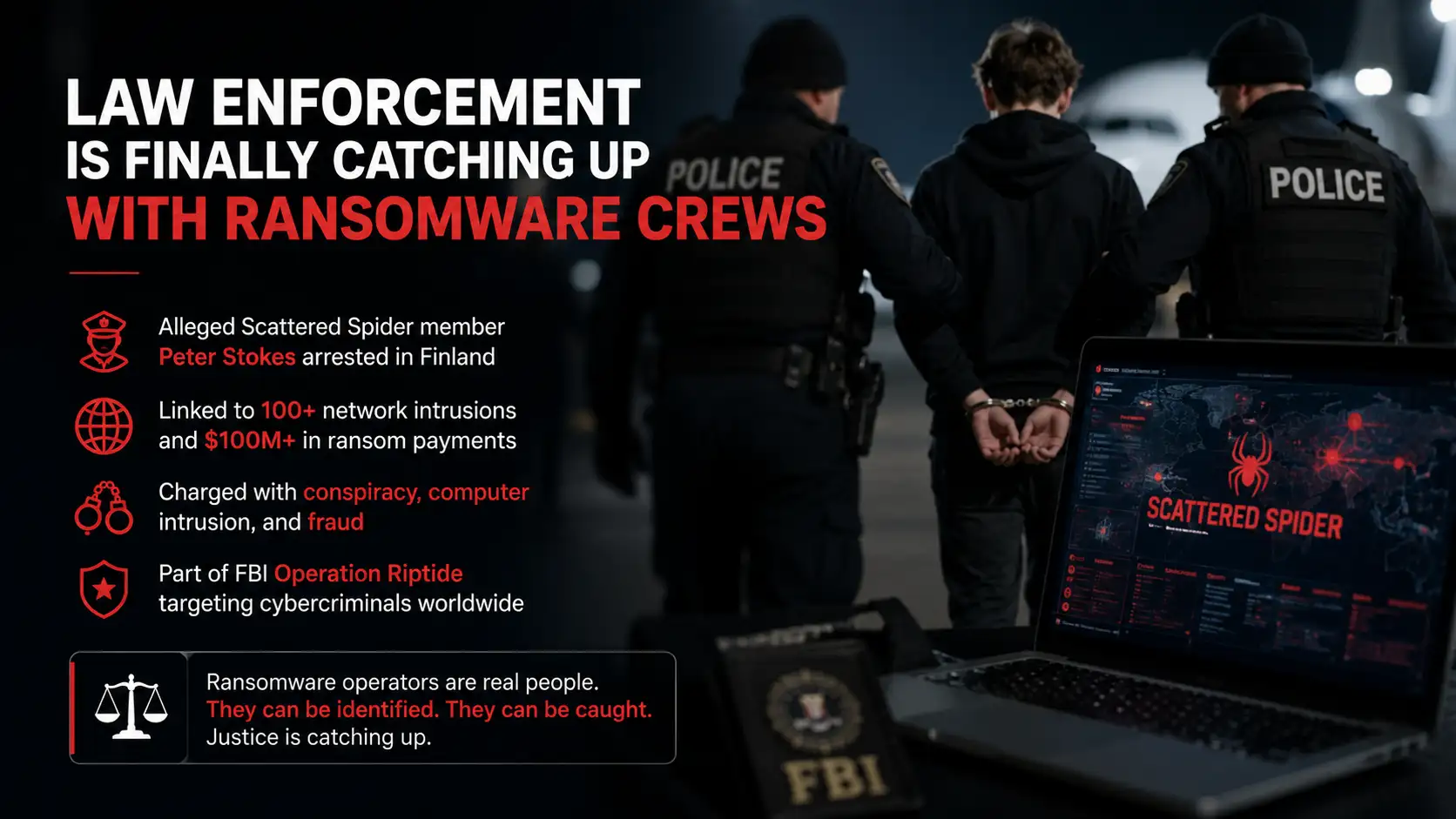
There was one genuinely good news story this week. The US Department of Justice announced that an alleged member of Scattered Spider, the hacking group also tracked as Octo Tempest and UNC3944, was arrested in Finland in April on an Interpol Red Notice and extradited to the United States. Nineteen year old Peter Stokes, a dual US and Estonian citizen, made his first court appearance in Chicago and was ordered held in custody, facing charges of conspiracy, computer intrusion, and fraud.
According to the unsealed complaint, Scattered Spider has been linked to more than 100 network intrusions and over 100 million dollars in ransom payments. Prosecutors allege Stokes was involved in a 2025 breach of a luxury jewelry retailer that led to an eight million dollar ransom demand, though the retailer's own security team managed to evict the attackers before any payment was made. This case follows other Scattered Spider related prosecutions in the UK and elsewhere, part of a wider FBI effort called Operation Riptide targeting the people and infrastructure behind cybercrime.
Arrests like this will not stop ransomware overnight, but they matter. They raise the personal cost of running these operations and send a signal that cross border cooperation between agencies is actually working. It is a reminder that ransomware is not a faceless, unstoppable force, it is carried out by real people who can be identified, tracked, and prosecuted.
What Businesses Should Actually Do About This
A few practical, plain moves come out of everything above, and none of them require exotic tools.
Patch internet facing infrastructure first, always, especially firewalls, VPN gateways, and collaboration platforms like SharePoint, since these are the systems attackers scan for constantly.
Treat every AI agent, whether it is a browser extension, a meeting bot, or a coding assistant, as a privileged user that needs access reviews, not as harmless software.
Rotate credentials regularly on anything that has ever faced the public internet, and enforce multi factor authentication everywhere it is technically possible.
Monitor your suppliers as closely as you monitor yourself, because a breach three steps removed from your own network can still expose your most sensitive product data.
Build an actual incident response plan before you need one. If your team has never rehearsed what happens in the first hour of a ransomware event, incident response and recovery support is worth arranging now rather than during an active crisis.
Frequently Asked Questions
What is the connection between AI security and ransomware attacks right now? AI tools like meeting bots and browser agents are being given real access to company systems, and attackers are exploring how to abuse that access the same way they abuse stolen firewall credentials, which is why AI governance is now treated as part of ransomware defense.
Why is FortiGate a repeated ransomware target? FortiGate firewalls sit at the edge of thousands of corporate networks, so a single credential leak can give attackers a direct path into the internal network, VPN, and domain controller, which is exactly what happened in the FortiBleed campaign.
Should private companies really follow the same patch deadline as federal agencies? Yes. CISA's July 4, 2026 deadline for CVE-2026-45659 applied to federal civilian agencies, but active exploitation does not stop at government networks, so private organizations running the same vulnerable software face the same real world risk.
Is Scattered Spider still active after this arrest? Security researchers, including Mandiant, have warned that other criminal crews continue to copy Scattered Spider's social engineering playbook even after several members were arrested, so the underlying techniques, like help desk impersonation, remain a live threat.
Hoplon Insight Box
Our recommendation this week is simple. Do not treat AI security and ransomware attacks as two separate budget lines. The FortiBleed and SharePoint stories show that patch delay is still the single biggest driver of ransomware risk, while the Teams bot policy shows that AI tools now need the same access governance as any human employee. Run an attack surface management review this month, confirm your edge devices are patched, and add AI agent access to your next security audit alongside employee accounts.
Reference Sources
FortiBleed campaign linked to INC,
If you want a second set of eyes on your own exposure to these exact risks, our team offers a straightforward starting point through a cyber resilience assessment, and you can find more breakdowns like this one on the Hoplon InfoSec blog.