Did Apple really sue OpenAI over hardware trade secrets? Yes. Apple filed a 41 page federal complaint on July 10, 2026, naming OpenAI, io Products, and two former Apple employees. The Apple OpenAI lawsuit alleges that confidential engineering files, manufacturing knowledge, supplier information, and physical hardware parts were improperly obtained or used to support OpenAI's consumer hardware program.
These claims have not been proven in court. This guide explains what the complaint says, who is named, how the alleged access occurred, why the case matters to security teams, and what organizations can learn from it. Legal status: This article reports allegations made in Apple's complaint. The defendants have not been found liable, and the court has not ruled on the merits.
What happened in the Apple OpenAI lawsuit?
Did Apple accuse OpenAI of stealing the knowledge behind its hardware products? That is the central claim in the Apple OpenAI lawsuit, filed on July 10, 2026, in the U.S. District Court for the Northern District of California.
The case is titled Apple Inc. v. Liu et al. and carries case number 5:26-cv-07078. Apple names Chang Liu, Tang Yew Tan, OpenAI Foundation, OpenAI Group PBC, and io Products LLC as defendants. The complaint says two former Apple employees took or used confidential information for the benefit of OpenAI's developing consumer hardware business.
That is Apple's account, not a court finding. OpenAI told the Associated Press that it has no interest in other companies' trade secrets and was reviewing the filing. The distinction matters. A complaint is detailed because it presents one party's case, but it does not establish that the allegations are true.
The dispute arrives at a complicated moment for Apple and OpenAI. The companies still have a documented product relationship through optional ChatGPT integration in Apple Intelligence. Apple's complaint states that the written agreement governing that integration is not part of this case. At the same time, Apple OpenAI AI competition has become more visible as OpenAI moves into consumer hardware.
Apple OpenAI lawsuit facts at a glance
| Item | Verified detail |
|---|---|
| Case | Apple Inc. v. Liu et al. |
| Case number | 5:26-cv-07078 |
| Filing date | July 10, 2026 |
| Court | U.S. District Court for the Northern District of California |
| Division | San Jose |
| Complaint length | 41 pages |
| Plaintiff | Apple Inc. |
| Defendants | Chang Liu, Tang Yew Tan, OpenAI Foundation, OpenAI Group PBC, and io Products LLC |
| Main claims | Trade secret misappropriation and breach of contract |
| Jury request | Apple demanded a jury trial |
| Current status | Complaint filed, with no ruling on liability |
The federal court's new case filing index confirms the case number and filing date. The court stamped complaint identifies the parties, six claims for relief, and the remedies Apple is asking the court to consider.
Who is named in the Apple OpenAI trade secret lawsuit?
The Apple OpenAI trade secret lawsuit does not target every former Apple employee who joined OpenAI. It names two individuals and three corporate entities. Others may appear in the allegations without being defendants.
| Party | Role | Case status |
|---|---|---|
| Apple Inc. | Claims ownership of the disputed confidential information | Plaintiff |
| Chang Liu | Former Apple engineer accused of retaining a device and accessing confidential files | Defendant |
| Tang Yew Tan | Former Apple design executive accused of using Apple information in recruiting and supplier work | Defendant |
| OpenAI Foundation | OpenAI entity accused of benefiting from the alleged misuse | Defendant |
| OpenAI Group PBC | OpenAI entity accused of benefiting from the alleged misuse | Defendant |
| io Products LLC | Hardware company accused of participating in supplier and manufacturing related misuse | Defendant |
| Yu-Ting “Alyssa” Peng | Mentioned in alleged communications with Liu | Not a defendant |
| Being mentioned in a complaint does not mean a person has been formally sued or found liable. |
Chang Liu
Apple says Liu worked at the company for eight years as a senior system electrical engineer and left on January 22, 2026. According to the complaint, he did not return at least one Apple owned computer and did not complete parts of Apple's departure process. The complaint further alleges that Liu remained in contact with Yu-Ting "Alyssa" Peng while she was still employed at Apple.
Apple says Liu used an Apple work computer authenticated through Peng's access after his own employment had ended. It also claims he reached a cloud based repository and downloaded confidential hardware files. These allegations make the Chang Liu Apple lawsuit portion of the case particularly important for cybersecurity teams.
The issue is not simply whether an account was disabled. It is whether sessions, trusted devices, cloud permissions, application access, and physical equipment were all removed or recovered at the same time.
Tang Yew Tan
Apple says Tan spent more than 24 years at the company and most recently served as vice president of product design. His work involved major product lines, including iPhone and Apple Watch. He later became a cofounder of io Products and is now OpenAI's chief hardware officer.
The Tang Yew Tan OpenAI allegations focus heavily on recruitment and interviews. Apple claims candidates were encouraged to discuss confidential projects, explain internal methods, and bring physical parts or design materials to interview sessions. Tan and OpenAI dispute the broader idea that OpenAI sought Apple's trade secrets, and the court has not determined what happened.
OpenAI and io Products
OpenAI announced in 2025 that the io Products team had merged with OpenAI. Jony Ive and LoveFrom remained independent while taking broad design and creative responsibilities.
Jony Ive is not named as a defendant in this complaint. That distinction is easy to miss in headlines about the io Products OpenAI lawsuit. The corporate defendant is io Products LLC, together with the two named OpenAI entities. The case concerns alleged conduct connected to hardware development, hiring, suppliers, and confidential information.
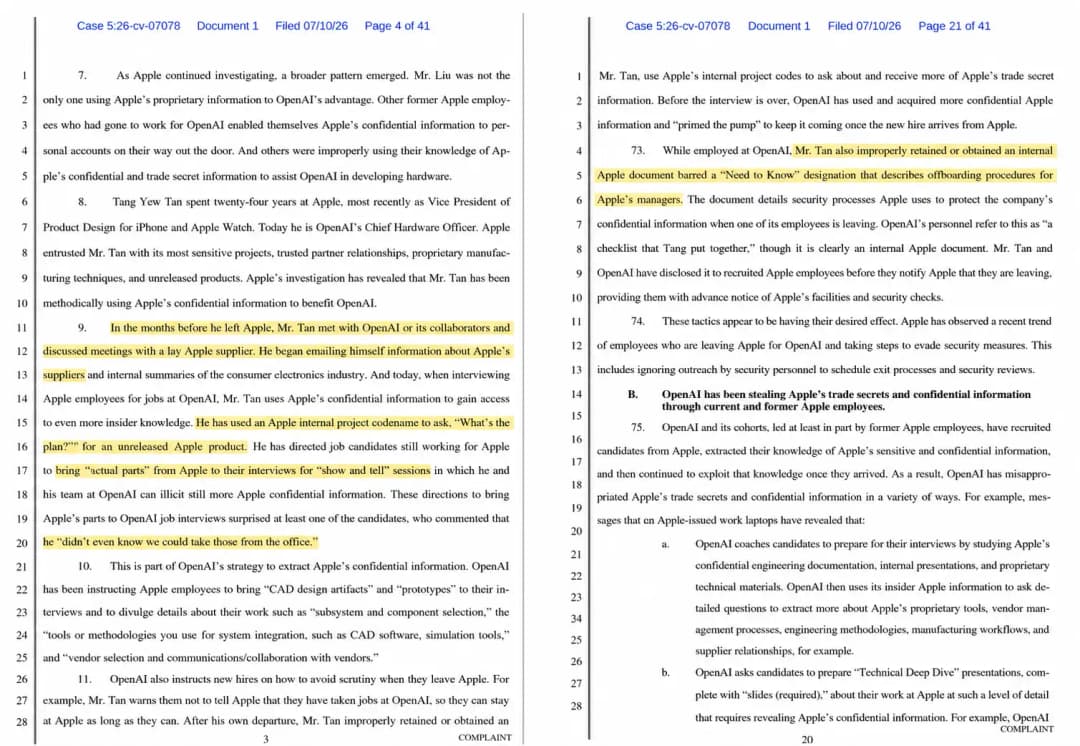
Legal complaint: Apple vs. OpenAI (source:cybersecuritynews)
What Apple says was taken or misused
People often imagine trade secret theft as a single blueprint copied onto a drive. The Apple OpenAI lawsuit describes something wider. Apple says the information covered engineering decisions, product development, manufacturing methods, testing, components, suppliers, and the lessons learned from designs that did not work.
Under the federal Defend Trade Secrets Act, information generally must have economic value because it is not widely known, and the owner must take reasonable steps to keep it secret. The law allows an owner to bring a civil action when an alleged trade secret relates to products or services used in interstate or foreign commerce. Readers can review the civil remedy framework in 18 U.S.C. Section 1836.
Hardware engineering and product design
Apple says its protected information includes circuit design, system architecture, power management, unreleased product concepts, product roadmaps, development schedules, and integration work involving machine learning features. A finished device can be purchased and examined.
That process may reveal what Apple shipped. It usually does not reveal every rejected design, the reason one component was selected over another, or the engineering compromises required to make many systems work inside a small enclosure.
Manufacturing and industrial design
The complaint describes manufacturing machinery, equipment settings, metal alloys, finishing methods, material specifications, production tolerances, and design for manufacturability, commonly called DFM. DFM is where a promising prototype becomes a product that factories can build repeatedly at scale.
A shape that looks simple on a desk may be difficult to manufacture millions of times with the same finish, strength, color, and fit. The process knowledge behind that consistency can be commercially valuable.
Components, testing, and negative know how
Apple also points to battery systems, displays, acoustic systems, touch systems, power management components, electromagnetic interference testing, failure analysis, lifecycle simulation, and manufacturing test data. One of the most valuable forms of engineering knowledge is sometimes called negative know how.
It is the record of what failed, what caused the failure, and which path a team decided not to repeat. A competitor that receives that history may avoid months or years of expensive experimentation.
Supplier and commercial information
Supplier identities, prices, capacity, qualification processes, production limits, communication methods, and sourcing strategies can shape whether a new device reaches the market on time. This part of the case is especially important because supply chain knowledge can be useful even when no design file changes hands.
Knowing which factory has a rare capability, which vendor can meet a tolerance, or which production line can scale a material may offer a shortcut that is hard to recreate through public research.
Hardware terms in the complaint
The filing includes several technical terms used in hardware engineering.
| Term | Plain English meaning |
|---|---|
| SIP | A compact package that combines several electronic components |
| MLB | The main logic board that connects key parts and carries power and signals |
| Shield | Conductive material used to reduce electromagnetic interference |
| Back glass | The rear glass panel of a device, including its finish, bonding, and durability |
| DFM | Designing a product so factories can build it reliably at scale |
| CAD | Digital design files containing measurements, geometry, and assembly details |
| Apple alleges that job candidates were asked to bring components, design files, samples, and prototypes, and to discuss vendor choices, technical tools, and recent projects. These claims remain allegations and have not been proven in court. |
How the alleged access problem worked
The most striking technical claim in the Apple OpenAI lawsuit concerns access after employment ended. Apple says Liu attempted to reach a cloud based network repository and discovered that he could still access it because of what the complaint calls an authentication vulnerability.
The filing does not identify a CVE or explain the technical root cause. There is no public basis yet to conclude whether the problem involved a stale session, token reuse, delayed account termination, trusted device status, inherited permissions, application specific access, or another flaw.
Calling it a specific vulnerability class would go beyond the available evidence. Even with that uncertainty, the control failure described by Apple is easy to understand. Disabling one directory account does not always terminate every active session or remove every device certificate. Access may survive inside a cloud application, local credential cache, mobile token, supplier portal, or project specific system.
A mature departure process should revoke active sessions, disable identity provider access, remove device trust, recover company equipment, review cloud permissions, rotate shared secrets, preserve relevant logs, and test whether the former employee can still reach protected systems. Strong endpoint security protection services and extended detection and response can help, but only when they are connected to identity and offboarding controls.
Why the recruiting allegations may matter just as much
The OpenAI hardware device lawsuit is not based only on the alleged authentication problem. Apple says OpenAI's interview process encouraged candidates to prepare detailed technical presentations, review internal information, discuss recent Apple projects, bring physical hardware, and explain supplier relationships. Engineers are allowed to change jobs.
They carry general skills, judgment, and experience with them. A person does not forget how to solve problems simply because a new employer competes with the old one. The legal boundary becomes more serious when a hiring process asks for nonpublic documents, prototypes, source materials, internal project names, unreleased product details, or supplier terms.
A responsible interviewer should stop the conversation when a candidate begins revealing another company's protected information. A practical hiring rule is simple: ask what the candidate can do, not what the former employer secretly built. Ask for a public portfolio, a fresh design exercise, or a hypothetical case. Do not ask for internal files, customer data, private code, prototypes, or confidential supplier details.
Why supplier access changes the risk
The complaint alleges that supplier relationships were used to seek manufacturing and component information. That turns the Apple trade secrets theft claim into a third party security issue as well as an employee access issue. Suppliers often serve several competitors.
They may hold drawings, specifications, process settings, samples, capacity plans, pricing, tooling data, and named contacts for each customer. A supplier can have strong perimeter security and still release sensitive information if an employee assumes a familiar former executive remains authorized.
Organizations should require suppliers to verify unusual requests, use named accounts, record approvals, restrict project data, and confirm authorization when a customer representative changes employers. Contracts should also define audit rights, incident reporting, data return, subcontractor use, and evidence preservation.
Why the case matters in cybersecurity
The Apple OpenAI lawsuit is a useful case study because it connects several controls that companies often manage separately. Human resources handles departure paperwork.
IT disables accounts. Security monitors endpoints. Legal protects intellectual property. Procurement manages vendors. Recruiting runs interviews. A gap between any two teams can become the path through which sensitive information moves.
Identity lifecycle management
Access should follow a person's role from onboarding through transfer and departure. High risk access should have an owner, a clear business purpose, and an expiration point.
When employment ends, revocation should be immediate and verified. The lesson is not to assume that a status change in one system has propagated everywhere. Security teams should test critical cloud applications, local administrator rights, source repositories, file shares, messaging tools, mobile access, developer platforms, and vendor portals.
Endpoint recovery and evidence preservation
An unreturned laptop is both a security problem and an evidence problem. It may contain local files, browser tokens, cached credentials, synchronized folders, logs, messages, or proof of access. Teams should know who can remotely lock or wipe a device, when they should preserve it instead, and how to maintain chain of custody.
When litigation or an investigation is likely, a rushed wipe may destroy evidence. A qualified digital forensic investigation can help establish what happened, when it happened, and which systems were involved.
Monitoring without treating everyone as a suspect
Insider risk programs can become harmful when they start from suspicion. A better approach begins with consistent controls, limited access, reliable logs, and transparent policies.
The goal is to detect meaningful behavior, such as unusual downloads, access after a role change, transfers to personal accounts, unapproved removable media use, or attempts to reach sensitive systems after departure. Controls should be proportionate, lawful, and reviewed with privacy and employment counsel.
Forensic readiness
Many organizations discover too late that important logs expired before an investigation began. Identity, endpoint, email, cloud storage, messaging, and supplier systems may all use different retention periods and time settings.
Forensic readiness means deciding in advance what evidence matters, how long it is retained, who can collect it, and how it will be protected. Hoplon's guide to the role of digital forensics explains why preservation and documentation matter when electronic evidence may be used in legal or disciplinary proceedings.
The six legal claims
Apple’s complaint includes four trade secret claims and two contract claims.
ClaimsDefendantsAllegation1 to 4Chang Liu, Tang Yew Tan, OpenAI, and io ProductsTrade secret misappropriation under the Defend Trade Secrets Act5 to 6Chang Liu and Tang Yew TanBreach of Apple’s Intellectual Property AgreementApple is seeking injunctions, the return of confidential information and company property, protection of evidence, damages, legal fees, and other court approved relief.This does not automatically mean OpenAI’s hardware projects will be stopped. Any restriction will depend on the evidence, legal standards, and the judge’s decision. The claims remain allegations until proven in court.
What the complaint does not prove
The filing does not prove that every piece of information Apple identifies is legally protected as a trade secret. Apple will generally need to describe the information with enough precision, show that it had economic value from secrecy, and demonstrate reasonable efforts to protect it.
It also does not prove that every defendant possessed, used, or benefited from every item described. Those questions may depend on documents, messages, device records, witness testimony, supplier communications, and expert analysis. The complaint does not identify malware, an external threat actor, or a confirmed public CVE.
This is not a conventional breach report. It is a civil case centered on alleged insider activity, post employment access, hiring practices, contracts, and supplier relationships.
Apple and OpenAI partnership questions
Searchers often mix the lawsuit with questions about the companies' commercial relationship.
Did Apple partner with OpenAI?
Yes. The official OpenAI and Apple partnership announcement described ChatGPT integration in Apple experiences. Apple's Apple Intelligence announcement also explained how ChatGPT could be used with permission in supported features. That OpenAI Apple partnership is separate from the lawsuit according to Apple's complaint. A partnership in one product area does not prevent the companies from competing or litigating in another.
Does Apple Intelligence use OpenAI?
Yes, supported Apple experiences can offer optional ChatGPT access. Apple Intelligence also includes Apple's own on device models and cloud based systems. So the answer to does Apple Intelligence use OpenAI is yes, but OpenAI is not the only technology involved.
Did Apple buy OpenAI or invest in it?
No official source confirms that Apple bought OpenAI, owns OpenAI, or completed an investment. Searches such as Apple buys OpenAI, did Apple buy OpenAI, does Apple own OpenAI, and did Apple invest in OpenAI can be answered with the same point: the documented relationship is a partnership, not an acquisition.
Questions such as can Apple buy OpenAI or could Apple buy OpenAI are hypothetical. There is also no official public figure showing how much did Apple pay OpenAI for the ChatGPT integration. Any specific payment claim without reliable documentation should be treated as unverified.
What company builds infrastructure for both firms?
The query what company builds tech infrastructure for Apple OpenAI does not have one verified answer. Both companies use broad networks of internal systems, vendors, cloud services, hardware suppliers, and partners. No official source identifies a single company as the builder of shared infrastructure for both.
Separate cases people often confuse with this one
The Apple OpenAI lawsuit is separate from the xAI antitrust dispute involving Elon Musk, Apple, and OpenAI. Queries such as Elon Musk OpenAI Apple feud, xAI sues Apple and OpenAI today, Elon Musk sues Apple, and Musk sues Apple refer to another legal conflict and should not be treated as part of Apple's July 2026 trade secret complaint.
It is also separate from the case commonly found through Apple sues Jon Prosser, which concerns alleged leaks of Apple software information. The historical query did Apple sue Microsoft points to Apple's 1988 graphical user interface copyright case and has no connection to the current dispute.
Broad searches such as Apple sue, Apple sues, sue Apple, how to sue Apple, how can I sue Apple, and how do I sue Apple have a different legal intent. This article explains a corporate trade secret case. It is not guidance for filing a personal claim against Apple.
Common misconceptions
Hiring a competitor's employee is automatically illegal
It is not. Employees can generally move between companies and use their general abilities and experience. The dispute begins when protected information is allegedly taken, disclosed, or used through improper means.
Confidential information and trade secrets are identical
They can overlap, but they are not always the same. A contract may protect a broad range of confidential material. A trade secret claim requires additional legal elements, including economic value from secrecy and reasonable protection measures.
A security bug proves Apple was hacked
No. The complaint describes alleged access linked to a former employee and an authentication issue. It does not establish an external intrusion, malware infection, or public exploit campaign.
The partnership means Apple owns OpenAI
No. OpenAI Apple integration does not create ownership. It means the companies agreed to connect certain services under defined terms.
The lawsuit has already stopped OpenAI's device
No. Apple requested injunctions, but a request is not a court order. The effect on the OpenAI AI hardware device program will depend on future rulings and evidence.
What organizations should do now
The strongest lesson from the Apple OpenAI lawsuit is that employee departure should be treated as a coordinated security event, not a form that travels quietly between departments.
Build one departure workflow. Human resources, identity teams, endpoint administrators, security, legal, facilities, and procurement should work from the same trigger and timestamp.
Revoke access in layers. Disable the main identity, terminate sessions, remove device certificates, revoke application tokens, rotate shared secrets, and review cloud and supplier accounts.
Recover and verify devices. Track every laptop, phone, badge, security key, storage device, prototype, and lab asset. Escalate missing equipment quickly.
Preserve evidence before deleting it. Keep identity, endpoint, email, file access, messaging, cloud, and vendor logs long enough to support an investigation. Use consistent time synchronization.
Set clean interview rules. Tell candidates not to disclose a former employer's secrets. Train interviewers to stop discussions involving private files, prototypes, code, customer data, internal project names, or supplier terms.
Review high risk changes. Senior engineers, product leaders, supplier managers, and employees joining direct competitors may require a documented security and legal review that respects employment law.
Verify supplier authority. Require vendors to confirm unusual requests, use named identities, log approvals, and notify customers when a former employee asks for project information.
Practice response before an incident. A tested incident response and recovery plan should identify who preserves devices, collects cloud records, contacts counsel, interviews witnesses, and communicates with suppliers. Regular reviews matter because access tends to accumulate. Hoplon's guide to regular security audits explains why organizations should examine roles, permissions, and onboarding and offboarding controls before a real incident exposes the gaps.
Hoplon Insight Box
The most dangerous failure in an insider risk case is often not one dramatic breach. It is a chain of ordinary exceptions. A device is not returned. A session remains active. A supplier trusts a familiar name. An interviewer asks one question too many. Each event looks manageable alone, but together they can create a serious legal and security problem. Security leaders should focus on proof, not assumptions.
Can the organization show when access ended? Can it identify every active token and device? Can it preserve the relevant messages and file records? Can suppliers verify who is still authorized? Those questions turn a policy into a defensible control. Organizations that are unsure where their gaps begin can use a cyber resilience assessment to review access control, logging, evidence preservation, supplier governance, and response readiness as one connected system.
What happens next?
The defendants can answer the complaint, challenge parts of it, or ask the court to dismiss claims. Apple may seek preliminary relief while both sides argue over evidence preservation, protective orders, discovery, and the identification of the alleged trade secrets.
Much of the decisive material may remain confidential. Trade secret cases often involve sealed exhibits, protected technical descriptions, private depositions, and expert reports. Public filings may show the outline of the conflict without revealing the product details at its center.
The court will eventually have to separate three categories: general employee knowledge, confidential information protected by contract, and legally recognized trade secrets. It will also examine what each defendant allegedly acquired, knew, used, or directed. For now, the case should be read carefully. Apple has filed detailed allegations. OpenAI has denied any interest in competitors' secrets. No judge or jury has decided the truth of those competing positions.
Key takeaways
Apple filed a 41 page federal complaint on July 10, 2026.
The case names OpenAI, io Products, Chang Liu, and Tang Yew Tan.
Apple alleges misuse of engineering, manufacturing, testing, component, and supplier information.
The complaint describes alleged post employment access, retained equipment, interview practices, and supplier activity.
It does not identify malware, an external attacker, or a public CVE.
Apple's ChatGPT integration agreement with OpenAI is not the subject of the complaint.
The most practical security lessons involve offboarding, session revocation, endpoint recovery, supplier authorization, clean interviews, and forensic readiness.
Frequently asked questions
Why did Apple sue OpenAI?
Apple alleges that OpenAI, io Products, and two former Apple employees improperly acquired or used confidential hardware, manufacturing, testing, and supplier information to support a consumer hardware program. The allegations have not been proven.
What did OpenAI allegedly take from Apple?
Apple describes engineering files, product plans, manufacturing methods, component information, test data, supplier knowledge, design artifacts, prototypes, and physical parts. The court has not decided whether each item qualifies as a trade secret or whether each defendant used it.
Are 400 former Apple employees accused?
No. The complaint names two former Apple employees as defendants. Claims that 400 former employees were accused appear to be unverified or misleading, and no official source confirms their authenticity.
Did Apple partner with OpenAI?
Yes. Apple and OpenAI announced ChatGPT integration in 2024. Apple's complaint says that commercial agreement is not at issue in this case.
Does Apple use OpenAI?
Yes, Apple offers optional ChatGPT access in supported Apple Intelligence experiences. Apple also uses its own models and infrastructure.
Could the lawsuit stop OpenAI's hardware device?
Apple has requested injunctions, but the court has not issued a final ruling. Any effect on OpenAI's hardware program will depend on the evidence and the scope of future court orders.
What should security teams learn from the case?
Treat employee departure as an identity, endpoint, supplier, legal, and evidence preservation event. Revoke access in layers, recover devices, preserve logs, set interview boundaries, and verify supplier authorization.
Conclusion
The Apple OpenAI lawsuit is more than a dispute between two famous technology companies. It shows how valuable knowledge may move through devices, cloud sessions, interviews, personal relationships, and suppliers. It also shows why a company must distinguish allegations from proven facts, especially when a case is new. For security leaders, the useful response is practical. Review how access ends, how equipment is recovered, how hiring teams handle confidential information, how suppliers verify authority, and how evidence is preserved. One forgotten device or one trusted exception may be enough to expose a much larger weakness.
Take the next step
Concerned that former employee access, unmanaged devices, or supplier permissions could expose sensitive information? Start with a focused cyber resilience assessment and build a documented plan for access control, evidence preservation, incident response, and third party risk.