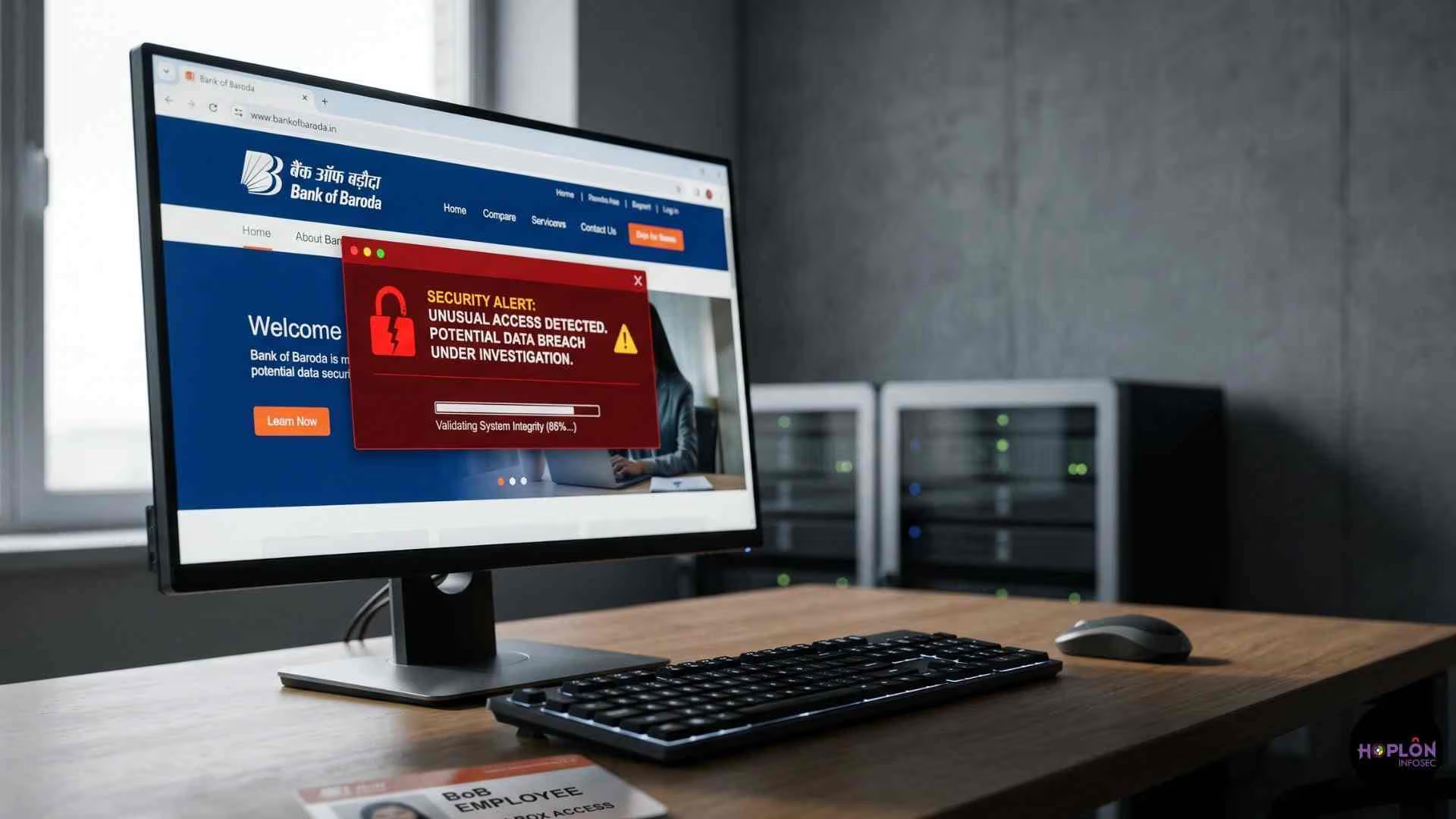
On July 27, 2026, one of India's largest state owned banks confirmed something that customers had already started whispering about on social media for days. Bank of Baroda admitted that an employee's email account had been compromised, and that this compromise led to unauthorized access to certain internal data. Around the same time, reports surfaced that nearly 1 terabyte of data, allegedly including customer KYC documents, loan records, and internal files, had shown up for sale and later for free on a dark web forum linked to a group calling itself TripleX.
If you bank with BoB, or you simply work in a field where you need to understand how a single compromised inbox can spiral into a national headline, this article walks through the confirmed facts, the parts that are still unverified, and the practical steps that actually matter right now. Nothing here is speculation dressed up as certainty. Where something is alleged rather than confirmed, that is stated plainly, because in a live regulatory investigation, precision matters more than drama.
| Detail | Status as of late July 2026 |
|---|---|
| Entry point | Confirmed: compromise of a single employee email account |
| Data volume allegedly leaked | Alleged: approximately 1 terabyte |
| Data types allegedly involved | Alleged: customer application forms, KYC documents, loan and account records, internal files |
| Group claiming responsibility | Alleged: a ransomware and extortion group known as TripleX |
| Bank's official position | Confirmed breach of one mailbox; has not confirmed the scale or attributed the incident to any specific group |
| Core banking systems | Bank states core banking infrastructure has not been reported as compromised |
| Regulatory framework in play | RBI Cyber Security Framework, CERT-In reporting rules, DPDP Act 2023 and DPDP Rules 2025 |
What Bank of Baroda Has Actually Confirmed
In its public statement, the bank described the root cause in a single sentence: an employee's email account was compromised, and this resulted in unauthorized access to certain data. That is deliberately narrow language, and it matters.
The bank has said a forensic investigation is underway and that it is working with the relevant authorities, but it has not confirmed the exact volume of data taken, has not verified the authenticity of the files posted online, and has not named an attacker group in its own statements.
Separately, dark web monitoring services and several media outlets reported that a group called TripleX, a relatively new ransomware and data extortion operation that has been active since around May 2026, claimed to have published the stolen dataset.
TripleX is also linked to an earlier claimed breach at a Southeast Asian bank, where customer contracts and identity documents were reportedly leaked in a similar pattern. None of this attribution has been independently confirmed by Bank of Baroda itself.
Why a Single Mailbox Compromise Can Cause This Much Damage
People often assume that hacking a bank means breaking into vaults or core transaction systems. In reality, most of the damaging bank related breaches over the last several years have started somewhere far less dramatic, in a normal employee inbox. An email account inside a bank is rarely just personal correspondence.
It typically holds attachments containing customer onboarding documents, internal memos, vendor communications, audit notes, and sometimes screenshots or exports pulled from internal systems for legitimate business reasons.
When that single account is compromised, an attacker does not need to touch core banking software at all. They simply read what is already sitting there, and in many cases they search the mailbox for specific keywords to find the most valuable material quickly.
This is why banks worldwide have shifted so much of their security investment toward protecting identity and email access, rather than only hardening the core transaction systems.
How Email Compromises Like This Typically Happen
Bank of Baroda has not disclosed the specific technique used against the compromised account, so the following is general industry context on how business email compromise incidents commonly unfold, not a claim about the specific method used in this case.
Attackers going after corporate mailboxes generally rely on a handful of well documented approaches. Phishing pages that sit between the victim and the real login page can intercept session tokens even when multi factor authentication is enabled, because the attacker captures the session after the user has already approved the login.
Infostealer malware, often picked up through a fake software download or a malicious attachment, quietly harvests saved passwords and browser cookies and sells them in bulk on criminal marketplaces. Weak or legacy email protocols that were never disabled can also be abused, since they often do not support modern authentication checks.
Once inside a mailbox, attackers commonly try to stay hidden rather than act immediately. This can include creating inbox rules that quietly forward or delete emails containing sensitive keywords, or registering a third party application with access permissions that survive even after the victim changes their password.
None of this is confirmed to have happened at Bank of Baroda specifically. It is simply the pattern seen repeatedly across the banking sector when investigators reconstruct similar incidents.
The Regulatory and Legal Angle
This incident is unfolding under a stricter legal environment than earlier Indian data breaches. Under the Digital Personal Data Protection Act 2023 and the DPDP Rules notified in November 2025, a data fiduciary such as a bank is required to notify both the Data Protection Board of India and every affected individual without undue delay after becoming aware of a personal data breach, and must submit a detailed report to the Board within 72 hours covering the nature of the breach, the categories of data affected, likely consequences, and remedial steps taken.
Separately, CERT-In's directions require reporting of cyber incidents within six hours of becoming aware of them, and the RBI's Cyber Security Framework places specific obligations on regulated banks around incident reporting, containment, and customer communication. Non compliance under the DPDP Act can carry penalties running into hundreds of crores of rupees, which is one reason banks tend to word public statements about breaches so carefully.
What You Should Actually Do If You Bank With BoB
Panic is not useful here, but a bit of healthy caution is. Since the bank has confirmed that some data exposure occurred, treat any unexpected call, SMS, or email claiming to be from Bank of Baroda with suspicion, especially if it references personal details to sound convincing. This is exactly the kind of incident that fuels impersonation scams, including so called digital arrest calls where fraudsters pose as police or tax officials.
A few concrete habits matter more than anything else right now. Never share an OTP with anyone, regardless of how official they sound or how much personal information they already seem to have. Do not install any banking app or utility sent to you as a direct link or APK file outside of official app stores.
If you receive a call pressuring you to act immediately, hang up and call the bank back using the number printed on your card or on the official BoB website, not a number provided by the caller. If you believe you have been targeted by fraud, report it immediately through India's National Cyber Crime Reporting Portal or the 1930 helpline, since fast reporting significantly improves the chances of freezing fraudulent transfers.
Frequently Asked Questions
Did hackers steal money directly from Bank of Baroda customer accounts?
There is no confirmed report of funds being directly withdrawn through this incident. The bank has stated its core banking systems were not reported as compromised. The real risk here is data being used to run convincing scams against customers, not a direct transfer of money out of accounts.
Is the leaked data confirmed to be real?
Not fully. Bank of Baroda has not verified the authenticity or scale of the data posted online, and independent confirmation is still pending as the forensic investigation continues.
Does changing my password protect me if my bank was breached?
It helps, but it addresses your own account security. It does not undo the fact that data already exposed from the bank's side remains exposed. The priority for customers is recognizing and avoiding follow on scams, not just password hygiene.
What is Bank of Baroda required to do next under Indian law?
Under the DPDP Act framework, the bank is expected to notify the Data Protection Board of India and affected individuals without undue delay, and file a detailed breach report within 72 hours, alongside its existing obligations to CERT-In and the RBI.
Official References
The Record: India's Bank of Baroda confirms cyber incident
GovInfoSecurity: Bank of Baroda Breach Tests Disclosure Readiness
Business Standard: BoB cyberattack coverage
Deccan Herald: Digital Arrest scam warning for BoB customers
Read More Articles:
Hackers Attacked India’s Biggest Businesses
French Bank Data Breach: 1.2M Accounts Exposed
Major Data Breach at Slim CD Exposes 1.7M Credit Cards
Biggest Data Breaches of 2025 and 2026
This article reflects information available as of July 29, 2026. Bank of Baroda's forensic investigation is ongoing, and details including the scope of exposed data and attribution to any specific group may change as more official information is released.