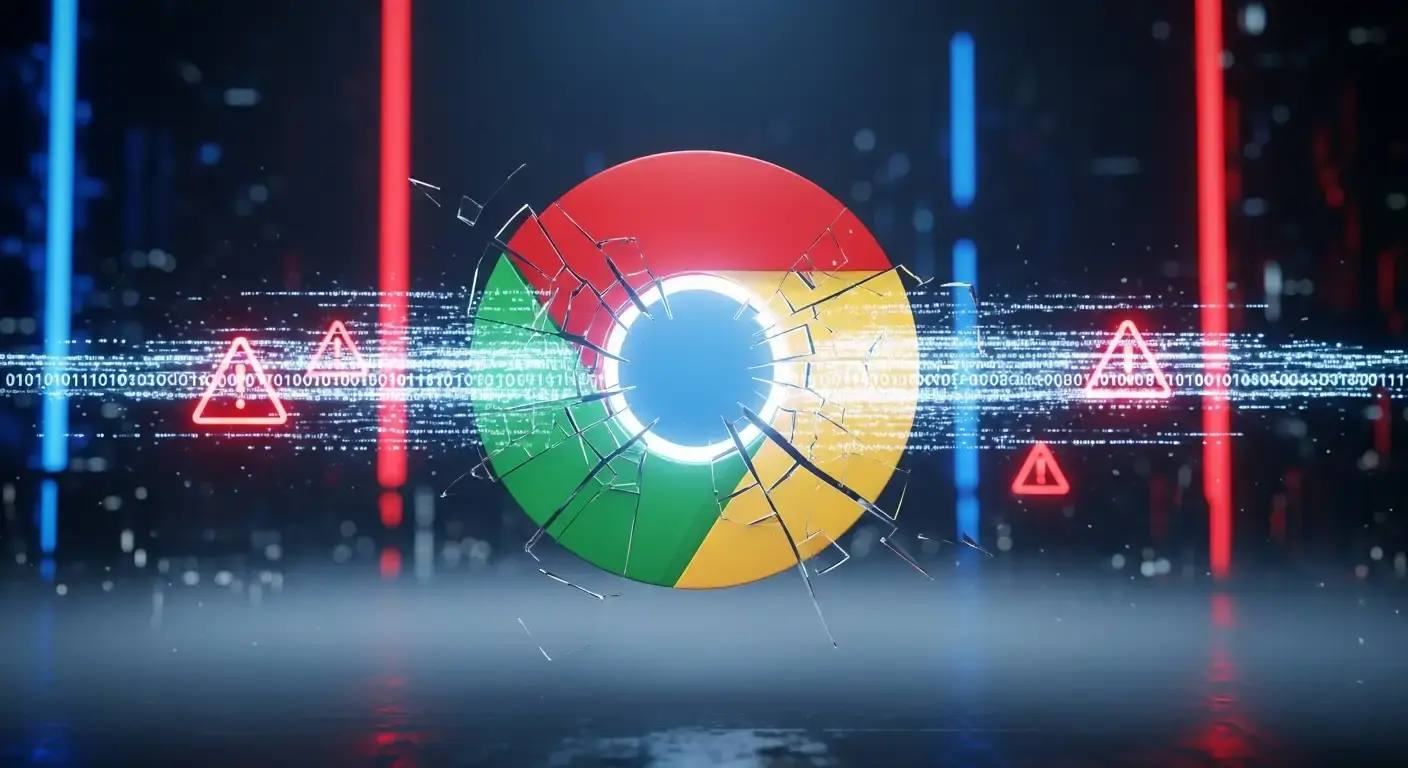
Has your Chrome browser updated itself recently without asking? If it has, there is a good reason for that. On June 9, 2026, Google pushed an emergency security patch to address a high-severity Chrome zero-day vulnerability that was already being exploited in real attacks. This is urgent, a real risk, and something you must address immediately.
The flaw, tracked as CVE-2026-11645, lives inside Chrome's V8 JavaScript engine, the core component that runs virtually every piece of JavaScript you interact with on the web. An attacker can craft a malicious webpage, you visit it, and the exploit fires silently without a single download or suspicious click on your part. That is the nature of a memory corruption bug in a browser, and that is exactly why Google marked this as a priority-one emergency patch.
This vulnerability is the fifth actively exploited Chrome zero-day patched in 2026 alone. That number deserves a pause. Five zero-days in six months is not a coincidence. It reflects the growing commercial and nation-state interest in owning the browser, because the browser is where modern life happens.
What is the Chrome zero-day vulnerability CVE-2026-11645?
Let me give you the clean version first. CVE-2026-11645 is an out-of-bounds memory vulnerability in Chrome's V8 JavaScript engine. It was discovered by an anonymous security researcher who responsibly reported it to Google. The company validated the bug, confirmed it was being actively exploited, and released an emergency fix under Chrome version 149.0.7827.102 for Windows and Linux and 149.0.7827.103 for macOS.
The vulnerability falls under two CWE classifications. CWE-125 covers out-of-bounds read, where an attacker reads data from memory locations that should be off-limits. CWE-787 covers out-of-bounds writes, where an attacker scribbles data into unauthorized memory regions. Both flavors are present here, which is what makes this bug particularly versatile from an attacker's perspective.
The severity is rated High. While an official CVSS score had not been published at the time of writing, memory corruption bugs in JavaScript engines consistently land in the 8.0 to 9.0 range on the CVSS scale due to their potential for information disclosure, denial of service, and code execution when chained with secondary vulnerabilities.
Understanding the Chrome V8 Engine: Why Attackers Love It
Most people have never thought about V8. But if you have opened a Chrome tab today, V8 has already executed thousands of lines of JavaScript on your behalf. It is Google's open-source high-performance JavaScript and WebAssembly engine, built in C++, and it is the reason Chrome feels fast.
V8 is used not just in Chrome but in all Chromium-based browsers, including Microsoft Edge, Brave, Opera, and Vivaldi. It also powers Node.js on the server side. This enormous reach is precisely why finding a bug in V8 is like finding a skeleton key. One vulnerability, potentially millions of targets.
V8 works by taking JavaScript source code and compiling it down to native machine code using a technique called just-in-time (JIT) compilation. This process involves complex memory operations happening at tremendous speed. When a bug exists in how V8 manages the memory it allocates for these compiled routines or the objects it tracks, an attacker can craft JavaScript that deliberately triggers the broken behavior. The code does not look malicious to a human reviewer. It looks like ordinary JavaScript. The exploit happens at the engine level, invisible to the person loading the page.
How the CVE-2026-11645 Attack Works: A Step-by-Step Breakdown
Think of it this way. Memory in a browser is organized like a massive apartment building. Each tenant, meaning each webpage, script, or browser process, is assigned specific floors and rooms. An out-of-bounds bug is what happens when a tenant gains the ability to read from or write into another tenant's apartment without permission.
In Stage 1, the attacker sets up a website with specially crafted JavaScript designed to trigger the V8 flaw. The page looks completely normal. There is no suspicious file download, no fake alert telling you your computer has a virus.
In Stage 2, when Chrome loads and executes that JavaScript, V8's memory management code encounters the crafted input. The out-of-bounds condition fires. The engine reads memory it should not be reading or writes data to memory locations outside its authorized range.
In Stage 3, this produces heap corruption. The heap is the region of memory where Chrome dynamically stores objects, variables, and runtime data during browsing.
In Stage 4, by reading unauthorized memory, the attacker can extract sensitive values stored nearby. This might include session tokens that authenticate you to websites, data from other tabs, or, critically, memory address information.
That last point about memory addresses leads us to something the original Google advisory mentioned but did not explain: ASLR bypass.

ASLR and Why Bypassing It Changes Everything
ASLR stands for Address Space Layout Randomization. It is a core defense for operating systems that randomizes where programs and their data are loaded in memory each time they run. The idea is simple: if an attacker does not know where things are in memory, they cannot reliably jump to malicious code even if they find a way to inject it.
Out-of-bounds read bugs are frequently used to defeat ASLR. By reading memory around V8's heap, an attacker can discover the actual addresses where Chrome's code and data are loaded. Once those addresses are known, the randomization is effectively defeated for that session.
This matters because ASLR bypass is often Step 1 in a two-step exploit chain. Step 2 is using a write primitive, which this bug also provides, to overwrite a function pointer or control flow structure with the attacker's chosen address. At that point, you are looking at potential arbitrary code execution, the ability to run any code the attacker wants inside Chrome's renderer process.
Who is at Risk?
The short answer is anyone running an unpatched version of Chrome. The longer answer is a bit broader than Google's advisory implies.
Chrome users on all platforms are affected. Windows users should be on version 149.0.7827.102 or later. macOS users need 149.0.7827.103. Linux users need 149.0.7827.102.
Chromium-based browser users are also potentially at risk. Microsoft Edge, Brave, Opera, and Vivaldi all share the same V8 engine through their Chromium foundation. Each of those projects needs to pull in and ship Google's V8 fix before their users are protected. Check those browsers individually for updates.
Indicators of exploitation are often invisible. Most victims of browser exploit campaigns notice nothing. No pop-up, no slow computer, no obvious file. The attack happens in memory. If Chrome crashes unexpectedly, if you notice strange redirects on sites you trust, or if your browser starts downloading files you did not request, those can be signs worth investigating. But in sophisticated attacks, there may be no sign at all.
How to Check and Update Chrome Right Now
This is genuinely simple, and it takes less than two minutes.
Open Chrome and click the three-dot menu in the top-right corner. Go to Help, then About Google Chrome. The browser will immediately check for updates and begin downloading if one is available. Once the download completes, click the Relaunch button. That restarts Chrome with the patched version loaded.
If you see "Chrome is up to date" and the version shown is 149.0.7827.102 or higher on Windows or Linux, or 149.0.7827.103 on macOS, you are protected.
On mobile, go to your device's app store, search for Chrome, and apply any pending update there.
If your organization manages Chrome through a fleet management tool, push the update to all endpoints immediately. Do not wait for the next patch cycle. This vulnerability is actively exploited, which means attackers are using it right now against real targets.
The 2026 Chrome Zero-Day Timeline: A Pattern Worth Noting
CVE-2026-11645 is not an isolated event. Here is how 2026 has gone so far for Chrome security:
|
CVE |
Component |
Vulnerability Type |
Exploited |
|
CVE-2026-2441 |
CSSFontFeatureValuesMap |
Use-after-free |
Yes |
|
CVE-2026-3909 |
Skia Graphics Library |
Out-of-bounds write |
Yes |
|
CVE-2026-3910 |
V8 Engine |
Type confusion |
Yes |
|
CVE-2026-5281 |
Dawn / WebGPU |
Heap buffer overflow |
Yes |
|
CVE-2026-11645 |
V8 Engine |
Out-of-bounds read/write |
Yes |
Five zero-days. All were actively exploited before patches were available. Two of them, including this one, target V8 specifically. This pattern reflects a broader trend in offensive security: nation-state groups and commercial spyware vendors have invested heavily in browser exploitation research because browsers are the single highest-value attack surface on any modern device.
Why Chrome Keeps Getting Targeted: The Threat Landscape Reality
Chrome holds roughly 65 percent of the global browser market. When you attack Chrome, you are potentially reaching the majority of the internet-connected world. That market share makes it the most strategically valuable target for everyone from state-sponsored espionage groups to criminal ransomware operators.
Google's own Threat Analysis Group (TAG) has documented dozens of campaigns over the past two years where Chrome vulnerabilities served as the initial access point. In many of these cases, the attackers were commercial spyware vendors selling surveillance tools to governments. In others, they were nation-state actors conducting targeted espionage against journalists, dissidents, and policymakers.
The V8 engine is the particular favorite because it runs untrusted code, meaning JavaScript from any website, at high privilege inside the browser. Finding a memory safety bug in V8 gives you a reliable foothold that works regardless of the victim's operating system. Windows, macOS, Linux—it does not matter. The browser abstracts it all.
For organizations using endpoint security protection services, this pattern highlights why browser security cannot be treated as a separate, lower-priority concern. The browser is an endpoint. Exploiting it is exploiting the endpoint.
What Security Teams Should Do Beyond the Patch
Updating Chrome is the immediate requirement. But if you are responsible for an organization's security posture, there are additional steps worth taking right now.
First, verify that Chrome auto-update is enabled across your fleet. Many enterprise configurations intentionally delay or disable auto-updates for stability reasons. That policy just became a risk. Work with your patch management team to push 149.0.7827.102 manually if needed.
Second, review your browser extension inventory. Malicious or compromised browser extensions can amplify the impact of a renderer-level exploit. Extensions with broad permissions, especially those that can read and modify data on all websites, deserve immediate scrutiny.
Third, consider enabling Chrome's Enhanced Safe Browsing setting, which provides faster detection of dangerous sites by sharing browsing data with Google in real time. In a zero-day exploitation scenario, this can provide an additional layer of warning.
Fourth, for high-risk environments, look at browser isolation technologies. Running Chrome in a containerized or sandboxed environment limits what an attacker can reach even if they successfully exploit a renderer vulnerability.
Teams running extended detection and response (XDR) solutions should ensure their tools are configured to detect and alert on unusual Chrome subprocess behavior, unexpected child process creation from browser processes, and anomalous network connections originating from browser-associated processes.
For organizations that have not recently conducted a web application security assessment, this is also a reminder that your own web properties, if compromised, could become delivery vehicles for browser exploits against your users or customers.

Understanding the Exploit Chain: Why One Bug Is Usually Not Enough
A common question after an announcement like this is whether simply visiting a malicious site is enough for an attacker to take over your computer. The honest answer is it depends on what the attacker chains together.
The Chrome renderer process, which is where JavaScript runs, operates inside a sandbox. That sandbox is specifically designed to limit what a compromised renderer can access on the broader system. So even if an attacker successfully exploits CVE-2026-11645 and achieves code execution inside the renderer, they are still contained, theoretically.
To break out of the sandbox and reach the operating system, the attacker typically needs a second vulnerability, a sandbox escape. These are rarer and harder to find than renderer-level bugs. But they exist, and sophisticated threat actors often carry multiple exploits. The out-of-bounds bug in V8 provides the memory layout information and write capability that makes finding and using a sandbox escape significantly easier.
This is why Google classifies any actively exploited renderer vulnerability as an emergency, even if they cannot confirm full sandbox escape in observed attacks. The window between "renderer compromise" and "full system compromise" is narrow when attacker resources are high.
Hoplon Infosec Recommendation: Treat CVE-2026-11645 as a Severity 1 incident in your patch cycle. Update all Chrome and Chromium-based browsers across your organization within 24 hours, not at the next scheduled maintenance window. If your organization relies on a managed browser deployment, override the standard update cadence immediately.
For organizations in finance, healthcare, government, or critical infrastructure, consider whether employees with access to sensitive systems should avoid nonessential browsing on unmanaged devices until the update is confirmed as deployed.
Teams looking for deeper vulnerability management support, or those that want to assess their current attack surface exposure, can reach out for a formal assessment. Browser-based attack paths are increasingly the primary vector in targeted intrusion campaigns, and your defenses need to reflect that reality.
Key Takeaways
CVE-2026-11645 is a serious, actively exploited Chrome zero-day vulnerability rooted in V8's memory management. It enables out-of-bounds read and write operations, giving attackers the ability to leak sensitive data, bypass ASLR, and potentially chain toward code execution. Chromium-based browsers beyond Chrome may also be affected. The fix is available now in Chrome 149.0.7827.102 and 149.0.7827.103. Update immediately, verify your extended browser fleet, and treat this as an urgent operational response rather than a routine patch.
The fifth actively exploited Chrome zero-day of 2026 is a signal, not just an incident. Browser exploitation is a primary attack vector for the most capable threat actors in the world. Your defenses need to reflect that.
If you are responsible for your organization's security and want to understand your true exposure to browser-based attack paths, contact Hoplon Infosec for a consultation. The time to assess is before an incident, not after.
Published: June 9, 2026 | Last Updated: June 9, 2026 | Author: Hoplon Infosec Research Team



-20260925120840.webp&w=3840&q=75)
-20260918120903.webp&w=3840&q=75)