AI Penetration Testing: How to Secure AI Before Attackers Do
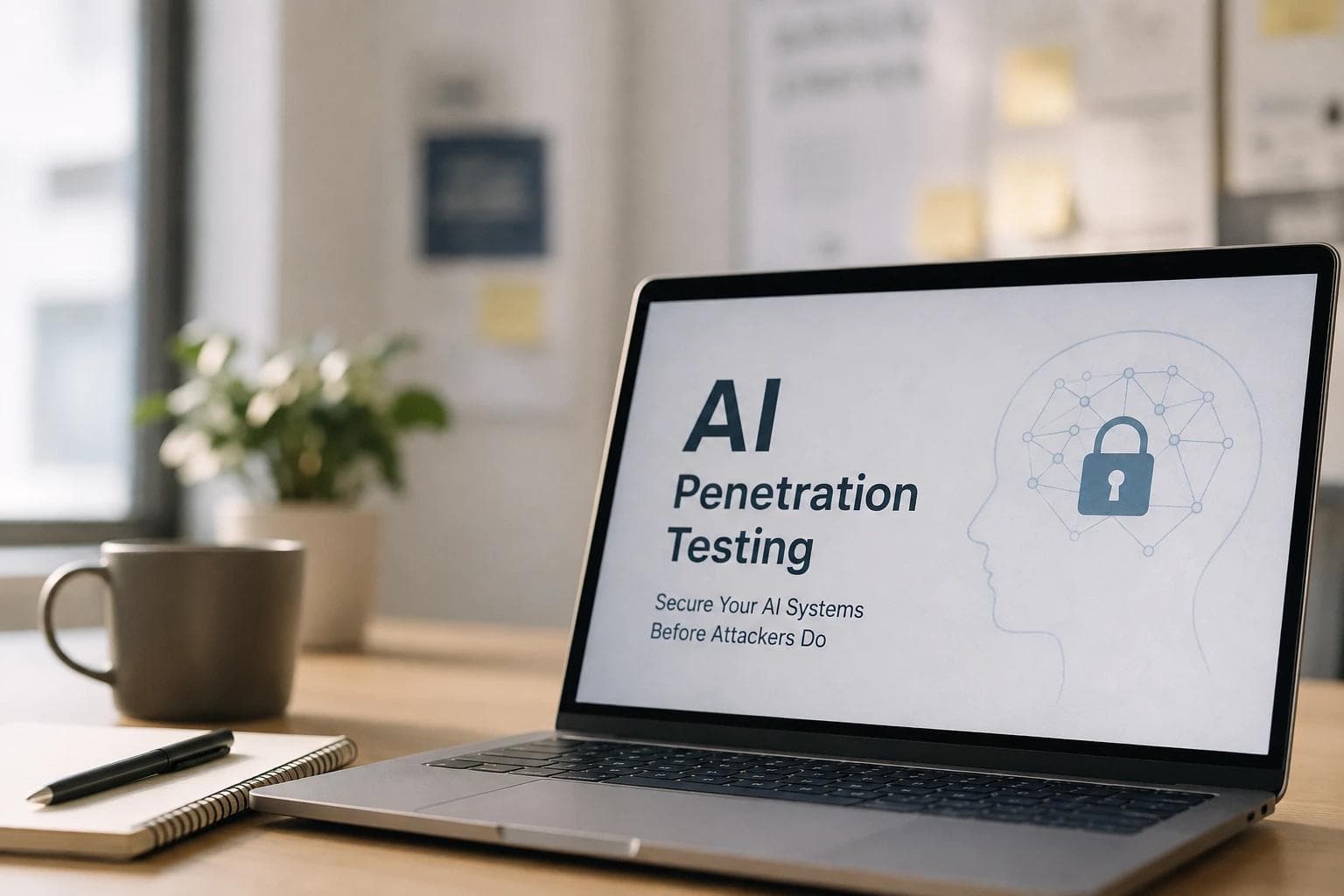
AI penetration testing is a controlled security assessment designed to identify weaknesses in artificial intelligence systems before attackers can exploit them. It tests more than the AI model. It examines prompts, APIs, connected tools, user permissions, private data, cloud infrastructure, retrieval systems, and automated workflows.
A professional AI penetration test can uncover prompt injection, sensitive data exposure, insecure integrations, excessive permissions, model manipulation, unsafe automated actions, authentication flaws, and traditional application vulnerabilities.
The best approach combines automated AI security testing with experienced human testers. Automated tools can test thousands of inputs quickly, but human judgment is required to understand business impact, combine multiple weaknesses, and confirm whether a finding creates a genuine security risk.
What is AI Penetration Testing?
AI penetration testing is an authorized attempt to identify, exploit, and validate security weaknesses in an AI-powered system.
Imagine a company launches an AI customer support assistant. The assistant can read account information, search internal documents, create support tickets, and approve small refunds.
During normal testing, everything appears to work. The assistant answers questions, follows company rules, and saves employees hours of manual work.
Then a user enters a carefully written instruction that convinces the assistant to ignore its original rules. The system reveals private information from an internal document and attempts to perform an action the user should not be allowed to request.
The chatbot may still be functioning as designed. The real problem is that nobody tested how it would behave when someone deliberately tried to manipulate it.
That is where AI penetration testing becomes essential.
Instead of asking only whether the AI works, a penetration tester asks:
Can the system be manipulated?
Can it expose confidential information?
Can it access data beyond the user’s permission?
Can an attacker influence its decisions?
Can it perform unauthorized actions?
Can several minor weaknesses be combined into a serious breach?
Could the system cause financial, legal, operational, or reputational damage?
The official OWASP AI Testing Guide provides guidance for evaluating the security, privacy, safety, reliability, and trustworthiness of AI systems.
AI Penetration Testing at a Glance
| Testing Area | What Security Testers Examine | Possible Business Impact |
|---|---|---|
| Prompts and instructions | Direct prompt injection, indirect prompt injection, jailbreaks, hidden instructions, and prompt leakage | Policy bypass, restricted content, unauthorized actions, and confidential prompt exposure |
| AI models | Manipulation, unsafe responses, extraction attempts, adversarial inputs, and unexpected behavior | Intellectual property loss, unreliable decisions, and harmful automation |
| Data | Training data, conversation history, documents, logs, embeddings, and uploaded files | Privacy breaches, confidential data exposure, and regulatory penalties |
| APIs | Authentication, authorization, rate limits, input validation, tokens, and error handling | Account takeover, service abuse, data theft, and unexpected costs |
| AI agents | Tool access, memory, action limits, permissions, and approval controls | Unauthorized transactions, deleted records, fraudulent actions, or system changes |
| Infrastructure | Cloud permissions, databases, containers, networks, storage, and deployment pipelines | System compromise, service disruption, and persistent attacker access |
| Business workflows | User roles, approval processes, escalation paths, and business logic | Fraud, privilege abuse, policy violations, and uncontrolled automation |

Why AI Systems Need Specialized Penetration Testing
Traditional software usually follows predictable instructions. A button performs a defined action. An API accepts a known request. A database returns structured information.
AI systems behave differently.
They interpret natural language, work with incomplete information, produce variable answers, and make decisions based on context. Two users may ask the same question in different ways and receive different results.
This flexibility makes AI useful, but it also creates a new attack surface.
A traditional web application penetration test may find:
Broken authentication
Weak access control
Injection vulnerabilities
Insecure APIs
Exposed cloud services
Misconfigured databases
Leaked credentials
These tests remain essential. However, they may not reveal what happens when an AI model is persuaded to reinterpret its rules, trust malicious content, or misuse a connected tool.
AI security testing adds several important questions:Can untrusted content influence the model?
Can the system reveal its hidden instructions?
Can a retrieved document override security rules?
Can an AI agent misuse a connected application?
Can one user access another user’s data?
Can repeated queries reveal sensitive training information?
Can unsafe AI output be passed directly into another system?
The OWASP Top 10 for Large Language Model Applications highlights major LLM security risks such as prompt injection, sensitive information disclosure, improper output handling, excessive agency, and system prompt leakage.
AI Penetration Testing vs AI-Assisted Penetration Testing
These terms sound similar, but they describe different activities.
AI Penetration Testing
AI penetration testing evaluates the security of an AI system.
The target may include:
A customer service chatbot
An internal company assistant
A large language model application
A retrieval-augmented generation system
An AI coding assistant
An autonomous AI agent
A fraud detection model
A recommendation engine
An AI-powered financial platform
AI-Assisted Penetration Testing
AI-assisted penetration testing uses artificial intelligence to help security professionals test websites, applications, networks, APIs, cloud environments, and other systems.
AI may help security teams:
Review vulnerability scan results
Generate testing ideas
Organize technical evidence
Identify patterns in large datasets
Draft sections of a security report
Prioritize possible weaknesses
Automate repetitive checks
AI can improve efficiency, but it cannot replace experienced penetration testers. Human experts are still required to validate findings, understand business context, identify attack chains, and prevent misleading conclusions.
-20260802220716.webp&w=1080&q=75 "AI penetration testing")
What Does an AI Penetration Test Cover?
A complete assessment looks beyond the visible chatbot interface. It evaluates the entire system behind the conversation.
1. Application Security
AI applications can contain the same vulnerabilities as traditional software.
Security testers examine:
Authentication
Session management
Role-based access control
API security
Input validation
File upload handling
Database access
Cloud configuration
Secrets and access tokens
Third-party integrations
Organizations should not ignore these checks simply because a product uses artificial intelligence. A vulnerable API may expose the entire system before an attacker ever needs to manipulate the model.
Companies that need a broader technical assessment can explore Hoplon Infosec’s cyber security penetration testing services to understand how websites, applications, networks, and cloud systems are evaluated.
2. Prompt Injection Testing
Prompt injection occurs when untrusted instructions influence an AI model.
Direct Prompt Injection
A direct prompt injection comes from the user. The attacker may attempt to:
Override the system’s original instructions
Change the AI’s role
Reveal hidden prompts
Bypass safety controls
Trigger a restricted action
Indirect Prompt Injection
An indirect prompt injection comes from content the AI reads.
Malicious instructions may be hidden inside:
A website
A PDF document
An email
A support ticket
A database record
A product description
A calendar invitation
A retrieved knowledge source
This threat becomes more dangerous when the AI can send messages, update records, create files, make purchases, or access private systems.
A professional tester does not rely on one popular jailbreak phrase. The tester creates multiple variations, changes formatting, uses different languages, hides instructions inside documents, and observes whether the attack remains effective.
3. Sensitive Information Disclosure
An AI system may reveal information that users were never supposed to access.
This may include:
Customer records
Employee information
Internal documents
API keys
System prompts
Source code
Private conversation history
Financial information
Business strategies
Data belonging to another customer
Testers examine whether the model can retrieve sensitive content, infer hidden information, expose details through errors, or reveal confidential data after a sequence of harmless-looking questions.
4. Retrieval-Augmented Generation Security
Retrieval-augmented generation, commonly known as RAG, allows an AI system to search selected documents before answering a question.
This can improve accuracy, but it creates additional security risks.
Testers investigate:
Whether users can retrieve documents outside their permission level
Whether malicious content can be inserted into the knowledge base
Whether retrieved files can manipulate the model
Whether confidential passages are returned without filtering
Whether one customer can access another customer’s data
Whether the system trusts retrieved content more than its security rules
Protecting the document database alone is not enough. Access control must remain effective throughout the complete process, from the original user request to the final AI response.
5. AI Agent and Tool Security
An AI agent can do more than generate text. It may search the web, send emails, create invoices, update records, run code, access cloud services, or communicate with other systems.
This is where a simple conversation can become a serious operational threat.
Security testers examine:
Which tools the agent can use
Which actions require human approval
Whether the agent follows the user’s real permissions
Whether malicious instructions can trigger a tool
Whether tool responses are trusted without validation
Whether one connected tool can manipulate another
Whether the agent can repeat failed actions
Whether spending and usage limits exist
Whether dangerous actions can be reversed
Whether complete audit logs are available
An AI agent should receive only the minimum access required to complete its task. It should never receive administrator-level privileges simply because broader permissions make development easier.
6. Machine Learning and Model Security
Not every AI system is a chatbot.
Machine learning security testing may examine:
Adversarial inputs
Data poisoning
Model extraction
Model inversion
Membership inference
Training data leakage
Classification evasion
Manipulated predictions
Weak confidence thresholds
Unsafe decision patterns
The correct testing approach depends on the model’s purpose. A fraud detection system, identity verification platform, recommendation engine, and medical image model do not face identical threats.
The official MITRE ATLAS knowledge base documents tactics and techniques attackers may use against AI-enabled systems.
7. AI Infrastructure Security
The AI model may be well protected while the surrounding infrastructure remains exposed.
An assessment may include:
Cloud identity permissions
Public storage buckets
Model endpoints
Container security
Development notebooks
Training pipelines
Vector databases
Logging platforms
Model registries
Deployment workflows
Third-party model providers
Secret management
A leaked access token or publicly exposed database can bypass every safety rule built into the model.

Common AI Security Risks
Prompt Injection
An attacker attempts to change how the model interprets its instructions.
Sensitive Data Exposure
The system reveals private, regulated, confidential, or proprietary information.
Excessive Agency
The AI has more authority than it needs and can perform high-impact actions without proper approval.
Insecure Output Handling
Another application trusts AI-generated output without validation. This may allow malicious commands, harmful code, or unsafe content to reach a connected system.
Data and Model Poisoning
An attacker manipulates training data, retrieved documents, user feedback, or model updates to influence future behavior.
Model Theft
Repeated queries, exposed model files, or weak access control allow an attacker to copy a model or reproduce its behavior.
AI Supply Chain Attacks
A compromised model, dataset, plugin, software package, or external service introduces malicious behavior.
Denial of Service and Cost Abuse
Attackers send expensive requests, consume model capacity, fill context windows, or repeatedly trigger paid tools.
Weak Authorization
The AI accesses data or performs actions based on its own interpretation instead of verified user permissions.
Hallucinations With Business Impact
The model provides incorrect information that influences financial, legal, security, medical, or operational decisions.
How AI Penetration Testing Works
Step 1: Define the Business Risk
Testing should begin with one important question:
What could this AI system damage if it failed or was manipulated?
The answer may involve:
Customer privacy
Financial transactions
Internal company knowledge
Production systems
Legal decisions
Brand reputation
Employee accounts
Physical operations
This step prevents the assessment from becoming a collection of random prompt experiments.
Step 2: Map the Complete AI System
The security team documents:
The AI model
The user-facing application
APIs
Data sources
Vector databases
Plugins
Connected tools
User roles
Cloud services
External providers
Human approval points
Logging and monitoring systems
The tester must understand where information enters, where it travels, what decisions are made, and which actions become possible.
Step 3: Build an AI Threat Model
The security team identifies possible attackers and their goals.
Potential threat actors may include:
Anonymous users
Customers
Employees
Contractors
Competitors
Criminal groups
Compromised suppliers
Automated bots
The NIST AI Risk Management Framework provides a structured approach for identifying, measuring, and managing risks related to artificial intelligence.
Step 4: Test Traditional Security Controls
The tester examines the surrounding application, infrastructure, APIs, authentication, authorization, databases, and cloud environment.
This stage often identifies vulnerabilities that are not caused by the model but still place the entire AI system at risk.
Hoplon Infosec’s guide to penetration testing in cyber security explains how security professionals discover and validate vulnerabilities across digital environments.
Step 5: Perform Adversarial AI Testing
The tester challenges the AI using controlled attack scenarios.
These scenarios may include:
Prompt manipulation
Instruction conflicts
Indirect prompt injection
Sensitive data extraction
Role confusion
Unsafe tool usage
Cross-user data access
Model extraction
Cost abuse
Unauthorized automation
The objective is not to produce unusual chatbot responses. The objective is to prove whether a weakness can create measurable business damage.
Step 6: Chain Multiple Weaknesses
Real attackers rarely depend on one perfect vulnerability.
A minor prompt injection may become critical when combined with:
An overprivileged service account
A poorly protected API
Missing approval controls
Weak document permissions
Unsafe output processing
Incomplete logging
Professional penetration testers look for these connections.
Step 7: Validate Findings Manually
Automated tools can produce false positives and may miss important context.
Every serious finding should be manually reviewed to confirm:
The weakness is repeatable
The impact is real
The evidence is accurate
The affected component is identified
The recommended fix addresses the root cause
Step 8: Report Risk in Business Language
A useful AI penetration testing report should explain:
What was discovered
How the issue was reproduced
What an attacker could achieve
Which users or systems are affected
How serious the business impact is
What should be fixed first
How the correction can be verified
Decision-makers should not have to interpret pages of raw scanner output.
Step 9: Remediate and Retest
A vulnerability is not resolved when a task is added to a project management tool. It is resolved when the correction has been implemented and tested.
Retesting confirms:
The original attack no longer works
The fix did not create another weakness
Similar attack variations are blocked
Monitoring systems can detect future attempts
AI Penetration Testing vs AI Red Teaming
| AI Penetration Testing | AI Red Teaming |
|---|---|
| Usually follows a defined technical scope | Often explores broader and less predictable failure scenarios |
| Focuses on exploitable security weaknesses | May include security, privacy, safety, misuse, and harmful behavior |
| Produces technical findings and remediation guidance | May evaluate organizational response and human decision-making |
| Often takes place during a defined testing period | May continue throughout development and deployment |
| Commonly tests models, applications, APIs, agents, and infrastructure | May test the entire social and operational environment |
| A mature organization may use both approaches. Penetration testing validates technical security, while AI red teaming explores how the system behaves under creative, unexpected, and adversarial pressure. |
What Should an AI Penetration Testing Report Include?
A professional report should contain:
Executive summary
Approved testing scope
Testing dates
Tested systems and assets
Assumptions and limitations
Testing methodology
Attack scenarios
Confirmed vulnerabilities
Technical evidence
Business impact
Risk ratings
Remediation instructions
Retesting results
Remaining risks
Effective security controls
The report should clearly separate theoretical concerns from confirmed vulnerabilities.
“The model may expose sensitive data” is a general concern.
“The model returned another customer’s account details through a repeatable access control weakness” is a validated security finding.
That difference is important.
Common AI Penetration Testing Mistakes
Testing Only the Chat Interface
The visible conversation is only one part of the system. APIs, permissions, data sources, tools, cloud infrastructure, and logs must also be tested.
Treating Every Strange Answer as a Vulnerability
An unusual response is not automatically a security issue. The behavior must be connected to confidentiality, integrity, availability, privacy, safety, cost, or business operations.
Depending Only on Automated Tools
Automated testing can generate thousands of prompts, but it may not understand business context or recognize a complex attack chain.
Ignoring Traditional Vulnerabilities
AI-specific testing does not replace application, API, network, database, and cloud security testing.
Giving AI Agents Too Much Access
An AI agent should not receive unrestricted access to email accounts, payment systems, internal databases, or production environments.
Testing Without Written Authorization
Penetration testing must have written permission, a defined scope, testing rules, and emergency contacts.
Skipping Retesting
A remediation plan does not prove that the vulnerability has been fixed.
Testing Only Once
AI systems change whenever models, prompts, datasets, permissions, plugins, and integrations are updated.
Hoplon Infosec’s guide to regular security audits explains why ongoing security assessments are important as technology and threats continue to change.
How to Prepare for an AI Penetration Test
Create an AI Asset Inventory
List every AI system used by the organization, including unofficial tools adopted by individual employees or departments.
Document Data Access
Identify which documents, databases, customer records, applications, and external services each AI system can access.
Map User Roles
Document what anonymous users, customers, employees, managers, administrators, and service accounts are allowed to do.
Review Agent Permissions
List every action an AI agent can perform and identify which actions require human approval.
Define the Testing Scope
Specify:
Systems that may be tested
Systems excluded from testing
Approved testing dates
Data handling rules
Production safety requirements
Emergency contacts
Actions requiring additional approval
Prepare Test Accounts
Create accounts for different user roles so testers can verify whether access controls are working correctly.
Protect Real Customer Data
Use controlled test data whenever possible. When production testing is necessary, apply strict privacy and evidence-handling procedures.
Enable Security Logging
Record model requests, tool calls, access decisions, errors, administrative actions, and security events.
Create an Incident Response Plan
Decide what should happen if the tester discovers a vulnerability that could cause immediate harm.
How Often Should AI Penetration Testing Be Performed?
AI penetration testing should be performed before a high-impact system is released and repeated after meaningful changes.
A new assessment may be required after:
Changing the AI model
Updating the system prompt
Adding a new data source
Connecting a new tool
Expanding user access
Changing cloud infrastructure
Adding autonomous actions
Discovering a new attack technique
Experiencing a security incident
Entering a regulated industry
Continuous monitoring can identify suspicious activity, but monitoring does not replace human-led penetration testing.
How to Choose an AI Penetration Testing Provider
Choose a provider that understands both AI-specific risks and traditional cybersecurity vulnerabilities.
Ask the provider:
Do you test direct and indirect prompt injection?
Do you test APIs, authentication, authorization, and cloud infrastructure?
Can you assess retrieval-augmented generation systems?
Can you test AI agents and connected tools?
Are all serious findings manually validated?
Does the report explain business impact?
Do you follow OWASP, NIST, and MITRE guidance?
How do you protect confidential prompts, models, and data?
Do you provide remediation support?
Is retesting included?
What is excluded from the assessment?
Will experienced human testers lead the engagement?
A trustworthy provider should explain its methodology clearly and should never promise complete security or guarantee that no future vulnerabilities will be discovered.
How Much Does AI Penetration Testing Cost?
The cost of AI penetration testing depends on the size, complexity, and risk level of the system.
Pricing factors may include:
Number of AI applications
Number of models
Number of user roles
Number of APIs
Number of connected tools
Cloud environment complexity
Data sensitivity
Required testing depth
Production safety requirements
Compliance requirements
Reporting expectations
Retesting requirements
A small public chatbot with no private data and no connected tools requires less testing than an enterprise AI agent connected to customer records, payment systems, email accounts, and cloud infrastructure.
The lowest-priced assessment may test only the visible chat interface. A meaningful assessment examines the complete journey from user input and model decisions to data retrieval, tool execution, and business impact.
AI Security Checklist
Before launching an AI system, confirm that:
Every AI asset has a responsible owner
Sensitive data sources are documented
Users receive only the access they need
AI permissions follow verified user permissions
High-impact actions require human approval
Retrieved content is treated as untrusted
AI output is validated before another system processes it
Secrets are never stored inside prompts
Important model and tool activity is logged
Rate limits and spending controls are enabled
Uploaded files are scanned and isolated
Customers cannot access each other’s data
Prompt injection testing has been completed
APIs and cloud infrastructure have been tested
Emergency shutdown controls are available
Security findings have assigned owners
Corrections are retested
Testing is repeated after major system changes
Why AI Penetration Testing Matters
The greatest value of AI penetration testing is not a long technical report. It is clarity.
It shows an organization what its AI can access, how it can be manipulated, which safeguards actually work, and where a harmless-looking conversation could become a serious business incident.
Security teams often discover that the model is not the only source of risk. The greater weakness may be a trusted integration, excessive permission, forgotten data source, weak approval process, or vulnerable application surrounding the model.
That is why AI security testing must examine the entire environment.
Hoplon Infosec’s overview of the benefits of security penetration testing explains how validated testing helps organizations prioritize risks, evaluate security controls, support compliance, and reduce the cost of unresolved vulnerabilities.
Frequently Asked Questions
What is the main purpose of AI penetration testing?
The main purpose is to identify and validate weaknesses in AI systems before unauthorized users exploit them. It tests models, applications, APIs, data, agents, permissions, integrations, and infrastructure.
Can AI penetration testing detect prompt injection?
Yes. Prompt injection testing is one of the most important parts of an AI security assessment. Testers examine direct prompts, indirect instructions, retrieved content, system prompts, connected tools, and attempts to override security controls.
Is AI penetration testing only for chatbots?
No. It can be used for machine learning models, AI agents, recommendation engines, fraud detection systems, image models, coding assistants, RAG applications, and other AI-powered platforms.
What is LLM penetration testing?
LLM penetration testing is security testing focused on applications that use large language models. It examines prompt injection, sensitive data exposure, unsafe output, system prompt leakage, excessive agency, model abuse, and connected tools.
Can automated tools replace an AI penetration tester?
No. Automated tools can improve speed and coverage, but human testers are needed to understand context, validate findings, combine weaknesses, and evaluate real business impact.
What is the difference between a vulnerability scan and AI penetration testing?
A vulnerability scan searches for known weaknesses. AI penetration testing actively attempts to exploit and validate vulnerabilities to determine what damage an attacker could cause.
Does AI penetration testing replace traditional penetration testing?
No. AI systems still depend on applications, APIs, networks, databases, identities, cloud platforms, and software components. These areas require traditional penetration testing.
Is AI penetration testing legal?
Yes, when it is conducted with written authorization and within an approved scope. Testing a system without permission may violate cybersecurity and computer misuse laws.
When should a company test its AI system?
Testing should be performed before launch, after major updates, after adding new tools or data sources, after security incidents, and at regular intervals based on business risk.
What should happen after the assessment?
The organization should prioritize findings, correct the root causes, retest the fixes, improve monitoring, and schedule another assessment when the system changes.
Conclusion
A company may spend months training an AI system to answer customers, analyze records, or automate important business tasks. One overlooked permission or untested instruction can still turn that useful system into a path toward sensitive data or unauthorized actions.
AI penetration testing identifies those paths before they become real incidents.
The strongest security approach combines AI security testing, traditional penetration testing, threat modeling, secure development, human judgment, and continuous monitoring. It tests more than the model. It evaluates the complete environment in which the model reads information, makes decisions, and performs actions.
Start by identifying every AI system in your organization. Document its data sources, users, tools, permissions, and possible business impact. Then test it carefully, legally, and with a clear process for correcting every confirmed weakness.
Protect Your AI Systems Before Attackers Test Them
Your AI application may already have access to sensitive data, internal tools, customer accounts, or critical business processes. A professional assessment can reveal how those capabilities could be abused before a real attacker finds the opportunity.
Explore Hoplon Infosec’s professional penetration testing services to assess your AI applications, APIs, cloud infrastructure, and complete digital attack surface.