What are the N-able zero-day vulnerabilities, and why did N-able act so fast?
On November 8–9, 2026, an independent researcher publicly released details and proof-of-concept code for 33 flaws in N-able’s N-central remote monitoring and management platform. N-able responded by taking hosted environments offline worldwide and later shipping N-central 2026.4 HF2 (build 2026.4.1.26) to address the most critical issues.
These N-able zero-day vulnerabilities matter because N-central is widely used by managed service providers (MSPs) and IT teams to manage customer endpoints. A compromised server can give an attacker a path into many downstream networks.
TL;DR / Quick Summary
- A researcher published Able2Shell, a set of 33 claimed flaws with working exploit chains affecting N-central (tested on appliance build 2026.4.0.31 and likely earlier versions).
- N-able took hosted N-central offline as a precaution on November 9 and released Hotfix 2 on November 10 covering seven CVEs, including critical XXE, OGNL injection, and remote code execution issues.
- Hosted servers have been upgraded; on-premises customers should apply the hotfix immediately, keep servers isolated until upgraded, and update Agents and Probes. Scanning has been observed; no confirmed customer compromises were reported in early updates.
Background: Why RMM Platforms Attract Attention
Remote monitoring and management tools sit at the center of many MSP operations. They hold credentials, can push software, and maintain persistent access to client devices. That makes them high-value targets.
N-central has faced scrutiny before. Earlier vulnerabilities appeared in CISA’s Known Exploited Vulnerabilities catalog, showing the product line has been targeted. The November 2026 disclosure stood out for volume and the public release of exploit code. Security firms noted scanning activity against honeypots shortly after the material appeared. Censys data pointed to more than 1,700 internet-exposed N-central instances at the time.
N-able described the disclosure as non-responsible and moved quickly to contain risk while validating fixes. The company stated it had not observed successful exploitation of customer environments in its early updates.
What Happened with the Able2Shell Disclosure
Security researcher Sean Bales (associated with the Oracle-Security GitHub account) published the Able2Shell repository late on November 8, 2026. It contained technical write-ups, screenshots, and proof-of-concept code for 33 issues tested against N-central Appliance 2026.4.0.31, a pre-release build. The researcher indicated most or all of the flaws likely affect earlier versions as well.
The material described multiple attack chains. Some required no authentication and could lead to command execution as the nable service account or privilege escalation to root. Potential impacts included credential theft, unauthorized administrator account creation, configuration changes, and remote code execution.
N-able took hosted N-central environments offline across the Americas, Europe, and Asia-Pacific on November 9. It advised on-premises customers to take their servers offline until further guidance. A hotfix was developed and validated under pressure.
On November 10, N-able released N-central 2026.4 HF2. By early November 11, hosted servers (NCODs) in all regions had been upgraded and returned to service. On-premises customers were strongly recommended to upgrade as soon as possible while keeping systems inaccessible from the internet until the update was complete.
Technical Details of the Patched Issues
N-able published seven CVEs addressed in the initial hotfix. These represent the most critical items from the disclosure. A follow-up hotfix was planned for additional issues.
|
CVE ID |
Description (per N-able) |
Notes |
|
CVE-2026-125883 |
Multiple XXE vulnerabilities |
High severity; unauthenticated potential |
|
CVE-2026-125878 |
Multiple OGNL Injection vulnerabilities |
Can lead to code execution |
|
CVE-2026-125879 |
Local privilege escalation to root via nable-writable syslog-ng config |
Local path to root |
|
CVE-2026-125880 |
Stored XSS via MMS3 patch metadata (admin context) |
Requires admin interaction in some scenarios |
|
CVE-2026-125881 |
Schema-hint SSRF via service import schema validation |
High severity |
|
CVE-2026-125882 |
RCE via file repository upload path traversal |
Credit: Nate Fair, Sprocket Security |
|
CVE-2026-91000 |
Insecure IPC Channels lead to local privilege escalation |
Local privilege escalation |
These cover XML external entity processing, expression injection, cross-site scripting in an administrative context, server-side request forgery, path traversal leading to remote code execution, and insecure inter-process communication. CVSS scores for the highest issues reached 9.3 on the CVSS 4.0 scale according to available records.
The public Able2Shell material claimed broader coverage. N-able’s first hotfix focused on the highest-risk items and noted further updates would follow.
Impact on MSPs and Customers
A successful compromise of an N-central server can expose every managed endpoint under that instance. Attackers could potentially push malware, steal credentials, alter configurations, or move laterally into client environments. For MSPs this creates both operational disruption (during the forced offline period) and residual risk if any pre-patch activity went unnoticed.
N-able reported observing scanning tied to the published proof-of-concept code. Security researchers recorded exploitation attempts against honeypots. At the time of the hotfix and early status updates, no confirmed successful customer compromises were publicly reported by N-able.
The temporary shutdown of hosted services and the recommendation to take on-premises servers offline created real operational pain for providers who rely on the platform for daily monitoring and patching.
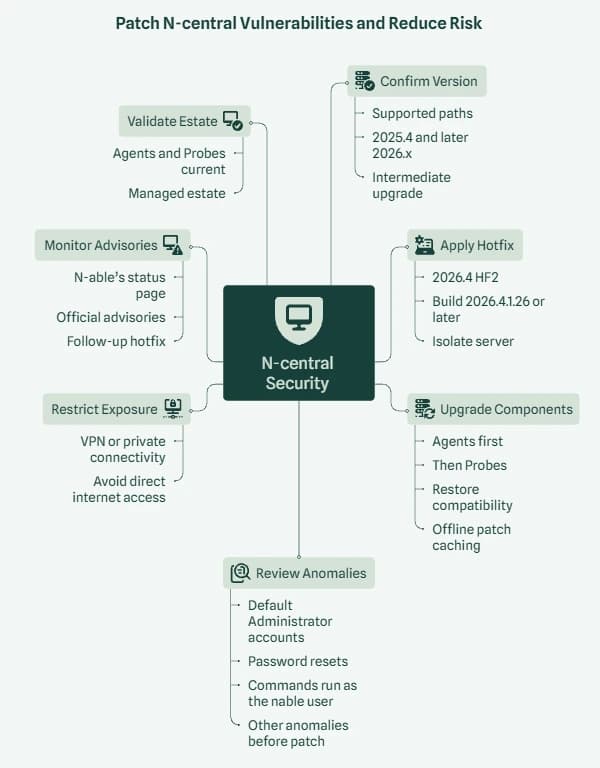
How to Patch N-able N-central Vulnerabilities and Reduce Risk
Immediate steps for on-premises deployments:
- Confirm current version. Upgrade only from supported paths (2025.4 and later 2026.x builds in most cases; earlier versions may need an intermediate upgrade first).
- Download and apply N-central 2026.4 HF2 (build 2026.4.1.26) or later. Keep the server isolated from the internet during and immediately after the upgrade.
- Upgrade Agents first, then Probes, to restore compatibility. Mismatched versions can break features such as offline patch caching.
- Review logs and accounts for unexpected Default Administrator accounts, password resets, unusual commands run as the nable user, or other anomalies from the period before the patch.
- Restrict network exposure. Prefer VPN or private connectivity over direct internet access to the console.
- Monitor N-able’s status page and official advisories for the follow-up hotfix and any additional guidance.
- Validate that Agents and Probes are current across the managed estate.
Comparison of approaches:
|
Approach |
Speed |
Residual Risk Level |
Operational Impact |
|
Apply HF2 + isolate until complete |
High |
Lowest once complete |
Temporary downtime |
|
Keep offline longer while validating |
Medium |
Low |
Higher service disruption |
|
Rely only on network controls without patch |
Low |
High |
Ongoing exposure |
Network segmentation, strong access controls, and regular review of privileged accounts remain essential layered defenses even after patching. Organizations should treat RMM platforms as high-value assets and include them in regular vulnerability management and monitoring programs.
Key Takeaways
N-able zero-day vulnerabilities of this scale in a widely used RMM tool highlight the concentrated risk these platforms carry. Rapid vendor response, including taking systems offline and shipping a targeted hotfix within roughly two days, limited the window. Customers who apply N-central 2026.4 HF2 promptly, update Agents and Probes, and review for signs of prior activity put themselves in a stronger position. Continued monitoring for the promised follow-up updates is warranted.
Frequently Asked Questions
What are the N-able N-central
zero-day vulnerabilities?
They refer to the set of 33 flaws publicly disclosed in early November 2026
under the Able2Shell name, with seven of the most critical issues assigned CVEs
and fixed in N-central 2026.4 HF2.
Are N-able zero-day vulnerabilities
being actively exploited?
N-able reported scanning activity associated with the published
proof-of-concept code. Security researchers observed attempts against
honeypots. As of the early status updates after the hotfix, no confirmed
successful compromises of customer environments were reported by the vendor.
How do N-central vulnerabilities
affect managed service providers?
A compromised N-central server can provide attackers with a foothold into the
networks of multiple clients managed through that instance, amplifying the
blast radius beyond a single organization.
Which N-central versions are
affected?
The researcher tested build 2026.4.0.31 and stated earlier versions are likely
affected. The hotfix targets versions prior to 2026.4.1.26 (also referenced as
before 26.4.1 in some records). Check official upgrade paths for your current
build.
Organizations running N-central should prioritize the available security update and verify their environment. For complex environments or uncertainty about residual risk, consult experienced cybersecurity professionals who can assist with assessment, patching validation, and monitoring.
How Hoplon InfoSec Can Help
Hoplon InfoSec can support MSPs and
IT teams by assessing N-central exposure, validating the 2026.4 HF2 patch and
agent/probe updates, reviewing logs for signs of prior activity, hardening RMM
access controls, and providing ongoing monitoring to reduce residual risk from
the disclosed zero-days.
Author Bio and Review
Author: Mohammed Talukder is the Co-Founder and CEO of Hoplon InfoSec, with over 16 years of experience in cybersecurity and technology. His expertise includes offensive security, vulnerability management, cyber risk management, and incident response. His professional credentials include CISM, CISA, CEH, and CompTIA PenTest+. He has also received Infosys recognition awards for his professional contributions. He shares practical cybersecurity insights to help organizations strengthen their security posture.
Technical reviewer: Gazi Mahmud, Co-Founder and CIO of Hoplon InfoSec LLC, cybersecurity leader, and CISM & CISA certified professional with expertise in cyber risk management, security governance, compliance, and incident response.