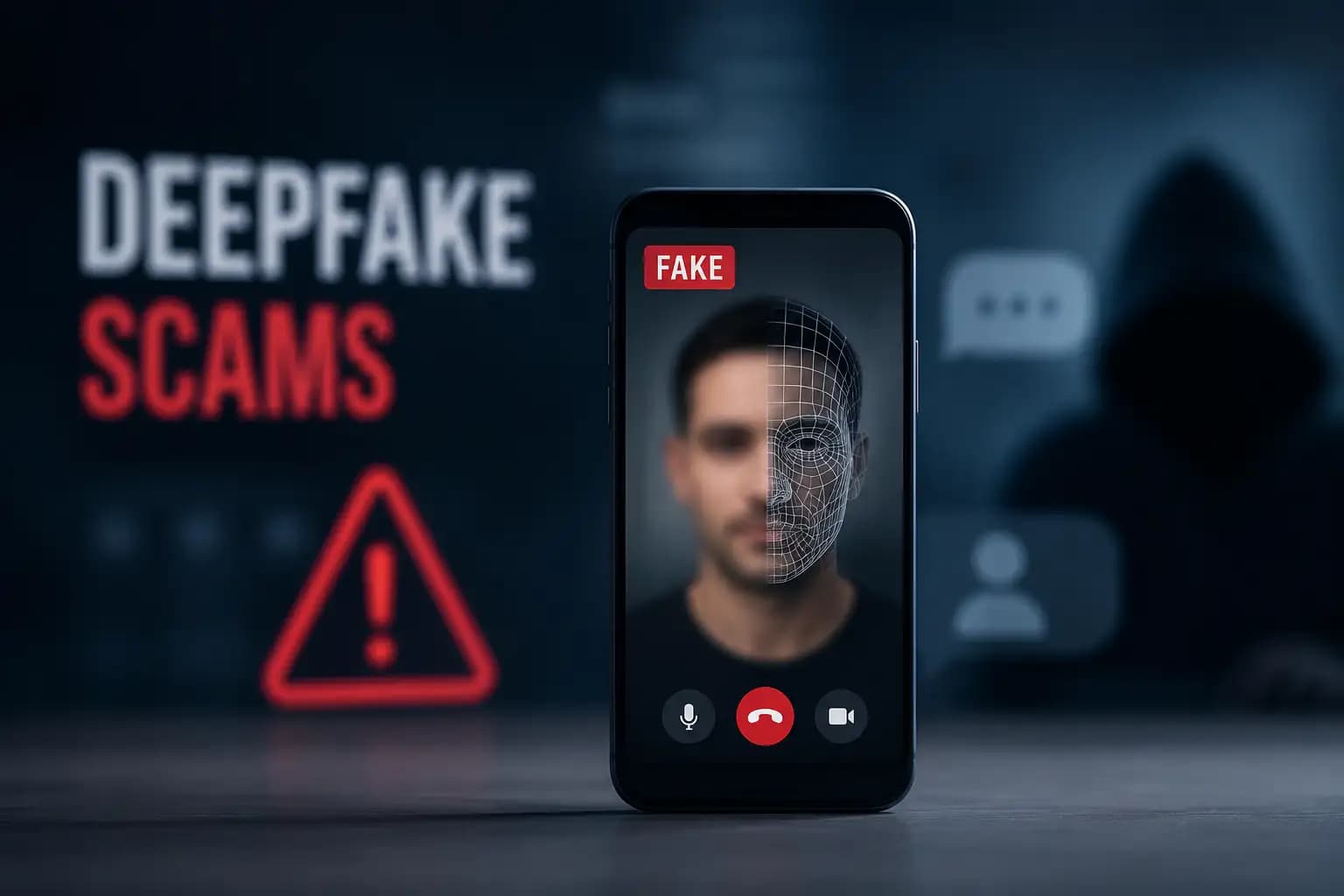
Deepfake Scams: How AI Voice and Video Fraud Works and How to Protect Yourself
A woman gets a call from her son. His voice is shaking, he says he has been in a car accident and needs money sent right now or things will get worse. Except her son is fine, sitting in a meeting three cities away, with no idea his voice was ever on that call. This is not a hypothetical anymore. It is one of the most common forms of deepfake scams happening today, and it is only getting more convincing.
Deepfake scams sit at the uncomfortable intersection of artificial intelligence and old fashioned confidence tricks. The technology is new, the psychology behind it is old. Scammers have always relied on urgency, fear, and trust to get people to act fast without thinking. AI just gave them a far more convincing costume to wear while they do it.
This guide breaks down what deepfake scams actually are, how they work step by step, the different forms they take, real examples that have already cost people and companies millions, and the practical steps individuals and businesses can take to protect themselves.
What is a Deepfake Scam
A deepfake scam is a form of fraud where criminals use AI generated audio or video to convincingly imitate a real person's voice or face, usually someone the victim trusts, in order to pressure them into sending money, sharing sensitive information, or approving a fraudulent transaction. It is essentially phishing scam tactics combined with synthetic media, which is why it is often called deepfake phishing.
What is a Deepfake and How is It Made
The word deepfake comes from combining deep learning and fake. It refers to media, whether that is a photo, an audio clip, or a full video, that has been created or altered by artificial intelligence to make it look or sound like something that never actually happened.
For years, producing a convincing fake voice or video required real skill, expensive software, and a lot of time. That is no longer the case. Voice cloning tools can now recreate a fairly convincing version of someone's voice from a few seconds of audio, the kind of clip that is easy to pull from a social media video, a voicemail greeting, or a public interview. Video generation tools have followed a similar path, and real time face swapping during a live video call is now something a motivated scammer can pull off without needing a computer science degree.
None of this means every AI tool is dangerous. The same technology that powers deepfake scams is also used in film production, accessibility tools, and voice assistants. The problem is not the technology itself, it is how easily it has become accessible to people with bad intentions, and how little source material they need to start.
How Deepfake Scams Work
Most deepfake scams, whether they involve a voice call or a video call, tend to follow a similar pattern.
- Gathering source material. The scammer collects audio and video of the person they want to impersonate, often scraped from social media posts, YouTube videos, webinars, interviews, or old voicemails.
- Generating the fake. That material is fed into an AI model that produces a cloned voice or a synthetic face that can move and speak in real time or in a pre recorded clip.
- Choosing the delivery method. The scam is delivered through a phone call, a video call on an app like Zoom or WhatsApp, a voice note, or occasionally a pre recorded video sent directly to the victim.
- Creating urgency and emotion. The message almost always involves fear, panic, or pressure, a family member in trouble, a boss demanding an urgent transfer, a friend in danger.
- Making the ask. The final step is always the same goal, get the victim to send money, share login credentials, approve a transaction, or hand over sensitive personal information.
Understanding this structure matters because the pattern rarely changes even as the technology improves. The fake gets better, but the playbook stays the same.
Types of Deepfake Scams
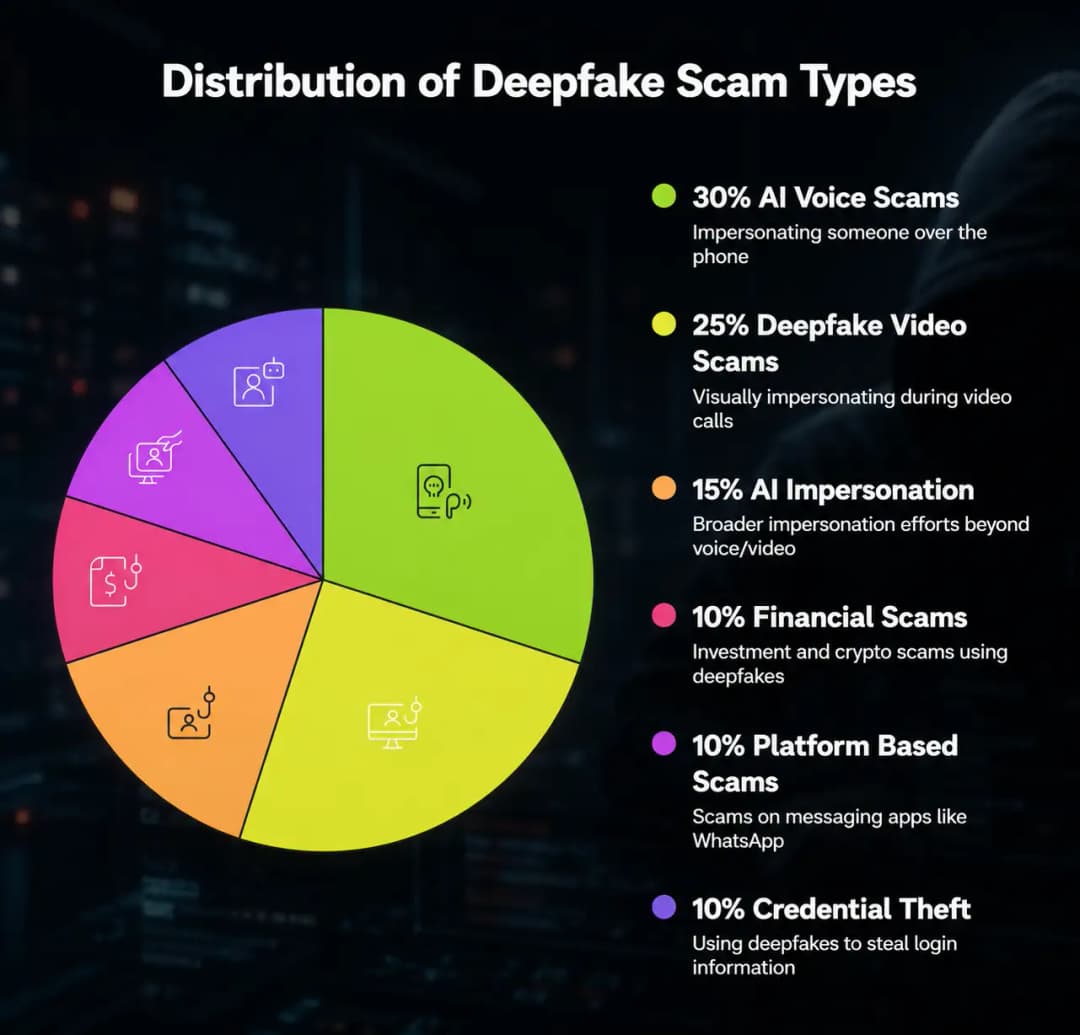
AI Voice Scams and Voice Cloning Scams
This is currently the most common category. An AI voice scam, sometimes called a deepfake voice scam or a form of vishing (voice phishing), uses a cloned voice to impersonate someone over a phone call. The classic version is the fake family emergency scam, where a cloned voice claims to be a grandchild, child, or relative in trouble and asks for money to be sent immediately, often through wire transfer or gift cards.
A close cousin of this is the fake boss voice scam, where an employee receives what sounds like an urgent voice message or call from a company executive instructing them to make a payment or share confidential data. This overlaps heavily with what security teams call an AI phone scam, since the entry point is almost always a regular phone call that feels completely ordinary until the request becomes strange.
Deepfake Video Scams and Fake Video Call Scams
Here the scammer uses a real time deepfake video scam to visually impersonate someone during a live video call, or sends a fake video call scam recording that appears to show a trusted person. Because seeing a face feels more convincing than hearing a voice alone, this category tends to be the most financially damaging, particularly inside businesses where a video call is often treated as proof enough of someone's identity.
AI Impersonation and Deepfake Identity Theft
Beyond voice and video, deepfake technology is increasingly used for broader AI impersonation scam efforts. This includes deepfake identity theft, where someone's likeness is used to open accounts or pass identity checks, fake profile scam and fake account scam setups on social media and dating platforms, and email impersonation scam attempts where a cloned voice note or video is attached to an otherwise ordinary looking email to add false credibility.
Financial and Investment Related Deepfake Scams
Investment scam and crypto scam operators have been quick to adopt this technology. A fake investment scam might use a celebrity deepfake scam, showing what looks like a well known public figure endorsing a trading platform or a crypto project. This is usually built around a fake celebrity endorsement, something the real celebrity has never actually said or agreed to. These ads often appear on social media and promise unrealistic guaranteed returns.
Platform Based Deepfake Scams
WhatsApp scam, Telegram scam, and Facebook scam variations of deepfake fraud are rising because messaging apps feel personal and less scrutinized than email. A voice note or short video sent through WhatsApp or Telegram from what looks like a known contact carries an automatic sense of trust that a stranger's email never would.
Credential Theft and Account Takeover
Some deepfake scams are not really about the fake media itself but about what it unlocks. A fake login page scam might be paired with a deepfake voice call pretending to be IT support, guiding a victim toward entering their credentials on a fraudulent site. In financial services, there is growing concern around KYC fraud deepfake attempts, where synthetic video or images are used to try to pass identity verification checks that rely on facial recognition.
Deepfake Blackmail Scam
A more serious and distressing form is the deepfake blackmail scam, where fabricated compromising images or videos of a person are used to extort money or demand further compliance. This is a serious form of harassment and criminal extortion, and anyone facing this should treat it as a police matter, not something to try to resolve alone.
Real World Deepfake Scam Examples
The clearest documented case so far involves Arup, a UK based engineering firm, at its Hong Kong office. In January 2024, a finance employee received an email that appeared to come from the company's UK based CFO, requesting a confidential transaction. He was initially suspicious, suspecting a phishing attempt. His doubts eased after he joined a video conference call where he recognized the CFO and several colleagues. Every person on that call was in fact an AI generated deepfake, built from publicly available video and audio of the real executives. Believing the request was legitimate, the employee carried out a series of transfers totaling roughly $25 million. The fraud was only discovered afterward, when he checked in with the company's head office. Hong Kong police later confirmed multiple arrests connected to related deepfake identity fraud schemes involving stolen identity cards used to bypass facial recognition checks.
This case is now widely referenced across the cybersecurity industry precisely because it shows how a well trained, cautious employee can still be fooled once a live video call appears to confirm what an email alone could not.
On the individual side, consumer protection agencies including the US Federal Trade Commission have publicly warned about the fake family emergency scam pattern, where a cloned voice is used to convince a parent or grandparent that a loved one is in danger and needs money urgently. These warnings note that scammers often need only a short public audio clip to produce a convincing enough imitation for a panicked, brief phone call.
Why Deepfake Scams Are Increasing
A few forces are driving this growth at the same time. Voice and video generation tools have become cheaper, faster, and require far less technical skill than they did even a couple of years ago. Social media has made it easy to gather source material, since most people have posted enough video and audio of themselves online without ever thinking about it as a security risk. Industry surveys have found that a large share of businesses report having already been targeted by some form of deepfake related fraud attempt, and many corporate leaders now view the threat as a serious risk to their financial security rather than a distant possibility.
As detection tools improve, deepfake generation tools tend to improve right alongside them. This is very much a moving target, and any specific statistic quoted in this space should always be checked against a current, dated source before being treated as up to date.
Warning Signs of a Deepfake Scam
Behavioral red flags
- A strong sense of urgency, being told to act immediately with no time to think
- An emotional push, fear, panic, guilt, or excitement designed to override caution
- A request that feels slightly off scale, too dramatic, too generous, or too outlandish
- Pressure to keep the interaction secret or to avoid telling anyone else
- A request to move to a less secure or less monitored communication channel
Technical red flags
- Unnatural pauses, flat emotion, or a slightly robotic quality in a voice
- Lip movements that do not quite match the audio
- Odd blinking patterns, or barely any blinking at all
- Lighting on a person's face that does not match the background around them
- Blurring or glitching around the edges of a face, hairline, or ears
- A sudden excuse to end the video call or keep the camera at a strange angle
 Real vs fake deepfake video call
How to Detect a Deepfake
- Pause before reacting. Scammers count on speed, so slowing down is already a form of defense.
- Ask a question only the real person would know the answer to, something that would not be answered by scraping social media.
- Watch the face closely during a video call, paying attention to blinking, lighting, and how well the mouth movements match the words.
- Listen for tone. A cloned voice can sound right on the surface but often lacks natural emotional variation.
- End the call and reconnect through a channel you already trust, such as calling the person back on a number saved in your own contacts.
- If it involves a business transaction, apply your organization's verification policy without exception, no matter how convincing the caller sounded.
Deepfake Detection Tools
A growing number of deepfake detection tools now exist, built to analyze inconsistencies in audio patterns, facial movement, and file metadata that are difficult for the human eye or ear to catch. These tools are useful, particularly for organizations handling high volumes of calls or transactions, but they are not a silver bullet. Detection technology and generation technology are locked in a constant back and forth, and a tool that catches today's deepfakes may need updating to catch tomorrow's. Human judgment and verification habits remain just as important as any piece of software.
For readers who want a hands on sense of how convincing deepfakes have become, Microsoft's public Spot the Deepfake tool offers a simple way to test your own ability to tell real footage from generated footage.
How to Avoid Deepfake Fraud: Prevention Tips for Individuals
- Agree on a family safe word or phrase in advance, something only your close family or friends would know, to be used in any emergency related communication
- Treat any urgent request for money over a call or video call with automatic suspicion, no matter how real it sounds
- Always verify through a second, independent channel before sending money or sensitive information
- Be mindful of how much personal audio and video you share publicly, since that is exactly what fuels voice cloning scam and deepfake video scam attempts
- Report suspicious calls or messages to your bank, the platform involved, and your local consumer protection authority
How Businesses Can Prevent Deepfake Phishing
- Run regular cybersecurity awareness training that specifically covers deepfake phishing and AI phishing scam scenarios, not just traditional email based phishing attack training
- Require callback verification through a fixed, pre agreed number for any high value financial request, regardless of who appears to be asking
- Put dual approval in place for wire transfers and other sensitive transactions, so no single employee can be pressured into acting alone
- Build deepfake scenarios into your incident response plan so staff know exactly what to do the moment something feels wrong
- Limit how much executive video and audio is publicly available where it is not necessary, since conference talks, webinars, and social posts are the easiest source material for scammers
- Work with a security partner who can help assess your organization's specific exposure to social engineering attack and deepfake related risk
What to Do If You Already Sent Money or Information
Acting quickly matters. Contact your bank or payment provider immediately to report the transaction and ask about reversal or fraud hold options. Change any passwords or credentials that may have been shared. Report the incident to your local police and to your country's relevant fraud or cybercrime reporting authority. If it involved a workplace account, notify your IT or security team right away so they can check for any wider compromise. Do not feel embarrassed about reporting it. These scams are specifically engineered to fool careful, intelligent people, and reporting quickly is what gives investigators and banks the best chance of limiting the damage.
FAQ
What is a deepfake scam? A deepfake scam is when someone uses AI generated audio or video to imitate a real person's voice or face in order to trick a victim into sending money or sharing sensitive information.
How do I detect an AI voice scam? Listen for unnatural pauses, flat emotion, or a slightly robotic tone, and always verify by calling the person back on a number you already have saved, never the number that called you.
How can I spot a deepfake video call? Watch for mismatched lip movement, odd blinking patterns, lighting that does not match the background, and any pressure to keep the camera at a strange angle or end the call quickly.
What should I do if I think I am on a deepfake call? End the call immediately, stay calm, and contact the person through a different, trusted channel to confirm before taking any action.
How do businesses prevent deepfake phishing attacks? Through employee awareness training, mandatory callback verification for financial requests, dual approval on transfers, and a clear incident response plan that includes deepfake scenarios.
Can deepfake scams happen over WhatsApp or Telegram? Yes, scammers increasingly use voice notes and video messages on messaging apps, since these platforms feel personal and less scrutinized than email.
Are deepfake scams the same as regular phishing scams? Not exactly. A traditional phishing scam usually relies on a fake email or website, while a deepfake phishing attempt adds a synthetic voice or face on top of that, which makes the deception feel far more personal and convincing.
Conclusion
Deepfake scams are proof that the oldest trick in fraud, exploiting trust and urgency, has simply been handed a more powerful tool. The technology behind AI deepfake scams will keep improving, and the line between real and fake will keep getting harder to see with the eyes alone. What does not change is the value of slowing down, verifying through a second channel, and treating any urgent, emotional request with a healthy amount of caution, no matter how familiar the voice or face on the other end sounds.
If your organization needs help assessing its exposure to deepfake phishing, social engineering attacks, or broader AI driven fraud, the security team at Hoplon InfoSec can help you build a practical, tested defense plan rather than relying on guesswork after something has already gone wrong.
Related Content:
This article reflects publicly reported cases and general industry guidance current as of publishing. Deepfake tactics and detection methods change quickly, so readers should check official sources such as the FTC, FBI, or Interpol for the latest verified alerts.